Best Vitamins for Skin: What the Science Actually Supports
A clinical look at vitamins A, C, D, and E — what they do, what they don't, and where to apply them.
The supplement aisle wants you to believe the answer is gummies. The dermatology research wants you to know that “vitamins for skin” is one of the most context-dependent phrases in skincare — because whether a vitamin actually does anything depends almost entirely on whether you swallow it or apply it.
Most of the meaningful evidence for vitamins improving skin comes from topical clinical trials, not oral supplementation. The same vitamin can be transformative on the skin and underwhelming in a pill. Here’s what the science actually shows for the four vitamins that matter most — and how to use each one to get the result the studies promise.
Vitamin A — The Only Vitamin That Reliably Reverses Skin Aging
Vitamin A, in its various retinoid forms, has more high-quality clinical data than any other ingredient in skincare. The consensus is overwhelming: topical retinoids reduce wrinkles, even out tone, thicken atrophic dermis, and stimulate new collagen synthesis. They do this by binding to nuclear retinoic acid receptors and changing how skin cells transcribe genes — effectively reprogramming the skin’s behavior at the cellular level.
In a landmark 1993 NEJM trial, tretinoin (the prescription form of vitamin A) treatment of photodamaged skin produced an 80% increase in collagen I formation, compared with a 14% decrease with vehicle alone [1]. A more recent network meta-analysis ranked retinoids — including over-the-counter retinol — as among the most effective topical interventions for facial photoaging.
What about oral vitamin A? Useful for general health, particularly for skin barrier function. But for the wrinkle-reducing, collagen-rebuilding effect, oral vitamin A doesn’t reach skin in the same form or concentration that topical application does. The skin produces and uses its own retinoic acid locally, and the topical route bypasses the systemic regulation that limits how much active retinoid reaches the dermis from a pill.
Practical use: Topical retinol or a prescription retinoid, applied at night, three to seven nights per week, indefinitely. This is the single highest-leverage skincare ingredient for women over 40.
Vitamin C — The Cofactor and Photoprotector
Topical vitamin C (L-ascorbic acid) does two things that are independently valuable.
Here’s what the science actually shows for the four vitamins that matter most — and how to use each one to get the result the studies promise.
It’s a required cofactor for collagen cross-linking. Without enough vitamin C, the collagen your fibroblasts make is structurally weaker. Topical 5% L-ascorbic acid in a 6-month double-blind randomized trial produced significant improvement in skin furrows, with histological confirmation of new collagen formation [2]. The mechanism is direct: vitamin C activates the prolyl and lysyl hydroxylase enzymes that mature procollagen into stable, load-bearing collagen.
It’s a daytime antioxidant that complements SPF. Sunscreen blocks UV photons, but UV that does penetrate generates reactive oxygen species in the skin. Vitamin C neutralizes those ROS before they can activate the matrix metalloproteinases that degrade collagen. A pivotal 2005 study showed that topical vitamin C combined with vitamin E and ferulic acid doubled the photoprotective effect, providing measurable protection against UV-induced damage [3].
Oral vitamin C is necessary for life — true vitamin C deficiency causes scurvy, which destroys skin integrity. But for a typical person without deficiency, additional oral vitamin C does little for skin appearance, because plasma vitamin C levels are tightly regulated and excess is excreted. The skin benefit comes from topical delivery, where you can achieve concentrations 20-40x what oral dosing produces in skin [4].
Practical use: 10-20% L-ascorbic acid serum applied in the morning, before SPF.
Vitamin E — The Antioxidant That Pairs, Not the One That Stands Alone
Vitamin E (tocopherol) is a lipid-soluble antioxidant that protects cell membranes from oxidative damage. The key research finding is unfortunately underwhelming: vitamin E by itself, applied topically, is unstable and largely destroyed by UV exposure [3]. Oral vitamin E supplementation at 400 IU daily does not provide meaningful photoprotection, and supplementation has not been shown to reduce skin’s sensitivity to UV.
But — and this is the important caveat — vitamin E combined with vitamin C is genuinely valuable. The two regenerate each other in a redox cycle, and the combination is far more stable and effective than either alone. The classic Pinnell formulation (15% vitamin C + 1% vitamin E + 0.5% ferulic acid) has the strongest evidence in this category.
Practical use: As part of a vitamin C + vitamin E + ferulic acid antioxidant serum. Don’t expect benefits from vitamin E alone — its role is to amplify vitamin C, not stand on its own.
Vitamin D is unusual: it’s the only vitamin your skin actually manufactures.
Vitamin D — Critical for Skin Function, but the Topical Story Is Murky
Vitamin D is unusual: it’s the only vitamin your skin actually manufactures. UVB radiation converts 7-dehydrocholesterol in the epidermis to vitamin D3. Aging reduces this capacity — a 70-year-old’s skin produces about 25% as much vitamin D from the same UV exposure as a 20-year-old’s skin.
Adequate vitamin D status is associated with better skin barrier function, reduced inflammation, and possibly slower extrinsic aging. A 2010 study found that adequate serum vitamin D levels were associated with better facial skin aging metrics in middle-aged women [5]. Vitamin D protects skin from photo-damage by repairing UV-induced DNA damage and reducing chronic inflammation [6].
But — and this matters — clinical trials of topical vitamin D for general anti-aging are limited. Topical calcitriol and calcipotriol are FDA-approved for psoriasis, not for cosmetic skin aging. The sensible interpretation: maintain healthy serum vitamin D levels through reasonable sun exposure or oral supplementation if you’re deficient (most middle-aged women in northern latitudes are), but don’t expect a vitamin D cream to be your wrinkle solution.
Practical use: Oral supplementation if blood levels show deficiency. Have your levels checked before assuming you need it.
What to Actually Buy
Here’s the practical takeaway, if you have shelf space and budget for one or two vitamin-based products:
- Topical vitamin A (retinol). This is non-negotiable if you want measurable improvement in fine lines, tone, and dermal collagen. The single most evidence-backed ingredient in skincare.
- Topical vitamin C serum (10-20% L-ascorbic acid), ideally with vitamin E and ferulic acid. Morning. Pairs with SPF for daytime defense and supports collagen synthesis.
- Vitamin D supplementation only if your blood levels are low. Test, don’t guess.
- Hair-skin-nails gummies are largely vitamin marketing aimed at biotin deficiency that almost no one has. Skip them unless your dermatologist recommended them.
Why the Topical Vitamin A You Use Matters
Most over-the-counter retinols work by penetrating the epithelial barrier through chemical force — penetration enhancers, alcohols, and lipid-mobility agents that disrupt the skin barrier to push retinol through. This is the mechanism behind the redness, peeling, and irritation that derails so many vitamin A routines before they have a chance to compound. A 2022 review of vitamin A cosmetic products noted that real-world adherence is the limiting factor for most users, not the ingredient itself.
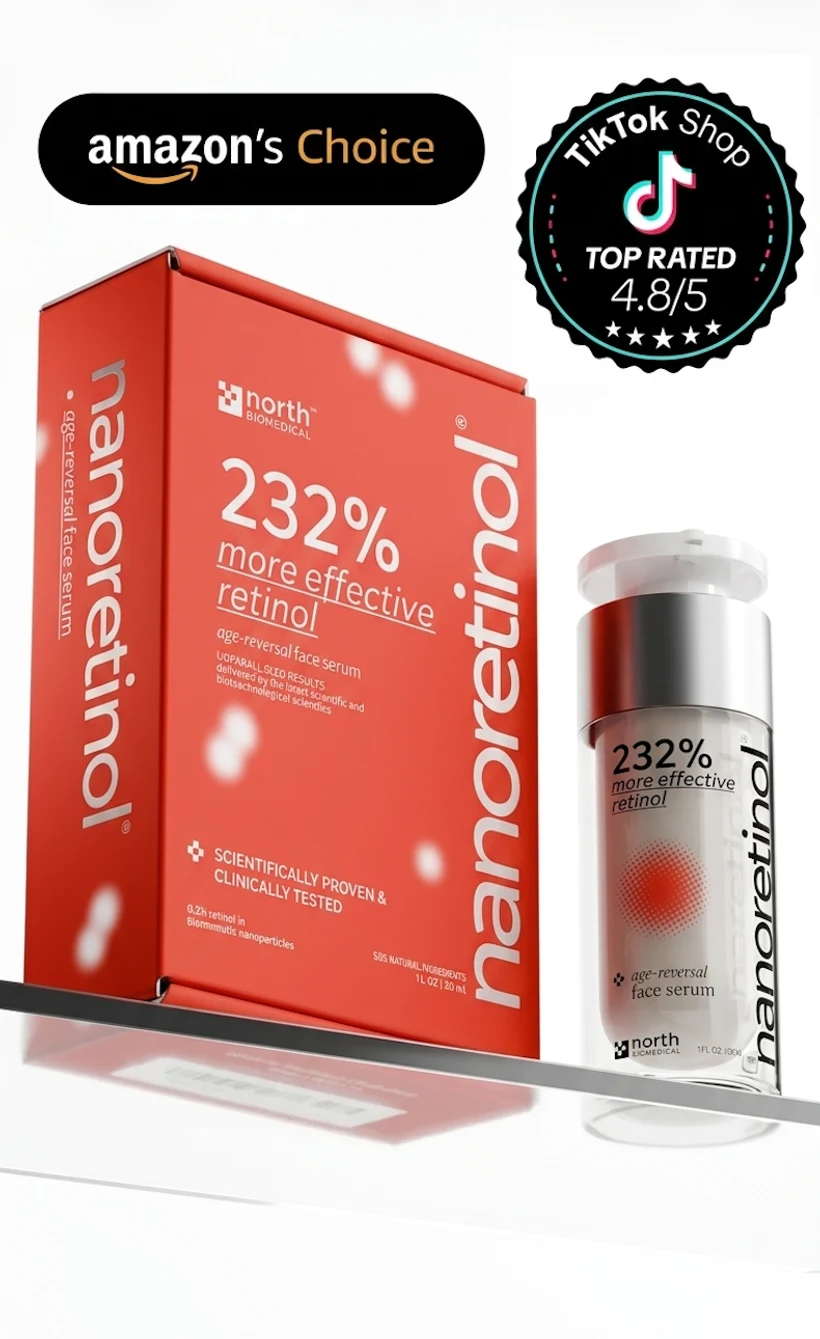
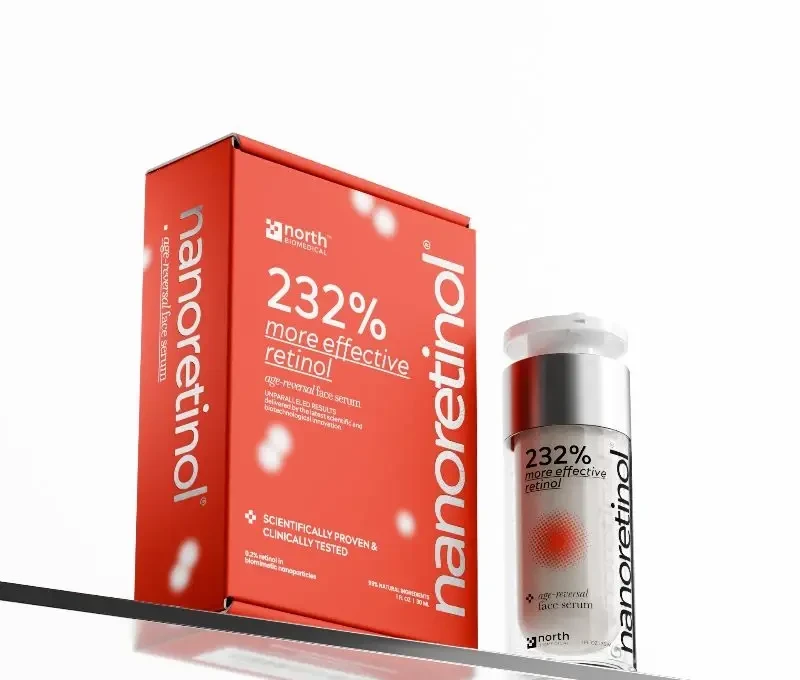
Nanoretinol takes a different delivery approach. Retinol is encapsulated in biomimetic lipid nanoparticles that the skin recognizes as “self” — the same nanoparticle drug-delivery technology used in modern medicine. The retinol crosses the epithelial barrier intact, without barrier disruption, and reaches the fibroblasts that need to rebuild collagen.
In clinical study, this delivery system produced 232% more collagen recovery and 73% more elastin recovery than conventional retinol. The reason isn’t a higher dose — Nanoretinol is only 0.2% retinol — it’s that more of the retinol actually reaches its target. For a vitamin whose entire benefit depends on intact retinol making it to the fibroblast, delivery efficiency matters more than the concentration on the label.
The result is a vitamin A routine that women can actually maintain. No peeling weeks, no barrier disruption, no skipping nights because the skin is too irritated. That consistency is what compounds into the structural changes the clinical trials promise.
Bringing It Together
The four vitamins worth caring about for skin are A, C, E, and D — but only two of them belong in your skincare routine, only one of them is structural, and only specific delivery formats actually work. Skip the gummies, prioritize topical vitamin A every night and topical vitamin C every morning, and your skin will compound improvements over months that no multivitamin will produce in years.
References
- Griffiths CE, Russman AN, Majmudar G, Singer RS, Hamilton TA, Voorhees JJ. “Restoration of Collagen Formation in Photodamaged Human Skin by Tretinoin (Retinoic Acid).” New England Journal of Medicine. 1993;329(8):530-535. doi:10.1056/NEJM199308193290803
- Al-Niaimi F, Chiang NYZ. “Topical Vitamin C and the Skin: Mechanisms of Action and Clinical Applications.” Journal of Clinical and Aesthetic Dermatology. 2017;10(7):14-17. PMID: 29104718
- Lin FH, Lin JY, Gupta RD, et al. “Ferulic acid stabilizes a solution of vitamins C and E and doubles its photoprotection of skin.” Journal of Investigative Dermatology. 2005;125(4):826-832. doi:10.1111/j.0022-202X.2005.23768.x
- Boo YC. “Ascorbic Acid (Vitamin C) as a Cosmeceutical to Increase Dermal Collagen for Skin Antiaging Purposes: Emerging Combination Therapies.” Antioxidants (Basel). 2022;11(9):1663. doi:10.3390/antiox11091663
- Chang AL, Fu T, Amir O, Tang JY. “Association of facial skin aging and vitamin D levels in middle-aged white women.” Cancer Causes Control. 2010;21(12):2315-2316. doi:10.1007/s10552-010-9646-y
- Mukherjee S, Date A, Patravale V, Korting HC, Roeder A, Weindl G. “Retinoids in the treatment of skin aging: an overview of clinical efficacy and safety.” Clinical Interventions in Aging. 2006;1(4):327-348. doi:10.2147/ciia.2006.1.4.327
- Bouloc A, Vergnanini AL, Issa MC. “A double-blind randomized study comparing the association of Retinol and LR2412 with tretinoin 0.025% in photoaged skin.” Journal of Cosmetic Dermatology. 2015;14(1):40-46. doi:10.1111/jocd.12131
- North Biomedical LLC. “Nanoretinol vs. Conventional Retinol: Efficacy in Collagen and Elastin Recovery.” Clinical Study Summary, 2024. northbiomedical.com