Bunny Lines: Why Those Wrinkles Appear on Your Nose and What Actually Smooths Them
The fine lines that form across the nasal bridge when you smile — and what makes them stick
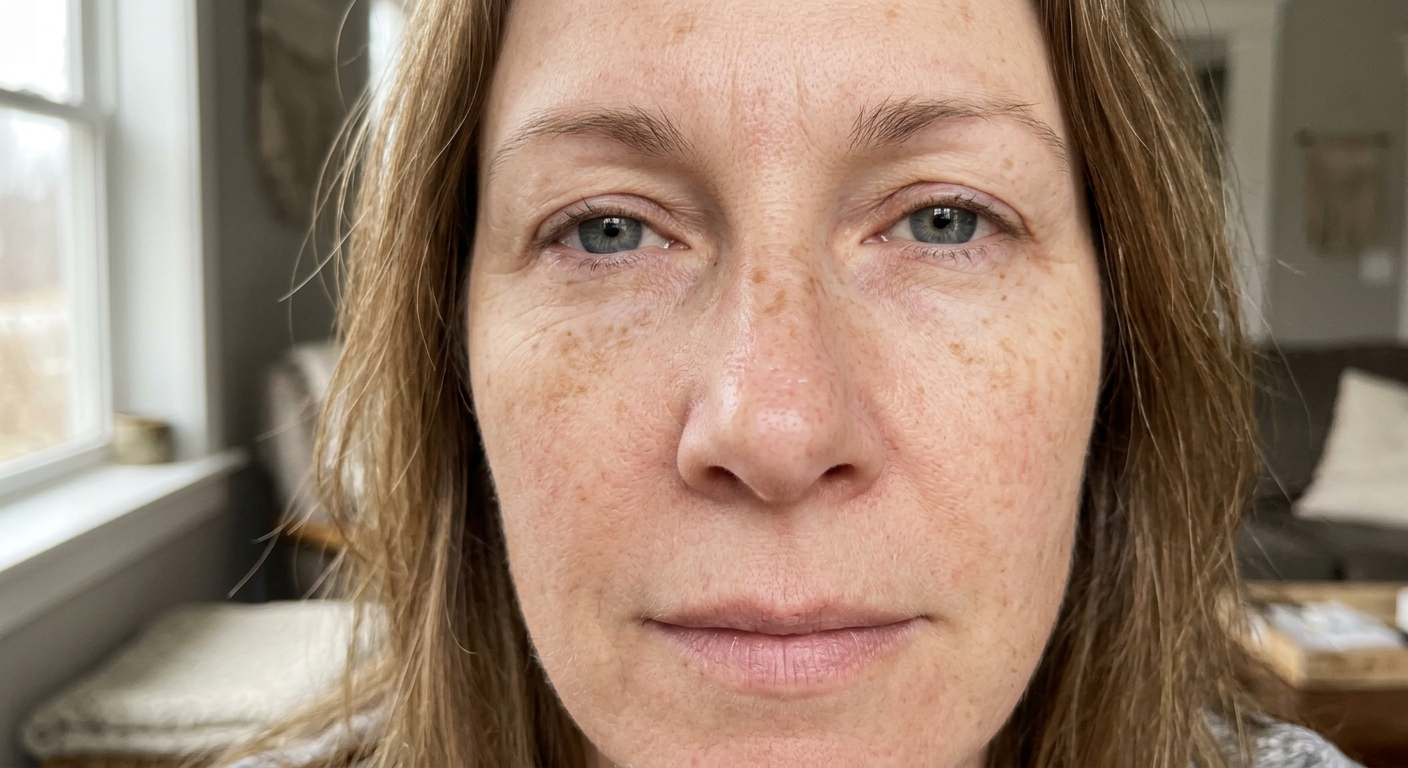
You make the same micro-expression hundreds of times a day. You squint slightly when you smile. You scrunch your nose at a smell, a joke, a bright window. Each time, the muscles around your nasal bridge contract — and over decades, those contractions leave a record on your skin in the form of fine, oblique lines that fan out across the upper sides of your nose.
These are bunny lines.
They’re often the first wrinkles to appear in your 30s and 40s, and they’re frequently the most ignored. Most people focus on crow’s feet or forehead wrinkles and don’t notice the bunny lines until someone takes an unflattering candid photo. By then, the lines have transitioned from purely dynamic — visible only during expression — to partially static, lingering even when your face is relaxed.
Here’s the science of why they form, and what actually softens them.
The Anatomy Behind the Lines
For decades, dermatologists assumed bunny lines were caused by contraction of the transverse nasalis muscle — the muscle that scrunches your nose. Recent research has complicated this picture in interesting ways.
A 2025 cadaveric and ultrasound study by Ahn and colleagues identified what they called the “bunny triangle” — a non-muscular region on the nasal bridge bordered by four muscles: the procerus above, the nasalis on the lateral side, the levator labii superioris alaeque nasi inferiorly, and the medial fibers of the orbicularis oculi laterally [1]. Bunny lines aren’t caused by contraction of a single muscle directly under the wrinkle. They’re caused by traction from the surrounding muscle complex pulling on a relatively unsupported skin region.
This explains why bunny lines often deepen along with smiling, squinting, and even certain expressions of disgust — they recruit different combinations of these surrounding muscles, all pulling on the same vulnerable patch of skin.
Why They Get Deeper With Age
Dynamic wrinkles transition into static wrinkles through a predictable sequence. Each muscle contraction stretches the overlying skin. Young skin has abundant elastin and collagen, so it snaps back. Aged skin doesn’t.
Three changes drive the transition:
Collagen breakdown. From your mid-20s onward, dermal collagen declines steadily — and UV exposure accelerates the process dramatically [2]. Photoaged skin shows disorganized collagen fibers and damaged, fragmented elastin throughout the upper dermis. Once that scaffolding is gone, repeated folding leaves a permanent crease.
By the time you’re in your late 40s, the skin in this region may be 20–30% thinner than it was in your 20s — meaning each muscle contraction creates a deeper, more visible fold.
Dermal thinning. The skin on the nasal bridge is already thin. With age, it thins further. By the time you’re in your late 40s, the skin in this region may be 20–30% thinner than it was in your 20s — meaning each muscle contraction creates a deeper, more visible fold.
UV-driven elastin damage. The nose protrudes from the face, which means it catches more direct sun than almost any other facial region. Cumulative UV exposure produces solar elastosis — abnormal accumulation of degenerate elastin material that gives photoaged skin its characteristic leathery, deeply lined appearance [2]. The bunny line region is particularly vulnerable.
The Sun Connection That Most People Miss
Here’s something people don’t realize until a dermatologist points it out: glasses don’t protect your nose. Sunglass frames cast shadows, but the nasal bridge often catches direct UV from above all day long. Hat brims help, but they don’t reach the nose. Sunscreen is the only real defense.
This is why people who spend significant time outdoors without consistent sunscreen often develop pronounced bunny lines a decade earlier than peers who’re equally expressive but more disciplined about SPF.
The good news: the same skincare interventions that prevent further damage can also partially reverse what’s already happened. Photoaged skin retains the capacity to remodel — slowly — when you give it the right inputs.
What Topical Skincare Can and Can’t Do
Let’s be honest about expectations.
What topicals can do: Improve the underlying skin quality so the lines are less visible at rest. Stimulate collagen synthesis. Thicken the dermis. Smooth the epidermal surface. Reduce the appearance of static creases.
What topicals can’t do: Stop the muscle contractions. If your bunny lines are primarily dynamic — appearing only when you smile or squint — even a perfect skincare routine won’t make them invisible during expression. That requires neuromodulators (botulinum toxin), which is a different conversation.
For static-component bunny lines and prevention of progression, topical retinoids are the most evidence-backed approach. A comprehensive review of retinoid clinical trials found that topical retinoids stimulate procollagen production, normalize keratinocyte differentiation, and visibly reduce fine wrinkles when used consistently for at least 12–24 weeks [3].
If your bunny lines are primarily dynamic — appearing only when you smile or squint — even a perfect skincare routine won’t make them invisible during expression.
A landmark New England Journal of Medicine study by Kang and colleagues demonstrated that topical tretinoin restores collagen formation in photodamaged human skin — and similar (though smaller) effects have been documented for over-the-counter retinol when properly formulated [4].
Why Consistency Matters More Than Concentration
People give up on retinol too early. The skin remodeling that softens bunny lines is a slow, biological process — fibroblasts have to be activated, new collagen has to be deposited, and damaged elastin has to be cleared. None of this happens in a week.
It’s also why “stronger is better” thinking is wrong. A high-concentration retinol that you can only tolerate three nights a week, abandoning it during winter when irritation flares, will give worse results than a moderate concentration you use every night for a year.
Consistency beats potency. Tolerability enables consistency. So the question isn’t really “what’s the strongest retinol I can buy?” — it’s “what’s the most effective retinol I can actually use every night?”
A Smarter Retinol for Thin, Reactive Skin
The skin around the nose is thin and sebum-rich, which means it absorbs poorly with standard retinol formulations and irritates easily when penetration is forced. This is why so many people develop redness, peeling, and that telltale “retinol burn” specifically across the nasal bridge.
Nanoretinol approaches the problem from a different angle. The active retinol is encapsulated in biomimetic lipid nanoparticles that are recognized as biologically self by the skin barrier — passing through without disruption [5]. Compared to conventional retinol, lab studies showed 232% greater collagen recovery and 73% greater elastin recovery, achieved at just 0.2% concentration in a water-based gel formulation that doesn’t rely on penetration enhancers or petroleum derivatives.
The clinical relevance: 56-day trials showed +61% increase in skin firmness and +56% increase in skin elasticity. For bunny lines specifically, that elasticity improvement matters — it’s exactly what allows skin to stop holding the crease at rest.
Putting It Together
A realistic plan for bunny lines:
- Daily SPF 30+ on the nasal bridge specifically. Reapply during outdoor exposure.
- Consistent nightly retinoid for at least 6 months before judging results.
- Hydration support with niacinamide or hyaluronic acid to maintain dermal cushioning.
- Quit picking and pulling at the area, which compounds the mechanical stress.
- Consider neuromodulators with a board-certified dermatologist if the dynamic component bothers you and topical results plateau.
Bunny lines are minor wrinkles in absolute terms, but they’re a useful early signal. They tell you the muscle-driven aging process has begun — and that the skin in the surrounding regions is starting to lose elasticity. The smarter you respond to that signal, the better your face will hold up over the next two decades.
References
-
Ahn H, Hu H, Kim SB, et al. “Anatomical etiology of bunny lines based on cadaveric dissection and ultrasonographic evaluation.” Clinical Anatomy. 2025;38(6):686-691. doi:10.1002/ca.24249
-
El-Domyati M, Attia S, Saleh F, et al. “Intrinsic aging vs. photoaging: a comparative histopathological, immunohistochemical, and ultrastructural study of skin.” Experimental Dermatology. 2002;11(5):398-405. doi:10.1034/j.1600-0625.2002.110502.x
-
Mukherjee S, Date A, Patravale V, et al. “Retinoids in the treatment of skin aging: an overview of clinical efficacy and safety.” Clinical Interventions in Aging. 2006;1(4):327-348. doi:10.2147/ciia.2006.1.4.327
-
Kang S, Fisher GJ, Voorhees JJ. “Photoaging: pathogenesis, prevention, and treatment.” Clinics in Geriatric Medicine. 2001;17(4):643-659. doi:10.1016/S0749-0690(05)70091-4
-
North Biomedical LLC. “Nanoretinol vs. Conventional Retinol: Efficacy in Collagen and Elastin Recovery.” Clinical Study Summary, 2024. Read the study