Hyaluronic Acid Benefits for Skin: Why Women Over 40 Need This Moisture-Binding Molecule
The science of how hyaluronic acid holds 1,000 times its weight in water — and why molecular weight determines whether it actually works
The Molecule Your Skin Is Losing Right Now
Your skin contains roughly 50% of your body’s total hyaluronic acid — and it’s disappearing faster than you think. By age 50, the average person retains only about half the hyaluronic acid they had at 20 [1]. This decline doesn’t happen overnight, but its effects compound: skin that feels perpetually dry despite moisturizing, fine lines that deepen seemingly out of nowhere, and a loss of that plump, luminous quality that no amount of highlighter can replicate. Because HA hydrates rather than rebuilds, it helps to see how it stacks up in hyaluronic acid vs collagen.
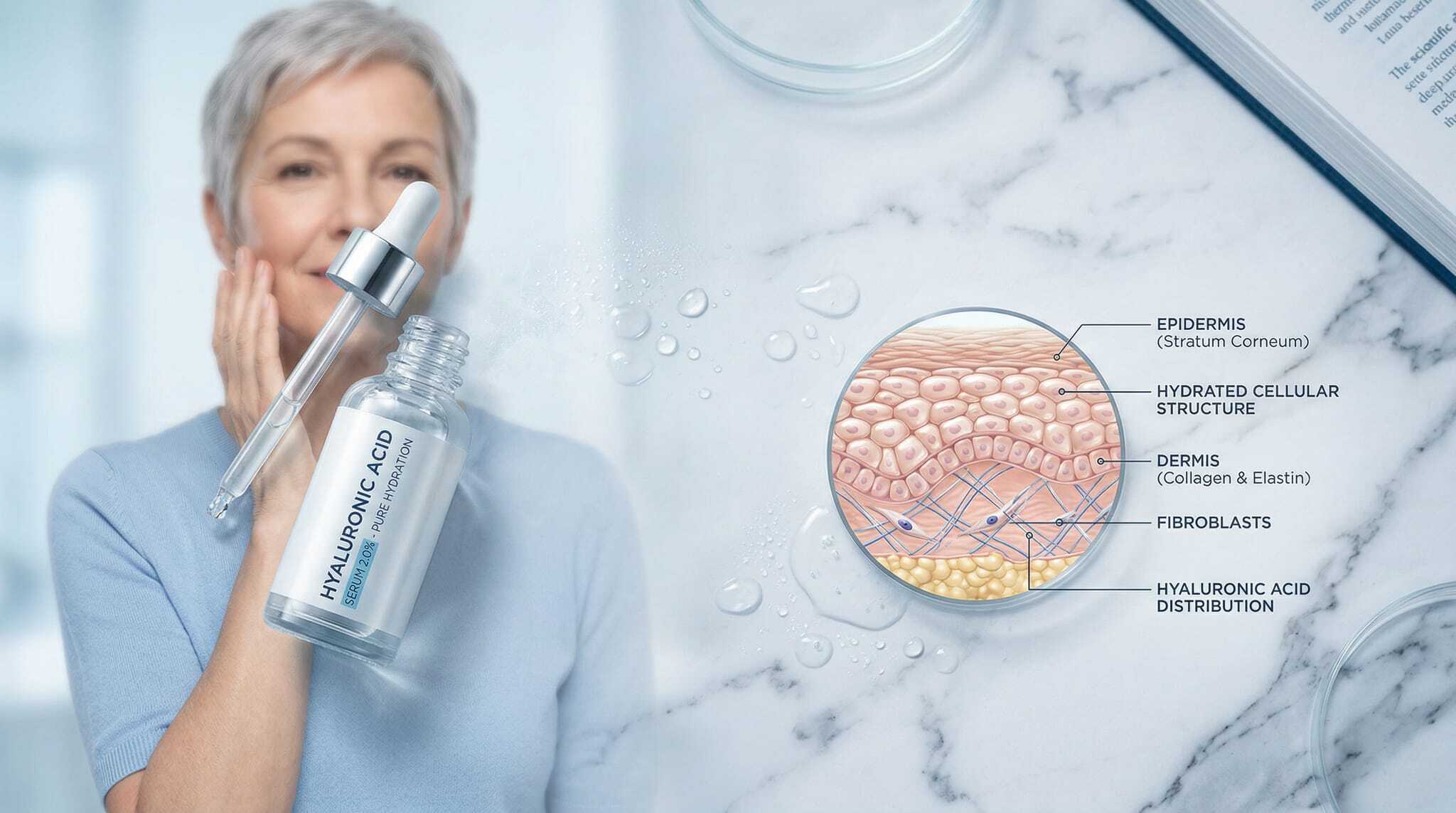
Hyaluronic acid (HA) is a glycosaminoglycan — a long sugar chain that occurs naturally in your skin’s extracellular matrix, the scaffolding between cells that gives skin its structure and resilience. Its defining property is water retention: a single gram of hyaluronic acid can hold up to 1,000 grams of water [2]. That extraordinary hydration capacity is why HA has become the most widely used ingredient in both clinical dermatology and consumer skincare.
But here’s what most people don’t know: not all hyaluronic acid works the same way. The molecule’s size — its molecular weight — determines where it acts, how deeply it penetrates, and what benefits it delivers. Understanding this distinction is the difference between a serum that sits on your surface and one that genuinely transforms your skin. The same label-reading problem shows up in the other big humectant category, which we unpack in our guide to the best snail mucin serum.
How Hyaluronic Acid Works in Your Skin
In healthy, young skin, HA performs three critical functions simultaneously.
Hydration. HA molecules in the dermis attract and bind water molecules, creating a hydrated gel-like matrix that keeps skin plump and supple. This isn’t surface moisture — it’s structural hydration from within the tissue itself [2].
Structural support. HA interacts with collagen and elastin fibers, maintaining the space between them and preventing the mechanical compression that leads to visible sagging. Think of HA as the water in a sponge — without it, the sponge collapses even though the fibers remain intact [3].
Cellular signaling. HA isn’t just a passive filler. It actively communicates with skin cells through CD44 receptors, influencing cell proliferation, migration, and inflammatory responses [4]. This signaling role becomes particularly important during wound healing and tissue repair.
Why HA Declines With Age
The decline isn’t just about producing less. Aging skin both synthesizes less HA and degrades it faster. UV exposure accelerates this process dramatically: a single episode of significant sun exposure can reduce dermal HA content by triggering hyaluronidase enzymes and inflammatory cascades that fragment existing HA chains [1].
Hormonal changes compound the problem. Estrogen stimulates HA synthesis in the skin, which is one reason why menopausal skin changes can feel so sudden and dramatic. When estrogen levels drop during perimenopause, HA production falls in tandem — contributing to the dryness, thinning, and loss of volume that many women experience in their 40s and 50s.
Molecular Weight: The Detail That Changes Everything
When you buy a hyaluronic acid serum, the label rarely tells you the most important thing: the molecular weight of the HA inside. This single factor determines whether the molecule can penetrate your skin or simply sits on top of it. The same molecular-weight question decides what genuinely separates an essence from a serum. If you are standing in front of the shelf, our guide to the best hyaluronic acid serum turns that spec into a buying rule. And if the real question is which serum to buy first, niacinamide vs hyaluronic acid sorts the two by the layer each one reaches. That size difference is also what separates it from the other common humectant, compared directly in hyaluronic acid vs glycerin.
Your skin contains roughly 50% of your body’s total hyaluronic acid — and it’s disappearing faster than you think.
High Molecular Weight HA (>1,000 kDa)
Large HA molecules cannot pass through the stratum corneum — they’re physically too big. Instead, they form a moisture-retaining film on the skin’s surface, reducing transepidermal water loss (TEWL) and creating an immediate plumping effect [5]. This is the “instant gratification” form of HA: your skin looks dewier within minutes of application.
The limitation is depth. High MW HA doesn’t reach the dermis, so its structural benefits are temporary. Once you wash it off, the plumping effect fades. However, high MW HA also has anti-inflammatory properties — it downregulates pro-inflammatory cytokines like TNF-α and IL-6, making it particularly useful for irritated or sensitized skin [4].
Low Molecular Weight HA (<500 kDa)
Smaller HA fragments can penetrate the epidermis and reach the upper dermis, where they stimulate fibroblast proliferation and upregulate collagen synthesis [5]. A 2021 study published in the Journal of Drugs in Dermatology found that a topical serum containing low MW HA significantly improved skin hydration, elasticity, and wrinkle depth after 8 weeks of use compared to vehicle control [6].
Low MW HA also plays a role in wound healing and tissue remodeling, communicating with cells through the CD44 receptor pathway to promote repair processes [4]. For aging skin, this translates to better recovery from micro-damage caused by environmental stressors.
Multi-Weight Formulations
The most effective HA serums contain a blend of molecular weights — high MW for immediate surface hydration, medium MW for mid-layer moisture retention, and low MW for dermal penetration and collagen stimulation. This layered approach addresses hydration at every level of the skin simultaneously [5].
Hyaluronic Acid and Retinol: The Synergy That Matters
If you use retinol — or want to — hyaluronic acid isn’t just complementary. It’s practically essential.
Retinol accelerates cell turnover and stimulates collagen production, but this process temporarily compromises the skin barrier. During the first weeks of retinol use, many people experience dryness, flaking, and sensitivity — the so-called retinol purge and adjustment period. HA directly counteracts these effects by reinforcing hydration, reducing transepidermal water loss, and calming inflammation [7].
This is why dermatologists routinely recommend pairing retinol with hyaluronic acid. Apply HA first (on damp skin for maximum absorption), let it absorb for a minute, then apply retinol on top. The HA creates a hydrated buffer layer that helps the skin tolerate retinol without the harsh drying effects that cause most people to quit.
The Delivery Problem — and the Fix
Even with HA supporting the barrier, conventional retinol formulations face their own penetration challenges. Most retinol molecules degrade before reaching the dermis, and chemical penetration enhancers used in traditional formulations can further irritate the skin barrier.
Nanoretinol® solves this with biomimetic lipid nanoparticles — delivery vehicles that the skin recognizes as its own cellular material. Instead of forcing retinol through a compromised barrier, these nanoparticles pass through naturally, delivering retinol directly to dermal fibroblasts. Clinical testing demonstrated +232% greater collagen recovery and +73% greater elastin recovery versus standard retinol, with dramatically reduced irritation [8].
If you use retinol — or want to — hyaluronic acid isn’t just complementary.
For women over 40 layering an HA serum with Nanoretinol®, the combination addresses both the hydration deficit and the collagen deficit simultaneously — the two primary drivers of visible aging in mature skin.
How to Use Hyaluronic Acid for Maximum Results
Apply to damp skin. HA is a humectant — it draws water toward itself. On damp skin, it pulls moisture inward. On dry skin in a dry environment, it can theoretically draw water from your dermis toward the surface, counterproductively dehydrating deeper layers. Always apply HA to slightly damp skin, then seal with a moisturizer or oil. This is why the format matters: a well-built hyaluronic acid moisturizer pairs the humectant with occlusives that keep that water in place. The same rule applies below the neck, where a hyaluronic acid body lotion works best smoothed onto skin that is still damp from the shower and paired with glycerin and a light seal.
Layer it under everything. HA serums should go on after cleansing and toning, before any active treatments (vitamin C, retinol) and before moisturizer. Its lightweight, water-based texture absorbs quickly and doesn’t interfere with subsequent products.
Use it morning and night. Unlike retinol, HA has no photosensitivity concerns. Use it in the morning under sunscreen for daytime hydration protection, and at night before your retinol treatment to buffer the skin.
Be patient with deeper results. Surface-level plumping is immediate, but improvements in fine lines, elasticity, and overall skin quality from low MW HA take 8–12 weeks of consistent use [6]. Don’t judge a good HA serum by day one — judge it by month three, and apply the same patience to a hyaluronic acid eye cream on the thinner skin around your eyes.
Beyond Serums: Oral Hyaluronic Acid
Emerging research suggests that oral HA supplements may complement topical application. A 2023 randomized, double-blind clinical trial found that oral administration of HA (120 mg/day) for 12 weeks significantly improved skin hydration and reduced wrinkle depth compared to placebo [9]. The proposed mechanism involves absorption of HA fragments through the gut, which then distribute to the skin and stimulate fibroblast activity.
While the evidence for oral HA is promising, it’s still earlier-stage than topical research. For now, a well-formulated multi-weight topical HA serum remains the most reliable delivery method — ideally paired with a collagen-rebuilding active like retinol for comprehensive anti-aging coverage.
The Hydration Foundation
Hyaluronic acid isn’t glamorous. It doesn’t promise to erase a decade overnight or reverse deep wrinkles in a week. What it does — reliably, measurably, and with virtually zero risk of side effects — is restore the foundational hydration that every other anti-aging ingredient depends on. Collagen can’t function in dehydrated tissue. Retinol can’t penetrate a compromised barrier. Antioxidants can’t protect cells that are already stressed by moisture loss.
Think of HA as the infrastructure beneath your skincare routine — the ingredient that makes everything else possible. After 40, when your skin’s natural HA reserves are depleting and hormonal changes are amplifying moisture loss, it stops being optional and becomes essential.
References
-
Papakonstantinou E, Roth M, Karakiulakis G. “Hyaluronic acid: A key molecule in skin aging.” Dermato-Endocrinology. 2012;4(3):253-258. doi:10.4161/derm.21923
-
Fallacara A, Baldini E, Manfredini S, Vertuani S. “Hyaluronic Acid in the Third Millennium.” Polymers. 2018;10(7):701. doi:10.3390/polym10070701
-
Stern R, Maibach HI. “Hyaluronan in skin: aspects of aging and its pharmacologic modulation.” Clinics in Dermatology. 2008;26(2):106-122. PMID: 18472055
-
Kavasi RM, Berdiaki A, Spyridaki I, et al. “HA metabolism in skin homeostasis and inflammatory disease.” Food and Chemical Toxicology. 2017;101:128-138. doi:10.1016/j.fct.2017.01.012
-
Bukhari SNA, Roswandi NL, Waqas M, et al. “Hyaluronic acid, a promising skin rejuvenating biomedicine: A review of recent updates and pre-clinical and clinical investigations on cosmetic and nutricosmetic effects.” International Journal of Biological Macromolecules. 2018;120(Pt B):1682-1695. doi:10.1016/j.ijbiomac.2018.09.188
-
Pavicic T, Gauglitz GG, Lersch P, et al. “Efficacy of cream-based novel formulations of hyaluronic acid of different molecular weights in anti-wrinkle treatment.” Journal of Drugs in Dermatology. 2011;10(9):990-1000. PMID: 22052267
-
Mukherjee S, Date A, Patravale V, Korting HC, Roeder A, Weindl G. “Retinoids in the treatment of skin aging: an overview of clinical efficacy and safety.” Clinical Interventions in Aging. 2006;1(4):327-348. doi:10.2147/ciia.2006.1.4.327
-
North Biomedical LLC. “Nanoretinol® vs. Conventional Retinol: Efficacy in Collagen and Elastin Recovery.” Clinical Study Summary, 2024.
-
Gao YR, et al. “Oral administration of hyaluronic acid to improve skin conditions via a randomized double-blind clinical test.” Skin Research and Technology. 2023;29(8):e13531. doi:10.1111/srt.13531