Collagen in Coffee: Does It Actually Work — or Does the Heat Ruin It?
What really happens to collagen powder in your morning coffee, and whether any of it reaches your skin
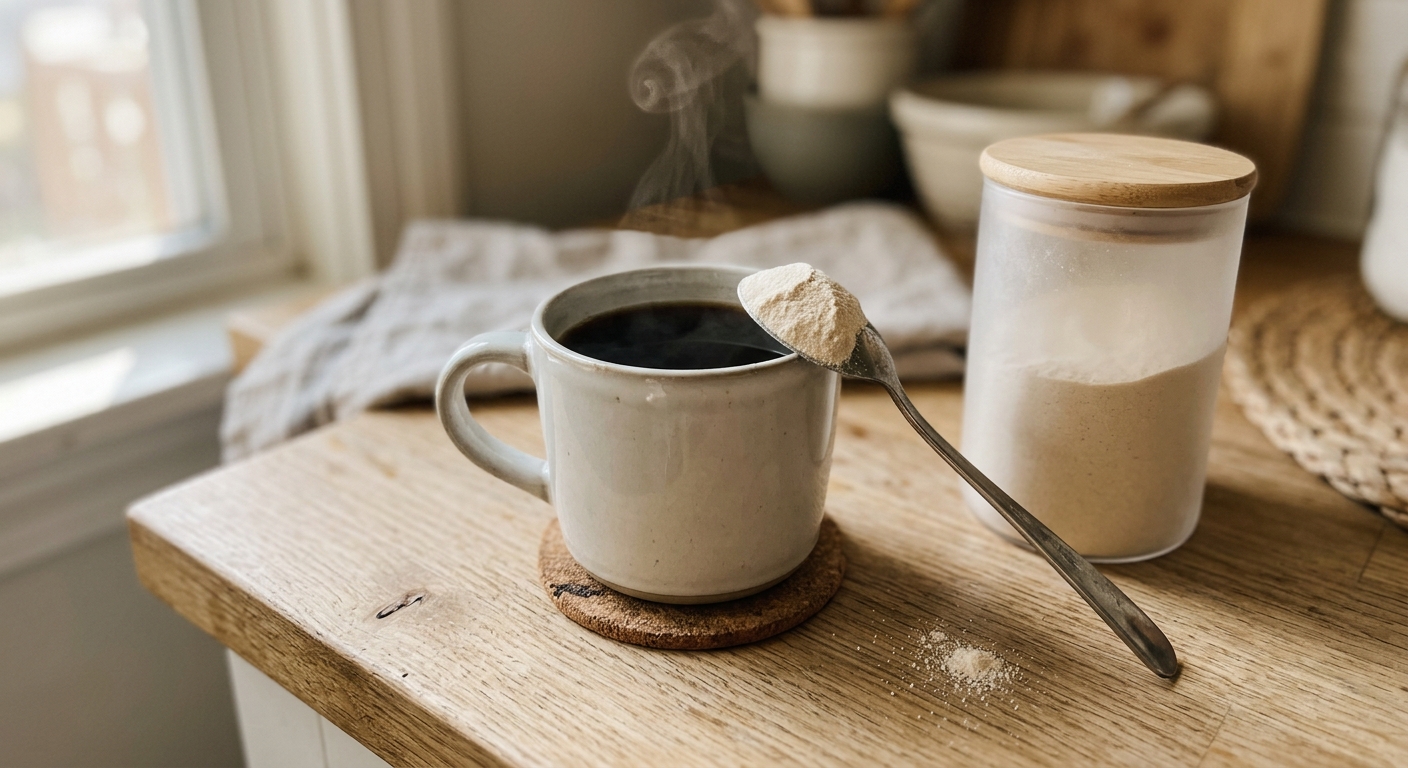
Stirring a scoop of collagen powder into your morning coffee has become one of the most popular skincare-adjacent rituals going. It’s easy, it feels productive, and the promise is appealing: firmer, plumper skin by lunchtime, no serum required. But a nagging question follows the trend around — doesn’t the heat of hot coffee just destroy the collagen before it can do anything? And even if it survives, does any of it actually reach your face?
The answers are more interesting than either the enthusiasts or the skeptics let on. Let’s take the two worries in order.
Does Hot Coffee “Destroy” the Collagen?
This fear rests on a real fact applied to the wrong material. Native collagen — the long, rope-like triple helix found in skin and bone — is genuinely fragile to heat. Laboratory work has shown that the type I collagen triple helix is thermally unstable even around normal body temperature, unwinding into loose strands well below the heat of a fresh cup of coffee [1]. If you were dropping raw collagen fibers into your mug, the “heat ruins it” crowd would have a point.
But that’s not what’s in the jar. The collagen powder people add to coffee is hydrolyzed collagen, also called collagen peptides — collagen that has already been broken down into short fragments during manufacturing. There is no intact triple helix left to unravel. Heat can’t “denature” something that’s already been taken apart. These small peptides are stable in a hot drink, and stirring them into coffee doesn’t meaningfully reduce whatever benefit they can offer.
When you drink collagen, your digestive system treats it like any other protein.
So the popular worry is largely a non-issue. The far more important question is the one people skip: once you swallow those peptides, where do they go?
The Real Bottleneck Isn’t the Coffee — It’s the Journey
When you drink collagen, your digestive system treats it like any other protein. It breaks the peptides down further into amino acids and very small di- and tri-peptides, which are absorbed into the bloodstream. Researchers have confirmed this happens: after volunteers drank collagen hydrolysate, collagen-specific peptide fragments like proline-hydroxyproline appeared in their blood within an hour or two, proving the material is genuinely absorbed [2].
That’s the good news. The complication is what happens next. Those amino acids and peptides enter a general circulating pool that your entire body draws from. Your skin has no priority claim on them — they can just as easily be routed to muscle, gut lining, or any tissue building protein that day. Drinking collagen doesn’t send a targeted package to your face; it tops up a body-wide supply and hopes some of it is spent on skin.
There’s also no guarantee the raw materials become collagen rather than fuel. Amino acids are used wherever the body decides they’re needed, which may have nothing to do with your cheeks.
Your skin has no priority claim on them — they can just as easily be routed to muscle, gut lining, or any tissue building protein that day.
So Does It Do Anything for Skin?
Here’s where the honest answer lands in the middle. Despite the indirect delivery, controlled trials do show measurable skin benefits from consistent oral collagen peptides. In a double-blind, placebo-controlled study, women taking a daily collagen hydrolysate saw significantly improved skin elasticity after just four weeks compared with placebo [3]. The proposed mechanism is clever: the specific peptide fragments may act less like building blocks and more like signals, nudging skin fibroblasts to ramp up their own collagen production.
The catch is the fine print. These results come from specific, studied doses (often several grams daily), taken consistently for weeks, and the effects are moderate rather than dramatic. A single scoop in occasional coffee, with no consistency, is a much weaker version of what the studies actually tested. Collagen in coffee isn’t a scam — but it’s a slow, diffuse, indirect strategy, and it works best as a supporting habit rather than a headline act. For the bigger picture on ingestible collagen, see our deep dives on collagen supplements and skin elasticity and how to boost collagen production.
The Principle Hiding in Your Coffee Cup
Step back and the collagen-in-coffee question reveals a rule that governs almost everything in skincare: it’s not how much active ingredient you take in — it’s how much actually reaches the target. A big scoop of collagen scattered across the whole body may do less for your face than a small amount delivered precisely where you want it. Dose is not the same as delivery.
This is exactly why topical strategies can punch above their weight. Rather than routing raw material through digestion and hoping the skin gets its share, you can act on skin directly. And the most proven direct-acting ingredient isn’t collagen at all — it’s retinol, which signals skin cells to manufacture their own new collagen. In a controlled study of aged skin, topical retinol raised glycosaminoglycan content and stimulated fresh collagen synthesis right where it was applied [4]. That’s targeted delivery doing what a body-wide top-up struggles to.
Where Nanoretinol Fits
If delivery is the whole game, then the smartest formulations are the ones obsessed with it — and that’s the entire premise behind Nanoretinol. It encapsulates retinol inside biomimetic lipid nanoparticles that the skin recognizes as “self” and admits through the barrier, so the active is carried precisely into the skin instead of being lost along the way. It’s a vivid illustration of the delivery-over-dose principle: Nanoretinol uses just 0.2% retinol, yet in North Biomedical’s clinical testing it proved 232% more effective in collagen recovery than conventional retinol, with a 61% increase in skin firmness over 56 days — because efficiency of delivery, not raw concentration, is what determines how much benefit the skin actually receives.
Keep enjoying your collagen coffee if you like the ritual; taken consistently, it can gently help. Just remember that the more reliable route to firmer skin is the one that skips the detour and delivers straight to the target.
References
- Leikina E, Mertts MV, Kuznetsova N, Leikin S. “Type I Collagen Is Thermally Unstable at Body Temperature.” Proceedings of the National Academy of Sciences of the United States of America. 2002;99(3):1314-1318. doi:10.1073/pnas.032307099
- Iwai K, Hasegawa T, Taguchi Y, Morimatsu F, Sato K, Nakamura Y, Higashi A, Kido Y, Nakabo Y, Ohtsuki K. “Identification of Food-Derived Collagen Peptides in Human Blood After Oral Ingestion of Gelatin Hydrolysates.” Journal of Agricultural and Food Chemistry. 2005;53(16):6531-6536. doi:10.1021/jf050206p
- Proksch E, Segger D, Degwert J, Schunck M, Zague V, Oesser S. “Oral Supplementation of Specific Collagen Peptides Has Beneficial Effects on Human Skin Physiology: A Double-Blind, Placebo-Controlled Study.” Skin Pharmacology and Physiology. 2014;27(1):47-55. doi:10.1159/000351376
- Kafi R, Kwak HSR, Schumacher WE, Cho S, Hanft VN, Hamilton TA, King AL, Neal JD, Varani J, Fisher GJ, Voorhees JJ, Kang S. “Improvement of Naturally Aged Skin With Vitamin A (Retinol).” Archives of Dermatology. 2007;143(5):606-612. doi:10.1001/archderm.143.5.606