Do Collagen Supplements Actually Improve Skin Elasticity? What the Science Says
Oral collagen is a billion-dollar industry — but the real question is whether swallowing collagen can rebuild what your skin has lost
The Collagen Supplement Question
Walk into any health food store or scroll any skincare influencer’s feed and you’ll find collagen supplements everywhere — powders, capsules, gummies, drinks. The promise is straightforward: take collagen, get more collagen in your skin, look younger. If you are comparing topicals instead, our hyaluronic acid vs collagen guide explains why neither directly rebuilds skin.
It’s an appealing idea. Collagen makes up roughly 75% of the skin’s dry weight, and its progressive loss is one of the most measurable drivers of visible aging [1]. After 25, your body produces approximately 1% less collagen per year. After menopause, the decline accelerates dramatically — women can lose up to 30% of their dermal collagen within five years of estrogen withdrawal [2].
So supplementing makes intuitive sense. But does swallowing collagen actually result in more collagen where it matters — in the dermis of your skin?
What Happens When You Take Collagen Orally
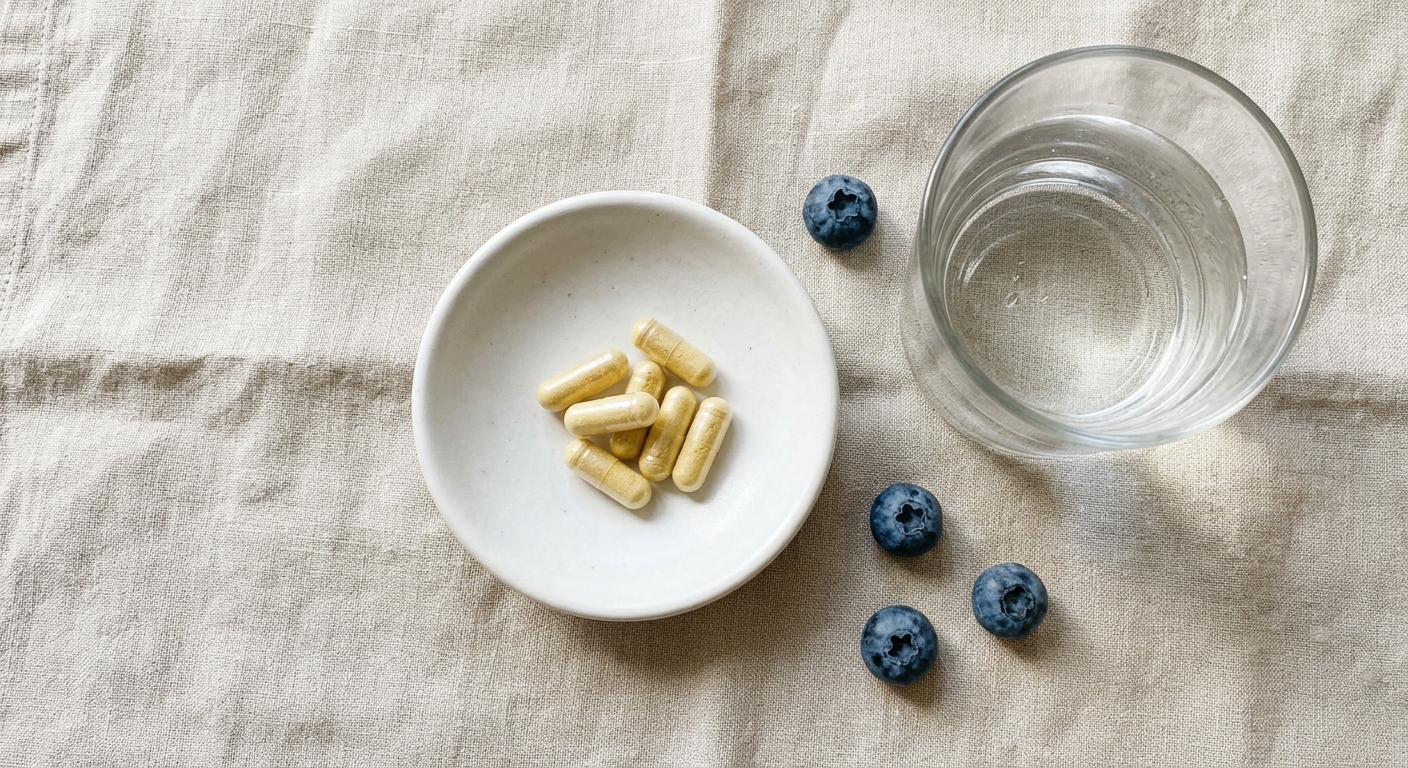
Collagen supplements typically contain hydrolyzed collagen peptides — collagen that’s been broken down into smaller fragments ranging from 2,000 to 5,000 daltons. This pre-digestion is critical because intact collagen molecules are far too large to survive the gastrointestinal tract intact.
When you ingest these peptides, your digestive system breaks them down further into dipeptides, tripeptides, and individual amino acids — primarily glycine, proline, and hydroxyproline. These fragments are absorbed through the intestinal wall into the bloodstream [3].
Here’s where it gets complicated. Once in the blood, these amino acids and peptide fragments don’t come with an address label that says “deliver to face.” They’re distributed throughout the entire body and used wherever the demand is highest — joints, bones, muscles, tendons, blood vessels, and yes, skin. How much actually ends up stimulating fibroblast activity in your facial dermis is a question that no study has definitively answered.
What the Clinical Evidence Actually Shows
Despite the absorption uncertainty, clinical trials on oral collagen do show measurable skin benefits. A 2023 systematic review and meta-analysis examining 26 randomized controlled trials found that oral collagen supplementation significantly improved skin hydration, elasticity, and wrinkle severity compared to placebo [4]. The effects were most consistent at doses of 2.5 to 10 grams daily over 8 to 12 weeks.
If you are comparing topicals instead, our hyaluronic acid vs collagen guide explains why neither directly rebuilds skin.
A 2023 randomized, double-blinded, placebo-controlled study found that low-molecular-weight collagen peptides improved skin hydration, roughness, and elasticity after 12 weeks of daily supplementation [5]. Similarly, a 2024 trial reported improvements in skin collagen density, hydration, and elasticity following 12 weeks of hydrolyzed collagen intake [6].
These results are real. But context matters.
The improvements documented in most studies are modest — typically in the range of 5 to 15% improvement in elasticity scores. For comparison, the age-related decline in collagen after menopause occurs at a rate that can outpace this rebuilding if the underlying causes of degradation aren’t addressed simultaneously.
The Gap Between Swallowing Collagen and Building It
The fundamental limitation of oral collagen supplementation is that it’s an indirect approach. You’re providing raw materials — amino acid building blocks — and hoping your body allocates enough of them to dermal collagen synthesis. You’re not directly activating the fibroblasts that produce new collagen. The same gap applies to what you put on your skin, which is why choosing the best collagen cream for face means reading past the front of the jar.
This distinction matters because collagen loss in aging skin isn’t primarily a supply problem. It’s a signaling problem. As skin ages, fibroblasts become less responsive to the growth factors and mechanical signals that drive collagen production [7]. The cellular machinery slows down. Matrix metalloproteinases (MMPs) — enzymes that break down collagen — become more active. The balance shifts from net production to net degradation.
Providing more amino acids doesn’t fix the signaling deficit. It’s like delivering bricks to a construction site where the workers have gone home.
This is why dermatologists consistently rank topical retinoids as the most effective intervention for stimulating dermal collagen — not because they provide building blocks, but because they directly activate the fibroblasts responsible for synthesis. Retinol upregulates procollagen gene expression, inhibits MMP activity, and has been demonstrated in controlled studies to measurably increase dermal collagen density over time [8].
It’s not a magic bullet, but it modestly improves measurable skin parameters over 8–12 weeks.
Why Delivery Determines Everything
If topical retinol is the most proven way to stimulate collagen where it matters, why doesn’t everyone just use it?
Tolerability. Conventional retinol formulations rely on chemical penetration enhancers to cross the skin barrier — and these enhancers often damage the barrier in the process. The result is the well-known retinol adjustment period: redness, peeling, dryness, and sensitivity that causes a significant percentage of users to quit before they see results.
For menopausal skin — already dry and barrier-compromised — this tolerability problem is especially severe. The women who need collagen stimulation most are often the ones least able to tolerate the most effective tool for it.
Nanoretinol® was designed specifically for this problem. By encapsulating retinol in biomimetic lipid nanoparticles that mimic the skin’s own cell membranes, it delivers the active ingredient directly to dermal fibroblasts without requiring barrier-disrupting chemicals. In clinical testing, this approach produced 232% greater collagen recovery compared to conventional retinol, with significantly reduced cytotoxicity [9].
This isn’t about choosing between supplements and topicals. It’s about understanding what each approach actually does: collagen supplements provide amino acid building blocks systemically, while targeted retinol delivery activates the fibroblasts that build collagen locally.
A Practical Framework
For anyone serious about maintaining or rebuilding skin elasticity, the evidence supports a combined approach:
Oral collagen (2.5–10g daily of hydrolyzed peptides) provides systemic amino acid support. It’s not a magic bullet, but it modestly improves measurable skin parameters over 8–12 weeks. Think of it as ensuring the raw materials are available.
Topical retinol provides the direct signal to fibroblasts to produce new collagen. This is the most clinically validated method for actually increasing dermal collagen density. The key is choosing a formulation that delivers effectively without barrier damage.
Sun protection prevents UV-driven collagen degradation through MMP activation. Without daily SPF, both your supplements and your retinol are working against a headwind that accelerates breakdown faster than you can rebuild.
Barrier support with ceramides and hyaluronic acid maintains the skin environment that allows active ingredients to work without creating additional stress.
The supplement industry has made collagen seem like a standalone solution. The science says it’s one piece of a larger system — and the most impactful piece happens not in your gut, but in your dermis.
References
- Varani J, Dame MK, Rittié L, et al. “Decreased Collagen Production in Chronologically Aged Skin: Roles of Age-Dependent Alteration in Fibroblast Function and Defective Mechanical Stimulation.” American Journal of Pathology. 2006;168(6):1861-1868. doi:10.2353/ajpath.2006.051302
- Brincat M, Moniz CJ, Studd JWW, et al. “Long-term Effects of the Menopause and Sex Hormones on Skin Thickness.” British Journal of Obstetrics and Gynaecology. 1985;92(3):256-259. doi:10.1111/j.1471-0528.1985.tb01091.x
- Iwai K, Hasegawa T, Taguchi Y, et al. “Identification of Food-Derived Collagen Peptides in Human Blood After Oral Ingestion of Gelatin Hydrolysates.” Journal of Agricultural and Food Chemistry. 2005;53(16):6531-6536. doi:10.1021/jf050206p
- Miranda RB, Weimer P, Rossi RC. “Effects of Oral Collagen for Skin Anti-Aging: A Systematic Review and Meta-Analysis.” Nutrients. 2023;15(9):2080. PMC10180699
- Song H, Hwang B, et al. “Low-Molecular-Weight Collagen Peptides Supplement Promotes a Healthy Skin: A Randomized, Double-Blinded, Placebo-Controlled Study.” Journal of Cosmetic Dermatology. 2023;22(12):3558-3567. PMID: 37822045
- Sato K, et al. “A Clinical Trial Shows Improvement in Skin Collagen, Hydration, Elasticity, Wrinkles, Scalp, and Hair Condition Following 12-Week Oral Intake of a Supplement Containing Hydrolysed Collagen.” Nutrients. 2024;16(14):2181. PMC11254459
- Fisher GJ, Varani J, Voorhees JJ. “Looking Older: Fibroblast Collapse and Therapeutic Implications.” Archives of Dermatology. 2008;144(5):666-672. doi:10.1001/archderm.144.5.666
- Mukherjee S, Date A, Patravale V, et al. “Retinoids in the Treatment of Skin Aging: An Overview of Clinical Efficacy and Safety.” Clinical Interventions in Aging. 2006;1(4):327-348. PMID: 18046911
- North Biomedical LLC. “Nanoretinol® vs. Conventional Retinol: Efficacy in Collagen and Elastin Recovery.” Clinical Study Summary, 2024. Study PDF