How to Get Rid of Wrinkles: What the Science Actually Says Works
A research-backed guide to softening the lines you have and preventing the ones you don't
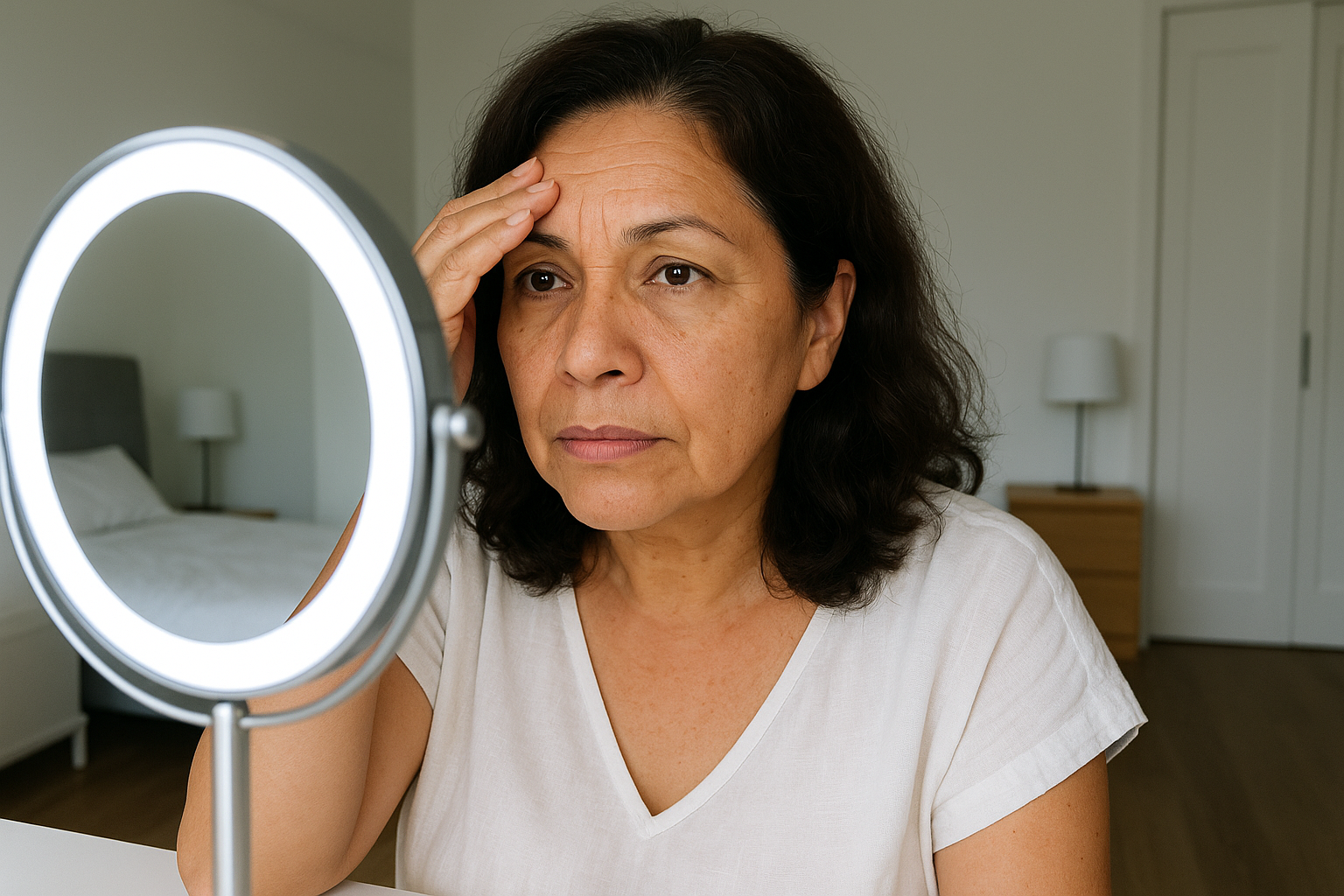
Wrinkles arrive quietly. One morning a crease that used to vanish when you stopped smiling is simply still there. It is one of the most-searched skincare questions for a reason — and one of the most misunderstood. There is no cream that irons skin flat overnight, and anyone promising that is selling you something. But the biology of why wrinkles form is well understood, and that understanding points to a short, honest list of things that genuinely work.
What Actually Causes Wrinkles
A wrinkle is not a surface problem. It is the visible signal of changes happening millimeters below, in the dense scaffolding layer of skin called the dermis. The dermis is built largely from collagen — the protein that gives skin its firmness — and elastin, which lets it spring back into place. As that scaffolding thins and frays, the surface above it loses support and begins to fold.
Two separate forces drive this. The first is simply time. A detailed morphometric study of human skin across the lifespan found that the collagen content of the dermis declines steadily with age, with the upper dermis thinning measurably decade by decade [1]. This is intrinsic aging — it is genetic, and it happens to everyone.
The second force is the one you can actually do something about: sunlight. Dermatologists draw a sharp line between intrinsic (chronological) aging and extrinsic aging caused by the environment [2]. Ultraviolet radiation switches on enzymes called matrix metalloproteinases that actively break down existing collagen, and repeated UV exposure leaves the dermis disorganized and depleted [3]. This is why the skin on the inside of your upper arm looks decades younger than the back of your hand. A large share of the lines you see in the mirror are not destiny — they are accumulated sun damage.
Most people fixate on the first job and ignore the second — which is backwards, because prevention is far easier than repair.
The Two Jobs of Any Wrinkle Plan
Once you understand the cause, the plan writes itself. Effective wrinkle care does two distinct jobs: it rebuilds and smooths the lines you already have, and it slows the formation of new ones. Most people fixate on the first job and ignore the second — which is backwards, because prevention is far easier than repair. A genuine plan does both at once.
Treatments That Genuinely Reduce Wrinkles
Retinoids: the most studied option there is
If one ingredient has earned its reputation, it is the retinoid family — vitamin A derivatives that include prescription tretinoin and over-the-counter retinol. The evidence stretches back decades. A landmark 1988 double-blind, vehicle-controlled trial found that topical tretinoin produced statistically significant improvement in photoaged skin while the placebo did not [4]. Retinoids work by signaling skin cells to build new collagen and by accelerating cell turnover — exactly the processes that decline with age. (For a deeper look at the mechanism, see our guide to how retinoids work.)
Crucially, you do not need a prescription to benefit. A randomized, double-blind study published in 2007 tested over-the-counter retinol on the naturally aged skin of elderly participants and found reduced fine wrinkles alongside measurable increases in collagen and skin-cushioning molecules [5]. That distinction matters: even the gentler, non-prescription form changes skin at the structural level, not just the surface.
Daily sunscreen: the most underrated treatment
Sunscreen is filed mentally under “prevention,” but a remarkable randomized trial proved it belongs in the treatment column too. Over four and a half years, Australian researchers followed adults assigned to either daily sunscreen use or their own discretion. The daily-use group showed no detectable increase in skin aging across the entire study; the discretionary group visibly aged [6].
Instead of forcing retinol through the skin barrier, Nanoretinol encapsulates it inside biomimetic lipid nanoparticles that carry the active across the barrier far more efficiently — which is why a gentle 0.2% concentration can still do meaningful structural work.
Read that again: not slower aging — no measurable aging at all. A broad-spectrum sunscreen of SPF 30 or higher, worn every single day, is the closest thing skincare has to a wrinkle insurance policy. It is also the cheapest item on this list.
Antioxidants: the supporting cast
Topical vitamin C plays a genuine supporting role by neutralizing the free radicals that UV light generates before they can damage collagen. A six-month double-blind trial of a 5% vitamin C cream showed clinically visible improvement in photodamaged skin, including smoother surface texture [7]. Antioxidants will not replace a retinoid, but they make a sensible daytime partner to sunscreen.
What to Skip
A quick, honest word on what the evidence does not support. Facial exercises and “face yoga” have very little controlled data behind them for wrinkle reduction. Luxury creams whose ingredient lists are mostly water, fragrance, and no proven active will buy you a pleasant texture and little else. And no topical product reaches the depth of an injectable or a laser — if a deep static wrinkle that never relaxes is your main concern, an in-office procedure is an honest conversation to have with a dermatologist. Topical products excel at fine lines, overall texture, and prevention; they are not surgery in a jar.
Why Delivery Beats Strength
Here is the catch with retinoids. The same potency that rebuilds collagen also causes the redness, flaking, and stinging that make so many people quit within a few weeks. Conventional retinol formulas partly work by disrupting the skin barrier to push the molecule inward — effective, but irritating, and self-defeating for anyone with sensitive skin.
This is the problem North Biomedical set out to solve with Nanoretinol. Instead of forcing retinol through the skin barrier, Nanoretinol encapsulates it inside biomimetic lipid nanoparticles that carry the active across the barrier far more efficiently — which is why a gentle 0.2% concentration can still do meaningful structural work. In North Biomedical’s clinical study comparing Nanoretinol to conventional retinol, participants saw a 61% increase in skin firmness and a 56% increase in elasticity over 56 days, with side effects that were milder and less frequent than those of standard retinol. For anyone who has tried a retinoid and abandoned it, a better-delivered, lower-irritation version is worth knowing about.
Where to Start
You do not need a ten-step routine to get rid of wrinkles. You need a retinoid at night, a broad-spectrum sunscreen every morning, and the patience to give them three to six months of consistent use. Wrinkles took years to form down in the dermis, so reversing even part of that is real biological work — but it is work that decades of research show genuinely pays off. Start small, stay consistent, and let the science do what it reliably does. Men face the same biology on thicker skin, and the guide to anti-wrinkle cream for men covers what changes. Shopping at drugstore prices changes the calculus again, as the guide to the best drugstore wrinkle cream sets out. And if you have been trying the kitchen route first, the evidence on home remedies for face wrinkles explains exactly where each one stops.
References
- Marcos-Garcés V, Molina Aguilar P, Bea Serrano C, García Bustos V, Benavent Seguí J, Ferrández Izquierdo A, Ruiz-Saurí A. “Age-related dermal collagen changes during development, maturation and ageing — a morphometric and comparative study.” Journal of Anatomy. 2014;225(1):98-108. doi:10.1111/joa.12186
- Lober CW, Fenske NA. “Photoaging and the skin: differentiation and clinical response.” Geriatrics. 1990;45(4):36-42. PMID: 2318416
- Fisher GJ, Kang S, Varani J, Bata-Csorgo Z, Wan Y, Datta S, Voorhees JJ. “Mechanisms of photoaging and chronological skin aging.” Archives of Dermatology. 2002;138(11):1462-1470. doi:10.1001/archderm.138.11.1462
- Weiss JS, Ellis CN, Headington JT, Tincoff T, Hamilton TA, Voorhees JJ. “Topical tretinoin improves photoaged skin. A double-blind vehicle-controlled study.” JAMA. 1988;259(4):527-532. PMID: 3336176
- Kafi R, Kwak HSR, Schumacher WE, Cho S, Hanft VN, Hamilton TA, King AL, Neal JD, Varani J, Fisher GJ, Voorhees JJ, Kang S. “Improvement of naturally aged skin with vitamin A (retinol).” Archives of Dermatology. 2007;143(5):606-612. doi:10.1001/archderm.143.5.606
- Hughes MCB, Williams GM, Baker P, Green AC. “Sunscreen and prevention of skin aging: a randomized trial.” Annals of Internal Medicine. 2013;158(11):781-790. doi:10.7326/0003-4819-158-11-201306040-00002
- Humbert PG, Haftek M, Creidi P, Lapière C, Nusgens B, Richard A, Schmitt D, Rougier A, Zahouani H. “Topical ascorbic acid on photoaged skin. Clinical, topographical and ultrastructural evaluation: double-blind study vs. placebo.” Experimental Dermatology. 2003;12(3):237-244. doi:10.1034/j.1600-0625.2003.00008.x