How to Look Younger at 40: The Science-Backed Skincare Strategy That Actually Works
What dermatology research really says about the four interventions that matter in your forties — and the ones that don't.
The honest answer to “how do I look younger at 40?” is shorter than the wellness industry wants you to believe. After a couple of decades of dermatology research, the list of interventions that actually slow visible aging is about four items long. Most of what’s sold around them is decoration.
That doesn’t mean the four are trivial. Done consistently, they outperform almost everything you can buy. Skipped, no expensive serum will compensate. This guide walks through what the science actually supports, in the order that matters.
What’s happening to your skin at 40
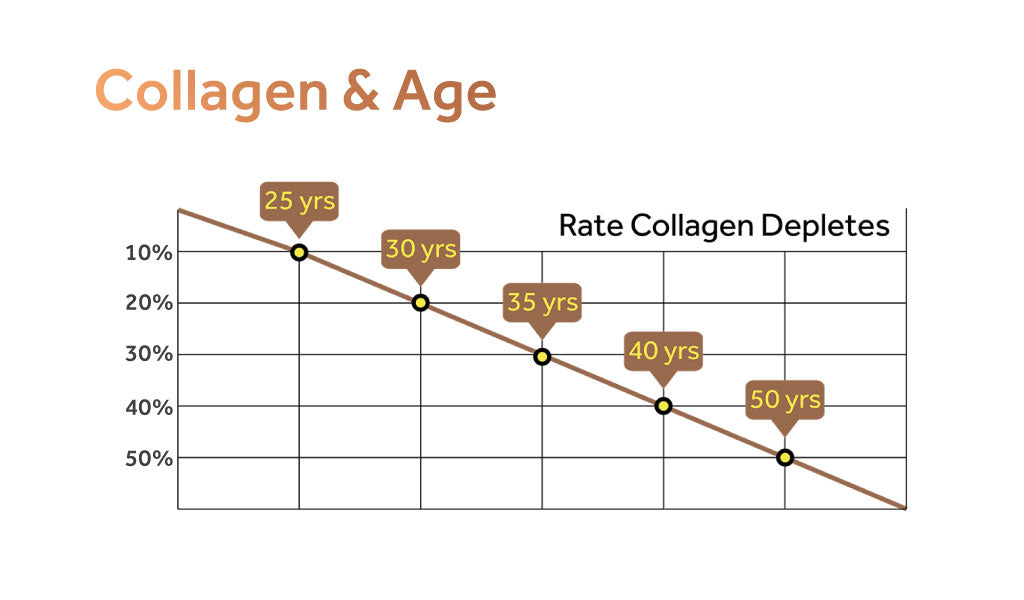
Skin collagen declines roughly linearly through adult life. Foundational research from the British Journal of Dermatology measured a steady loss of about 1% per year from age 25 onward, with women starting from a lower baseline than men [1]. By 40, that’s a 15% reduction in the protein that gives skin its tensile strength — enough to start showing as fine lines, looser texture across the lower face, and a slower bounce-back when skin is pinched. If you are approaching that mark rather than past it, our skin care routine for your 30s covers the preventive version of the same plan.
Two other things tend to converge around the same age. The cumulative UV exposure of three to four decades begins to surface as uneven pigmentation, broken capillaries, and the deeper “photoaging” wrinkles that don’t relax overnight. And for many women, perimenopause begins anywhere from the late thirties to mid-forties, with measurable effects on skin collagen even before menstruation stops [2]. For the step-by-step morning and night version of this plan, see the skin care routine for your 40s.
None of this is catastrophic. It’s just the point where intervention shifts from optional to high-leverage.
Intervention #1: Daily broad-spectrum SPF
If you do one thing differently after 40, this is it. Daily sunscreen is the single most clinically validated anti-aging intervention in existence.
A landmark randomized trial published in Annals of Internal Medicine followed 903 adults under 55 for 4.5 years. One group used SPF 15+ daily; the other used sunscreen at their discretion. Skin aging was measured by silicone impressions of the back of the hand. The daily group showed 24% less photoaging than the discretionary group — measurable, photograph-able, and statistically robust [3].
The mechanism is straightforward. UV exposure activates a family of enzymes called matrix metalloproteinases (MMPs) that chew through existing collagen. A classic New England Journal of Medicine paper showed that even a single dose of UVB triggers MMP activity for days after exposure, and that the effect compounds with repeat exposures [4]. Tretinoin pre-treatment in the same study suppressed MMP activation by 70-80% — which is also why retinoids are the second item on this list.
If you are approaching that mark rather than past it, our skin care routine for your 30s covers the preventive version of the same plan.
Sunscreen isn’t sexy. It is the closest thing to a guaranteed return in skincare. Read why even more is at stake in our deep dive on sunscreen for aging skin.
Intervention #2: A nightly retinoid
After sunscreen, retinoids are the most heavily evidenced category in topical anti-aging. The same Archives of Dermatology trial that confirmed retinol works in elderly skin found that even a modest 0.4% concentration, applied three times weekly, produced measurable reductions in fine wrinkles and increased dermal procollagen after 24 weeks [5].
Retinoids work by accelerating skin cell turnover, signaling fibroblasts to produce more collagen, and downregulating the MMPs that UV exposure activates. For someone at 40, that combination addresses both the structural decline and the photoaging accelerator at the same time.
Practical notes for starting retinol in your 40s:
- Begin with two to three nights per week, not nightly.
- Pair with a ceramide moisturizer to buffer irritation.
- Expect six to twelve weeks before visible change — collagen turnover is slow.
- Never skip morning SPF; retinoids increase photosensitivity.
If you’re brand new to retinoids, our retinol for beginners guide walks through the ramp-up protocol that minimizes purging and redness.
Intervention #3: Address perimenopause directly
Skin in the four years before and after menopause loses collagen faster than at any other adult stage. A foundational study by Brincat and colleagues showed that postmenopausal women receiving topical estrogen recovered measurable skin collagen — confirming the hormone’s structural role [2]. Subsequent work put numbers on it: roughly 30% of skin collagen is lost in the first five years after menopause, then about 2% per year after that.
The implication for women in their 40s is that the steady 1%-per-year decline doesn’t continue smoothly. It accelerates during the perimenopausal window — often before the formal diagnosis. Skincare choices made in this stretch have outsized impact because they’re catching collagen loss at its fastest rate.
Here’s the catch that derails most 40-something women’s retinol attempts: conventional retinol either doesn’t penetrate well, or penetrates by damaging the skin barrier on the way in.
Three practical responses:
- Layer a peptide serum or growth-factor formulation with your retinoid to give fibroblasts as much production signal as possible.
- Switch cleansers if your current one strips your skin barrier; barrier function declines alongside estrogen.
- Hydrate more aggressively. Skin water content drops measurably in this phase even when no other routine changes.
Our piece on perimenopause skin changes covers the timeline in more detail.
Intervention #4: Topical antioxidants in the morning
Antioxidants — primarily vitamin C — neutralize the free radicals UV creates before those radicals can fragment collagen. They’re the third leg of the daytime stool: sunscreen blocks photons, antioxidants mop up the few that get through.
A double-blind, vehicle-controlled trial of 5% topical L-ascorbic acid published in Experimental Dermatology showed significant clinical and ultrastructural improvement in photoaged skin compared to placebo [6]. The combination of vitamin C plus daily SPF outperforms either alone for both pigment evenness and fine-line density.
What doesn’t move the needle (despite the marketing)
Several mid-40s skincare staples have weaker evidence than the price tags suggest:
- Collagen drinks and pills — most peptides are broken into amino acids during digestion, with no targeted reassembly in skin. Some small trials show modest hydration benefits; none show comparable structural change to topical retinoids.
- “Plumping” hyaluronic-acid-only serums — useful for short-term hydration; not a long-term wrinkle treatment.
- Multi-step Korean-style routines without an active — pleasant; not anti-aging unless one of the 10 steps is a retinoid, vitamin C, or peptide.
If your routine is missing one of the four pillars above, layering more products on top doesn’t substitute.
The retinol-delivery problem
Here’s the catch that derails most 40-something women’s retinol attempts: conventional retinol either doesn’t penetrate well, or penetrates by damaging the skin barrier on the way in. The result is the classic retinol experience — redness, peeling, and quitting after three weeks.
Newer encapsulation chemistry has flipped this. Nanoretinol packages 0.2% retinol inside biomimetic lipid nanoparticles — particles externally identical to the membranes of your own skin cells. The barrier reads them as native and lets them through without disruption. Once inside, retinol releases gradually while the surrounding cells absorb the nanoparticle’s phospholipids.
The internal clinical study showed +232% more collagen recovery and +73% more elastin recovery versus conventional retinol, with measurable +61% firmness and +56% elasticity gains over 56 days. For women in their 40s — when both peak production and tolerance for irritation are dropping — this delivery model removes the trade-off that makes most people quit retinol just before it would have started working.
Putting it together
A complete 40-something routine isn’t long. Morning: gentle cleanser, vitamin C serum, broad-spectrum SPF. Evening: cleanser, encapsulated retinol, ceramide moisturizer. That’s it. Add a peptide serum or a hydrator if your skin needs it. Our morning skincare routine guide explains why those three daytime steps are the ones that survive scrutiny.
The mistake most people make at 40 is layering eight optional products around zero of the core four. The mistake from 50 forward — covered in our how to look younger at 50 guide — is starting then. Forty is the leverage window. The collagen you preserve now is the collagen you have at 55.
References
- Shuster S, Black MM, McVitie E. “The influence of age and sex on skin thickness, skin collagen and density.” British Journal of Dermatology. 1975;93(6):639-643. doi:10.1111/j.1365-2133.1975.tb05113.x
- Brincat M, Versi E, O’Dowd T, et al. “Skin collagen changes in post-menopausal women receiving oestradiol gel.” Maturitas. 1987;9(1):1-5. doi:10.1016/0378-5122(87)90045-4
- Hughes MCB, Williams GM, Baker P, Green AC. “Sunscreen and prevention of skin aging: a randomized trial.” Annals of Internal Medicine. 2013;158(11):781-790. doi:10.7326/0003-4819-158-11-201306040-00002
- Fisher GJ, Wang ZQ, Datta SC, Varani J, Kang S, Voorhees JJ. “Pathophysiology of premature skin aging induced by ultraviolet light.” New England Journal of Medicine. 1997;337(20):1419-1428. doi:10.1056/NEJM199711133372003
- Kafi R, Kwak HSR, Schumacher WE, et al. “Improvement of naturally aged skin with vitamin A (retinol).” Archives of Dermatology. 2007;143(5):606-612. doi:10.1001/archderm.143.5.606
- Humbert PG, Haftek M, Creidi P, et al. “Topical ascorbic acid on photoaged skin. Clinical, topographical and ultrastructural evaluation: double-blind study vs. placebo.” Experimental Dermatology. 2003;12(3):237-244. doi:10.1034/j.1600-0625.2003.00008.x