Lash Growth Serum: What Actually Makes Lashes Longer (And What's Just Marketing)
The science behind prostaglandins, peptides, and castor oil — and why most lash serums fall into one of two very different categories
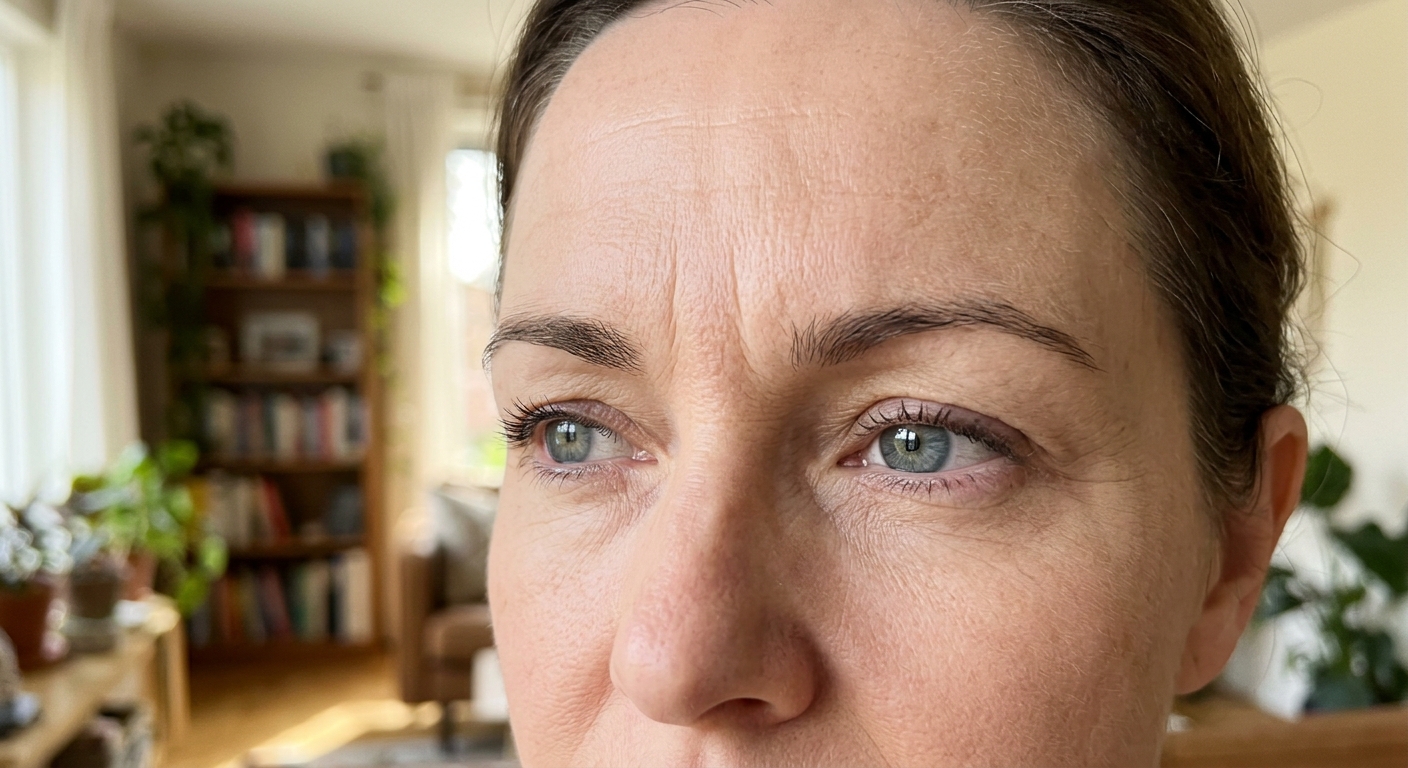
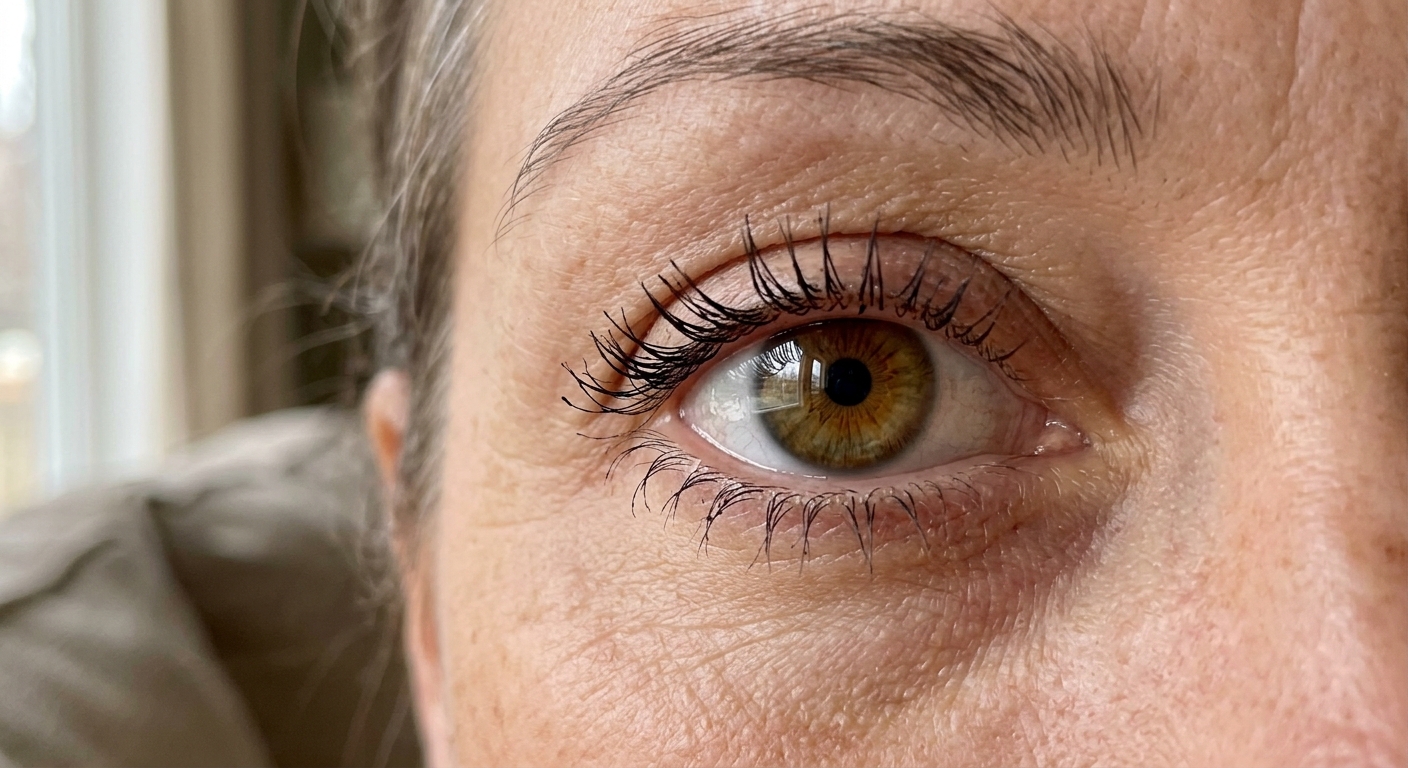
Somewhere between forty and fifty-five, most women notice that their lashes are not what they used to be. They are sparser, shorter, lighter, more brittle. Eyelash follicles age along with the rest of the body — the anagen growth phase shortens, the resting phase lengthens, and individual hairs come in finer and less pigmented [8].
The lash serum category exploded into a multi-billion-dollar industry on that biological reality. The problem is that the bottles on the shelf are wildly different from each other in what they actually do. Some are FDA-approved drugs. Some are well-studied cosmetic peptides. Some are oils with no clinical evidence whatsoever. They are all sold with similar marketing imagery.
This article will sort them into three buckets, walk through what the published science supports for each, and explain why “more growth” almost always comes with tradeoffs.
How an eyelash actually grows
Every hair on your body cycles through three phases: anagen (active growth), catagen (regression), and telogen (rest). The anagen phase determines the maximum length a hair can reach. Scalp hairs have a long anagen — years — which is why scalp hair can grow waist-length. Eyelashes have an extremely short anagen phase, roughly one to two months [8]. That is why your lashes never grow past the length they reach, and why losing one means waiting weeks to months for replacement.
Any product that genuinely grows lashes has to act on the follicle cycle itself. It needs to either extend the anagen phase, push resting follicles into anagen, or both. Surface conditioning with oils or moisturizers can make existing lashes look fuller and reduce breakage, but it does not change the follicle’s biology. Makeup works on the same surface level, and the choice matters more than it sounds: our guide to the best mascara for older women covers which formulas add visible density without adding mechanical load.
This distinction — surface conditioning versus follicle-cycle modulation — is the single most important framework for understanding the category.
Bucket one: bimatoprost (the FDA-approved one)
In 2008, the FDA approved bimatoprost 0.03% — sold under the brand name Latisse — for the treatment of eyelash hypotrichosis. It is the only prescription drug ever cleared by the agency for inadequate eyelashes, and it remains the gold standard against which every other lash product is implicitly measured.
In 2008, the FDA approved bimatoprost 0.03% — sold under the brand name Latisse — for the treatment of eyelash hypotrichosis.
Bimatoprost is a prostaglandin analog, originally developed as a glaucoma drug because it lowers intraocular pressure. During clinical trials for that indication, ophthalmologists kept noticing the same side effect: patients’ lashes were getting noticeably longer, thicker, and darker on the treated eye [3, 5]. That side effect became the basis for a separate cosmetic indication.
The mechanism is well characterized. Prostaglandin and prostamide analogs bind to prostanoid receptors on the dermal papilla of the hair follicle, stimulating telogen-phase resting follicles into the anagen growth phase and prolonging the duration of anagen once it begins [3]. The result is more lashes growing simultaneously, growing for longer, and reaching greater length and pigment density.
A 12-month randomized, double-masked, vehicle-controlled trial demonstrated the magnitude of the effect. Roughly 40% of patients with idiopathic eyelash hypotrichosis met the primary efficacy endpoint, compared with under 7% on vehicle. Among patients with chemotherapy-induced lash loss, 37.5% responded versus 18.2% on vehicle [1]. Improvements regressed within four to six months of stopping treatment, confirming that the effect depends on continued application — the follicle reverts to its baseline cycle once the drug is withdrawn.
The catch is the safety profile. A pooled safety analysis of six randomized trials documented the most common adverse events: conjunctival hyperemia (red eye), eyelid pruritus, skin hyperpigmentation along the lash line, eye irritation, and dry eye symptoms [2]. Most are mild and reversible on discontinuation. The more concerning issue is prostaglandin-associated periorbitopathy, first described in glaucoma patients using bimatoprost unilaterally [4]. Affected eyes show periorbital fat atrophy, a deepening upper eyelid sulcus, relative enophthalmos (a sunken-eye look), and loss of lower-lid fullness. Changes are partially but not fully reversible after discontinuation. For glaucoma patients losing vision the trade-off is obviously worth it. For cosmetic users, it is a real counseling point.
A head-to-head trial against latanoprost (another prostaglandin glaucoma drug) showed bimatoprost produced significantly more eyelash growth, which is part of why bimatoprost — not latanoprost — became the FDA-approved cosmetic agent [5]. A 2023 systematic review and meta-analysis of six randomized trials of topical prostaglandin analogs for hair loss confirmed the class effect: significant improvements in hair length and density versus placebo, with no significant increase in adverse-event rates in the cosmetic trials [6].
Bucket two: peptide-based “lash conditioners”
Almost every cosmetic lash serum on the shelf that does not require a prescription is in this bucket. The marketing language has converged on the same handful of ingredients: biotinoyl tripeptide-1, myristoyl pentapeptide-17, panthenol, hyaluronic acid, and various amino acids and conditioning agents. The labels promise “longer, fuller lashes” without using the word “drug.”
The honest summary of the peptide evidence is that the effects exist but are smaller than what bimatoprost delivers. A 2024 open-label clinical trial of a peptide- and glycosaminoglycan-based eyelash serum in 30 women, evaluated by digital image analysis at 12 weeks, found lash length increased about 8%, lash number about 5%, lash width about 10%, and lash volume about 14%, with 84% patient-reported satisfaction by week 12 and no adverse effects [7]. Those are real numbers. They are also considerably smaller than the bimatoprost effect, and the trial was open-label without a placebo control, which inflates apparent results.
Nanoretinol’s biomimetic lipid nanoparticle delivery is specifically designed to bypass that barrier-disruption mechanism, which is why the formulation is rated safe for the eye contour area at 0.2% encapsulated retinol.
The advantage of the peptide category is the safety profile. None of the documented prostaglandin side effects — pigment changes, fat atrophy, eye redness — show up with the peptide-based serums in the published literature. For people who want a modest improvement and prefer to avoid drug-level risks, the peptides occupy a defensible middle ground. They will not match Latisse, but they will not cause sunken eyes either.
The key shopping tip is to read the actual ingredient list rather than the front of the bottle. If the active is a peptide complex plus humectants and conditioning agents, you are in this bucket and should expect modest, gradual results over three months. If the back of the bottle quietly lists isopropyl cloprostenate, dechloro dihydroxy difluoro ethylcloprostenolamide, or a similar tongue-twister ending in “-prost,” you are actually in a prostaglandin product marketed as cosmetic — be aware of the periorbitopathy risk and discuss with an ophthalmologist if you wear contact lenses or have glaucoma history.
Bucket three: castor oil and the myth-versus-mechanism problem
Castor oil is the most popular natural lash serum, recommended endlessly on social media. The honest scientific summary is that there is a plausible mechanism, no human trial evidence, and a lot of confirmation bias driving the testimonials.
The plausible mechanism comes from a landmark 2012 paper showing that prostaglandin D2 (PGD2) — a different prostaglandin from the ones in Latisse — inhibits hair growth, and that PGD2 synthase is elevated in the bald scalps of men with androgenetic alopecia [9]. PGD2 acts through the GPR44 receptor to suppress follicle activity. A 2015 in silico molecular docking study then predicted that ricinoleic acid, the principal fatty acid in castor oil, could bind well to PGD2 synthase and inhibit it [10]. That is computational modeling — a hypothesis, not a result.
No randomized human trial has shown that topical castor oil increases lash length, density, or thickness. The lashes do often look better with castor oil application, but that is consistent with surface conditioning: a lubricated lash reflects light differently, breaks less from rubbing, and combs neatly. That is a real benefit. It is not the same as follicle stimulation. If your goal is fewer broken lashes and a glossier look, castor oil is fine. If your goal is meaningfully more lashes, it is not the right tool.
When lash loss is medical, not cosmetic
A clinical review of madarosis — the formal medical term for eyebrow and eyelash loss — outlines causes that no lash serum will address: alopecia areata, frontal fibrosing alopecia, thyroid disease, telogen effluvium, trichotillomania, and certain medications [8]. If you have lost lashes suddenly, in patches, alongside eyebrow loss, or with other systemic symptoms, you need a dermatologist before you need a serum. Age-related involutional lash thinning develops gradually and symmetrically over years; everything else warrants a workup.
Where Nanoretinol fits
Nanoretinol is not a lash growth product, and we would not recommend applying it directly to lash follicles. But it does address the broader picture that drives a lot of women toward lash serums in the first place — the visible aging of the eye area. Thinning lashes are often noticed alongside crepiness on the lids, fine lines at the outer corners, and loss of firmness across the upper cheek.
For that periorbital skin, retinol applied around the eyes remains one of the most studied anti-aging interventions. The challenge has always been tolerability — conventional retinol on thin eyelid skin tends to cause irritation and barrier disruption. Nanoretinol’s biomimetic lipid nanoparticle delivery is specifically designed to bypass that barrier-disruption mechanism, which is why the formulation is rated safe for the eye contour area at 0.2% encapsulated retinol. The 232% improvement in collagen recovery versus conventional retinol reported in the underlying clinical study comes from delivery efficiency, not concentration [North Biomedical LLC, 2024]. Paired with a peptide-based lash conditioner (or, if you want the strongest possible lash growth and are willing to accept the trade-offs, a physician-prescribed bimatoprost), it addresses the eye area from both ends.
Choosing what is right for you
If your priority is maximum lash growth and you are willing to manage real medication risks, bimatoprost is the only option with proven clinical magnitude. Discuss it with a dermatologist or ophthalmologist before starting, especially if you have light-colored eyes (the pigment risk) or any concern about the periorbital fat changes.
If you want measurable but modest improvement with a much friendlier safety profile, the peptide-based serums backed by published trials are the right tier. Expect a few percent in length and density over three months, not the dramatic before-and-after photos in the ads.
If your real goal is healthier, glossier lashes that break less, castor oil and similar conditioning oils will do exactly that — without changing the follicle biology. Set your expectations accordingly.
And if your lash loss is sudden, patchy, or paired with other hair loss, skip the serum aisle entirely and see a dermatologist first.
References
- Glaser DA, Hossain P, Perkins W, Griffiths T, Ahluwalia G, Weng E, Beddingfield FC. “Long-term safety and efficacy of bimatoprost solution 0.03% application to the eyelid margin for the treatment of idiopathic and chemotherapy-induced eyelash hypotrichosis: a randomized controlled trial.” British Journal of Dermatology. 2015;172(5):1384-1394. doi:10.1111/bjd.13443
- Wirta D, Pariser DM, Yoelin SG, Arase S, McMichael A, Weng E, Mao C, Demos G, Vandenburgh A. “Bimatoprost 0.03% for the Treatment of Eyelash Hypotrichosis: A Pooled Safety Analysis of Six Randomized, Double-masked Clinical Trials.” Journal of Clinical and Aesthetic Dermatology. 2015;8(7):17-29. PubMed: 26203317
- Law SK. “Bimatoprost in the treatment of eyelash hypotrichosis.” Clinical Ophthalmology. 2010;4:349-358. doi:10.2147/opth.s6480
- Filippopoulos T, Paula JS, Torun N, Hatton MP, Pasquale LR, Grosskreutz CL. “Periorbital changes associated with topical bimatoprost.” Ophthalmic Plastic and Reconstructive Surgery. 2008;24(4):302-307. doi:10.1097/IOP.0b013e31817d81df
- Noecker RS, Dirks MS, Choplin NT, Bernstein P, Batoosingh AL, Whitcup SM. “A six-month randomized clinical trial comparing the intraocular pressure-lowering efficacy of bimatoprost and latanoprost in patients with ocular hypertension or glaucoma.” American Journal of Ophthalmology. 2003;135(1):55-63. doi:10.1016/s0002-9394(02)01827-5
- Jiang S, Hao Z, Qi W, Wang Z, Zhou M, Guo N. “The efficacy of topical prostaglandin analogs for hair loss: A systematic review and meta-analysis.” Frontiers in Medicine. 2023;10:1130623. doi:10.3389/fmed.2023.1130623
- Fernandez-Gonzalez P, Truchuelo-Díez MT, Gómez-Sánchez MJ. “Open clinical trial evaluating the efficacy of a novel eyelash growth enhancer with peptides and glycosaminoglycans.” Journal of Cosmetic Dermatology. 2024;23(6):2170-2180. doi:10.1111/jocd.16265
- Nguyen B, Hu JK, Tosti A. “Eyebrow and Eyelash Alopecia: A Clinical Review.” American Journal of Clinical Dermatology. 2023;24(1):55-67. doi:10.1007/s40257-022-00729-5
- Garza LA, Liu Y, Yang Z, Alagesan B, Lawson JA, Norberg SM, Loy DE, Zhao T, Blatt HB, Stanton DC, Carrasco L, Ahluwalia G, Fischer SM, FitzGerald GA, Cotsarelis G. “Prostaglandin D2 inhibits hair growth and is elevated in bald scalp of men with androgenetic alopecia.” Science Translational Medicine. 2012;4(126):126ra34. doi:10.1126/scitranslmed.3003122
- Fong P, Tong HHY, Ng KH, Lao CK, Chong CI, Chao CM. “In silico prediction of prostaglandin D2 synthase inhibitors from herbal constituents for the treatment of hair loss.” Journal of Ethnopharmacology. 2015;175:470-480. doi:10.1016/j.jep.2015.10.005