Can You Use Retinol Around Your Eyes? The Complete Guide to Eye Area Retinol
The periorbital area ages fastest — here's how to treat it safely with retinol
Why the Eye Area Ages First
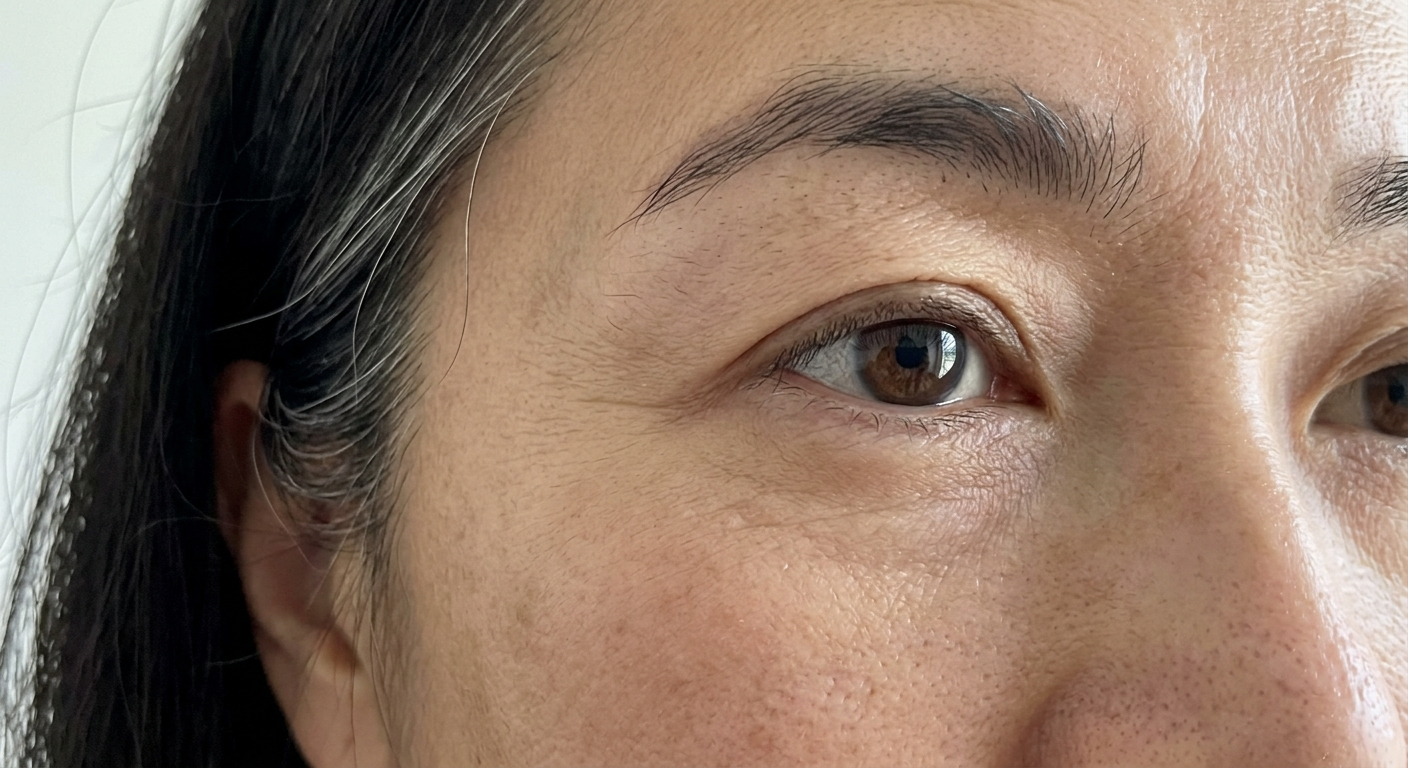
If you’ve ever looked in the mirror and noticed that the skin around your eyes seems to be aging faster than the rest of your face, you’re not imagining things. The periorbital region — the skin surrounding your eyes — is structurally different from facial skin everywhere else.
It’s roughly 0.5 mm thick, compared to about 2 mm on the rest of the face [1]. It has fewer sebaceous glands, which means less natural oil production and a weaker moisture barrier. It’s more vascular (hence dark circles), sits on top of a muscle that contracts thousands of times a day (every blink, squint, and smile), and is constantly exposed to UV radiation in an area most people forget to apply sunscreen. Our guide to sunscreen around the eyes explains why that gap happens and which formulas stay put.
The result? Crow’s feet, crepey texture, fine lines, and loss of elasticity tend to appear here first — often years before the rest of the face shows visible aging.
So the question becomes inevitable: if retinol is the gold standard for anti-aging, can you use it in the area that needs it most?
The Short Answer: Yes, With Caveats
Retinol is safe for the eye area. Multiple clinical studies have demonstrated that retinol improves fine lines, texture, and pigmentation around the eyes when formulated and applied correctly [2]. Dedicated eye-area retinol products have been studied and shown to reduce crow’s feet severity after 12–24 weeks of consistent use.
The caveat isn’t about safety — it’s about tolerance. Because periorbital skin is thinner and more permeable, it absorbs topicals more readily than thicker facial skin. That’s a double-edged sword: retinol penetrates more effectively, but so does the potential for irritation. If your eye area is reactive to begin with, start with our guide to the best eye cream for sensitive skin before adding anything active.
This is why many dermatologists recommend starting with a lower concentration for the eye area, even if your face tolerates a higher percentage just fine.
Concentration Matters More Here
On the rest of your face, you might work up to 0.5% or even 1% retinol over time. Around the eyes, clinical evidence suggests 0.25% or lower is the sweet spot for most people — enough to stimulate collagen production and accelerate cell turnover, but gentle enough for this delicate terrain [3].
Here’s why this matters at a cellular level: retinol’s mechanism of action doesn’t change based on location. It still converts to retinoic acid via retinol dehydrogenases and retinaldehyde dehydrogenases in the skin, binds to nuclear retinoic acid receptors (RARs), and upregulates collagen synthesis while normalizing cell differentiation [4]. But thinner skin means a shorter path to those target cells, so less retinol delivers proportionally more retinoic acid to the dermis.
On the rest of your face, you might work up to 0.5% or even 1% retinol over time.
In practical terms: you don’t need a high concentration to get results around the eyes. You need consistent, gentle delivery.
How to Apply Retinol Around Your Eyes
Technique matters more here than anywhere else on your face:
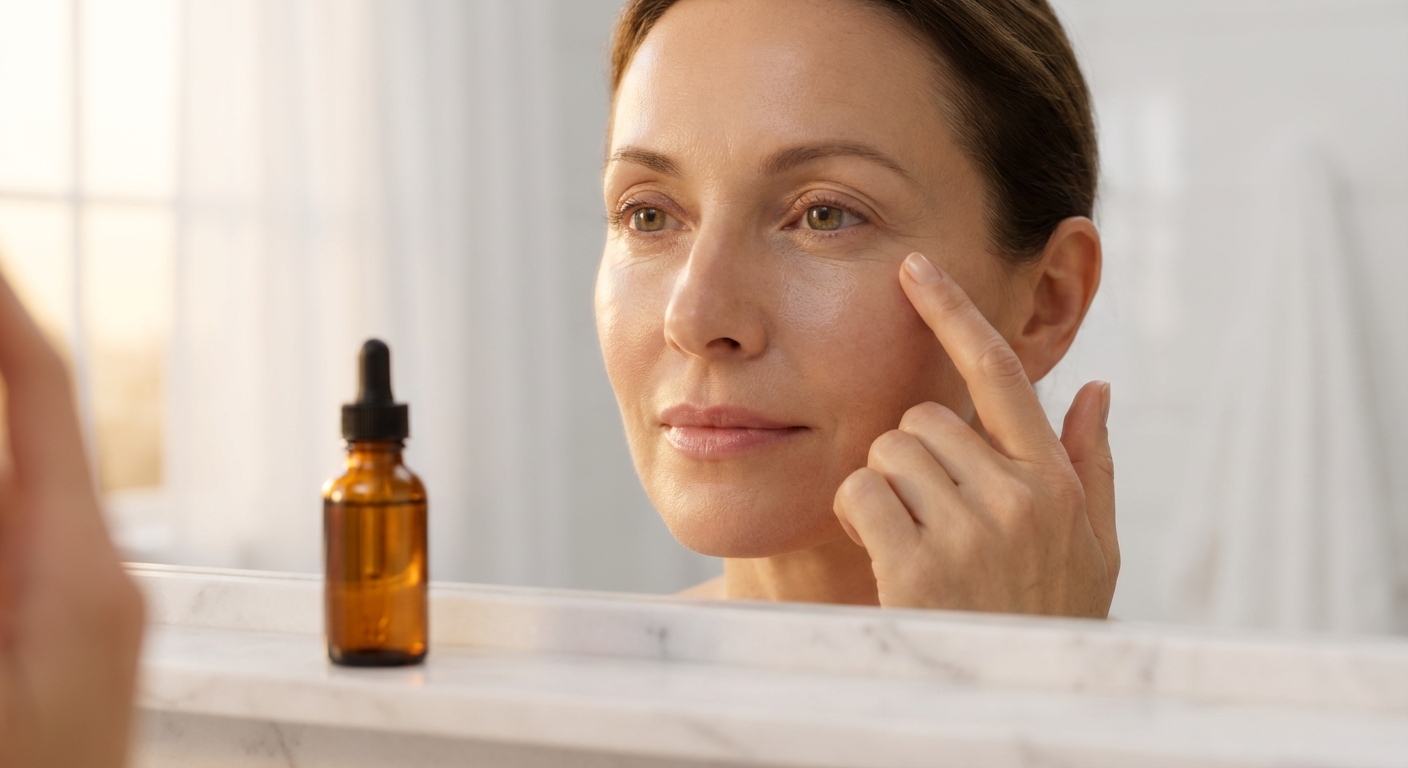
Use a rice-grain amount. For both eyes combined, that’s all you need. Over-application is the number one cause of irritation in the eye area. Apply to the orbital bone, not the eyelid. Place product along the bone that circles your eye socket — under the eye along the cheekbone and at the outer corner where crow’s feet form. The product will naturally migrate toward the eyelid through normal movement. Applying directly to the lid increases the risk of getting product into the eye itself.
Pat, don’t rub. Use your ring finger (it applies the least pressure) and gently pat the product along the orbital bone. Dragging or rubbing stretches this delicate skin. The same placement rules govern any eye product, and the migration studies behind them are covered in how to apply eye cream.
Buffer if needed. If you’re new to retinol in this area, apply your eye cream first, wait a few minutes, then apply retinol on top. This “buffering” technique slows absorption and reduces irritation while you build tolerance.
Start slow. Two nights per week for the first month, then alternate nights, then nightly if tolerated. This graduated approach minimizes the retinol adjustment period in this sensitive zone.
Retinol Eye Cream vs Your Regular Retinol
The beauty industry sells a lot of dedicated “retinol eye creams.” Are they worth it?
In most cases, a dedicated eye product simply means a lower retinol concentration in a more emollient base — often with added peptides, caffeine, or hyaluronic acid. If your facial retinol is already at a low concentration (0.25% or below) and you apply it carefully, you can often use the same product around your eyes.
Retinol remodels collagen and thickens the dermis, but it can’t fully reverse decades of repetitive muscle contraction.
However, there’s a genuine argument for separate products when your facial retinol is at a higher concentration (0.5%+). Diluting it by mixing with moisturizer is imprecise, and the stakes around the eyes are higher — irritation here can cause puffiness, contact dermatitis on the eyelids, and discomfort that lasts days.
The most important factor isn’t the marketing — it’s the delivery system. How retinol reaches your skin cells matters far more than the concentration printed on the label.
What to Realistically Expect
Setting honest expectations prevents the frustration that leads people to quit:
Weeks 2–4: You may notice mild dryness or flaking around the eyes. This is the adjustment period. It’s normal and temporary.
Weeks 4–8: Skin texture begins to improve. The surface feels smoother and fine lines may appear slightly softened — not from structural changes yet, but from improved hydration and normalized cell turnover.
Weeks 12–24: This is where real structural improvement happens. Collagen remodeling is a slow biological process. Clinical studies show measurable reduction in fine line depth and improved elasticity in the periorbital area after 12+ weeks of consistent retinol use [2]. 6+ months: Continued improvement in skin firmness, texture, and crow’s feet depth. Retinol is a long game — the longer you use it, the more pronounced the benefits.
Deep expression lines (true crow’s feet that are visible even at rest) will improve but likely won’t disappear completely. Retinol remodels collagen and thickens the dermis, but it can’t fully reverse decades of repetitive muscle contraction. For those deep dynamic lines, retinol works best as part of a broader approach.
Why Delivery Technology Changes Everything
Here’s the fundamental problem with conventional retinol around the eyes: traditional formulations rely on chemical penetration enhancers — solvents and petroleum derivatives that disrupt the skin barrier through a process called lipid mobility. On thicker facial skin, this is manageable. On periorbital skin that’s already barrier-compromised, it’s the primary driver of the redness, stinging, and peeling that makes people abandon retinol in this area.
This is where Nanoretinol® takes a fundamentally different approach. Instead of forcing retinol through the barrier with irritating solvents, it encapsulates retinol in biomimetic lipid nanoparticles — structures the body recognizes as “self” — that pass through the epithelial barrier without disrupting it. The result is significantly reduced cytotoxicity (gentler on skin cells) while delivering 232% more effective collagen recovery compared to conventional retinol.
For the eye area specifically, this matters enormously. Nanoretinol® is explicitly formulated to be safe for the eye contour, with a water-based gel texture that absorbs completely — no heavy residue migrating into the eyes. At 0.2% retinol concentration, it’s already in the ideal range for periorbital skin, and the nanoparticle delivery ensures that 0.2% works harder than conventional formulations at higher concentrations.
Making Retinol Work for Your Eyes
The eye area deserves the same evidence-based anti-aging attention as the rest of your face — it just needs a gentler, smarter approach. Start low, apply carefully, be patient, and choose a delivery system designed for delicate skin. Your future self will notice the difference.
References
-
Hwang K, Kim H, Kim DJ. “Thickness of skin and subcutaneous tissue of the free flap donor sites.” Microsurgery. 2016;36(5):354-358. doi:10.1002/micr.30024
-
Randhawa M, Wang S, Leyden JJ, Cula GO, Patel A, Feldman SR. “Daily Use of a Facial Broad Spectrum Sunscreen Over One-Year Significantly Improves Clinical Evaluation of Photoaging.” Dermatologic Surgery. 2015;41(12):1373-1381. doi:10.1097/DSS.0000000000000879
-
Mukherjee S, Date A, Patravale V, Korting HC, Roeder A, Weindl G. “Retinoids in the treatment of skin aging: an overview of clinical efficacy and safety.” Clinical Interventions in Aging. 2006;1(4):327-348. doi:10.2147/ciia.2006.1.4.327
-
Zasada M, Budzisz E. “Retinoids: active molecules influencing skin structure formation in cosmetic and dermatological treatments.” Postepy Dermatologii i Alergologii. 2019;36(4):392-397. doi:10.5114/ada.2019.87443
-
Kang S, Duell EA, Fisher GJ, et al. “Application of retinol to human skin in vivo induces epidermal hyperplasia and cellular retinoid binding proteins characteristic of retinoic acid but without measurable retinoic acid levels or irritation.” Journal of Investigative Dermatology. 1995;105(4):549-556. doi:10.1111/1523-1747.ep12323445