
Loose Skin on Thighs: Why It Happens and How to Firm It Up
From collagen loss to weight changes — the real causes of saggy thigh skin and what actually tightens it.
Few signs of aging feel as quietly frustrating as loose skin on the thighs. You notice it pinching at the inner thigh, or catching the way the skin no longer snaps back when you cross your legs. It can appear after a big weight loss, after menopause, or simply after a birthday that ends in a zero. Whatever the trigger, the question is always the same: is this fixable, and if so, how?
The honest answer has layers. Some causes of saggy thigh skin respond well to consistent skincare; others need more. Knowing which is which saves you money, time, and disappointment.
What “Loose Skin on Thighs” Actually Is
It helps to separate three things that often get blamed together: fat, cellulite, and skin laxity.
Fat sits beneath the skin and changes with diet and activity. Cellulite is the dimpled texture created when fat presses against fibrous bands under the skin. Skin laxity is different — it is the skin itself losing its ability to stay taut and recoil. When you gently pinch the skin on your inner thigh and it stays tented for a beat before settling back, that is laxity.
Thigh skin is especially prone to it. The inner thigh in particular has thinner skin, fewer oil glands, and less sun-driven thickening than areas like the outer forearm, so structural decline tends to show there early.
The Real Causes of Saggy Thigh Skin
Collagen quietly leaves
Collagen is the protein scaffold that gives skin its firmness — it makes up roughly 70 to 80 percent of skin’s dry weight. The problem is that production slows with age. Researchers at the University of Michigan showed that dermal fibroblasts, the cells that manufacture collagen, produce significantly less type I procollagen in people over 80 than in people in their twenties [1]. Worse, aged fibroblasts lose mechanical contact with the surrounding collagen network, which dials new collagen synthesis down even further [1].
When you gently pinch the skin on your inner thigh and it stays tented for a beat before settling back, that is laxity.
Elastin stops bouncing back
If collagen is the scaffold, elastin is the elastic band — it is what lets stretched skin return to shape. A 2025 study tracking women from age 25 to 66 found that elastic fibers thicken, curl, and fragment with age, and that this degeneration accelerates noticeably after 40, correlating directly with measurable loss of elasticity [2]. Once elastic fibers fragment, the skin simply has less spring.
Weight changes stretch the system
Significant weight loss is one of the most common triggers for loose thigh skin. When skin is held stretched for a long period and the underlying volume then disappears, the collagen and elastin network can be left damaged. A 2024 study comparing skin samples after massive weight loss found measurable differences in the dermal elastic-fiber network depending on how the weight came off [3]. Skin that has been stretched for years does not always keep the structural reserves to fully retract.
Everyday accelerators
Sun exposure on the legs, smoking, yo-yo dieting, chronic dehydration, and the estrogen decline of menopause all speed the loss of firmness. None of these act overnight, which is exactly why loose thigh skin seems to “suddenly” appear in your forties and fifties.
What Actually Firms Loose Thigh Skin
Start with realistic expectations. Severe, hanging skin — the kind sometimes seen after very large weight loss — is a structural problem that, honestly, only surgery fully resolves. But the far more common situation is mild to moderate crepey laxity, and that genuinely responds to the right approach.
Build the muscle underneath. Resistance training for the legs adds firmness beneath the skin and improves how taut it looks. It will not rebuild elastin, but it changes the canvas the skin sits on.
A separate comparative study confirmed that retinol upregulates the COL1A1 and COL3A1 collagen genes, with matching increases in procollagen protein.
Protect what you still have. Daily sun protection on exposed legs, staying hydrated, not smoking, and avoiding rapid weight swings all preserve the collagen and elastin still in place. For a fuller routine, our guides on how to tighten loose skin and crepey skin on legs go deeper.
Stimulate new collagen. This is where topical treatment earns its place. The most evidence-backed ingredient for prompting skin to make fresh collagen is retinol.
Why Retinol Is the Skincare Workhorse Here
Retinol, a form of vitamin A, signals skin cells to behave younger — speeding cell turnover and, crucially, switching collagen genes back on. In a landmark study, topical retinol applied to the naturally aged skin of elderly participants significantly increased procollagen I, the raw material of new collagen [4]. A separate comparative study confirmed that retinol upregulates the COL1A1 and COL3A1 collagen genes, with matching increases in procollagen protein [5].
That is exactly the mechanism saggy thigh skin needs: not a temporary surface tightener, but a genuine signal to rebuild from within.
There is a catch. Conventional retinol is notoriously harsh, and body skin — especially the thin inner thigh — flakes and reddens easily. Many people quit before they ever see a benefit. The limiting factor has never really been retinol itself. It has been the delivery.
A Smarter Way to Deliver It
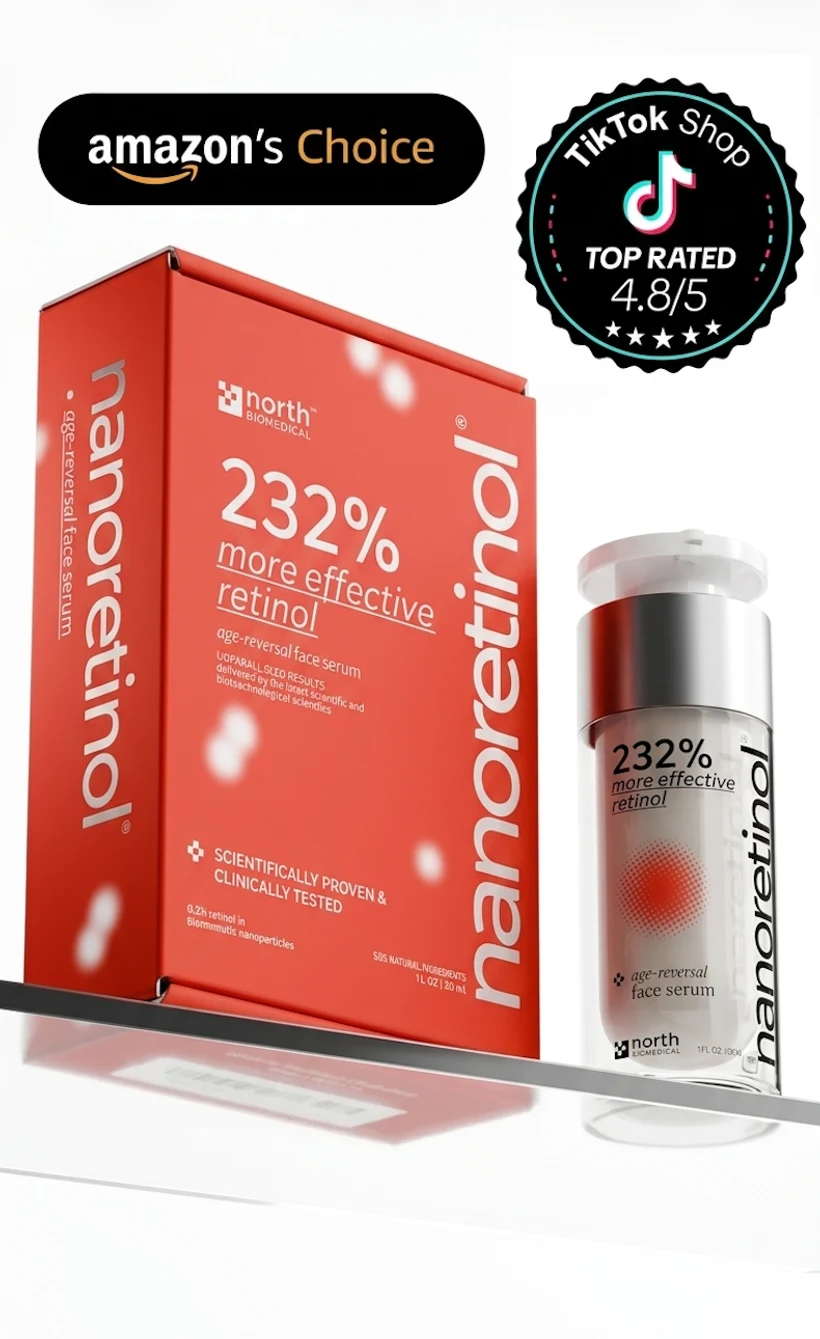
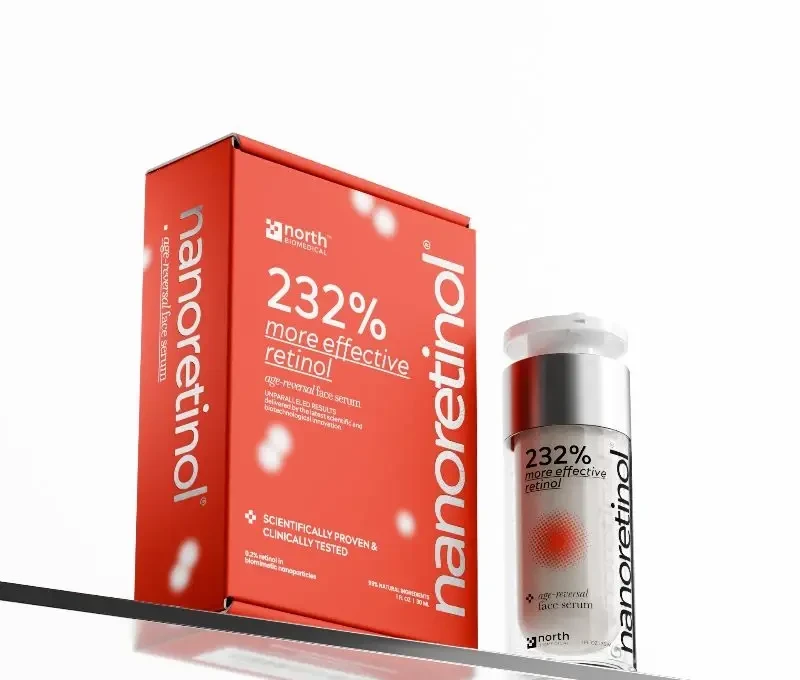
This is the gap Nanoretinol was built to close. Instead of relying on harsh chemical penetration, Nanoretinol encapsulates retinol inside biomimetic lipid nanoparticles — particles the skin recognizes as “self” and allows through its barrier without damage. The result is a retinol that works deeper while staying gentle enough for body skin.
In North Biomedical’s clinical study summary, Nanoretinol vs. Conventional Retinol: Efficacy in Collagen and Elastin Recovery (2024), the encapsulated form proved 232% more effective at collagen recovery and 73% more effective at elastin recovery than conventional retinol, with users seeing a 61% increase in skin firmness over 56 days. For loose thigh skin, where both collagen and elastin are the problem, that pairing is precisely the point. Its lightweight, water-based gel also spreads well over larger body areas without the greasy residue of heavy creams.
Firmer Thighs Take Time
Loose skin on thighs is rarely one problem. It is collagen decline, elastin fragmentation, and often a history of weight change, all surfacing at once. You cannot reverse every part of it — but mild to moderate laxity is far from a lost cause. Protect the structure you still have, build the muscle underneath, and give your skin a real, well-delivered signal to make new collagen. Consistency over months, not days, is what changes thigh skin.
References
- Varani J, Dame MK, Rittié L, Fligiel SEG, Kang S, Fisher GJ, Voorhees JJ. “Decreased collagen production in chronologically aged skin: roles of age-dependent alteration in fibroblast function and defective mechanical stimulation.” American Journal of Pathology. 2006;168(6):1861-1868. doi:10.2353/ajpath.2006.051302
- Kondo S, Ozawa N, Sakurai T. “The effect of degeneration of elastic fibres on loss of elasticity and wrinkle formation.” International Journal of Cosmetic Science. 2025;47(1):205-212. doi:10.1111/ics.13021
- Hany M, Zidan A, Ghozlan NA, et al. “Comparison of Histological Skin Changes After Massive Weight Loss in Post-bariatric and Non-bariatric Patients.” Obesity Surgery. 2024;34(3):855-865. doi:10.1007/s11695-024-07066-y
- Kafi R, Kwak HSR, Schumacher WE, et al. “Improvement of naturally aged skin with vitamin A (retinol).” Archives of Dermatology. 2007;143(5):606-612. doi:10.1001/archderm.143.5.606
- Kong R, Cui Y, Fisher GJ, Wang X, Chen Y, Schneider LM, Majmudar G. “A comparative study of the effects of retinol and retinoic acid on histological, molecular, and clinical properties of human skin.” Journal of Cosmetic Dermatology. 2016;15(1):49-57. doi:10.1111/jocd.12193