Menopause Skin Dryness: Why It Happens and How to Restore Hydration
Estrogen loss reshapes the skin barrier in measurable ways. Here's the science behind menopausal dryness — and what actually rebuilds moisture.
Somewhere around your mid-forties, your moisturizer stops working. The cream that felt rich and reassuring last winter now disappears in seconds. Your cheeks feel tight by mid-morning. The skin under your eyes looks crinkled when you smile, then stays crinkled. Nothing seems to soak in.
This isn’t your imagination, and it isn’t your skincare routine failing. It’s the most under-discussed signature of menopause: a measurable, biochemical collapse of the skin’s ability to hold water. That is a retention problem rather than an intake problem, which is why drinking more water rarely resolves it on its own.
The Hormone-Skin Connection No One Warned You About
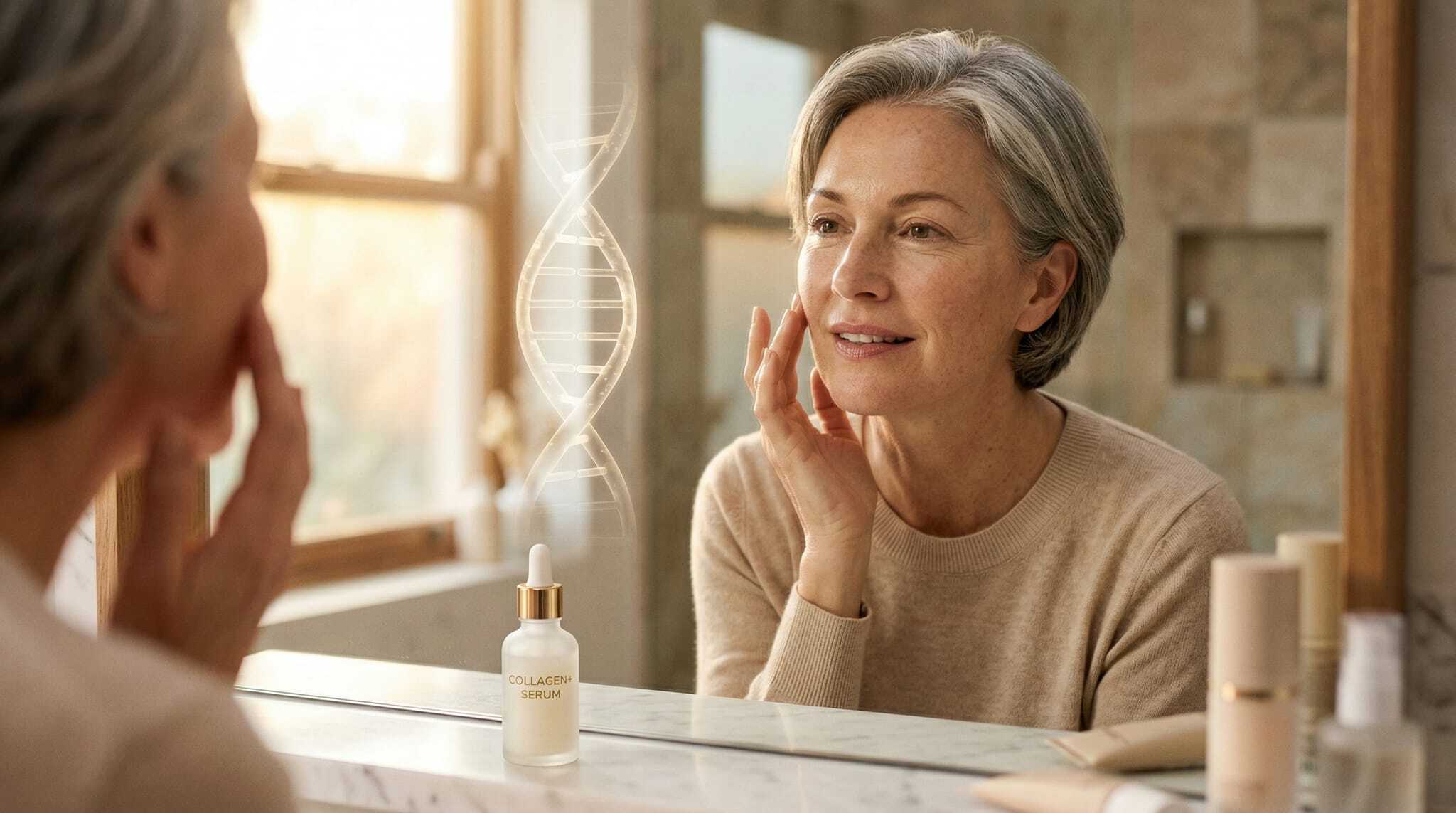
Estrogen is a structural hormone for skin. Receptors for it sit on keratinocytes (the cells that build your skin’s outer wall), on fibroblasts (the cells that produce collagen and elastin), and on sebocytes (the cells that produce oil) [1]. When estrogen levels stay stable, these receptors keep telling each cell type to do its job — produce barrier lipids, lay down collagen, synthesize hyaluronic acid, generate sebum.
In perimenopause, estrogen output begins to swing unpredictably. By the time menstruation stops entirely, circulating estradiol can be a tenth of what it was at age 35. The signal drops. The cells stop receiving the instructions they’ve been following for decades.
The dermis loses roughly 30% of its collagen in the first five years after menopause, then continues to thin at about 2.1% per year for the next 15 years — a finding first documented in the Brincat studies of the 1980s and confirmed across decades since [2]. But collagen loss is only part of the picture. The reason your skin feels parched is happening in a much thinner layer, closer to the surface.
Why Menopausal Skin Loses Water
The stratum corneum — the outermost 15-20 micrometers of your skin — is built like a brick wall. The “bricks” are flattened, protein-rich cells. The “mortar” between them is a precisely formulated mix of three lipid families: ceramides, cholesterol, and free fatty acids. That mortar is what prevents water from evaporating out of your body through your face.
A 2022 study published in Scientific Reports used mass spectrometry to compare the stratum corneum lipid profile of postmenopausal women not on hormone therapy against those receiving HRT [3]. The result was striking: postmenopausal skin contained lower levels of ceramides overall, and the ceramides that remained were shorter in chain length. Shorter ceramides pack less tightly. They make weaker mortar. Water escapes faster.
This is why menopausal dryness feels different from “just dry skin.” It isn’t a surface issue you can paper over with a heavier cream. The barrier itself has been chemically restructured.
The Cascade Beyond Dryness
Once the barrier weakens, four other problems follow:
The skin under your eyes looks crinkled when you smile, then stays crinkled.
Transepidermal water loss increases. Your skin actively leaks moisture into the air. The dryer the indoor air, the faster this happens. That makes indoor humidity one of the few environmental levers genuinely worth adjusting — see running a humidifier for dry skin.
Dermal hyaluronic acid drops. Estrogen normally upregulates hyaluronic acid synthesis in the dermis. Without that signal, the gel-like substance that gives skin its plumpness diminishes — taking visible volume with it [4].
Sebum production falls. Oil production declines roughly 60% in postmenopausal women, removing the thin lipid film that normally coats the skin’s surface.
Wound healing slows. Cuts and small irritations that healed in days now take weeks. The skin’s regenerative engine is running on reduced fuel.
The combined effect: skin that feels tight, looks dull, develops fine “crepey” lines especially around the eyes and on the neck, and stops bouncing back the way it used to.
What Actually Rebuilds Hydration
Generic “menopause moisturizers” rarely do the work they claim. The barrier problem is specific — and a serious response has to address each layer of it. Our guide to the best moisturizer for dry menopausal skin turns that into a concrete buying filter.
1. Replace the missing lipids
If your stratum corneum has lost ceramides, the most direct intervention is putting ceramides back. Topical ceramides have repeatable evidence for reducing transepidermal water loss and restoring barrier function. Look for formulations with ceramides in their physiological ratio (roughly 3:1:1 ceramide-to-cholesterol-to-fatty-acid). Cholesterol matters as much as the ceramide itself — without it, you’re laying down brick without enough mortar.
2. Hold water in the layers underneath
Humectants like glycerin, hyaluronic acid, and panthenol pull water into the upper layers of the skin and slow its evaporation. They work best applied to damp skin and sealed in with an occlusive (a heavier cream containing fatty acids or squalane). On menopausal skin, that “sandwich” approach beats any single product.
3. Address the collagen decline directly
This is where most menopause-skincare advice stops short. Hydration repair is necessary but not sufficient. To rebuild the structural matrix that estrogen used to maintain, you need something that signals fibroblasts to produce collagen again. Topical retinoids are the most studied, most evidence-backed category for this — they upregulate procollagen synthesis, increase epidermal thickness, and reduce fine lines in postmenopausal women across multiple controlled trials [5].
Oil production declines roughly 60% in postmenopausal women, removing the thin lipid film that normally coats the skin’s surface.
The problem: conventional retinol is unstable, frequently irritating, and during perimenopause when the barrier is already compromised, applying it often triggers redness, flaking, and stinging that send women running. The result is that the women who most need a retinoid skip it.
4. Protect what you have from further damage
Estrogen loss makes skin more vulnerable to UV-induced collagen breakdown. A broad-spectrum SPF 30+ every morning is non-negotiable for menopausal skin, regardless of whether you plan to be outdoors.
Where Nanoretinol Fits
Most “gentle” retinol formulations dilute the active until it barely does anything. Nanoretinol takes a different approach: it encapsulates retinol inside biomimetic lipid nanoparticles that the skin recognizes as “self” and allows through the barrier without disrupting it [6]. The retinol delivers where it’s needed — the dermal fibroblasts — without the surface burning, peeling, and redness that traditional retinol causes.
For menopausal skin, where the barrier is already compromised, this matters more than at any other life stage. North Biomedical’s clinical study documented a 232% improvement in collagen recovery and a 73% improvement in elastin recovery versus conventional retinol, with significantly reduced cytotoxicity. The water-based, gel-like formulation absorbs into already-dry skin without adding a heavy oily layer that menopausal skin tends to resist.
It’s the difference between forcing your skin to repair through irritation and giving it the building signals while leaving the barrier intact.
A Realistic Routine for Menopausal Skin
Morning: gentle hydrating cleanser, a humectant serum on damp skin (glycerin or hyaluronic acid), ceramide-rich moisturizer, mineral SPF 30+.
Evening: same cleanser, Nanoretinol on dry skin (start every third night, build to nightly), ceramide moisturizer over the top to seal it in.
Give it twelve weeks. The barrier rebuilds on the timeline of cellular turnover — about 40-60 days in postmenopausal skin — and the collagen response from a topical retinoid shows on histology around the 12-week mark.
What to Stop Doing
Hot showers, foaming cleansers with sulfates, alcohol-based toners, scrubs, and anything that “tingles” — all of these strip the lipids your skin can no longer easily replace. The instinct to “do more” when skin feels rough usually backfires. Less, but better-chosen, wins on menopausal skin.
Living With the Change
Menopausal skin dryness isn’t a flaw to overcome — it’s a structural shift that requires you to change your inputs. The women who do well aren’t using more product; they’re using fewer, more targeted ones. Ceramides to rebuild the mortar. A retinoid your barrier can tolerate to rebuild the foundation. Sunscreen to stop further damage. Everything else is optional.
Your skin in your fifties isn’t supposed to look like your skin in your thirties. But it can absolutely be hydrated, comfortable, and resilient — once you give it what estrogen used to provide for free.
References
-
Thornton MJ. “Estrogens and aging skin.” Dermato-Endocrinology. 2013;5(2):264-270. doi:10.4161/derm.23872
-
Brincat M, Moniz CF, Studd JW, Darby AJ, Magos A, Cooper D. “Sex hormones and skin collagen content in postmenopausal women.” British Medical Journal (Clinical Research Ed.). 1983;287(6402):1337-1338. doi:10.1136/bmj.287.6402.1337
-
Kendall AC, Pilkington SM, Wray JR, Newton VL, Griffiths CEM, Bell M, Watson REB, Nicolaou A. “Menopause induces changes to the stratum corneum ceramide profile, which are prevented by hormone replacement therapy.” Scientific Reports. 2022;12:21761. doi:10.1038/s41598-022-26095-0
-
Rzepecki AK, Murase JE, Juran R, Fabi SG, McLellan BN. “Estrogen-deficient skin: The role of topical therapy.” International Journal of Women’s Dermatology. 2019;5(2):85-90. doi:10.1016/j.ijwd.2019.01.001
-
Sitohang IBS, Makes WI, Sandora N, Suryanegara J. “Topical tretinoin for treating photoaging: A systematic review of randomized controlled trials.” International Journal of Women’s Dermatology. 2022;8(1):e003. doi:10.1097/JW9.0000000000000003
-
North Biomedical LLC. “Nanoretinol vs. Conventional Retinol: Efficacy in Collagen and Elastin Recovery.” Clinical Study Summary, 2024.