Microcurrent Facials: What Science Says About the 'Natural Face Lift'
Electrical pulses at millionths of an ampere are doing real work at the cellular level — here's what the evidence shows
The term “natural face lift” gets attached to a lot of things that do not deserve it. Facial yoga, gua sha, cold plunging — most operate more on lymphatic drainage and psychological satisfaction than on measurable structural change. Microcurrent is the exception on this list. It has a real mechanism, a growing body of peer-reviewed research, and results that are reproducible — with appropriate caveats about what it can and cannot do.
What Microcurrent Actually Is
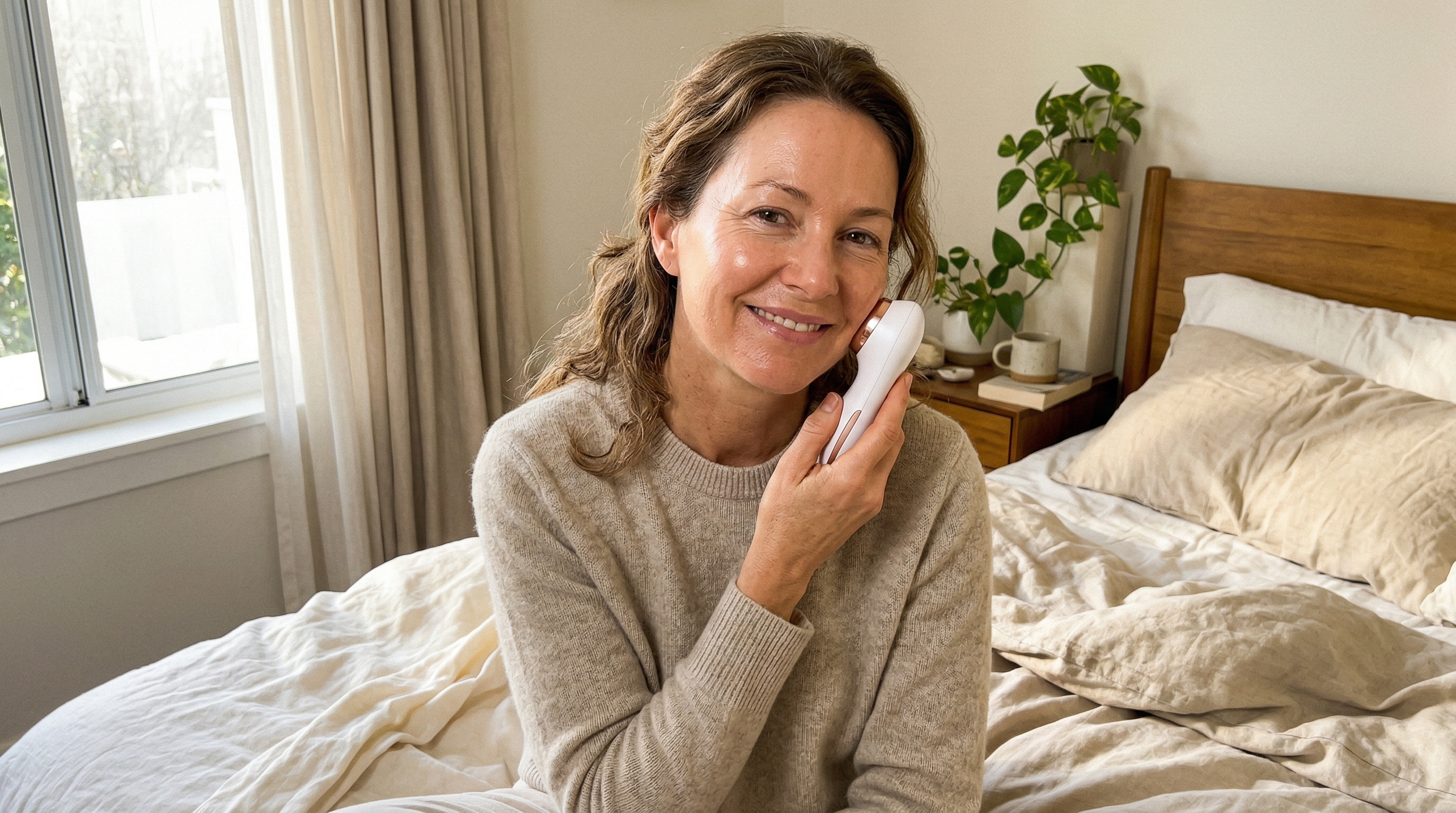
Microcurrent therapy uses electrical currents measured in microamperes — millionths of an ampere — delivered to the skin via conductive wands or pads. For context, one microampere is approximately the level at which the body’s own bioelectrical signaling operates. This is not TENS therapy or RF energy, both of which use much higher currents and different mechanisms. Microcurrent works at a biological level the body recognizes as its own signal.
When injury occurs, the body generates an endogenous electrical field at the wound site that guides cell migration and promotes repair. Microcurrent devices replicate a version of this signal, directing it at target areas of the face. The practical consequence: cells respond as if they have received a biological instruction rather than an external force.
What Happens at the Cellular Level
The fibroblast is the key target cell. Fibroblasts synthesize collagen, elastin, and the extracellular matrix proteins that give skin its structural integrity. A 2020 study in Cells demonstrated that microcurrent stimulation activates MAPK signaling pathways in fibroblasts and triggers the release of TGF-β1, a growth factor that directly stimulates collagen and extracellular matrix production [1]. This is not a cosmetic trick — it is the same intracellular signaling cascade that drives wound repair in skin.
A 2018 study examining the effect of pulsed electrical fields on human dermal fibroblasts found measurable increases in collagen and elastin gene expression and significant reductions in MMP-1, the enzyme that degrades existing collagen [2]. Less MMP-1 means less daily collagen breakdown; more TGF-β1 means more collagen production. Applied consistently, this combination shifts the balance in the direction of net collagen accumulation — which is the opposite of what happens to unmanaged aging skin.
A comprehensive review of electrical stimulation effects on skin confirmed that microcurrent accelerates fibroblast proliferation, supports neovascularization (the formation of new capillary networks), and promotes thickening of the epithelial layer [3]. These are structural changes, not simply surface-level improvements in hydration or temporary puffiness.
If you are choosing between units, our best microcurrent device guide compares them on stated microamperage and waveform rather than on price.
The Evidence on Facial Lifting and Wrinkle Reduction
The clinical evidence for facial-specific microcurrent outcomes is growing but still building. A double-blind, randomized controlled study on a home-use microcurrent device delivering high-frequency, low-level transdermal pulsations demonstrated measurable eyebrow lifting at 6 and 12 weeks versus placebo — a result scored by blinded assessors using standardized photography [5]. The study used conservative energy levels typical of at-home devices rather than professional settings.
A review of at-home beauty devices for facial rejuvenation — including microcurrent systems — found that devices achieving measurable outcomes consistently shared one characteristic: they produced effects at the dermis level, not just at the skin surface [4]. Devices that operate only at the epidermis produce hydration effects that resolve within hours; the high frequency facial wand sits at that shallow end, acting on the surface through ozone rather than on fibroblasts. Devices that reach fibroblasts produce structural changes that accumulate over weeks.
Professional-grade treatments (spa microcurrent facials, in-office protocols) deliver higher current amplitudes than consumer devices and typically produce more noticeable immediate results. Consumer devices — including NuFace and similar products — operate at lower energy levels, which means cumulative use over weeks to months produces the meaningful structural changes rather than a single session. If you are choosing between units, our best microcurrent device guide compares them on stated microamperage and waveform rather than on price.
How It Compares to Other Non-Invasive Options
Non-surgical skin tightening encompasses several categories: radiofrequency (RF), focused ultrasound (HIFU), LED therapy, and microcurrent. They operate through different mechanisms and produce different results. RF generates heat in the dermis, denaturing existing collagen fibers so they contract and stimulating new collagen production as part of the healing response. HIFU focuses ultrasonic energy at precise depths to generate controlled thermal injury. Both produce stronger effects than microcurrent in head-to-head comparisons — but both also carry more discomfort, higher cost, and recovery considerations. Microcurrent’s advantage is that it can be used daily at home with no downtime, no thermal injury, and no interference with other skincare.
Red light therapy is perhaps the most natural comparison. Like microcurrent, red light operates by delivering an energy signal the cell uses to enhance its own mitochondrial function and collagen synthesis. Some practitioners use both in combination on the premise that they stimulate overlapping but non-identical pathways — red light at the mitochondrial level, microcurrent at the MAPK/TGF signaling level. There is no strong clinical evidence yet for the combination, but the theoretical basis is sound.
Who Should and Should Not Use Microcurrent
Microcurrent is appropriate for most adults seeking to support skin firmness and improve muscle tone over time. Contraindications include pregnancy, implanted electronic devices (pacemakers, cochlear implants), active seizure disorders, and metal implants near treatment areas. Anyone with active skin infections or open wounds should avoid the area.
Nanoretinol — 0.2% retinol in lipid nanoparticles — delivers retinol to target cells without requiring the barrier-disrupting mechanism that makes conventional retinol problematic.
For women in their 40s and 50s, microcurrent is particularly well-suited as a supportive tool alongside topical actives. The two approaches address the problem from different angles: microcurrent works on the muscular and structural layer, while actives like retinol work on the epidermal and upper dermal layers. They do not compete; they complement.
Maximizing Microcurrent Results: The Topical Layer
Microcurrent works best when the skin it is stimulating has optimal conditions for collagen synthesis. That means three things: adequate hydration at the time of treatment (conductance drops in dehydrated skin), no active irritation from actives applied immediately before (redness or barrier compromise can increase discomfort), and a consistent long-term topical regimen to maintain the structural gains.
For the topical component, retinol remains the most well-documented active for stimulating collagen production in the epidermis and upper dermis — a complementary mechanism to microcurrent’s fibroblast-level effects. Conventional retinol formulations have a barrier-disruption trade-off: they can cause enough irritation that daily use becomes impractical for many people. This is where delivery matters. Nanoretinol — 0.2% retinol in lipid nanoparticles — delivers retinol to target cells without requiring the barrier-disrupting mechanism that makes conventional retinol problematic. In North Biomedical’s clinical study, Nanoretinol produced a +61% increase in skin firmness and a +56% increase in elasticity in 56 days of use, with significantly fewer side effects than conventional retinol at comparable concentrations. That firming effect, layered on top of microcurrent’s structural lifting, is a more complete approach to skin aging than either tool alone.
Setting Realistic Expectations
Microcurrent is not a replacement for surgical intervention in cases of significant facial laxity. If you have well-established jowling or deep structural tissue loss, a device operating at microampere levels will not reverse that. What it can do is meaningfully slow progression, support the structural integrity of areas experiencing early-to-moderate change, and maintain results achieved through more intensive procedures.
The people who get the most out of microcurrent are those who use it consistently — daily or near-daily with a home device, or weekly in a professional setting — over a period of months and continue indefinitely. Unlike a procedure with a discrete result, microcurrent produces maintenance-dependent gains. Cells that stop receiving the signal will, over time, revert to their baseline activity.
What to Use and When
In-office microcurrent: Most effective, higher amplitude, typically weekly. Results appear faster. Good for establishing a baseline before transitioning to at-home maintenance.
At-home devices: Lower amplitude but usable daily. Cumulative effects over 8 to 12 weeks of daily use comparable to periodic professional treatment in some studies.
Conductive gel: Not optional. Microcurrent does not penetrate without adequate conductivity. Use the device’s recommended gel or a pure aloe vera gel as a workable alternative.
Timing with skincare: Apply device before serums. Post-microcurrent, the skin’s absorption is enhanced — a logical window for retinol or peptide serums. For how microcurrent sits against the rest of the menu, see which modalities have published data behind a facial for wrinkles.
References
- Konstantinou E, Zagoriti Z, Pyriochou A, Poulas K. “Microcurrent Stimulation Triggers MAPK Signaling and TGF-β1 Release in Fibroblast and Osteoblast-Like Cell Lines.” Cells. 2020;9(9):1924. doi:10.3390/cells9091924
- Nguyen EB, Wishner J, Slowinska K. “The Effect of Pulsed Electric Field on Expression of ECM proteins: Collagen, Elastin, and MMP1 in Human Dermal Fibroblasts.” J Electroanal Chem. 2018;812:265-272. doi:10.1016/j.jelechem.2018.01.050
- Xu X, Zhang H, Yan Y, Wang J, Guo L. “Effects of electrical stimulation on skin surface.” Acta Mech Sin. 2021;37(12):1843-1871. doi:10.1007/s10409-020-01026-2
- Bu P, Duan R, Luo J, Yang T, Liu N, Wen C. “Development of Home Beauty Devices for Facial Rejuvenation: Establishment of Efficacy Evaluation System.” Clin Cosmet Investig Dermatol. 2024;17:553-563. doi:10.2147/CCID.S449599
- Nobile V, Michelotti A, Cestone E. “A home-based eyebrows lifting effect using a novel device that emits electrostatic pulses containing RF energy, resulting in high frequency, low level transdermal microcurrent pulsations: Double blind, randomized clinical study of efficacy and safety.” J Cosmet Laser Ther. 2016;18(4):234-8. doi:10.3109/14764172.2016.1156704