Post-Inflammatory Hyperpigmentation: Why Those Dark Spots Linger and How to Actually Fade Them
PIH is not a stain — it's a wound response. Understanding the mechanism is how you choose the right treatment.
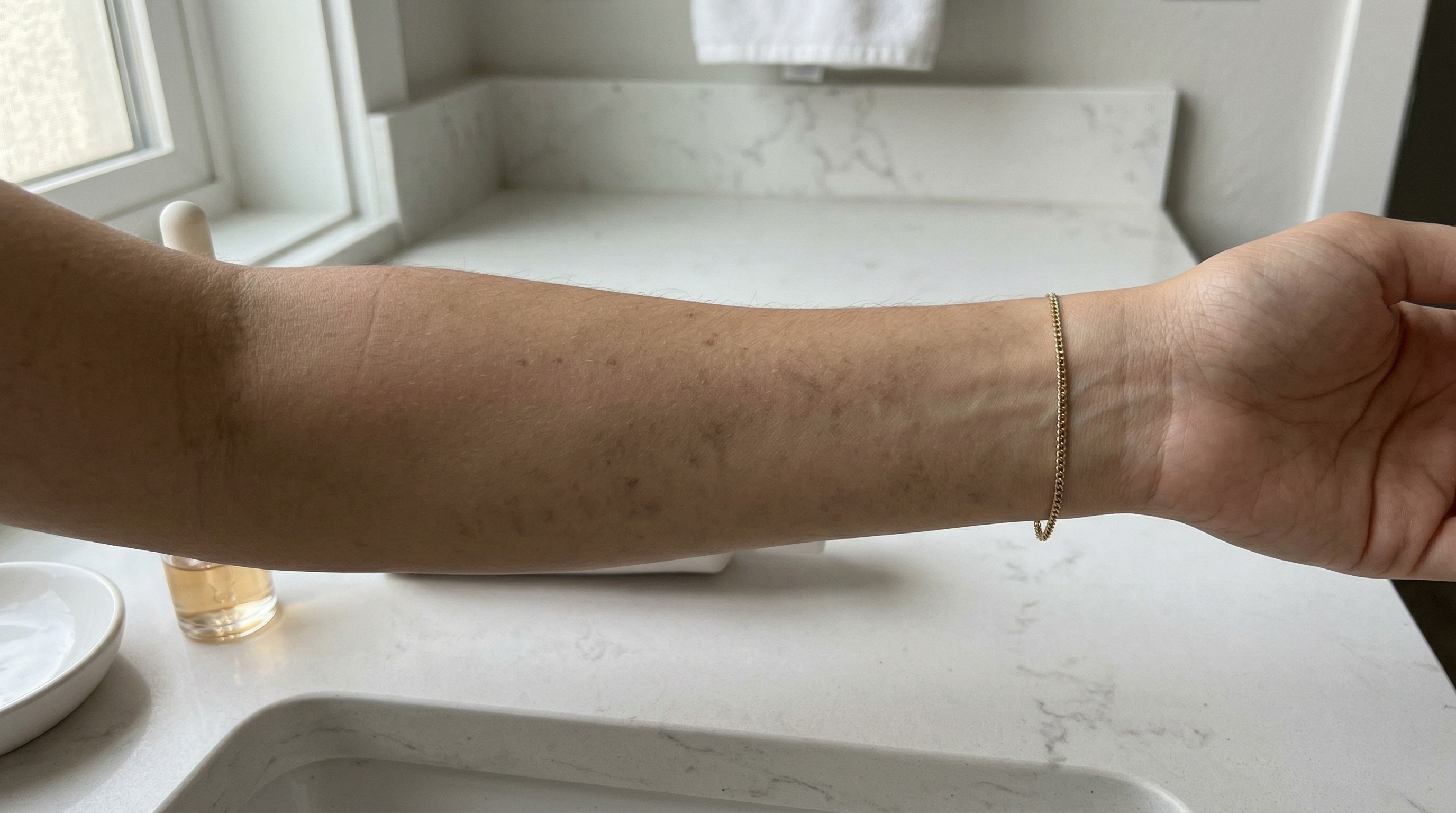
You clear the acne. The inflammation subsides. And then — sometimes for months — a flat, brownish or grayish mark sits exactly where the blemish used to be. It is not a scar. It is not a stain. It is post-inflammatory hyperpigmentation, and it has a specific biological explanation that is worth understanding before you throw a serum at it.
What PIH Actually Is
Post-inflammatory hyperpigmentation (PIH) occurs when the skin’s melanin-producing cells — melanocytes — overproduce pigment in response to injury or inflammation [1]. The trigger can be acne, a cut, an eczema flare, a chemical burn, or even an aggressive facial. The immune response that rushes to repair the site also signals melanocytes to ramp up activity. When inflammation resolves, those cells sometimes don’t get the memo to stop. Excess melanin gets deposited in the epidermis, in the dermis, or in both layers simultaneously.
The depth of the deposit matters enormously for how long the mark lasts and how well it responds to treatment. Epidermal PIH — melanin concentrated in the upper skin layers — typically appears tan or brown, and responds reasonably well to topical agents. Dermal PIH — pigment deposited deeper in the skin — presents as gray or bluish-brown and is significantly harder to treat, sometimes persisting for years regardless of what you apply topically [1].
Who Gets PIH More Severely
PIH occurs across all skin tones, but its prevalence and severity skew toward people with Fitzpatrick skin types IV through VI — medium to deep complexions [2]. In these populations, PIH is frequently reported as a more distressing condition than the original acne or inflammation that triggered it. The reason is purely biological: darker skin contains more melanocytes and those melanocytes are constitutively more active. Any insult to the skin produces a proportionally larger melanin response. Individuals with lighter skin tones are by no means immune, but their pigment tends to fade more quickly through natural cell turnover.
Hormonal factors also influence PIH severity. Estrogen amplifies melanocyte activity, which is why hyperpigmentation worsens during pregnancy, around menstruation, and in perimenopause. This overlapping hormonal context makes midlife PIH particularly stubborn — you are dealing with both a trigger (hormonal acne or rosacea) and an amplified pigmentation response simultaneously.
Prevention Comes Before Treatment
The most underappreciated aspect of PIH management is that the best treatment is preventing it from forming in the first place. Sunscreen is not optional here — UV exposure dramatically deepens existing PIH and can stimulate fresh deposits even when the original inflammation has cleared. A broad-spectrum SPF 30 or higher applied daily is the non-negotiable baseline [2]. Skipping sun protection while applying brightening actives is roughly equivalent to mopping the floor with the tap still running.
A comprehensive clinical review found that topical retinoids produce measurable lightening of PIH in as little as 4 to 12 weeks of consistent use, with improvements continuing over 6 months.
Physical protection matters too. Anything that extends inflammation — picking at acne, over-exfoliating, using actives at concentrations your skin cannot tolerate — adds more fuel to the melanin response. The fastest route to fading PIH is managing whatever caused the inflammation in the first place while simultaneously protecting skin from UV.
Treatments with the Strongest Evidence
A 2022 systematic review examining topical agents for PIH identified retinoids, hydroxy acids, niacinamide, and certain botanical extracts as having the highest-quality evidence [3]. A more recent systematic review in 2024 confirmed that retinoids and hydroquinone-based regimens consistently produce the most measurable improvements across patient populations [4].
Retinoids. Retinoids accelerate cell turnover, which means the pigmented epidermal cells shed faster. They also directly inhibit the enzyme tyrosinase, which melanocytes use to synthesize melanin. A comprehensive clinical review found that topical retinoids produce measurable lightening of PIH in as little as 4 to 12 weeks of consistent use, with improvements continuing over 6 months [2]. The challenge with conventional retinol formulations is that their irritation profile — redness, peeling, barrier disruption — can temporarily worsen PIH by triggering fresh inflammation. This is not a flaw unique to low-quality products; it is a consequence of how conventional retinol penetrates the skin through a barrier-disrupting mechanism. Managing retinol carefully, starting at low concentrations and building slowly, is critical.
Niacinamide. Niacinamide does not inhibit melanin production directly. Instead, it blocks the transfer of melanosomes — the packets that carry melanin — from melanocytes into surrounding keratinocytes, reducing the amount of visible pigmentation even when production continues. It is one of the gentlest options available and is an excellent pairing with actives that have higher irritation potential [3].
Vitamin C (ascorbic acid). L-ascorbic acid functions both as a tyrosinase inhibitor and an antioxidant that neutralizes the reactive oxygen species that amplify pigmentation after UV exposure. Stability is the main limitation: conventional vitamin C formulations oxidize quickly, reducing efficacy. Newer stabilized forms and combinations with vitamin E and ferulic acid have addressed much of this.
Tranexamic acid and azelaic acid. Both have gained substantial evidence for PIH, whether as a prescription gel or azelaic acid cream, a tranexamic acid serum or an azelaic acid serum, particularly in skin of color where their tolerability advantages over hydroquinone make them preferable for long-term use. Azelaic acid at 15 to 20% functions as both a mild keratolytic and a competitive inhibitor of tyrosinase. Tranexamic acid interrupts UV-stimulated keratinocyte signaling to melanocytes [3].
Azelaic acid at 15 to 20% functions as both a mild keratolytic and a competitive inhibitor of tyrosinase.
Hydroquinone. Still considered the gold standard by many dermatologists for its efficacy, hydroquinone at 4% produces measurable lightening but is associated with rebound hyperpigmentation, potential exogenous ochronosis with prolonged use, and regulatory restrictions in several markets. It works best in short, targeted courses rather than indefinite application.
The Delivery Problem Nobody Talks About
Ingredient selection matters, but ingredient delivery matters just as much. Retinol is among the most well-documented depigmenting and cell-turnover actives available. But conventional retinol barely makes it past the stratum corneum — the topmost layer of skin — in clinically meaningful concentrations. Much of what you apply oxidizes on contact with air or breaks down before it penetrates.
This is the core limitation that encapsulated retinol formulations were developed to address. When retinol is delivered via lipid nanoparticles — particles structurally identical to skin cell membranes — it bypasses the barrier disruption that conventional retinol requires to function. The nanoparticles are recognized as “self” by skin cells and transported intact through the epithelial layer, releasing retinol directly where melanin synthesis and cell turnover occur.
North Biomedical’s Nanoretinol uses this exact mechanism: 0.2% retinol encapsulated in biomimetic lipid nanoparticles shown to be +232% more effective at collagen recovery than conventional retinol at higher concentrations. For PIH specifically, the advantage is that it delivers retinol without triggering the inflammatory cascade that conventional formulations can provoke — which means you get the brightening and cell-turnover benefits without inadvertently triggering more PIH in the process.
How Long Does PIH Take to Fade?
Realistically: epidermal PIH with consistent treatment and sun protection typically takes 3 to 6 months to show meaningful improvement. Dermal PIH can take significantly longer — 12 to 24 months — and may not fully resolve with topical treatment alone. If you have been treating a mark for 6 to 9 months without improvement, a dermatology consultation to assess depth (often via Wood’s lamp examination) can clarify whether topical treatment alone is realistic or whether in-office procedures — chemical peels, laser, microneedling — make more sense.
Consistency is what separates people who see results from those who don’t. A retinoid applied intermittently, combined with irregular sunscreen use, will produce no meaningful change. The same ingredients applied daily, with SPF layered on top every morning, will produce measurable fading within months.
What to Put Together
A practical PIH protocol for women dealing with post-acne or hormonal marks:
- Morning: Antioxidant serum (vitamin C), followed by SPF 30+ — every single day
- Evening: Retinol or retinoid (start at 2-3 nights per week, build to nightly as tolerated), optionally layered with niacinamide
- Weekly: Gentle chemical exfoliant (lactic or glycolic acid) to support cell turnover without provoking fresh inflammation
Patience is the active ingredient most people skip. The marks did not appear overnight, and they will not fade that way either — but with the right stack and sun protection, they will fade.
References
- Kaufman BP, Aman T, Alexis AF. “Postinflammatory Hyperpigmentation: Epidemiology, Clinical Presentation, Pathogenesis and Treatment.” Am J Clin Dermatol. 2018;19(4):489-503. doi:10.1007/s40257-017-0333-6
- Callender VD, Baldwin H, Cook-Bolden FE, Alexis AF, Stein Gold L, Guenin E. “Effects of Topical Retinoids on Acne and Post-inflammatory Hyperpigmentation in Patients with Skin of Color: A Clinical Review and Implications for Practice.” Am J Clin Dermatol. 2022;23(1):69-81. doi:10.1007/s40257-021-00643-2
- Tan MG, Kim WB, Jo CE, Nabieva K, Kirshen C, Ortiz AE. “Topical treatment for postinflammatory hyperpigmentation: a systematic review.” J Dermatol Treatment. 2022;33(5):2518-2526. doi:10.1080/09546634.2021.1981814
- Kashetsky N, Feschuk A, Pratt ME. “Post-inflammatory hyperpigmentation: A systematic review of treatment outcomes.” J Eur Acad Dermatol Venereol. 2024;38(3):470-479. doi:10.1111/jdv.19566
- Davis EC, Callender VD. “Postinflammatory hyperpigmentation: a review of the epidemiology, clinical features, and treatment options in skin of color.” J Clin Aesthetic Dermatol. 2010;3(7):20-31. PMID:20725554