How to Reverse Skin Aging: What the Evidence Actually Supports
The difference between damage you can undo and damage you can only slow — and where to spend your effort.
Search “reverse skin aging” and you will meet two extremes: creams that promise to erase a decade by Friday, and dermatologists who insist nothing topical does anything at all. The truth sits in a more useful place. Some of what we call “aging” is genuinely reversible. Some of it is not. Knowing which is which is the entire game — because it tells you exactly where your money, patience, and effort will actually pay off.
Two Kinds of Aging, and Only One Is Reversible
Skin ages along two separate tracks. Intrinsic aging is the slow, genetically programmed thinning that happens everywhere on your body, even on skin the sun never touches. Extrinsic aging — overwhelmingly driven by ultraviolet light — is the sun damage stacked on top, and it accounts for the large majority of the wrinkles, mottling, and rough texture people actually notice on the face, neck, and hands.
That split matters because the two respond very differently to treatment. Intrinsic aging can be slowed but not meaningfully undone. Extrinsic damage, by contrast, is a wound the skin is often still capable of partially repairing once you stop re-inflicting it. When someone’s skin visibly improves on a good regimen, they are almost always cashing in on the reversible, sun-driven portion.
What “Aged” Skin Looks Like Underneath
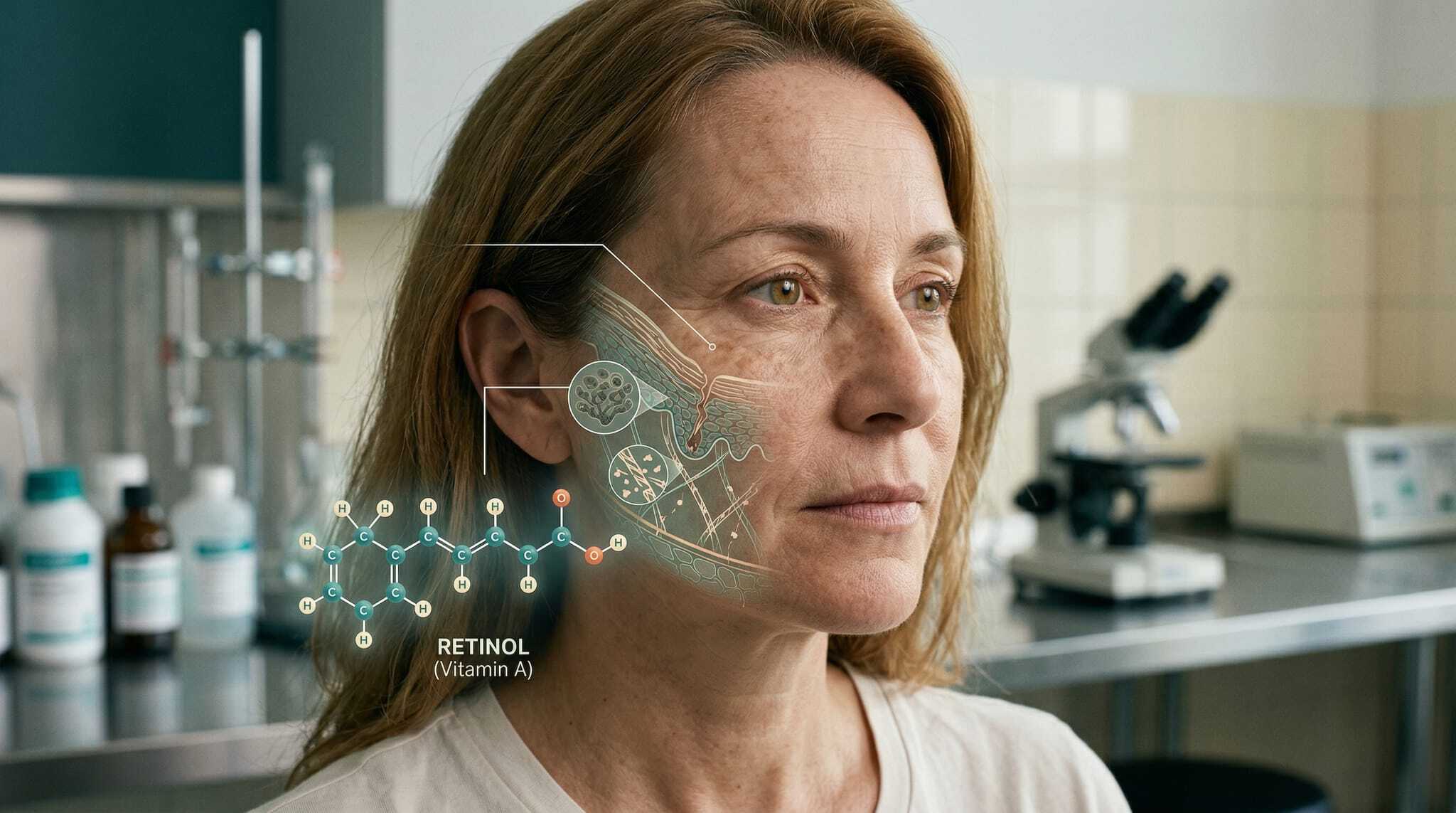
To reverse something, you have to know what broke. Under a microscope, photoaged skin shows fragmented, disorganized collagen and a tangle of abnormal elastic tissue called solar elastosis [1]. UV light triggers enzymes called matrix metalloproteinases that chew through healthy collagen while simultaneously suppressing the fibroblasts that build new collagen — a double hit of more demolition and less construction [1].
Chronology adds its own quiet tax. Skin collagen falls measurably with age, and the decline begins far earlier than most people expect.
Intrinsic aging is the slow, genetically programmed thinning that happens everywhere on your body, even on skin the sun never touches.
Women lose collagen faster than men at every age, and the drop accelerates around menopause [2]. So the target for any reversal effort is clear: rebuild collagen, calm the enzymes tearing it down, and give the skin’s own repair machinery room to work.
Step One Is Subtraction, Not Addition
The single most evidence-backed way to reverse the trajectory of aging skin is also the least glamorous: block the ultraviolet light that is causing most of the damage. In a landmark randomized trial, adults assigned to daily broad-spectrum sunscreen showed no detectable increase in skin aging over four and a half years, while the group using it only occasionally kept aging visibly [3]. Daily sunscreen users were 24 percent less likely to show increased signs of aging.
Read that carefully. Sunscreen is usually sold as prevention, but the trial revealed something more interesting: with the UV assault switched off, skin that is left alone tends to catch up on repairs it could not make before. Subtraction comes first. Every active you layer on afterward is working against a smaller headwind.
Retinoids: The Most Reversible Evidence We Have
If one topical ingredient has earned the word “reverse,” it is the retinoid family. In a controlled study of photodamaged skin, tretinoin (prescription vitamin A acid) produced measurable new collagen formation in the upper dermis compared with placebo — visible, quantifiable rebuilding, not just surface smoothing [4]. Decades of subsequent work confirm retinoids increase collagen production, slow its breakdown, speed cell turnover, and fade uneven pigment, which is why they remain the benchmark every other anti-aging active is measured against [5].
Over-the-counter retinol is a gentler cousin of prescription tretinoin; the skin converts it into the active form in two enzymatic steps, which makes it milder but slower. The trade-off is real, and it is where formulation quality quietly decides whether you see results at all.
Conventional retinol has to survive light, air, and the skin’s own barrier before it can act, and much of it never arrives.
The Supporting Cast: Vitamin C and Niacinamide
Retinoids do the heavy lifting, but two other ingredients earn their place. Vitamin C is a required cofactor for the enzymes that assemble collagen — without it, the body physically cannot cross-link collagen fibers properly — and it doubles as an antioxidant that blunts UV-driven free-radical damage [6]. Skin vitamin C levels fall with age, which is part of why topping it up topically is worth the effort.
Niacinamide (vitamin B3) is the quiet all-rounder. In controlled facial studies it reduced the appearance of wrinkles, blotchiness, sallow yellowing, and hyperpigmented spots while strengthening the skin barrier [7]. It also plays well with almost everything, making it an easy addition to a routine built around a retinoid.
Building a Routine That Actually Reverses Anything
The winning regimen is unglamorous and consistent: a broad-spectrum sunscreen every morning, an antioxidant like vitamin C in the daytime, and a retinoid at night, all given months rather than weeks to work. Collagen remodeling is slow biology — the tretinoin studies ran for six to twelve months before the dermal changes matured. Expect texture and tone to shift first, and deeper structural change to follow.
Two mistakes sabotage most people: quitting a retinoid during the initial adjustment period, and skipping sun protection so that each night’s repair is undone by the next day’s exposure. Reversal is a ledger. You are trying to keep the repair column ahead of the damage column, month after month. For a deeper look at the science of rebuilding collagen, see our guide on how to boost collagen production, and our overview of what to look for in a good anti-aging serum.
Where Delivery Becomes the Bottleneck
Here is the catch that undermines a lot of well-intentioned routines: an active ingredient only works if it reaches the living cells in the dermis. Conventional retinol has to survive light, air, and the skin’s own barrier before it can act, and much of it never arrives. That is why two products with identical retinol percentages can deliver wildly different results.
This is the problem Nanoretinol was built to solve. It encapsulates retinol inside biomimetic lipid nanoparticles that the skin recognizes as “self” and allows through the barrier, so the active is carried to its target rather than left to degrade on the surface. Because delivery is so much more efficient, Nanoretinol works at a gentle, fully stabilized 0.2% concentration — in North Biomedical’s testing it proved 232% more effective at collagen recovery and 73% more effective at elastin recovery than conventional retinol, while causing far less irritation. When the goal is reversing collagen loss, getting the retinoid to the cells that build collagen is not a detail. It is the whole point.
Aging Skin Is Not a One-Way Street
You cannot rewind the clock, but you can absolutely repay a meaningful share of the debt — the part written by the sun. Cut the UV exposure, put a proven retinoid to work where it can actually reach, and support it with vitamin C and niacinamide. Do that consistently, and the skin does what it has quietly been trying to do all along: rebuild.
References
- Fisher GJ, Kang S, Varani J, Bata-Csorgo Z, Wan Y, Datta S, Voorhees JJ. “Mechanisms of Photoaging and Chronological Skin Aging.” Archives of Dermatology. 2002;138(11):1462-1470. doi:10.1001/archderm.138.11.1462
- Shuster S, Black MM, McVitie E. “The Influence of Age and Sex on Skin Thickness, Skin Collagen and Density.” British Journal of Dermatology. 1975;93(6):639-643. doi:10.1111/j.1365-2133.1975.tb05113.x
- Hughes MCB, Williams GM, Baker P, Green AC. “Sunscreen and Prevention of Skin Aging: A Randomized Trial.” Annals of Internal Medicine. 2013;158(11):781-790. doi:10.7326/0003-4819-158-11-201306040-00002
- Griffiths CEM, Russman AN, Majmudar G, Singer RS, Hamilton TA, Voorhees JJ. “Restoration of Collagen Formation in Photodamaged Human Skin by Tretinoin (Retinoic Acid).” New England Journal of Medicine. 1993;329(8):530-535. doi:10.1056/NEJM199308193290803
- Mambwe B, Mellody KT, Kiss O, O’Connor C, Bell M, Watson REB, Langton AK. “Cosmetic retinoid use in photoaged skin: A review of the compounds, their use and mechanisms of action.” International Journal of Cosmetic Science. 2025;47(1):45-57. doi:10.1111/ics.13013
- Pullar JM, Carr AC, Vissers MCM. “The Roles of Vitamin C in Skin Health.” Nutrients. 2017;9(8):866. doi:10.3390/nu9080866
- Bissett DL, Oblong JE, Berge CA. “Niacinamide: A B Vitamin that Improves Aging Facial Skin Appearance.” Dermatologic Surgery. 2005;31(7 Pt 2):860-865. doi:10.1111/j.1524-4725.2005.31732