
Soft Jawline: Why You Lose Definition and How to Restore It
A soft jawline isn't always sagging — it's the slow loss of the bone, fat, muscle, and skin that gave your lower face a defined edge
You catch yourself in a video call and notice it before you can name it: the line between your face and your neck has gone fuzzy. There is no obvious sag, no jowl, no hanging skin. Just a softness where there used to be an edge.
A soft jawline is one of the earliest visible signs of facial aging, and it shows up well before sagging skin does. The frustrating part is that most advice you find online is written for people decades older — face-lift before-and-afters, jowl creams, neck-tightening devices. None of it answers the actual question, which is why a healthy 30- or 40-something face starts losing its lower edge in the first place.
The answer involves four separate tissues, all aging on slightly different timetables. Understanding which ones are changing tells you which interventions are worth your time and money.
The Four Layers Behind a Defined Jawline
A sharp jawline is the visible result of four structures stacked on top of one another: bone, fat, muscle, and skin. When any of them shifts, the contour above shifts with it.
1. Bone — your built-in scaffold
The mandible (jawbone) doesn’t stay the same shape across a lifetime. CT studies tracking facial bones across decades show that the mandible undergoes measurable resorption with age. Ramus height decreases by about 5.3 mm in women and 4.2 mm in men, and the mandibular angle gradually opens [1]. The chin loses projection. The pre-jowl region — that small valley just in front of the jowl — loses bone first, which is why the line there softens earliest [2].
This matters because every layer above the bone — fat, muscle, skin — depends on the underlying scaffold for shape. A jawbone that has lost a few millimeters of height and projection no longer pushes the soft tissue forward the way it used to.
2. Fat — the redistribution problem
Fat doesn’t just disappear with age. It moves. Imaging studies show that the fat in the upper face (around the eyes, cheeks, and temples) atrophies, while the fat in the lower face — particularly the submental fat under the chin and the jowl pad — tends to hypertrophy [3]. The result is a face that loses definition on top while gaining bulk on the bottom, blurring the edge between cheek and neck.
3. Muscle — the part nobody talks about
The masseter (chewing muscle) and temporalis (the muscle at your temple) lose volume with age in a process called sarcopenia. A 10-year longitudinal CT study following healthy adults found progressive decline in both muscles, with measurable atrophy beginning in midlife [4]. The masseter contributes to the squared-off look of a defined male jawline and the soft taper of a defined female one. As it thins, the lower face loses lateral structure.
4. Skin — the surface you actually see
The skin draped over those three layers is doing its own aging in parallel. From around age 20, the skin loses roughly 1% of its dermal collagen per year [5]. UV exposure activates matrix metalloproteinases (MMPs) — enzymes that fragment existing collagen and shut down the synthesis of new collagen [6]. The dermis thins. Elastin frays. The skin loses the firmness that used to drape tightly over the bony edge of the jaw and now drapes loosely instead.
What “Soft” Actually Looks Like
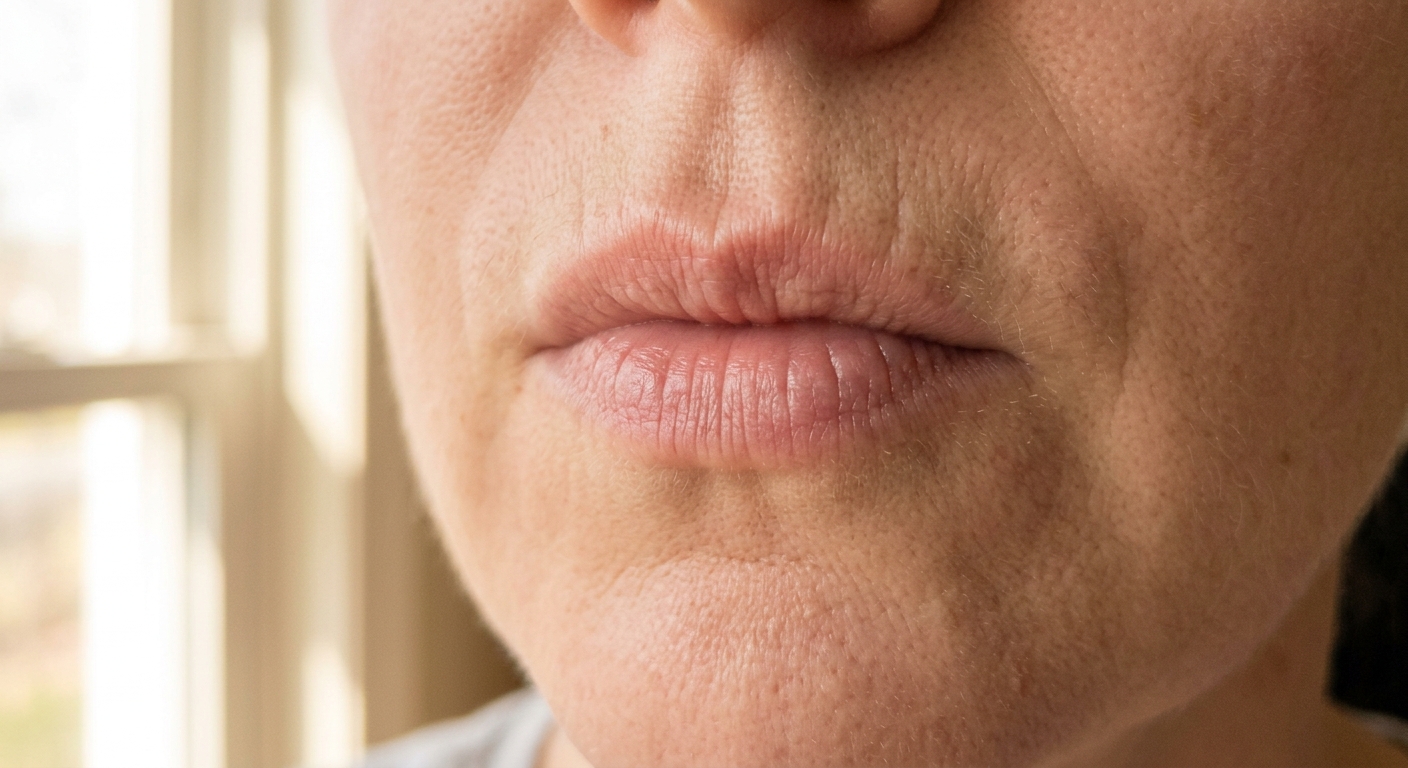
The earliest sign of a softening jawline isn’t a jowl. It’s three subtler changes most people register as “I look tired” before they identify them:
From around age 20, the skin loses roughly 1% of its dermal collagen per year.
- A blurred shadow line. The crisp shadow that used to fall under the mandible becomes diffuse.
- A loss of pre-jowl projection. The small concavity in front of the jowl deepens slightly, breaking the smooth line of the jaw.
- A wider lower face. As masseter mass shrinks and submental fat thickens, the lower third of the face loses its taper.
If you’ve ever wondered why a friend “looks the same” but somehow older, this is usually what your eye picked up on.
What Doesn’t Work (and Why You’ll Be Sold It Anyway)
Before getting to what works, it’s worth flagging what the evidence does not support:
- Chewing gum or “jawline trainers.” No controlled study shows that hypertrophying the masseter via chewing produces a more defined jawline in non-athletes — and overuse can cause masseter hypertrophy that widens the lower face, the opposite of what most people want.
- Face yoga for the jaw. Surface-mimicking exercises don’t reverse bone resorption or fat redistribution. The small benefits seen in some face yoga studies apply mainly to mid-face fullness, not jaw definition.
- “Lifting” creams without active ingredients. Most firming creams produce a transient skin-tightening effect from film-formers. The result fades within hours of washing.
What the Evidence Actually Supports
Topical retinoids — the only at-home intervention with strong dermal evidence
Among topical ingredients studied for skin firmness, retinoids are the most evidenced. A landmark NEJM study showed that tretinoin produced an 80% increase in collagen I formation in photodamaged skin, compared with a 14% decrease in vehicle-treated controls [7]. Topical retinol — the over-the-counter form — induces similar histological and gene-expression changes, with effect sizes more than half those of prescription retinoic acid [8]. Retinoids work through two mechanisms relevant to a softening jawline: they suppress UV-driven MMP activation (the enzymes that fragment collagen) and they upregulate procollagen synthesis in dermal fibroblasts [6].
Sunscreen — the prevention layer
The bone, fat, and muscle changes are partly genetic and partly age. The skin layer is the one most influenced by UV. Daily SPF won’t restore a jawline, but it slows the rate of dermal collagen breakdown that softens the contour further. (See our deep dive on why sunscreen is the strongest evidence-based anti-aging product.)
Resistance training and protein intake
Sarcopenia of the masseter mirrors sarcopenia elsewhere in the body. Adequate protein intake (roughly 1.2 g/kg body weight for adults over 40) and resistance training are the only interventions with consistent evidence for slowing age-related muscle loss [4]. There is no jaw-specific exercise that reliably preserves masseter volume, but maintaining systemic muscle mass is the closest thing to a foundation.
Clinical procedures — when at-home isn’t enough
For pronounced bone or fat changes, hyaluronic acid filler placed along the mandibular border can sharpen the contour, and procedures like radiofrequency microneedling can stimulate dermal collagen. These are upstream of skincare in cost and downside, and they don’t replace the daily skin work — they sit on top of it. Our guide to non-surgical skin tightening covers the procedural options in detail.
Why Delivery Matters More Than Concentration
Here is the part that surprises most people: a higher percentage of retinol on the bottle does not mean more retinol reaching the dermis. Retinol is fat-soluble, unstable in the presence of air and light, and has to traverse the stratum corneum — the skin barrier built specifically to keep things out — to reach the fibroblasts that make collagen.
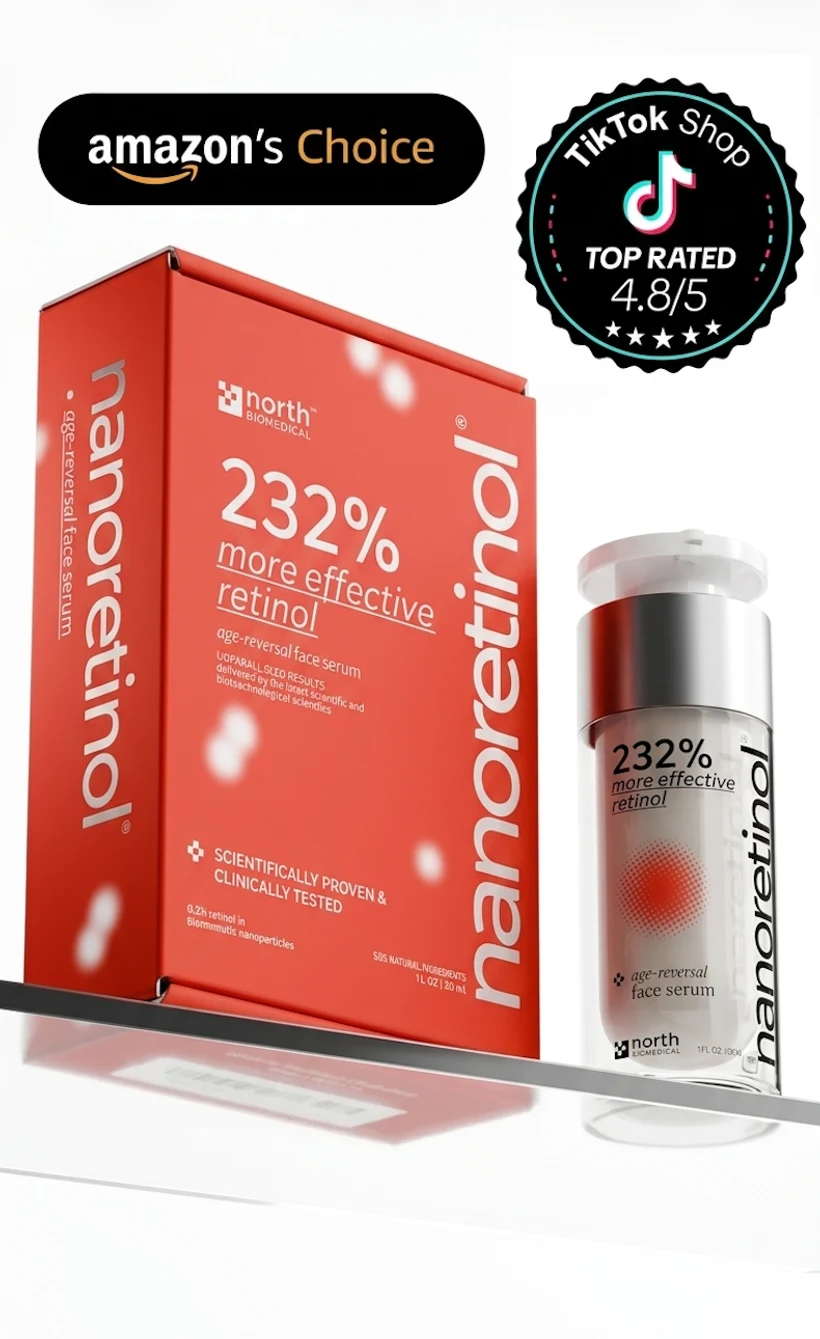
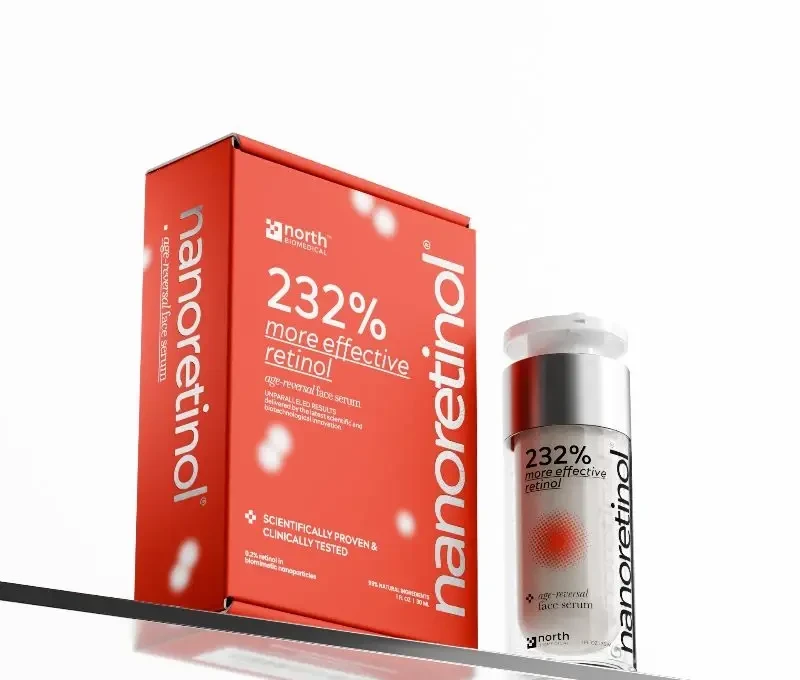
In comparative testing, Nanoretinol delivered +232% more collagen recovery and +73% more elastin recovery than conventional retinol, and clinical use over 56 days produced a +61% increase in skin firmness.
Most conventional retinol formulations rely on solvents and penetration enhancers that compromise the skin barrier to push the active through. That is the mechanism behind the redness, peeling, and stinging that drives most people to abandon retinol within weeks.
Nanoretinol takes a different approach. The retinol is encapsulated in biomimetic lipid nanoparticles — externally identical to the skin’s own cells, so the epithelial barrier recognizes them as “self” and lets them through intact. The same nanotechnology underpins certain cancer drug-delivery systems. In comparative testing, Nanoretinol delivered +232% more collagen recovery and +73% more elastin recovery than conventional retinol, and clinical use over 56 days produced a +61% increase in skin firmness [9]. The 0.2% concentration looks low on a label and outperforms higher percentages because the delivery does the work the concentration usually has to brute-force.
For a softening jawline, where the skin contribution to definition is largely a question of dermal collagen and firmness, that distinction matters more than the number on the bottle.
Building a Realistic Plan
If you’ve noticed your jawline going soft, the honest framework looks like this:
- Skin layer (the part you control most): A nightly retinoid plus daily broad-spectrum SPF. Expect to see firmness changes in 8–12 weeks of consistent use.
- Muscle layer: Total-body resistance training 2–3 times per week and adequate protein. Slows masseter atrophy as part of slowing sarcopenia generally.
- Fat layer: Maintain a stable weight. Large fluctuations accelerate jowl pad changes.
- Bone layer: Largely genetic. Consider professional consultation if structural changes are pronounced.
The skin layer is where consumer products can plausibly help. Everything else either sits upstream (procedures) or runs on a longer timeline you influence through general health rather than skincare.
The Reframe
A soft jawline is one of the most unfairly judged signs of facial aging. People assume it means weight gain or laziness. In reality, it is the visible signature of four tissues that have been quietly doing their own thing since your late twenties — the bone resorbing slowly, the fat redistributing downward, the masseter losing fibers, the dermis losing collagen at one percent per year.
You can’t reverse all four. But the skin contribution — collagen, firmness, elasticity — is genuinely modifiable, and it’s the part you see most. A retinoid you can actually tolerate, used consistently, plus the sunscreen that protects the work it does, is the at-home intervention with the strongest evidence behind it.
References
-
Shaw RB Jr, Katzel EB, Koltz PF, et al. “Aging of the facial skeleton: aesthetic implications and rejuvenation strategies.” Plastic and Reconstructive Surgery. 2011;127(1):374-383. doi:10.1097/PRS.0b013e3181f95b2d
-
Mendelson B, Wong CH. “Changes in the facial skeleton with aging: implications and clinical applications in facial rejuvenation.” Aesthetic Plastic Surgery. 2012;36(4):753-760. doi:10.1007/s00266-012-9904-3
-
Wysong A, Joseph T, Kim D, Tang JY, Gladstone HB. “Quantifying soft tissue loss in facial aging: a study in women using magnetic resonance imaging.” Dermatologic Surgery. 2013;39(12):1895-1902. doi:10.1111/dsu.12362
-
Yamaguchi K, Tohara H, Hara K, et al. “Factors associated with masseter muscle quality assessed from ultrasonography in community-dwelling elderly individuals: A cross-sectional study.” Archives of Gerontology and Geriatrics. 2019;82:128-132. doi:10.1016/j.archger.2019.02.003
-
Shuster S, Black MM, McVitie E. “The influence of age and sex on skin thickness, skin collagen and density.” British Journal of Dermatology. 1975;93(6):639-643. doi:10.1111/j.1365-2133.1975.tb05113.x
-
Pittayapruek P, Meephansan J, Prapapan O, Komine M, Ohtsuki M. “Role of matrix metalloproteinases in photoaging and photocarcinogenesis.” International Journal of Molecular Sciences. 2016;17(6):868. doi:10.3390/ijms17060868
-
Griffiths CE, Russman AN, Majmudar G, et al. “Restoration of collagen formation in photodamaged human skin by tretinoin (retinoic acid).” New England Journal of Medicine. 1993;329(8):530-535. doi:10.1056/NEJM199308193290803
-
Kong R, Cui Y, Fisher GJ, et al. “A comparative study of the effects of retinol and retinoic acid on histological, molecular, and clinical properties of human skin.” Journal of Cosmetic Dermatology. 2016;15(1):49-57. doi:10.1111/jocd.12193
-
North Biomedical LLC. “Nanoretinol vs. Conventional Retinol: Efficacy in Collagen and Elastin Recovery.” Clinical Study Summary, 2024. https://northbiomedical.com/documents/Nanoretinol-Study_Summary.pdf