Cortisol Face: What Stress Really Does to Your Skin and How to Reverse It
The puffiness is only the surface story — chronic cortisol quietly dismantles the collagen that keeps your face firm.
Scroll through skincare videos for more than a minute and you’ll meet the phrase “cortisol face” — usually attached to a side-by-side photo of a rounder, puffier, more tired-looking version of someone’s own reflection. The implication is that stress has physically reshaped their features. It’s a catchy idea, and like most viral skincare terms, it’s part true and part oversimplified.
Cortisol face is real in the sense that stress genuinely changes how your face looks. But the puffiness everyone fixates on is the least important part of the story. The part that actually matters for how your skin ages happens far below the surface, where you can’t photograph it.
What People Mean by “Cortisol Face”
When most people say cortisol face, they’re describing a constellation of changes: a puffy or fuller appearance (especially around the cheeks and jaw), under-eye bags, a dull or grayish tone, and skin that simply looks more tired than it did a year ago. They’ve correctly connected this to feeling chronically stressed, overworked, and under-slept.
Cortisol is your body’s primary stress hormone. When you’re under pressure, your brain signals the adrenal glands — through what scientists call the hypothalamic-pituitary-adrenal (HPA) axis — to release it. In short bursts, cortisol is helpful and even protective. The problem is chronic elevation: the low-grade, never-quite-switching-off stress that defines a lot of modern life.
Before going further, an honest caveat: a dramatically rounder face that appears quickly, along with symptoms like a fatty hump at the upper back, purple stretch marks, or unexplained weight gain, can signal a genuine medical condition such as Cushing’s syndrome or a thyroid issue. That deserves a doctor’s evaluation, not a serum. The everyday “cortisol face” of stress and poor sleep is a different, far more common situation — and it’s the one skincare can actually help with.
The damage that doesn’t reverse on its own is happening in your dermis — the deep layer where collagen and elastin give skin its structure.
The Puffiness Is the Decoy
The fluid retention behind cortisol-related puffiness is real but largely temporary. Cortisol influences how your body holds onto sodium and water, which is why a stressful, salty, sleep-deprived stretch can leave your face looking swollen by morning. Reduce the stress, sleep well, hydrate, and that puffiness tends to ease within days.
The damage that doesn’t reverse on its own is happening in your dermis — the deep layer where collagen and elastin give skin its structure. Here, chronically elevated cortisol behaves less like a passing tide and more like a slow leak in your skin’s foundation.
Research on human dermal fibroblasts — the cells that manufacture collagen — has mapped this out in detail. One 2023 study identified specific genes switched on by the glucocorticoid receptor (the docking site cortisol acts through) that suppress collagen production, and showed that silencing those genes reversed the collagen shutdown [1]. In plain terms: cortisol doesn’t just fail to support collagen. It actively tells your skin cells to make less of it.
A separate set of experiments on human skin cells found that cortisol drove down both type 1 collagen and hyaluronic acid — the molecule responsible for skin’s plumpness and hydration [2]. So the same hormone behind the temporary puffiness is, over months and years, depleting the two things that keep a face looking firm and full.
Stress Tears at the Skin’s Architecture
Zoom out from the lab and the pattern holds. A review of stress and skin collagen integrity, drawing on both animal models and human conditions, concluded that stress compromises collagen through glucocorticoid-mediated processes that disrupt the balance between collagen synthesis and breakdown [3]. Your skin is constantly building and demolishing collagen; cortisol tips that balance toward demolition.
Your skin is constantly building and demolishing collagen; cortisol tips that balance toward demolition.
It also weakens the skin barrier. In a study of psychological stress and barrier function, researchers found that stress activated an enzyme called 11β-HSD1, which converts inactive cortisone into active cortisol right inside the skin — raising local cortisol levels and measurably impairing the barrier’s ability to retain moisture and protect itself [4]. Notably, when patients’ stress was treated, their barrier function improved. A compromised barrier is what makes stressed skin feel tight, look dull, and react more easily.
This is why cortisol face, left unaddressed for years, doesn’t just look puffy — it looks aged. Thinner, less resilient, more lined. The puffiness comes and goes; the structural loss accumulates.
What Actually Helps
The first half of the solution isn’t topical at all, and pretending otherwise would be dishonest. Lowering chronically high cortisol is the foundation: prioritizing sleep, building in genuine recovery time, moving your body, and reducing the stimulants and late-night screens that keep the HPA axis idling. For the short-term puffiness specifically, hydration, lower sodium, and a good night’s sleep do more than any cream.
The second half is supporting your skin’s structure so it can rebuild what stress has been quietly taking. That means three things working together: protecting the barrier (gentle cleansing, moisturizers with ceramides, daily SPF), supplying antioxidants to offset stress-related oxidative damage, and — most importantly for collagen — using a proven collagen-building active.
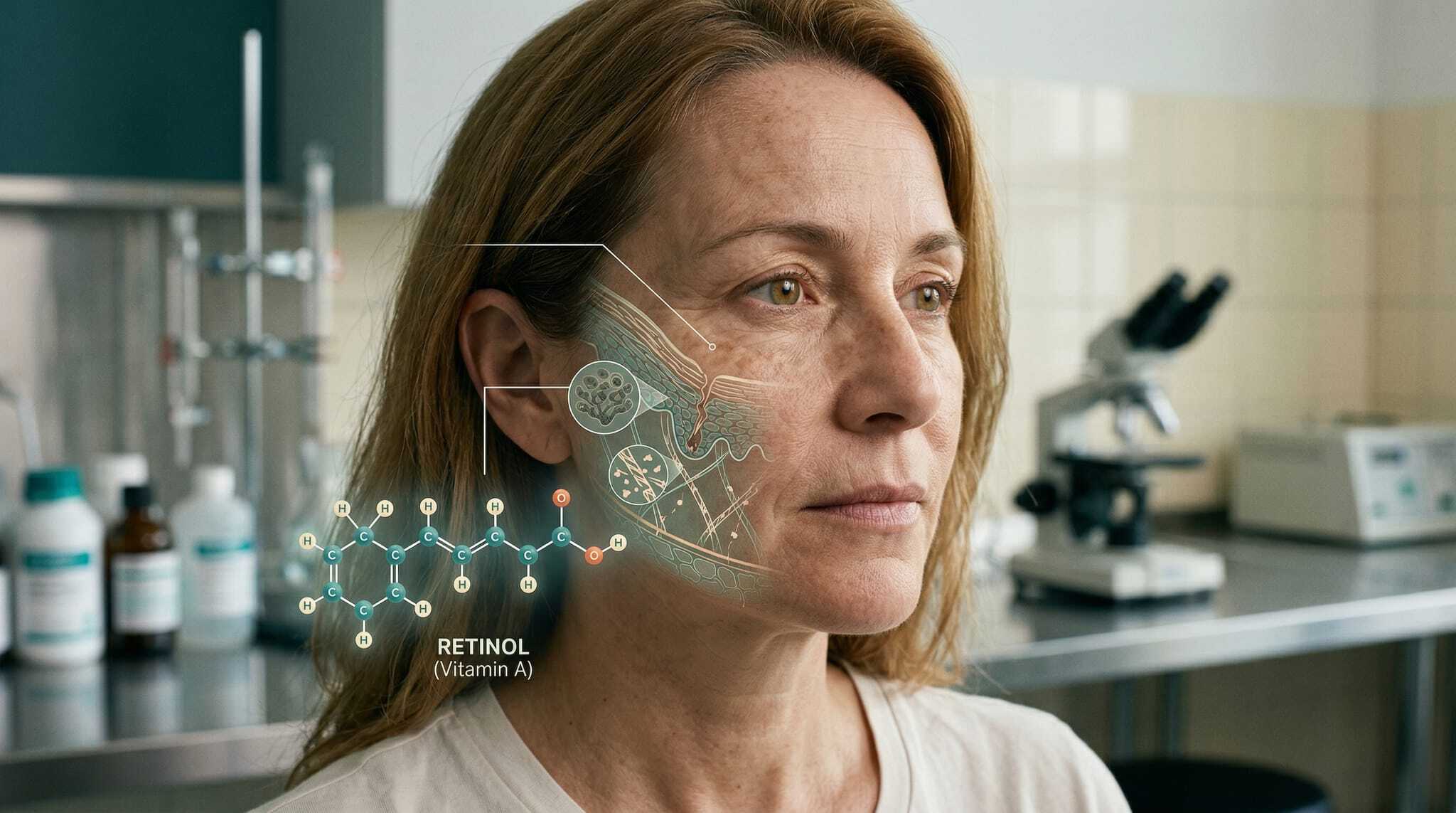
That active is retinol. Decades of clinical research show that topical retinoids reduce the enzymes that degrade collagen while stimulating fibroblasts to produce more of it [5]. If cortisol’s signature move is to suppress collagen synthesis and accelerate its breakdown, retinol is one of the few ingredients shown to push back on both fronts. You can read more about how it works in our guide on how to boost collagen production, and on the broader hormonal picture in our menopause skin guide.
Why Gentleness Matters Here
There’s a catch. Stressed skin often has a compromised barrier, and conventional high-strength retinols can be harsh — the redness and peeling that drive so many people to quit. Layering an irritating retinoid onto an already stressed, barrier-impaired face is a recipe for frustration.
This is exactly the gap Nanoretinol was built to close. It encapsulates retinol inside biomimetic lipid nanoparticles that the skin recognizes as “self,” allowing the active to pass through the barrier without the chemical disruption conventional formulas rely on. The result is a stabilized 0.2% retinol that, in North Biomedical’s research, proved 232% more effective at collagen recovery and 73% more effective at elastin recovery than conventional retinol — while being significantly gentler on skin cells. For a face whose collagen is being depleted by cortisol and whose barrier is already under strain, “more effective and gentler” is precisely the combination that makes sense.
The Real Takeaway
Cortisol face is a useful wake-up call wrapped in a slightly misleading name. The puffiness that makes for dramatic before-and-afters is the part that fades on its own. The part worth your attention is the slow erosion of collagen and barrier integrity that chronic stress drives beneath the surface. Manage the stress, protect the barrier, and give your skin a genuine tool for rebuilding structure — and you address cortisol face where it actually lives, not just where it photographs.
References
- Choi D, Kang W, Park S, Son B, Park T. “Identification of Glucocorticoid Receptor Target Genes That Potentially Inhibit Collagen Synthesis in Human Dermal Fibroblasts.” Biomolecules. 2023;13(6):978. doi:10.3390/biom13060978
- Choo JH, Lee HG, Lee SY, Kang NG. “Iris Pallida Extract Alleviates Cortisol-Induced Decrease in Type 1 Collagen and Hyaluronic Acid Syntheses in Human Skin Cells.” Current Issues in Molecular Biology. 2023;45(1):353–363. doi:10.3390/cimb45010025
- Kahan V, Andersen ML, Tomimori J, Tufik S. “Stress, immunity and skin collagen integrity: evidence from animal models and clinical conditions.” Brain, Behavior, and Immunity. 2009;23(8):1089–1095. PubMed: 19523511
- Choe SJ, Kim D, Kim EJ, Ahn JS, Choi EJ, Son ED, Lee TR, Choi EH. “Psychological Stress Deteriorates Skin Barrier Function by Activating 11β-Hydroxysteroid Dehydrogenase 1 and the HPA Axis.” Scientific Reports. 2018;8:6334. doi:10.1038/s41598-018-24653-z
- Mukherjee S, Date A, Patravale V, Korting HC, Roeder A, Weindl G. “Retinoids in the treatment of skin aging: an overview of clinical efficacy and safety.” Clinical Interventions in Aging. 2006;1(4):327–348. doi:10.2147/ciia.2006.1.4.327