Crepey Eyelids: Why the Skin Above Your Eyes Wrinkles First and What Actually Smooths It
The thinnest skin on your body needs a different kind of help
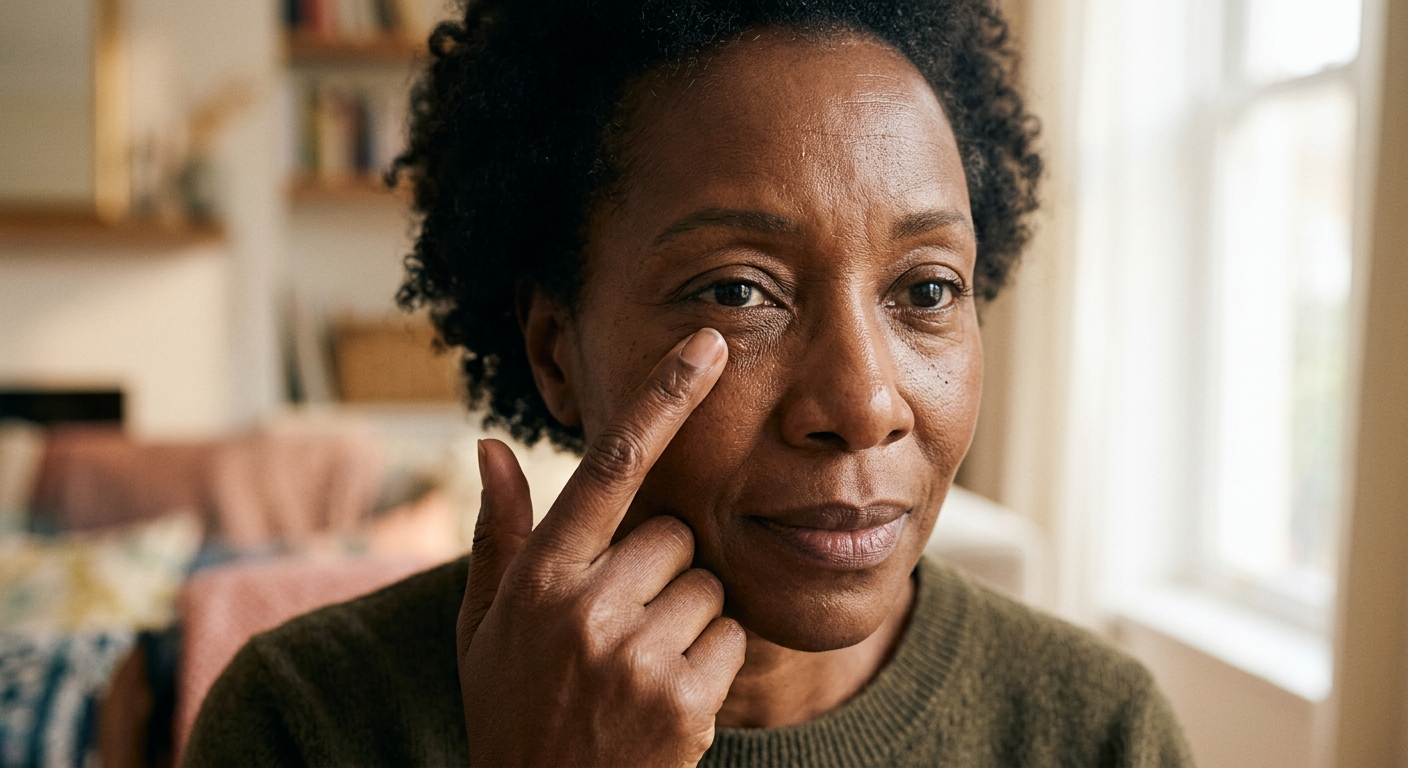
You notice it in the morning mirror first. The skin on your upper eyelid has started to look like tissue paper that’s been balled up and smoothed back out — finely creased, slightly translucent, no longer sitting cleanly against the bone underneath. Eye makeup that used to glide on now catches in the folds. If that catching is your main frustration, our guide to eye makeup for mature women covers the formulas and placement that hold on a creased lid. If the lid has also started to fold down over the crease, hooded eyes makeup deals with that geometry specifically. For the lash line itself, the best mascara for older women is the one that comes off without scrubbing a lid this thin. The texture is the giveaway. Crepey eyelids do not look like wrinkles. They look like fabric.
This is not the same problem as crow’s feet, hooded eyes, or undereye bags, even though they often arrive at roughly the same time. Crepey eyelids are a structural change in the skin itself — a loss of the springy mesh that once held it taut.
Why Eyelid Skin Is the First to Crepe
Eyelid skin is the thinnest skin on your entire body. The dermis there is roughly half the thickness of the dermis on your cheek, and the lipid-rich barrier that locks moisture in is correspondingly thinner. That thin construction is by design — your eyelids need to be light and flexible enough to blink an estimated 15,000 to 20,000 times a day. The trade-off is that everything that happens to skin as it ages happens to eyelid skin first, and faster.
The two proteins that determine whether skin looks crepey or smooth are collagen, which provides structural firmness, and elastin, which provides recoil. From your mid-twenties onward, collagen production declines by roughly 1% per year, and elastin production essentially stops in adulthood — your body keeps the elastin you have, but it does not make significant new supply [1]. UV exposure, oxidative stress, and the rising activity of enzymes called matrix metalloproteinases (MMPs) progressively degrade what’s there.
A 2021 study using computational 3D structural analysis compared elastin fibers in young versus aged eyelids and found something striking: in aged eyelid skin, the elastin fibers were significantly shorter, thicker, and more curved than in young skin — and the changes in eyelids were more pronounced than the equivalent changes in abdominal skin from the same individuals [2]. The eyelid is uniquely exposed to UV, repeated mechanical stretching from blinking, and oxidative stress from constant tear-film exchange. All three accelerate elastin breakdown.
From your mid-twenties onward, collagen production declines by roughly 1% per year, and elastin production essentially stops in adulthood — your body keeps the elastin you have, but it does not make significant new supply.
The Mechanical Layer
Beyond the protein chemistry, eyelid skin endures more mechanical stress per square millimeter than almost any other facial site. Every blink stretches and releases the skin. Add expression — squinting, smiling, raising the brows — and the upper lid can flex tens of thousands of times daily. In young skin with intact elastin, that flex returns to baseline. In skin where elastin fibers have shortened and become disordered, the recoil is incomplete. Each cycle leaves the skin a fraction more relaxed than it was.
Then add barrier dysfunction. With age, the stratum corneum — the outermost lipid layer that locks water inside the skin — produces fewer ceramides and less cholesterol [3]. Transepidermal water loss climbs. The skin dehydrates from the inside out, and the loose, dehydrated lattice of fibers and cells starts to fold under the slightest pressure. That fine, paper-like wrinkling is what you see in the mirror.
What Doesn’t Work (And Why)
The skincare aisle is full of “crepey skin” creams that lean almost entirely on heavy occlusives and hyaluronic acid. They make the skin look temporarily plumper because they trap water in the upper layers — but they do nothing to address the underlying collagen and elastin loss that caused the creping in the first place. Stop using the cream and the texture returns within days. The same ceiling applies to eye patches for wrinkles, which hold water against the surface for hours rather than days. Makeup runs into that ceiling too, and our guide to the best eyeliner for older women covers working with crepey lid texture rather than against it.
Cosmetic procedures get closer to the cause but come with real trade-offs around the eye. Lasers and radiofrequency devices can stimulate collagen but require an experienced practitioner to use safely on eyelid skin. Surgical blepharoplasty removes excess skin but does not improve its quality. None of these is a daily-use solution.
The single class of topical ingredient with strong, repeated clinical evidence for genuinely rebuilding the dermal matrix is the retinoids — vitamin A derivatives that bind nuclear receptors and upregulate collagen synthesis while suppressing the MMPs that break it down. A 2025 systematic review and meta-analysis of eight randomized controlled trials covering 1,361 patients confirmed that topical tretinoin produces statistically significant improvement in both fine and coarse wrinkles from photoaged skin [4]. A 2022 study specifically on a retinoid eye cream applied to fine to moderate periorbital wrinkles showed measurable reduction in wrinkle severity over 12 weeks, with most participants tolerating the formulation well [5].
A 2022 study specifically on a retinoid eye cream applied to fine to moderate periorbital wrinkles showed measurable reduction in wrinkle severity over 12 weeks, with most participants tolerating the formulation well.
The Eye-Area Problem with Conventional Retinol
Conventional retinol works through a delivery method that is itself irritating: it relies on small molecules that disrupt the lipid mobility of the skin barrier to push retinol into the dermis. On a robust cheek that may be tolerable. On the eyelid — where the barrier is already half as thick — the same delivery method often causes redness, peeling, and the kind of stinging that makes people abandon their eye cream within two weeks.
This is the central tension in eyelid skincare. The skin needs the ingredient most likely to irritate it. Most people resolve the conflict by simply not using retinoids near their eyes, which means the area that needs them most receives them least.
Building a Routine That Actually Helps
A sensible approach to crepey eyelids combines four elements:
- Daily SPF 30+ extended onto the orbital bone. Sun exposure is the single largest accelerant of elastin breakdown around the eye. Mineral filters with iron oxides are the gentlest option for sensitive eyelids.
- A barrier-supporting moisturizer with ceramides. Reinforcing the lipid layer reduces the water loss that exaggerates the crepey appearance.
- Internal links worth the time: for the related but distinct concern of fine lines at the outer corner, see our piece on crow’s feet, and for the broader picture of barrier change with age see aging-associated skin barrier loss.
- A retinoid the skin can actually tolerate. This is where formulation matters more than concentration.
- A realistic target. Crepe and hooding usually arrive together, and our guide to the best eye cream for hooded eyes sets out which half of that appearance a cream can actually move.
A Smarter Delivery for the Most Delicate Skin
Nanoretinol was developed specifically to address the delivery problem. Retinol is encapsulated in biomimetic lipid nanoparticles that the skin recognizes as “self” and absorbs without disrupting the barrier. There is no chemical lipid mobility, no petroleum-derived solvent forcing molecules across the stratum corneum. The nanoparticles pass through intact, then release their retinol payload in the dermis where collagen and elastin synthesis happens.
Clinical results show 232% greater collagen recovery and 73% greater elastin recovery compared to conventional retinol, while side effects in trial participants were milder than those caused by conventional formulations [6]. For eyelid skin — already thin, already barrier-compromised, already creping because elastin is shortening and curving — a delivery system that does not depend on barrier disruption is not a luxury. It is the difference between a product you can use nightly and one you abandon by week three.
The 0.2% Nanoretinol formulation is a water-based gel that is safe for use on the eye contour and applied at night, the period of peak skin repair. Pair it with a ceramide moisturizer over the top, daily SPF in the morning, and patience — collagen turnover means visible results take 8 to 12 weeks. The eyelid that ages faster than the rest of the face can also recover, given the right ingredient and a delivery system that respects what little barrier is left.
References
- Uitto J. “The role of elastin and collagen in cutaneous aging: intrinsic aging versus photoexposure.” Journal of Drugs in Dermatology. 2008;7(2 Suppl):s12-16. PMID: 18404866
- Tohgasaki T, Kondo S, Nishizawa S, et al. “Evaluation of elastin fibres in young and aged eyelids and abdominal skin using computational 3D structural analysis.” Skin Health and Disease. 2021;1(4):e58. doi:10.1002/ski2.58
- Wang Z, Man MQ, Li T, Elias PM, Mauro TM. “Aging-associated alterations in epidermal function and their clinical significance.” Aging (Albany NY). 2020;12(6):5551-5565. doi:10.18632/aging.102946
- Huang HY, Lee LTJ. “Tretinoin for Photodamaged Facial Skin: Systematic Review and Meta-Analysis of Randomized Controlled Trials.” Dermatology Practical & Conceptual. 2025;15(4):a5172. doi:10.5826/dpc.1504a5172
- Kaufman J, Callender VD, Young C, Jones P, Wortzman M, Nelson DB. “Efficacy and Tolerability of a Retinoid Eye Cream for Fine to Moderate Wrinkles of the Periorbital Region.” Journal of Drugs in Dermatology. 2022;21(9):932-937. doi:10.36849/JDD.6815
- North Biomedical LLC. “Nanoretinol vs. Conventional Retinol: Efficacy in Collagen and Elastin Recovery.” Clinical Study Summary, 2024. Study Summary