
Estrogen and Your Skin: The Hormone Behind Midlife Changes (and What to Do About Them)
Collagen drops 30% in the first five years after menopause. Here's why — and what helps.
Most women describe the change as sudden. One year their skin feels like it always has, and the next it feels different — drier, thinner, more reactive, slower to bounce back. The mirror agrees: fine lines that weren’t there last spring, a jaw that’s softened, a glow that has dimmed.
It is not a coincidence and it is not your imagination. It is estrogen.
The decline of this single hormone during perimenopause and after menopause drives a cascade of structural changes in skin that no amount of moisturizer can compensate for on its own. Understanding the mechanism is the first step toward choosing the right interventions — and there are real ones, both hormonal and not.
What Estrogen Actually Does in Skin
Estrogen is not just a reproductive hormone. Skin is one of its most responsive non-reproductive target tissues. Estrogen receptors live on keratinocytes, fibroblasts, melanocytes, hair follicles, sebaceous glands, and the cells lining dermal blood vessels. When estrogen binds to those receptors, it stimulates collagen and elastin production, supports hyaluronic acid synthesis for hydration, maintains the lipid components of the skin barrier, and improves wound healing and microcirculation [1].
When estrogen drops, every one of those functions weakens. Not because skin is failing — because the signal that was driving them has gone quiet.
The Numbers Are Striking
The most famous data on this came from work by Brincat and colleagues at King’s College Hospital in the 1980s, and the findings have been confirmed many times since. Their 1985 paper in the British Journal of Obstetrics and Gynaecology showed that postmenopausal women had measurably less skin collagen than premenopausal women, and that the decline tracked with menopausal age — not chronological age [2].
The follow-up data is what most women are not told: type I and type III collagen — the structural backbone of skin — drop by as much as 30% in the first five years after menopause, then continue declining at roughly 2% per year after that [1]. Skin thickness falls in parallel. By a decade past menopause, the dermis is significantly thinner and weaker than it was the year before perimenopause began.
By a decade past menopause, the dermis is significantly thinner and weaker than it was the year before perimenopause began.
This is why the change feels sudden. The biggest losses happen in a narrow window.
The Visible Signature
The functional consequences map cleanly onto what shows up in the mirror:
- Drier skin and a weaker barrier. Estrogen supports the barrier lipids that keep water in. When it drops, transepidermal water loss rises and skin feels tight, flaky, sensitive.
- Loss of firmness and elasticity. Less collagen and less elastin mean less spring under pressure. Cheeks soften. Jawlines blur. The pillow line at 7am stays visible longer.
- More fine lines and crepiness. A thinner dermis crepes more easily under expression and gravity, particularly around the eyes and on the décolleté.
- Slower wound healing. Cuts and irritations take longer to resolve.
- Reduced glow. Microcirculation declines and the rosy, vital undertone fades.
Hair follicles also respond to the hormonal transition. When the change shows up as sparse brows, a fine-stroke eyebrow pencil for older women can restore the visual frame while the cause of thinning is assessed separately.
For more on how this manifests across the face specifically, our piece on menopause face covers the visible patterns in more detail.
Hormone Replacement Therapy: What the Evidence Says for Skin
The most direct way to address an estrogen deficiency is to replace estrogen. For women who are candidates for systemic hormone replacement therapy (HRT), the skin benefits are well-documented. A 2025 narrative review in the Journal of Cosmetic Dermatology synthesized the evidence: HRT initiated in the early postmenopausal window can preserve skin collagen content, improve elasticity, increase epidermal hydration, and slow the decline in dermal thickness [3]. Earlier randomized data showed that one year of oral estrogen therapy could increase dermal thickness by roughly 30% in postmenopausal women [1].
The honest answer is: less than HRT, but more than nothing, especially when you start early and stay consistent.
But HRT is a medical decision with risks and contraindications that go far beyond skin. It belongs in a conversation with your physician, weighed against your full health picture — not chosen because of a Sephora ad.
Topical Estrogen for the Face
A growing trend, particularly in the US and UK, is topical estrogen creams applied to the face — not as systemic hormone therapy, but as targeted skin treatment. Small studies suggest that low-dose topical estradiol or estriol can improve dermal collagen, hydration, and skin thickness in postmenopausal women, with much lower systemic absorption than oral HRT [4].
The realistic caveats: most products are compounded by prescription, the dosing is not standardized, long-term safety data on facial topicals specifically is limited, and women with a history of hormone-sensitive cancers should not use them. This is also a physician conversation, not a self-prescribed routine.
Non-Hormonal Options That Actually Work
For most women — and certainly for those who can’t or don’t want to take hormones — the practical question is what works without estrogen. The honest answer is: less than HRT, but more than nothing, especially when you start early and stay consistent.
The interventions with the best evidence target the same downstream changes estrogen used to control:
- Daily SPF, every morning. UV accelerates the same collagen breakdown that estrogen loss contributes to. Without it, no other intervention has a chance.
- Topical antioxidants like vitamin C, niacinamide, and ferulic acid to slow oxidative damage to remaining collagen.
- Hydration support through humectants like hyaluronic acid and barrier-repair ingredients like ceramides and lipids — addressing the dryness and barrier weakness that follow estrogen loss. Our guide to the best moisturizer for dry menopausal skin explains how to pick one.
- A retinoid at night. This is the only over-the-counter category that has been shown in vivo to stimulate new collagen synthesis in human skin, independent of hormonal status.
A 2017 study in the International Journal of Cosmetic Science showed that topical retinol significantly increased dermal vascularity, type I collagen, fibronectin, and elastin in naturally aged human skin — the same matrix components that decline most sharply with estrogen loss [5]. The mechanism is non-hormonal: retinol acts directly on fibroblast gene expression, telling them to build matrix regardless of what their hormonal environment is signaling. For a more thorough look at this category in the menopausal context, our retinol menopause article dives deeper.
Where Nanoretinol Fits In
Conventional retinol works on aging skin, but it is also more irritating on aging skin, because the same estrogen drop that thinned the dermis also weakened the barrier above it. The petroleum-based solvents in most retinol formulations make this worse — they loosen the barrier to push retinol through, and on already-thin skin, that loosening shows up as redness, flaking, and the kind of stinging that makes women in their fifties give up on the category entirely.
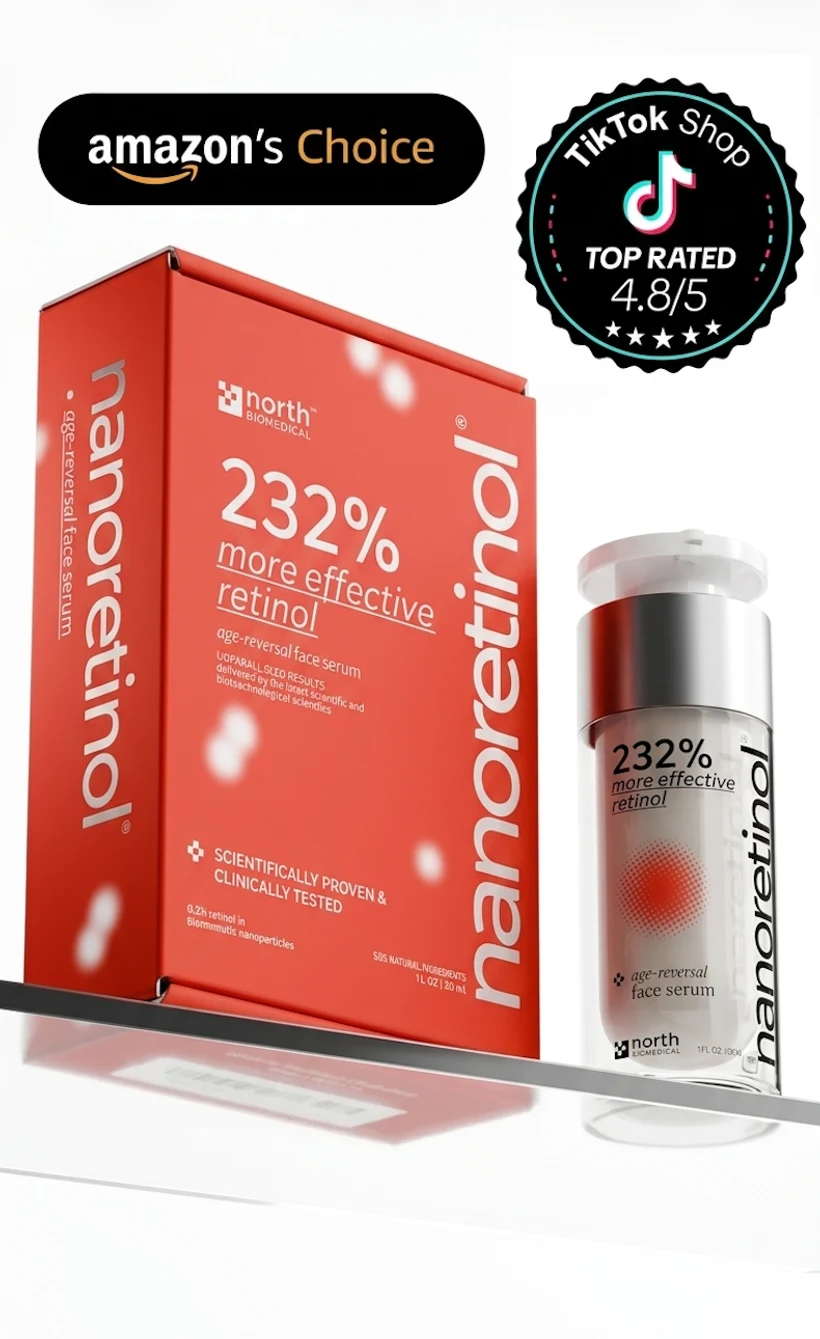
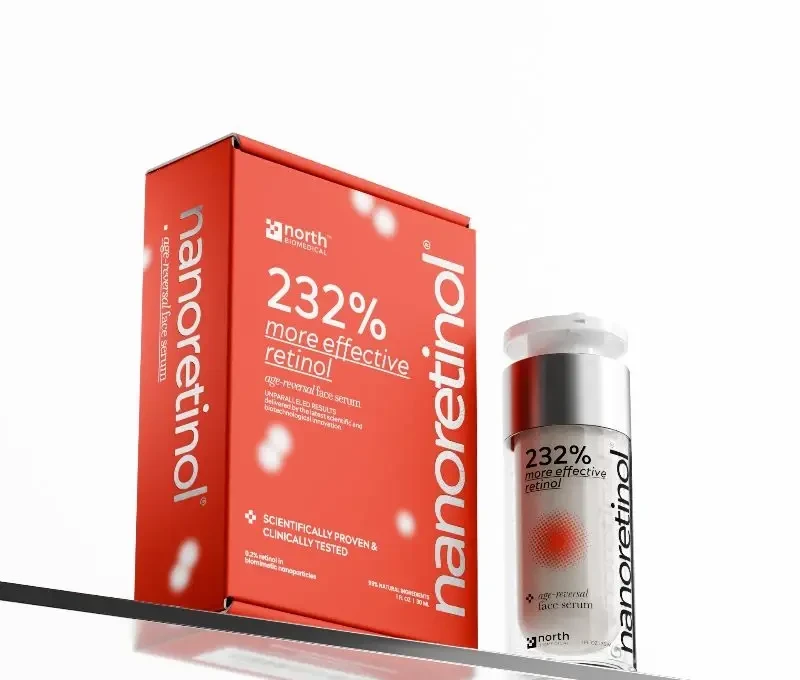
Nanoretinol takes a different route. The retinol is encapsulated in lipid nanoparticles whose outer membrane mimics the lipid composition of human skin cells. The barrier recognizes them as biological “self” and allows them through without being disrupted. In comparative testing, this delivery achieved a 232% improvement in collagen recovery and 73% improvement in elastin recovery versus conventional retinol — at significantly lower cellular toxicity. For skin that is already losing collagen by 2% a year, the delta matters.
Where to Start
If you are in your forties and noticing the early shifts, the most useful thing you can do is start before the steepest decline begins. SPF, antioxidants, and a tolerable nightly retinoid are not glamorous, but they are the only interventions that have been shown to either slow the loss or replace some of what was lost. For women already past menopause, the same routine is still worth starting — a thinner, drier dermis can still build collagen when given the right signals.
The change is not your imagination. The good news is that the biology that drove it is also the biology you can work with.
References
- Thornton MJ. “Estrogens and aging skin.” Dermato-endocrinology. 2013;5(2):264-270. doi:10.4161/derm.23872
- Brincat M, Moniz CF, Studd JW, Darby AJ, Magos A, Cooper D. “Long-term effects of the menopause and sex hormones on skin thickness.” British Journal of Obstetrics and Gynaecology. 1985;92(3):256-259. doi:10.1111/j.1471-0528.1985.tb01091.x
- Viscomi B, Bartoli F, Greco A. “Managing Menopausal Skin Changes: A Narrative Review of Skin Quality Changes, Their Aesthetic Impact, and the Actual Role of Hormone Replacement Therapy in Improvement.” Journal of Cosmetic Dermatology. 2025;24(8):e70393. doi:10.1111/jocd.70393
- Stevenson S, Thornton J. “Effect of estrogens on skin aging and the potential role of SERMs.” Clinical Interventions in Aging. 2007;2(3):283-297. doi:10.2147/cia.s798
- Shao Y, He T, Fisher GJ, Voorhees JJ, Quan T. “Molecular basis of retinol anti-ageing properties in naturally aged human skin in vivo.” International Journal of Cosmetic Science. 2017;39(1):56-65. doi:10.1111/ics.12348