Estrogen Face Cream: Does It Actually Work for Aging Skin?
What the clinical research actually shows about topical estriol and estradiol creams — and the non-hormonal alternative with prescription-tier results.
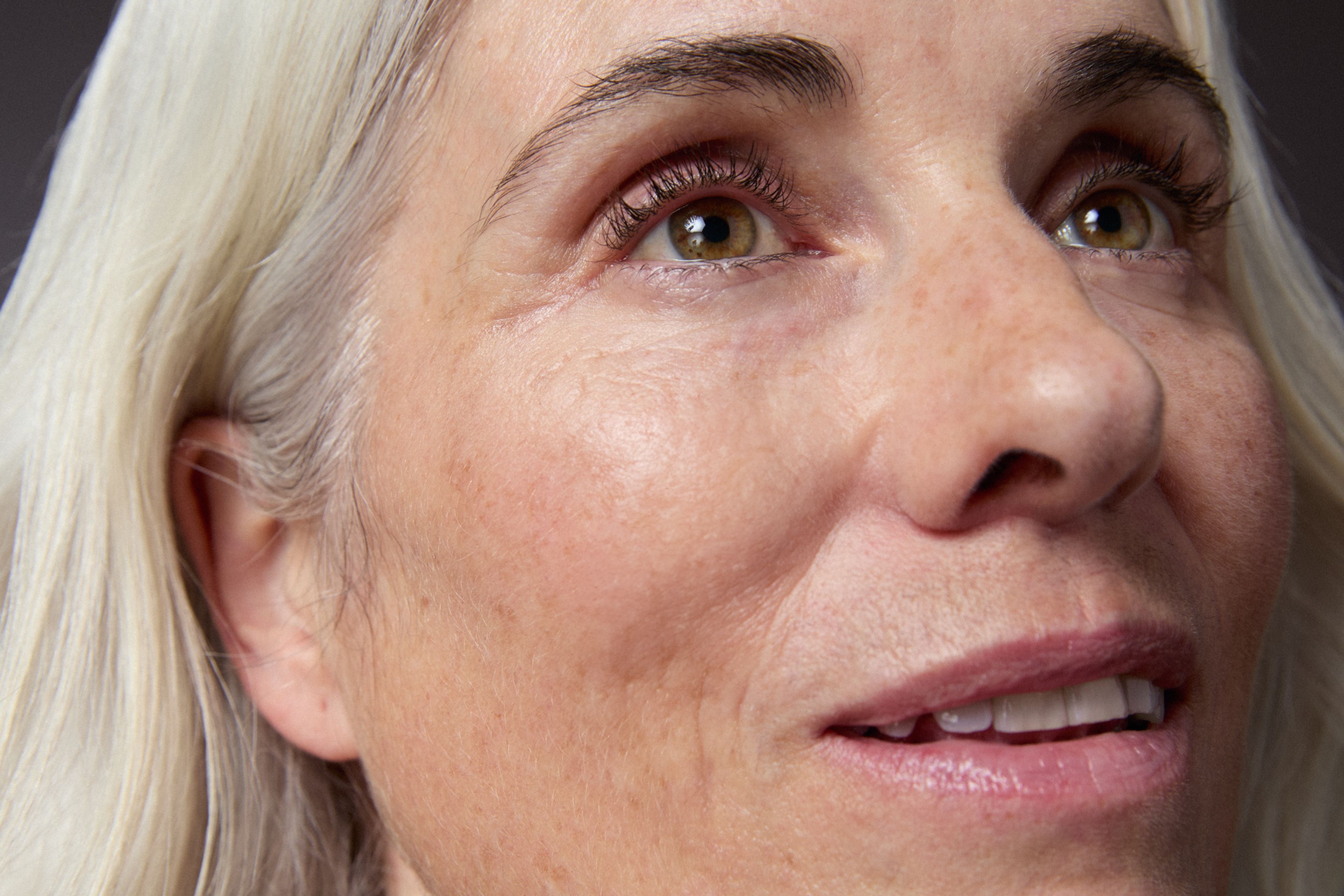
Somewhere around your late forties, your skin starts behaving like someone else’s. The cheek you used to take for granted feels slack. Pores you never noticed seem larger. Foundation that used to glide now drags. None of this is your imagination. It tracks almost exactly with the drop in circulating estrogen that begins in perimenopause and accelerates after your final period.
That’s the problem topical estrogen face creams are trying to solve. The pitch is direct: the hormone whose absence is causing the skin changes is the hormone we’ll put back. And there are clinical studies — small but real — that show it works.
So why doesn’t every woman over 50 use estrogen face cream? And if you don’t want to (or can’t), what’s the next-best evidence-backed move?
Why menopausal skin changes so quickly
In the first five years after menopause, skin collagen content can decrease by up to 30%, and after that initial period continues falling at roughly 2.1% per postmenopausal year over a 15-year window [1]. Dermal thickness drops at about 1.13% per year for the first 19 years postmenopause. Elasticity declines by approximately 1.5% per year.
These aren’t subtle changes you have to look for. They’re the rate of structural loss responsible for the visible shift: thinning, sagging, looser jawline, deeper wrinkles, dryer surface, easier bruising.
The driver is estrogen withdrawal, not chronological aging. The skin’s fibroblasts have estrogen receptors. So do its keratinocytes and melanocytes. When estrogen drops, those cells stop receiving the signal that previously kept them producing collagen, holding moisture, and maintaining elasticity [2]. Postmenopausal skin collagen content correlates better with years since menopause than with calendar age.
What topical estrogen actually does
The foundational research on topical estrogen for facial skin goes back to a 1994 pilot study by Schmidt and colleagues. Eighteen perimenopausal women applied either 0.3% estriol or 0.01% estradiol cream daily for six months. Both groups showed measurable improvements in elasticity, firmness, and skin moisture. Wrinkle depth measured by skin profilometry decreased significantly in both groups, with estriol producing slightly stronger results. No systemic hormonal side effects were detected on serum monitoring [3].
That small study has been replicated and extended. Brincat et al. demonstrated in 1987 that postmenopausal women using topical estradiol gel showed significant increases in skin collagen content within one year, with the response proportional to baseline collagen levels — meaning women with more depleted skin benefited most [4].
Somewhere around your late forties, your skin starts behaving like someone else’s.
A broader review of the evidence by Stevenson and Thornton concluded that estrogen administration meaningfully delays skin aging through documented mechanisms: increased keratinocyte proliferation, thicker epidermis, improved hydration, increased dermal collagen content and quality, and improved vascularization [5]. A 2025 narrative review on managing menopausal skin reached similar conclusions: hormone replacement therapy — systemic or topical — measurably improves skin quality in postmenopausal women [6].
So the basic answer is: yes, topical estrogen face cream works. The clinical evidence, though it relies on small studies, is real and reasonably consistent. Wrinkle depth decreases, elasticity improves, collagen content rises.
Why most women don’t use it (and probably shouldn’t run to it)
Several practical obstacles stand between the research and a routine that uses estrogen cream:
It requires a prescription, in most cases. Estriol and estradiol creams formulated for facial skin are not over-the-counter products in the United States. They are compounded by pharmacies or prescribed off-label from formulations intended for vaginal use. That means a doctor visit, a prescription, an ongoing relationship with a compounding pharmacy, and a recurring cost that varies considerably by formulation and location.
It’s not appropriate for everyone. Women with a history of estrogen-sensitive cancers (breast, endometrial), unexplained vaginal bleeding, active blood clots, or certain liver conditions are not candidates. The systemic absorption from a small amount of topical estriol applied to facial skin is low — pharmacokinetic studies have not shown clinically significant serum estradiol changes from short-term use — but the long-term safety data for sustained facial use specifically is still limited [7].
The evidence base, while consistent, is thin. Most of the foundational studies are small, often lack placebo controls, and run for six months to a year. There aren’t large randomized controlled trials of the size that would normally back a mainstream dermatology recommendation.
It addresses one pathway among several. Estrogen is the dominant driver of menopausal skin change, but it’s not the only one. UV damage, glycation, oxidative stress, and sleep disruption all contribute. Estrogen cream doesn’t address any of those. A complete approach still needs sun protection, antioxidant support, and a foundational topical that drives collagen regardless of hormone status.
The non-hormonal pathway: doing the same job without the prescription
Topical retinoids work on the same downstream output that estrogen does: they signal fibroblasts to produce more type I and type III collagen, thicken the viable epidermis, improve elasticity, and reduce wrinkle depth. They reach this effect by a different mechanism, but the visible result on aging skin overlaps significantly with what topical estrogen produces.
In the published clinical evaluation, the consequence of better delivery was a 61% increase in skin firmness and a 56% increase in skin elasticity over 56 days — numbers in the range of prescription-level results, produced at 0.2% retinol concentration.
A systematic review of randomized controlled trials of topical tretinoin for photoaging — substantially more robust than the estrogen evidence base — confirmed consistent improvements in fine lines, pigmentation, and skin texture across studies running from 3 to 24 months [8]. Tretinoin and over-the-counter retinol drive the same cellular changes that fibroblasts make when stimulated by estrogen. The signaling pathway differs; the output overlaps.
This is the practical reason most dermatologists who treat menopausal skin still recommend a foundational retinol or retinoid for every patient who tolerates one, regardless of whether the patient is also on hormone replacement therapy. Retinoid output doesn’t depend on hormonal status. It works on premenopausal skin, postmenopausal skin, women who can’t use estrogen, and women who do.
Phytoestrogens — plant-derived compounds that weakly bind estrogen receptors — are sometimes positioned as a non-prescription alternative to estrogen creams. A 2020 review in Phytotherapy Research found measurable anti-aging effects of phytoestrogens on collagen, water content, and oxidative stress in laboratory and small clinical models, but the topical clinical evidence remains weaker than either prescription estrogen or topical retinoids [9]. Useful as adjuncts, not as standalone therapy.
When estrogen cream might still be the right choice
Some women have skin changes severe enough, and a clinical profile favorable enough, that a discussion with a knowledgeable physician about topical estrogen makes sense. The candidates who most clearly benefit:
- Significant menopausal skin atrophy with thinning and severe dryness that hasn’t responded to a thorough topical regimen
- No contraindications to estrogen (no estrogen-sensitive cancer history, no clotting disorders)
- Willingness to follow up regularly with the prescribing physician
- Clear understanding that this is off-label use of a hormonal medication, not a cosmetic
Even in these cases, topical estrogen and topical retinoids work well together. They aren’t mutually exclusive. The retinoid does foundational collagen work; the estrogen targets the specific receptor-mediated signaling that menopause has shut down.
Where Nanoretinol fits
The real challenge with topical retinol — especially for menopausal women whose skin is already thinning and easily irritated — is that conventional formulations work against the skin to deliver the active. Standard retinol depends on petroleum-derived penetration enhancers that disrupt the epithelial barrier to push retinol across. The result is the redness, peeling, and stinging that drive most postmenopausal users to quit before they see benefits.
Nanoretinol takes a different approach: it encapsulates retinol in biomimetic lipid nanoparticles that pass through the epithelium because the body recognizes the lipid envelope as “self.” Same delivery technology used in pharmaceutical drug carriers, including some novel cancer therapies. The barrier stays intact. The retinol arrives at the fibroblasts that need to make new collagen.
In the published clinical evaluation, the consequence of better delivery was a 61% increase in skin firmness and a 56% increase in skin elasticity over 56 days — numbers in the range of prescription-level results, produced at 0.2% retinol concentration. For postmenopausal skin that has been losing 2% of its collagen content per year and tends to react badly to conventional formulations, a water-based gel that bypasses the petroleum-derived solvents is a meaningfully different option.
It doesn’t restore estrogen. It doesn’t have to. What it does is drive the same downstream cellular output that estrogen used to — without a prescription, without a compounding pharmacy, and without the contraindications that exclude many of the women who most need help.
How to think about this decision
If you’re under 50 and starting to notice early menopausal skin changes, the question isn’t really estrogen vs. retinol. The answer is start with a well-tolerated topical retinoid, layer in daily sunscreen, support hydration, and let the foundational work compound for six to twelve months before considering anything escalated. See our guide on retinol during menopause for how to set up that routine.
If you’re well past menopause and the skin changes have advanced, an integrated plan often does best: a tolerable daily retinoid as the foundation, with the option to layer in prescription topical estrogen if your clinical picture supports it. Procedural options — laser, RF microneedling, focused ultrasound — sit on top of, not in place of, daily topical work. See non-surgical skin tightening for how those fit.
What doesn’t work: hoping a hyaluronic acid serum and a vitamin C will compensate for the rate of collagen loss postmenopausal skin is undergoing. They won’t. The math is too steep. You need something that signals fibroblasts to do more, not less.
References
- Viscomi B, Muniz M, Sattler S. “Managing Menopausal Skin Changes: A Narrative Review of Skin Quality Changes, Their Aesthetic Impact, and the Actual Role of Hormone Replacement Therapy in Improvement.” Journal of Cosmetic Dermatology. 2025;24(Suppl 4):e70393. doi:10.1111/jocd.70393
- Thornton MJ. “Estrogens and Aging Skin.” Dermato-endocrinology. 2013;5(2):264–270. doi:10.4161/derm.23872
- Schmidt JB, Binder M, Macheiner W, Kainz C, Gitsch G, Bieglmayer C. “Treatment of skin ageing symptoms in perimenopausal females with estrogen compounds. A pilot study.” Maturitas. 1994;20(1):25–30. doi:10.1016/0378-5122(94)90097-3
- Brincat M, Versi E, O’Dowd T, Moniz CF, Magos A, Kabalan S, Studd JW. “Skin collagen changes in post-menopausal women receiving oestradiol gel.” Maturitas. 1987;9(1):1–5. doi:10.1016/0378-5122(87)90045-4
- Stevenson S, Thornton J. “Effect of estrogens on skin aging and the potential role of SERMs.” Clinical Interventions in Aging. 2007;2(3):283–297. doi:10.2147/cia.s798
- Wang Z, Man MQ, Li T, Elias PM, Mauro TM. “Aging-associated alterations in epidermal function and their clinical significance.” Aging (Albany NY). 2020;12(6):5551–5565. doi:10.18632/aging.102946
- Liu T, Li N, Yan YQ, Liu Y, Xiong K, Liu Y, Xia QM, Zhang H, Liu ZD. “Recent advances in the anti-aging effects of phytoestrogens on collagen, water content, and oxidative stress.” Phytotherapy Research. 2020;34(3):435–447. doi:10.1002/ptr.6538
- Sitohang IBS, Makes WI, Sandora N, Suryanegara J. “Topical tretinoin for treating photoaging: A systematic review of randomized controlled trials.” International Journal of Women’s Dermatology. 2022;8(1):e003. doi:10.1097/JW9.0000000000000003
- North Biomedical LLC. “Nanoretinol vs. Conventional Retinol: Efficacy in Collagen and Elastin Recovery.” Clinical Study Summary, 2024. Study summary