
Gaunt Face: What Causes a Hollow, Sunken Look — and How to Restore It
The real reasons a face looks gaunt, and what actually makes skin look fuller and firmer again
A gaunt face is rarely about the number on the scale. Two people can weigh exactly the same — one looks full and rested, the other looks drawn, shadowed, and older than their years. The difference isn’t fat versus thin. It’s architecture: how fat, bone, and skin are arranged across the face, and how much of each is still there.
When we describe a face as gaunt, we usually mean a specific pattern: cheeks that cave slightly inward, temples that dip, under-eyes that fall into shadow, and skin that seems to drape over the bone rather than sit plumply on top of it. Figuring out why that pattern appears matters enormously, because the causes are different — and so are the things that actually help.
The Face Loses Fat in a Very Particular Order
Your face isn’t padded with one uniform layer of fat. It’s built from discrete compartments — deep pads that sit against the bone and provide structural lift, and superficial pads nearer the surface that give softness and contour. These compartments don’t age at the same rate.
Detailed imaging studies show that the deep fat pads deflate first and fastest. In one computed-tomographic analysis of the midface, the deep compartments were dramatically smaller in older subjects, and the ratio of deep-to-superficial fat fell by more than half with age [1]. When the deep scaffolding shrinks, the superficial fat above it loses its support and slides downward. The result is the signature gaunt look: hollowing high on the cheek and under the eye, with softness pooling lower down toward the jaw.
This is why a gaunt face and a sagging face are often the same face. The hollow up top and the heaviness down low are two ends of a single process — deep-compartment volume loss.
Your face isn’t padded with one uniform layer of fat.
The Bone Underneath Is Shrinking, Too
Fat gets most of the attention, but the foundation itself changes. The facial skeleton is not a fixed frame; it remodels throughout life. Three-dimensional CT studies of aging faces show measurable bone resorption at key sites — the eye sockets widen, the mid-face angle recedes, and the bony rim that supports the cheek and brow pulls back [2].
As the bony platform retreats, everything layered on top of it — fat, muscle, skin — has less to rest against. A cheek that once projected forward now has nothing pushing it out. Eyes look more deep-set because the orbital rim has literally opened up. No cream changes bone, but knowing this explains why some hollowing resists every topical product: part of the cause sits deeper than any skincare can reach.
Thinning Skin Turns Soft Shadows Into Sharp Hollows
Here’s where skin — the one layer you can influence directly — enters the story. Skin that is thick, firm, and light-reflective softens the appearance of whatever is happening beneath it. Skin that is thin and slack does the opposite: it collapses into every dip and broadcasts every shadow.
And skin genuinely does thin with age. Dermal collagen, the protein that gives skin its thickness and bounce, declines steadily — research on chronologically aged skin shows that older fibroblasts simply produce less new collagen, and the existing collagen network becomes fragmented and disorganized [3]. From the mid-twenties onward, the net loss runs at roughly one percent per year. Multiply that across decades and the skin draped over a hollowing face is thinner, less elastic, and far more prone to looking crepey and sunken.
This is the crucial insight for anyone frustrated by a gaunt reflection: you may not be able to rebuild the deep fat or the bone, but improving skin quality changes how the entire face reads. Firmer, thicker skin catches light instead of falling into shadow. If you’re also noticing this on the mid-face specifically, our guide to sunken cheeks breaks the region down in more detail, and facial volume loss covers the broader picture.
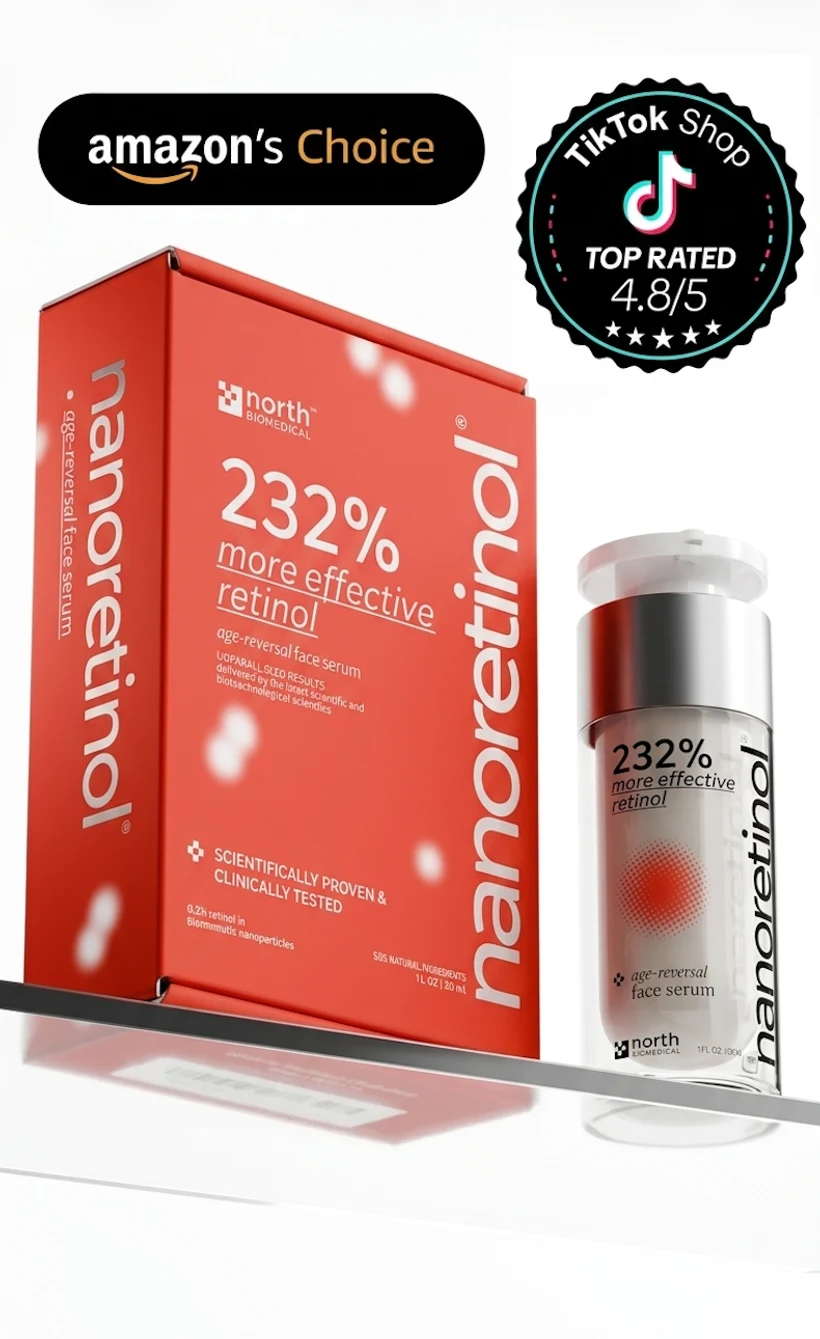
In North Biomedical’s clinical testing, Nanoretinol proved 232% more effective in collagen recovery and 73% more effective in elastin recovery than conventional retinol, and delivered a 61% increase in skin firmness and a 56% increase in skin elasticity over 56 days of use.
When Rapid Weight Loss Enters the Picture
Gauntness has accelerated in a new population lately: people losing large amounts of weight quickly. When fat leaves the body fast, it leaves the face too — and the face has proportionally little to spare. Dermatology reviews of rapid weight loss note that the sudden drop in subcutaneous fat removes the cushion that kept skin taut, unmasking laxity, hollowing, and folds that make a face look prematurely aged [5]. If you’re on that path, the mechanism (and what to do about it) is worth reading in our piece on Mounjaro face.
What Actually Helps — And What Doesn’t
The honest answer splits into two lanes.
Restoring volume is a structural problem. Lost fat and receded bone can only be replaced by things that add mass: dermal fillers, fat grafting, or — in the case of very low body fat — simply carrying a little more of it. Regaining a few pounds often softens a gaunt face faster than anything in a jar. No topical product adds volume, and any that claims to is overpromising.
Improving skin quality is the lane skincare owns, and it’s more powerful than people expect. Thicker, firmer, better-hydrated skin makes hollows look shallower and shadows look softer, even when the underlying volume hasn’t changed. The best-evidenced ingredient here is topical vitamin A. In a controlled study of naturally aged skin, retinol significantly increased glycosaminoglycan content and stimulated new collagen production — measurable matrix-building, not just surface smoothing [4]. Daily sunscreen protects that collagen from further breakdown, and a consistent, gentle routine supports the barrier so skin holds water and stays plump. For a fuller plan, see how to improve skin elasticity.
Where Nanoretinol Fits
If skin quality is the half of gauntness you can actually move, the tool you use for it should be as effective and as gentle as possible — because thinned, hollow-looking skin is often already fragile.
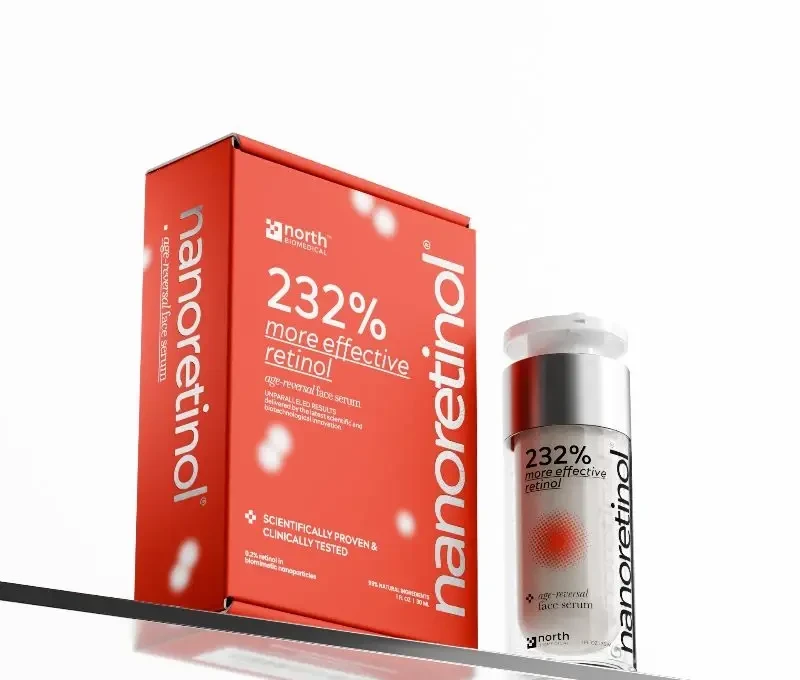
Nanoretinol was built for exactly this situation. It encapsulates retinol inside biomimetic lipid nanoparticles that the skin recognizes as “self,” carrying the active through the epithelial barrier without the chemical disruption conventional retinol relies on. In North Biomedical’s clinical testing, Nanoretinol proved 232% more effective in collagen recovery and 73% more effective in elastin recovery than conventional retinol, and delivered a 61% increase in skin firmness and a 56% increase in skin elasticity over 56 days of use. Because the delivery is gentle rather than barrier-breaking, it’s markedly less irritating — a real advantage for skin that already looks depleted.
It won’t refill a hollow cheek. Nothing topical will. But firmer, denser, more elastic skin is precisely what turns a gaunt, shadowed face into one that simply looks its age — rested rather than drawn.
Reading Your Own Face
The most useful thing you can do with a gaunt reflection is separate the layers. Ask what’s volume (fat and bone) and what’s surface (skin quality). Volume is a conversation about weight, nutrition, and — if you choose — an aesthetic professional. Surface is a conversation you can start tonight, with sun protection, hydration, and a collagen-building retinol. Address the layer you control well, and the whole face reads younger for it.
References
- Gierloff M, Stöhring C, Buder T, Gassling V, Açil Y, Wiltfang J. “Aging Changes of the Midfacial Fat Compartments: A Computed Tomographic Study.” Plastic and Reconstructive Surgery. 2012;129(1):263-273. doi:10.1097/PRS.0b013e3182362b96
- Shaw RB Jr, Kahn DM. “Aging of the Midface Bony Elements: A Three-Dimensional Computed Tomographic Study.” Plastic and Reconstructive Surgery. 2007;119(2):675-681. doi:10.1097/01.prs.0000246596.79795.a8
- Varani J, Dame MK, Rittié L, Fligiel SEG, Kang S, Fisher GJ, Voorhees JJ. “Decreased Collagen Production in Chronologically Aged Skin: Roles of Age-Dependent Alteration in Fibroblast Function and Defective Mechanical Stimulation.” The American Journal of Pathology. 2006;168(6):1861-1868. doi:10.2353/ajpath.2006.051302
- Kafi R, Kwak HSR, Schumacher WE, Cho S, Hanft VN, Hamilton TA, King AL, Neal JD, Varani J, Fisher GJ, Voorhees JJ, Kang S. “Improvement of Naturally Aged Skin With Vitamin A (Retinol).” Archives of Dermatology. 2007;143(5):606-612. doi:10.1001/archderm.143.5.606
- Haykal D, Hersant B, Cartier H, Meningaud JP. “The Role of GLP-1 Agonists in Esthetic Medicine: Exploring the Impact of Semaglutide on Body Contouring and Skin Health.” Journal of Cosmetic Dermatology. 2025;24(1):e16716. doi:10.1111/jocd.16716