Mounjaro Face: Why Rapid Weight Loss Ages the Face — and What Helps
The dermatology behind the sunken, sagging look after tirzepatide — and how to protect your skin
The results can be remarkable. In the SURMOUNT-1 trial, people taking tirzepatide — the drug sold as Mounjaro and Zepbound — lost an average of up to 20.9% of their body weight over 72 weeks, with about nine in ten participants losing weight at all [1]. For millions of people, that’s life-changing.
But there’s a catch that shows up in the mirror. As the weight comes off, many notice their face looks older, thinner, and more drawn than it did before — hollow cheeks, a softening jawline, deeper folds around the mouth. The internet named it “Mounjaro face” (a cousin of “Ozempic face”), and while the nickname is casual, the phenomenon behind it is real and well understood.
The Face Has Very Little Fat to Spare
Weight loss is fat loss, and fat doesn’t leave the body from wherever you’d prefer. It comes off everywhere — including the face, which carries proportionally little to begin with. Those small facial fat pads do outsized work: they hold the cheeks forward, keep the under-eye smooth, and fill the temples. When they shrink, the face doesn’t just look slimmer. It looks deflated.
The fat pads also don’t empty evenly. The deep pads that sit against the bone and provide structural lift tend to lose volume first, which collapses the mid-face inward while softness drifts downward toward the jaw [2]. That’s the exact recipe for the sunken-yet-saggy look people describe — hollow up high, heavy down low, on the same face at the same time.
In the SURMOUNT-1 trial, people taking tirzepatide — the drug sold as Mounjaro and Zepbound — lost an average of up to 20.9% of their body weight over 72 weeks, with about nine in ten participants losing weight at all.
Skin Doesn’t Shrink as Fast as Fat Disappears
Fat can vanish in months. Skin cannot keep up.
Skin holds its shape through a dense network of collagen and elastin. When it’s stretched over a larger frame for years and then that frame rapidly shrinks, the skin is left with more surface area than it has structure to support — so it hangs. Dermatology reviews of GLP-1–driven weight loss describe exactly this: the sudden reduction in subcutaneous fat removes the mechanical support skin was relying on, unmasking laxity and folds and accelerating the visible signs of facial aging [3]. The faster and larger the loss, the more pronounced the effect.
Age stacks the deck further. Skin’s ability to snap back depends on how much healthy collagen it has, and that reserve is already declining with time — older skin cells produce less new collagen, and the existing network grows fragmented [4]. Lose weight quickly at 30 and the skin often recoils reasonably well. Lose it quickly at 55 and there’s simply less elastic capacity to draw on.
What You Can Influence — and When
Some of “Mounjaro face” is structural volume loss that skincare can’t reverse; that lane belongs to weight management and, if you choose it, an aesthetic professional. But a large share of what makes the look worse is skin quality — thinning, laxity, and crepiness — and that lane is very much yours to work in. The mechanics overlap heavily with the broader Ozempic face conversation and with loose skin generally, covered in saggy face after weight loss.
A few levers matter most:
Lose at a sustainable pace. Slower loss gives skin time to remodel and contract, so laxity is less severe than it would be with a crash.
Some of “Mounjaro face” is structural volume loss that skincare can’t reverse; that lane belongs to weight management and, if you choose it, an aesthetic professional.
Protect your protein and muscle. Rapid weight loss on GLP-1 drugs strips lean tissue alongside fat; keeping protein intake high and doing resistance training helps preserve the underlying structure that supports the face.
Build collagen in the skin itself. This is where a proven topical earns its place. In a controlled study of naturally aged skin, topical retinol significantly boosted glycosaminoglycan levels and stimulated new collagen synthesis — genuine matrix-building that thickens and firms skin over time [5]. Firmer, denser skin tolerates volume loss far more gracefully than thin, slack skin does. For a routine-level plan, see how to tighten loose skin.
Where Nanoretinol Fits
The problem with fighting laxity during rapid weight loss is timing: your skin needs collagen support most at exactly the moment it’s under the most stress — and stressed, thinning skin is easily irritated by aggressive actives. You want maximum collagen-building with minimum harshness.
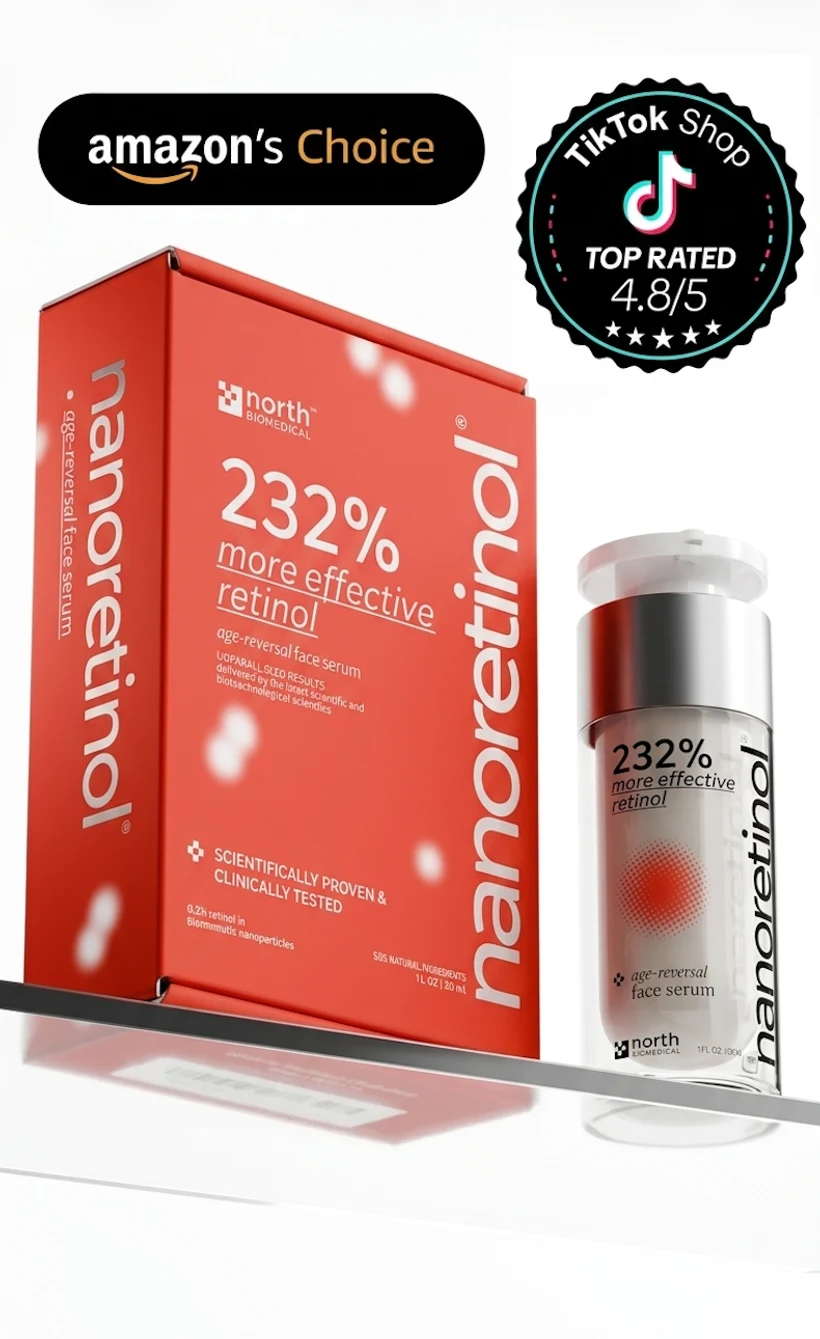
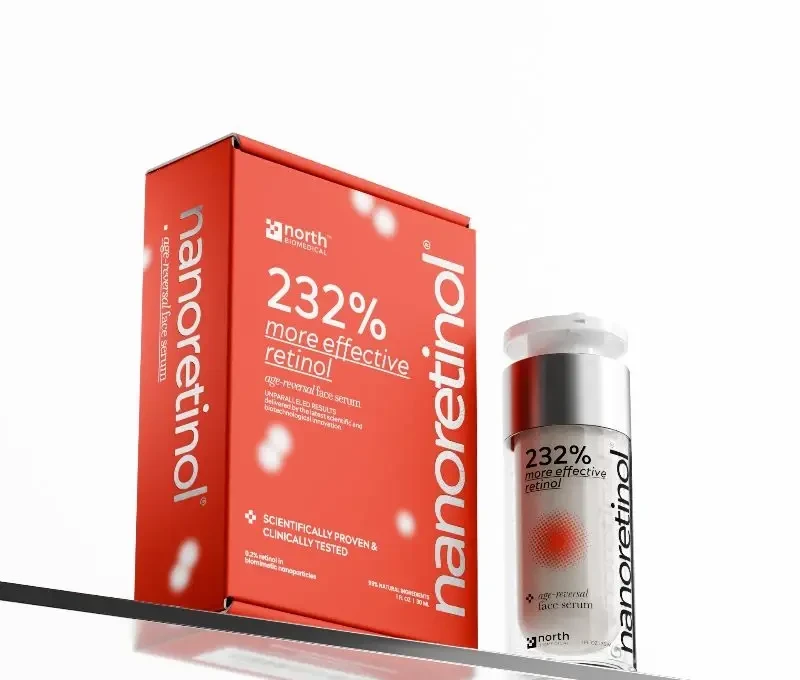
That’s the gap Nanoretinol was designed to close. It wraps retinol inside biomimetic lipid nanoparticles that pass through the skin barrier because the body recognizes them as “self,” rather than forcing entry by breaking the barrier down the way conventional retinol does. In North Biomedical’s clinical testing, Nanoretinol was 232% more effective in collagen recovery and 73% more effective in elastin recovery than conventional retinol, producing a 61% increase in skin firmness and a 56% increase in skin elasticity over 56 days — while being significantly gentler, with drastically reduced cytotoxicity to skin cells.
For someone watching their face change week by week on Mounjaro, that combination — strong collagen and elastin stimulation without the burning and peeling — is the whole point. It won’t refill lost fat, but it directly targets the firmness and elasticity that decide whether skin drapes or holds.
The Takeaway Worth Keeping
Mounjaro face is the predictable consequence of fast fat loss meeting skin that can’t shrink at the same speed. You can’t stop the fat from leaving your face, but you can change how well the skin over it holds up — by losing weight at a livable pace, defending your muscle and protein, and building real collagen in the skin before, during, and after the journey. The goal isn’t to look heavier. It’s to keep the face that emerges looking firm and rested instead of hollow and tired.
References
- Jastreboff AM, Aronne LJ, Ahmad NN, et al. “Tirzepatide Once Weekly for the Treatment of Obesity.” New England Journal of Medicine. 2022;387(3):205-216. doi:10.1056/NEJMoa2206038
- Gierloff M, Stöhring C, Buder T, Gassling V, Açil Y, Wiltfang J. “Aging Changes of the Midfacial Fat Compartments: A Computed Tomographic Study.” Plastic and Reconstructive Surgery. 2012;129(1):263-273. doi:10.1097/PRS.0b013e3182362b96
- Haykal D, Hersant B, Cartier H, Meningaud JP. “The Role of GLP-1 Agonists in Esthetic Medicine: Exploring the Impact of Semaglutide on Body Contouring and Skin Health.” Journal of Cosmetic Dermatology. 2025;24(1):e16716. doi:10.1111/jocd.16716
- Varani J, Dame MK, Rittié L, Fligiel SEG, Kang S, Fisher GJ, Voorhees JJ. “Decreased Collagen Production in Chronologically Aged Skin: Roles of Age-Dependent Alteration in Fibroblast Function and Defective Mechanical Stimulation.” The American Journal of Pathology. 2006;168(6):1861-1868. doi:10.2353/ajpath.2006.051302
- Kafi R, Kwak HSR, Schumacher WE, Cho S, Hanft VN, Hamilton TA, King AL, Neal JD, Varani J, Fisher GJ, Voorhees JJ, Kang S. “Improvement of Naturally Aged Skin With Vitamin A (Retinol).” Archives of Dermatology. 2007;143(5):606-612. doi:10.1001/archderm.143.5.606