How to Get Glass Skin Over 40: The Korean Approach, Translated for Mature Skin
Glass skin is barrier function plus hydration plus light reflection — here is what actually delivers it after menopause.
What “Glass Skin” Actually Means
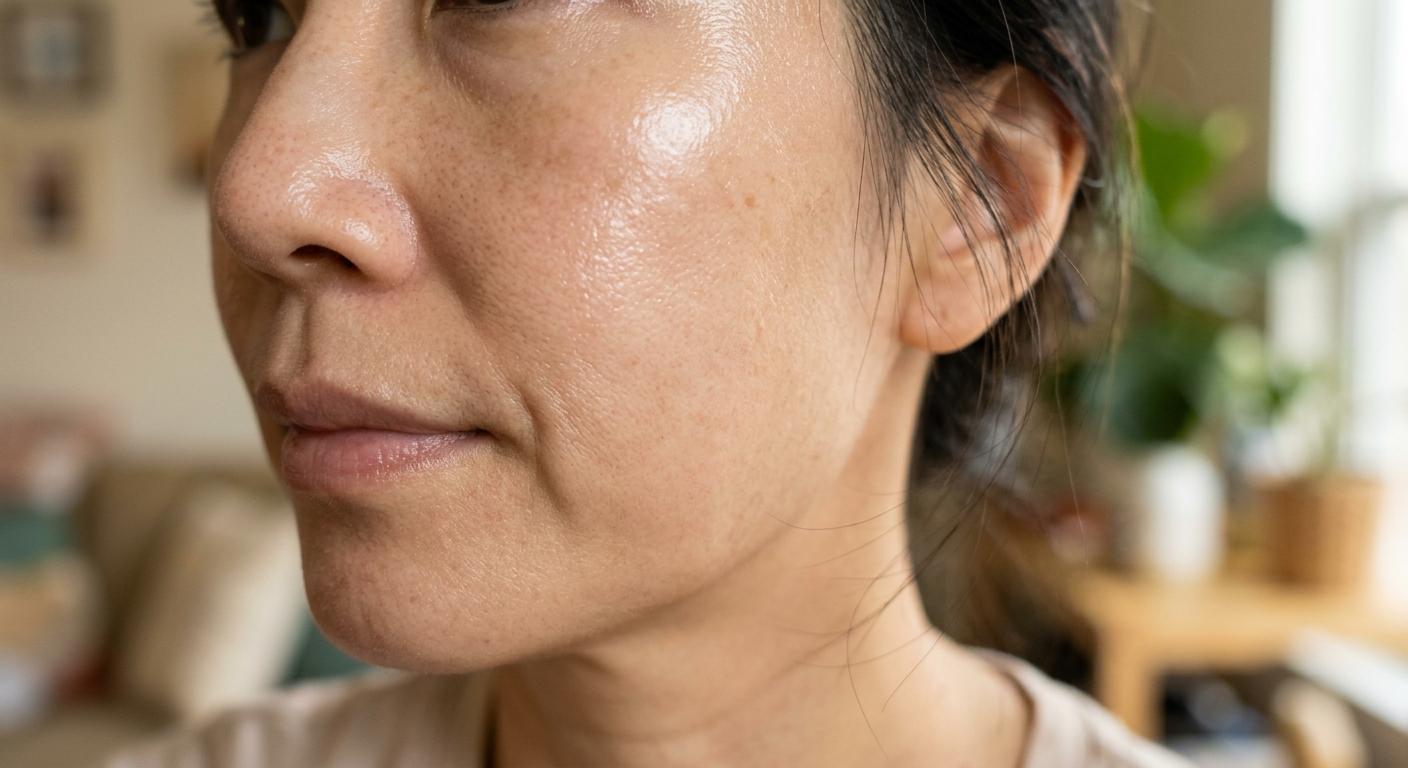
Set aside the Instagram aesthetic for a second. “Glass skin” is not a filter and it is not a single product. It is what skin looks like when three things are simultaneously true: the stratum corneum is fully hydrated, the lipid barrier is intact and reflective, and the dermis underneath is plump enough to push light back out evenly. Korean dermatologists popularized the term, but the underlying biology is universal.
The reason glass skin gets harder to achieve after 40 is not mysterious. Each of those three layers loses ground at midlife. Stratum corneum lipids decline. Hyaluronic acid in the dermis drops. Cell turnover slows. The result is the dull, flat, sometimes crepey look that women describe as “my skin doesn’t catch light the way it used to.”
The good news: the same biology that creates glass skin in a 22-year-old K-beauty influencer can be re-engineered in a 50-year-old face. The routine just looks different.
The Three Layers of Glass Skin
Layer 1: The Stratum Corneum (Surface Reflection)
For skin to look like glass, its outermost layer needs to be smooth and water-saturated. A well-hydrated stratum corneum reflects light specularly — like a polished surface — while a dehydrated one scatters light diffusely, producing a dull, matte appearance.
This is why glass skin routines obsess over hydration, not “moisture” in the colloquial sense. The marker that matters is stratum corneum hydration measured by capacitance, and the marker that signals problems is transepidermal water loss (TEWL). When TEWL is high, water is escaping faster than humectants can pull it in, and no amount of expensive cream fixes that without barrier repair underneath.
Layer 2: The Lipid Barrier (Integrity)
Beneath the corneocytes sits a lipid matrix made roughly of ceramides, cholesterol, and free fatty acids in a specific ratio. After 40 — and especially after menopause — ceramide content drops. This is the structural reason skin starts to feel rough, look duller, and react more to actives.
A qualitative review of 12 randomized controlled trials concluded that ceramide-containing topical preparations meaningfully improve barrier function and reduce TEWL in compromised skin [1]. The clinical magnitude varies, but the direction is unambiguous.
Layer 3: The Dermis (Push Back the Light)
Glass skin is not just a surface effect. The dermis underneath has to be dense enough to support the structures above. Two things matter here: collagen density (which provides architecture) and dermal hyaluronic acid (which holds water, providing volume). Both fall with age. A dermis that is thin and dehydrated produces skin that looks crepey no matter how much moisturizer sits on top.
Set aside the Instagram aesthetic for a second. “Glass skin” is not a filter and it is not a single product.
This is why a teenager can produce glass skin with a single sheet mask and a 55-year-old cannot. The teenager’s dermis is already doing the heavy lifting.
The Korean Routine, Translated for Mature Skin
Traditional 10-step routines were optimized for skin that already has structural integrity. Over 40, simplify and prioritize the actives that rebuild — not just hydrate.
Step 1: A Cleanser That Does Not Strip
High-pH foaming cleansers are the fastest way to destroy glass-skin potential. They lift the surface lipids you are trying to preserve. Use a low-pH, syndet, or oil-based cleanser. Aim for skin that feels supple — not “clean” in the squeaky sense.
Step 2: Layered Hydration With Low-Molecular-Weight HA
Hydration toners and essences carry small humectant molecules that pull water into the stratum corneum. Molecular weight matters: a 2024 randomized controlled trial in elderly subjects found that low-molecular-weight hyaluronic acid produced significantly higher skin capacitance values than high-molecular-weight HA after four weeks of topical application [2]. Mature skin specifically benefits from LMW HA because it can actually penetrate the stratum corneum rather than sitting on top. Warm steam swells that same layer temporarily, which is why a facial steamer can make skin look glassy for an hour without changing anything lasting.
Step 3: Niacinamide Serum
Niacinamide is the closest thing to a glass-skin multitasker. In keratinocyte models, niacinamide increases ceramide biosynthesis by 4.1- to 5.5-fold by upregulating serine palmitoyltransferase — the rate-limiting enzyme in sphingolipid synthesis [3]. In humans, 2% niacinamide reduces TEWL by roughly 24% and increases stratum corneum hydration by 35%. It also brightens by inhibiting melanosome transfer and refines pore appearance — all visible glass-skin markers.
Step 4: Ceramide-Rich Moisturizer
Look for products that list multiple ceramide types (NP, AP, EOP) plus cholesterol and fatty acids. This is barrier replacement therapy in cream form. Synthetic ceramides in physiological ratios outperform single-ceramide products in TEWL reduction [1].
Step 5: A Glycerin-Rich Layer
Glycerin is the most underrated glass-skin ingredient because it sounds boring. A controlled in-vivo study found that glycerol-treated sites recovered barrier function faster than control sites after tape stripping and detergent-induced damage [4]. Beneficial effects persisted after treatment cessation — meaning glycerin stimulates endogenous repair, not just surface humectancy.
This is the step most “glass skin over 40” guides skip — and the one that actually changes the outcome.
Step 6: The Active That Rebuilds the Dermis (At Night)
This is the step most “glass skin over 40” guides skip — and the one that actually changes the outcome.
Surface hydration produces a glass-skin effect that lasts hours. Structural change in the dermis produces an effect that lasts years. The most reliable dermal-rebuilding active is a retinoid. In the landmark Kafi et al. study, applying 0.4% retinol three times weekly to the arms of elderly subjects (mean age 87) for 24 weeks produced significant increases in glycosaminoglycan expression and procollagen I — and significant reductions in fine wrinkling [5]. Glycosaminoglycans are exactly what hold water in the dermis. Procollagen I is exactly what restores the density that supports light reflection.
Conventional retinol delivers these benefits but only after a tolerability gauntlet of redness, peeling, and barrier disruption — the opposite of glass skin. For routine maintenance of mature skin, the formulation matters as much as the molecule.
Where Glass-Skin Routines Fall Apart Over 40
The single most common failure mode is doing the hydration steps perfectly while skipping the active that rebuilds the dermis. Skin looks plump and glowy for a few hours after the routine, then collapses back to baseline by mid-afternoon because the underlying structure has not changed.
The second most common failure mode is over-exfoliating. K-beauty influencers in their twenties sometimes layer AHAs and BHAs aggressively. After 40, the lipid barrier cannot tolerate this — TEWL spikes and the glass-skin effect inverts into the opposite: red, dry, and rough.
A Pragmatic Routine That Actually Works
Morning:
- Low-pH cleanser
- Low-molecular-weight HA essence
- Niacinamide serum
- Ceramide moisturizer
- SPF 50 (non-negotiable — UV degrades collagen via MMP-1 activation [6])
Evening:
- Oil cleanse, then low-pH cleanser
- LMW HA essence
- Niacinamide serum
- Encapsulated retinol — applied to dry skin
- Ceramide moisturizer to lock everything in
The Delivery Question
The reason most “glass skin over 40” routines fail at step 6 is that conventional retinol is incompatible with the barrier integrity the rest of the routine is trying to build. Burning, peeling, and redness directly negate glass-skin markers.
Nanoretinol addresses this with biomimetic lipid nanoparticles. The particles are recognized by skin cells as “self” and pass through the epithelial barrier without disrupting it [7]. Independent clinical testing demonstrated 232% greater collagen recovery and 73% greater elastin recovery vs. conventional retinol, with a 61% increase in skin firmness and 56% increase in skin elasticity at 56 days. Crucially for a glass-skin routine, side effects are minimal — meaning users can run the active nightly without triggering the very redness and peeling that would undo the rest of the routine.
For women over 40 chasing the glass-skin look, the practical question is not “what serum tonight” but “what actually rebuilds the dermis I have now.” A delivery system that does not break the barrier on its way in is the missing piece.
The Honest Timeline
Hydration steps produce visible glass-skin effects in days. Niacinamide-driven barrier improvements show up in 2-4 weeks. Dermal rebuilding from retinol takes 12-24 weeks to show structurally [5]. Photos of “glass skin in 7 days” are almost always before-and-after lighting changes plus surface hydration.
Plan for three months of consistent use before judging the look. Glass skin over 40 is achievable — it just runs on a longer clock than glass skin at 22.
References
- Kono T, Miyachi Y, Kawashima M. Clinical significance of the water retention and barrier function-improving capabilities of ceramide-containing formulations: A qualitative review. The Journal of Dermatology. 2021;48(12):1807-1816. doi:10.1111/1346-8138.16175
- Muhammad P, Novianto E, Setyorini M, et al. Effectiveness of topical hyaluronic acid of different molecular weights in xerosis cutis treatment in elderly: a double-blind, randomized controlled trial. Archives of Dermatological Research. 2024;316(6):329. doi:10.1007/s00403-024-03003-2
- Tanno O, Ota Y, Kitamura N, Katsube T, Inoue S. Nicotinamide increases biosynthesis of ceramides as well as other stratum corneum lipids to improve the epidermal permeability barrier. British Journal of Dermatology. 2000;143(3):524-531. doi:10.1111/j.1365-2133.2000.03705.x
- Fluhr JW, Gloor M, Lehmann L, Lazzerini S, Distante F, Berardesca E. Glycerol accelerates recovery of barrier function in vivo. Acta Dermato-Venereologica. 1999;79(6):418-421. doi:10.1080/000155599750009825
- Kafi R, Kwak HS, Schumacher WE, et al. Improvement of naturally aged skin with vitamin A (retinol). Archives of Dermatology. 2007;143(5):606-612. doi:10.1001/archderm.143.5.606
- Quan T, Fisher GJ. Role of age-associated alterations of the dermal extracellular matrix microenvironment in human skin aging: a mini-review. Gerontology. 2015;61(5):427-434. doi:10.1159/000371708
- North Biomedical LLC. “Nanoretinol vs. Conventional Retinol: Efficacy in Collagen and Elastin Recovery.” Clinical Study Summary, 2024. northbiomedical.com/documents/Nanoretinol-Study_Summary.pdf