
Saggy Face After Weight Loss: Why It Happens and What You Can Actually Do About It
The face you saw in the mirror at 180 pounds isn't the same face at 130 — and the reason isn't only the missing fat.
Most people who lose 30, 50, or 100 pounds describe the same surprise. The clothes fit, the bloodwork improves, the mirror shows a smaller body — and a face that looks ten years older than it did six months ago. Cheekbones suddenly visible, jawline blurred instead of sharper, eye sockets a little deeper, lines that weren’t there before now framing the mouth.
This isn’t your imagination, and it isn’t bad luck. It’s anatomy and biomechanics colliding with a kind of weight loss the face has no good adaptive response to.
The Face Is Built on Compartments, Not One Big Layer of Fat
Anatomists used to assume facial fat was a single subcutaneous blanket. In 2007, Rohrich and Pessa published the cadaver dissection work that changed the model: facial fat is partitioned into discrete, compartmentalized pads separated by fibrous septa — each with its own vascular supply and its own behavior [1].
That detail matters because the compartments don’t empty proportionally. The deep medial cheek fat pad, the buccal fat pad, the lateral temporal fat — each loses volume at its own rate during weight loss, and never in the symmetric way the rest of the body does. The result is what plastic surgeons call “skeletonization”: the underlying bony architecture starts showing through because the fat pads padding it are gone.
You don’t lose facial weight smoothly. You lose it in chunks, from compartments you can’t choose.
Why Skin Doesn’t Just Snap Back
The intuitive expectation — that skin shrinks to fit the new face — runs into two biological problems.
The first is the mechanical loading hypothesis. Skin fibroblasts behave like miniature engineers: they read the tension on the surrounding matrix and adjust collagen production accordingly. Varani’s group demonstrated that fibroblasts which lose mechanical loading downregulate collagen synthesis dramatically [2]. When facial fat empties, the dermis loses its tension scaffolding, and the cells that should be rebuilding the matrix instead go quiet.
The second is fibroblast collapse. Fisher’s mechanistic review described this as a self-perpetuating loop: collapsed fibroblasts produce less collagen and more matrix-metalloproteinases (MMPs), which then degrade what collagen remains. Loose skin doesn’t just sit there waiting to retract — it’s actively being broken down faster than it’s being rebuilt [3].
The elastin in your face is mostly the elastin you were born with.
The Speed of Weight Loss Decides the Outcome
A 2024 systematic review compared facial soft-tissue outcomes across bariatric surgery, medical weight loss, and GLP-1 receptor agonist therapy. The authors documented “accelerated facial aging from fat devolumization and skin laxity” — and the pattern correlated with how fast the weight came off [4]. Slow, gradual loss gave skin a chance to remodel. Rapid loss didn’t.
This is the unflattering truth about GLP-1 medications. They work too well, too quickly, for the face to keep up. A separate 2025 systematic review of “Ozempic face” in plastic surgery characterized the phenomenon as a real clinical entity, not a media invention — GLP-1-induced facial laxity is reproducible across patient cohorts and increasingly common in aesthetic dermatology consultations [5]. A 24-patient clinical case series the same year documented the phenotype in detail and described radiofrequency intervention outcomes [6].
The mechanism is straightforward: a body losing 1.5-2 pounds per week on semaglutide is losing facial volume faster than the skin’s collagen turnover cycle can adapt.
Why Your Forties Make This Worse
If you lost weight at 25, your face would partially recover. At 45, it largely won’t — and the reason is in your elastin.
Elastin is the protein that gives skin its ability to recoil after being stretched. It’s also one of the longest-lived proteins in the human body. A landmark 1991 study used radiocarbon dating from atmospheric nuclear weapons tests to estimate the half-life of human elastic fibers at approximately 70 years [7]. The elastin in your face is mostly the elastin you were born with.
Your body essentially does not replace elastin. The fibers you have at 40 are what you’ll have at 60 — and what you damage in your 40s through rapid weight loss, sun exposure, or smoking is not coming back. This is why facial recoil capacity drops so sharply in the fourth decade: there’s no manufacturing line replacing the worn parts.
Add in age-related collagen loss — roughly 1% per year from age 25, accelerating during perimenopause — and the structural margin for facial fat loss in midlife is thin.
At 45, it largely won’t — and the reason is in your elastin.
What Actually Helps (And What Doesn’t)
The interventions stack up by evidence quality:
Surgical fat grafting and fillers — strongest evidence. Restoring volume to the emptied compartments is, mechanically, the only thing that truly reverses the deflated look. This is what dermatologists and plastic surgeons offer.
Energy-based devices (RF microneedling, ultrasound). Moderate evidence for inducing dermal remodeling and modest collagen synthesis. They help skin texture more than they fix volume.
Topical retinoids — meaningful, well-documented effect on collagen. The Griffiths 1993 NEJM trial showed that tretinoin produced an 80% increase in collagen I formation in photodamaged skin over six months, while vehicle showed a 14% decrease [8]. This is the gold-standard randomized controlled trial on topical collagen induction, and it directly addresses the mechanism that’s failing after weight loss: collapsed fibroblasts under-producing collagen.
Hydration, peptides, vitamin C. Supportive, not transformative. Useful as part of a stack but won’t move the needle alone.
“Skin tightening” creams without retinoid mechanism. Mostly marketing.
The other things that get suggested — facial exercises, gua sha, jade rollers, supplements — have either no controlled evidence for sagging skin or evidence so weak it doesn’t survive a careful read.
The Retinol Problem (and What’s Replaced It)
If retinoids drive the structural collagen response, why don’t more women in their 40s and 50s use them through weight loss?
Because conventional retinol burns. The peeling, redness, and barrier disruption are why ~60% of women who start retinol stop within three months — exactly the wrong move when you need months of fibroblast stimulation to remodel post-weight-loss skin. Tretinoin vs retinol and how long retinol takes to work both explore why irritation derails the only proven topical that addresses structural laxity.
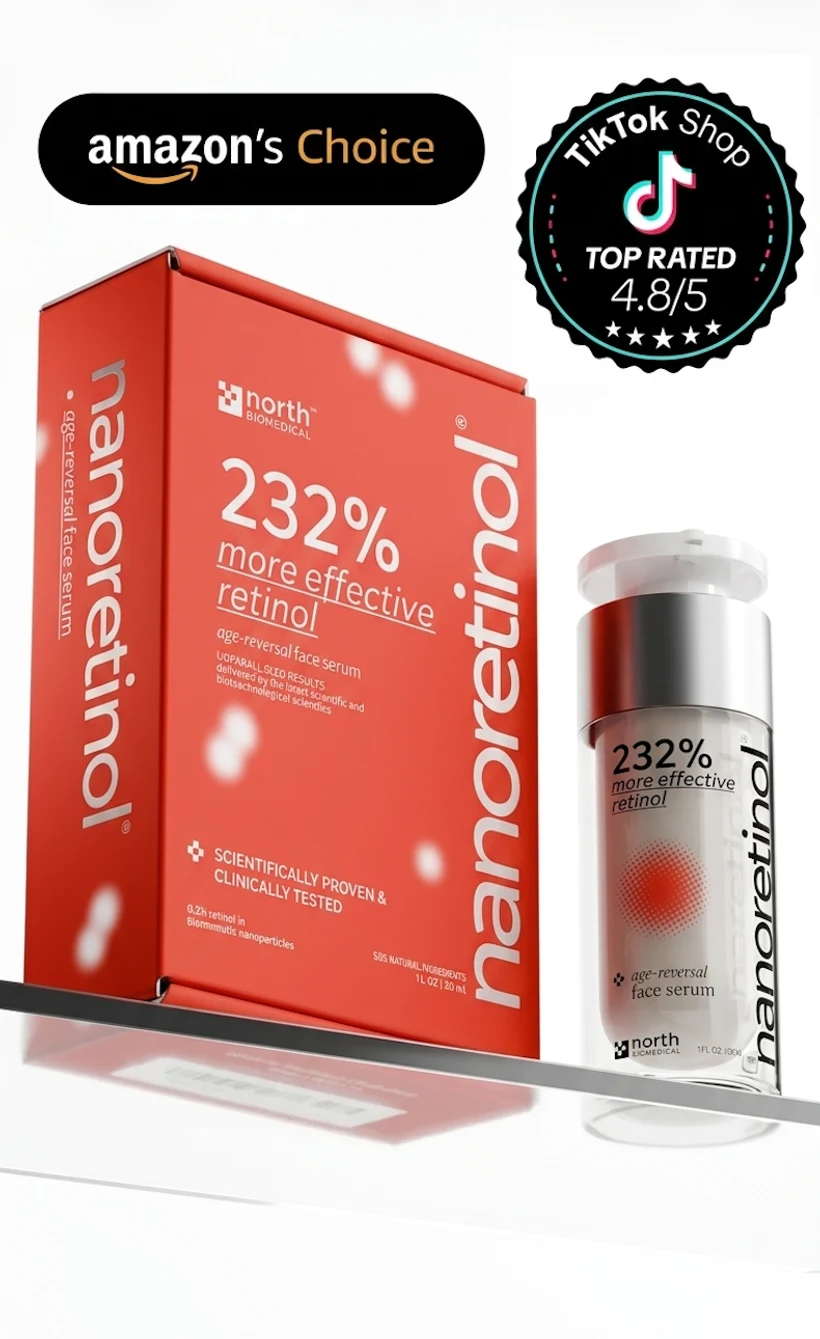
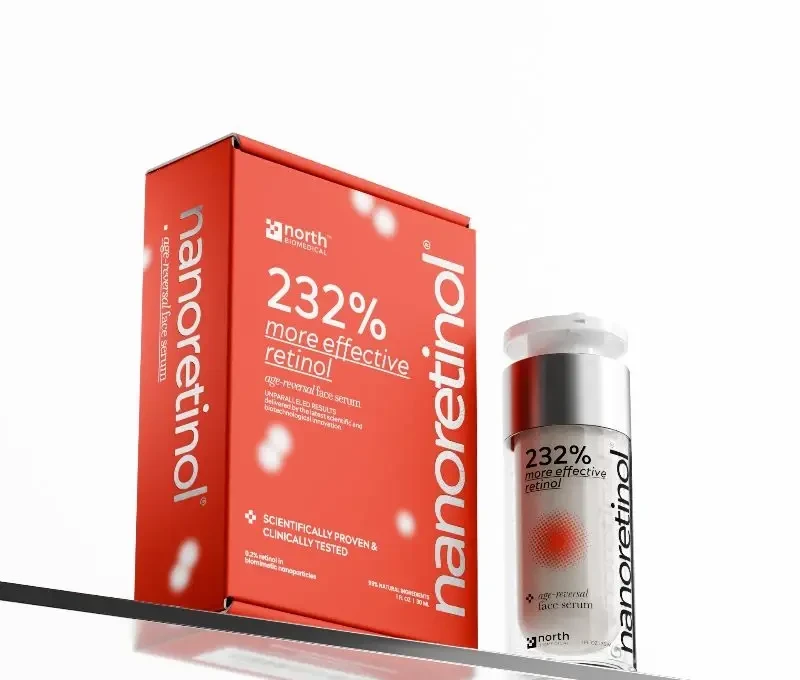
This is the gap Nanoretinol was developed to close. Conventional retinol formulations break through the epithelial barrier by disrupting it — the same mechanism that produces the burning. Nanoretinol uses biomimetic lipid nanoparticles: the retinol is encapsulated in particles externally identical to skin cells, which the epithelial barrier recognizes as “self” and allows through intact. The barrier never has to be damaged.
The clinical study comparing Nanoretinol to conventional retinol showed 232% greater collagen recovery, 73% greater elastin recovery, and a 56% increase in skin elasticity over 56 days — alongside significantly reduced cytotoxicity. For women trying to remodel the face during or after major weight loss, the math is straightforward: the structural response retinol drives, without the barrier damage that would force them to stop.
A Realistic Plan If You’re Mid-Weight-Loss Right Now
Most of the advice on the internet about post-weight-loss face sagging is sold by people who want you to book a consultation. The boring, low-cost prevention plan looks more like this:
- Slow the rate of loss if you can. 1 pound per week gives the face more time to remodel than 2-3 pounds per week. This is one decision you actually control on a GLP-1.
- Start retinoid therapy at the beginning of weight loss, not the end. Collagen turnover takes months. Starting at the start means the dermis is rebuilding while it’s deflating.
- Protect the elastin you have. Daily SPF, no smoking, manage alcohol. The elastic fibers in your face are the ones you’ll have at 70.
- Adequate protein intake. Skin synthesis is amino-acid-limited. 1.2-1.6 g protein per kg of goal body weight, especially on aggressive weight loss protocols.
- Accept that some of this will need volume restoration eventually. Topicals build collagen; they don’t refill an empty buccal fat pad. Knowing what’s a topical problem and what’s a facial volume loss problem prevents a lot of wasted money on the wrong products.
The face you’ll have a year from now is being decided by what you do over the next twelve months — most of it now, not after the weight is off.
References
- Rohrich RJ, Pessa JE. The fat compartments of the face: anatomy and clinical implications for cosmetic surgery. Plastic and Reconstructive Surgery. 2007;119(7):2219-2227. doi:10.1097/01.prs.0000265403.66886.54
- Varani J, Dame MK, Rittie L, et al. Decreased collagen production in chronologically aged skin: roles of age-dependent alteration in fibroblast function and defective mechanical stimulation. American Journal of Pathology. 2006;168(6):1861-1868. doi:10.2353/ajpath.2006.051302
- Fisher GJ, Varani J, Voorhees JJ. Looking older: fibroblast collapse and therapeutic implications. Archives of Dermatology. 2008;144(5):666-672. doi:10.1001/archderm.144.5.666
- Jafar AB, Jacob J, Kao WK, Ho T. Soft tissue facial changes following massive weight loss secondary to medical and surgical bariatric interventions: a systematic review. Aesthetic Surgery Journal Open Forum. 2024;6:ojae069. doi:10.1093/asjof/ojae069
- Daneshgaran G, Shauly O, Gould DJ. “Ozempic face” in plastic surgery: a systematic review of the literature on GLP-1 receptor agonist mediated weight loss and analysis of public perceptions. Aesthetic Surgery Journal Open Forum. 2025;7:ojaf056. doi:10.1093/asjof/ojaf056
- Catalfamo L, De Ponte FS, De Rinaldis D. “Ozempic face”: an emerging drug-related aesthetic concern and its treatment with endotissutal bipolar radiofrequency. Journal of Clinical Medicine. 2025;14(15):5269. doi:10.3390/jcm14155269
- Shapiro SD, Endicott SK, Province MA, Pierce JA, Campbell EJ. Marked longevity of human lung parenchymal elastic fibers deduced from prevalence of D-aspartate and nuclear weapons-related radiocarbon. Journal of Clinical Investigation. 1991;87(5):1828-1834. doi:10.1172/JCI115204
- Griffiths CEM, Russman AN, Majmudar G, Singer RS, Hamilton TA, Voorhees JJ. Restoration of collagen formation in photodamaged human skin by tretinoin (retinoic acid). New England Journal of Medicine. 1993;329(8):530-535. doi:10.1056/NEJM199308193290803