
Necklace Lines: What Those Horizontal Rings Around Your Neck Really Are
Sometimes called Venus rings or necklace wrinkles — why they appear earlier than you would expect, and what genuinely softens them
They have a surprisingly poetic name for something most people are not thrilled to notice: Venus rings. More plainly, they are necklace lines — the horizontal creases that wrap around the neck like the impression of a fine chain. Unlike most signs of aging, these can show up early, sometimes in the twenties or thirties, which is exactly what makes them so unsettling to spot in a photograph.
If you have started noticing yours, the first thing worth knowing is that necklace lines are their own specific concern, distinct from the other things that happen to a neck over time. Treating them well starts with understanding what they actually are — and being honest about which ones you can erase and which ones you can only soften.
What necklace lines actually are
Necklace lines are horizontal folds that run side to side across the front of the neck. That horizontal direction is the key detail, because it separates them from the two other common neck complaints. Vertical cords that stand out when you tense — those are platysmal neck bands, a muscle issue. A general thin, crinkled looseness across the whole neck is crepiness. Necklace lines are the discrete, ringed creases that sit in fixed positions, as if the skin has been folded along the same lines again and again.
And in many cases, it has. Some necklace lines are partly structural from birth or early life, set into the skin by the way the neck naturally flexes and folds. This is why a slim, young person with no other signs of aging can still have them. Others are earned over decades. Most people have a mix of both, which is the single most important fact for setting expectations: the treatable portion is the part driven by aging and damage, not the part built into the neck’s architecture.
Vertical cords that stand out when you tense — those are platysmal neck bands, a muscle issue.
Why the neck shows these lines so readily
The neck is, in skincare terms, a difficult neighborhood. Its skin is among the thinnest on the body and carries fewer oil glands than the face, so it dries out faster and has less structural cushion to begin with. Layered on top of that is the same collagen decline that affects skin everywhere: skin collagen falls by roughly 1% per year through adult life, and the dermis grows thinner along with it [1]. On a neck that started thin, that steady loss is felt sooner and shows more.
Then there is movement. The neck bends every time you look down — at a phone, a book, a screen — and each fold stresses the same lines of skin, the mechanism behind what is now commonly called tech neck. Repeated folding along a fixed crease gradually etches it deeper, the same way a sheet of paper creased in the same spot eventually holds the fold on its own.
The role of the sun
Sunlight does to the neck what it does everywhere, only faster, because the neck is so often left out of daily sunscreen. Ultraviolet radiation drives skin cells to produce matrix metalloproteinase enzymes that break down existing collagen, dismantling the very scaffolding that keeps a crease from setting [2]. Over years, chronic exposure also produces solar elastosis — an accumulation of clumped, abnormal elastin that has lost its ability to spring the skin back into place [3]. A neck with degraded collagen and non-functional elastin has little capacity to resist a fold, so the lines deepen and stay.
That is also the encouraging part of the story. The sun-and-collagen component of necklace lines is the part you can influence — which means daily sun protection is not an optional add-on here. It is the single most effective thing you can do to keep the treatable lines from getting worse.
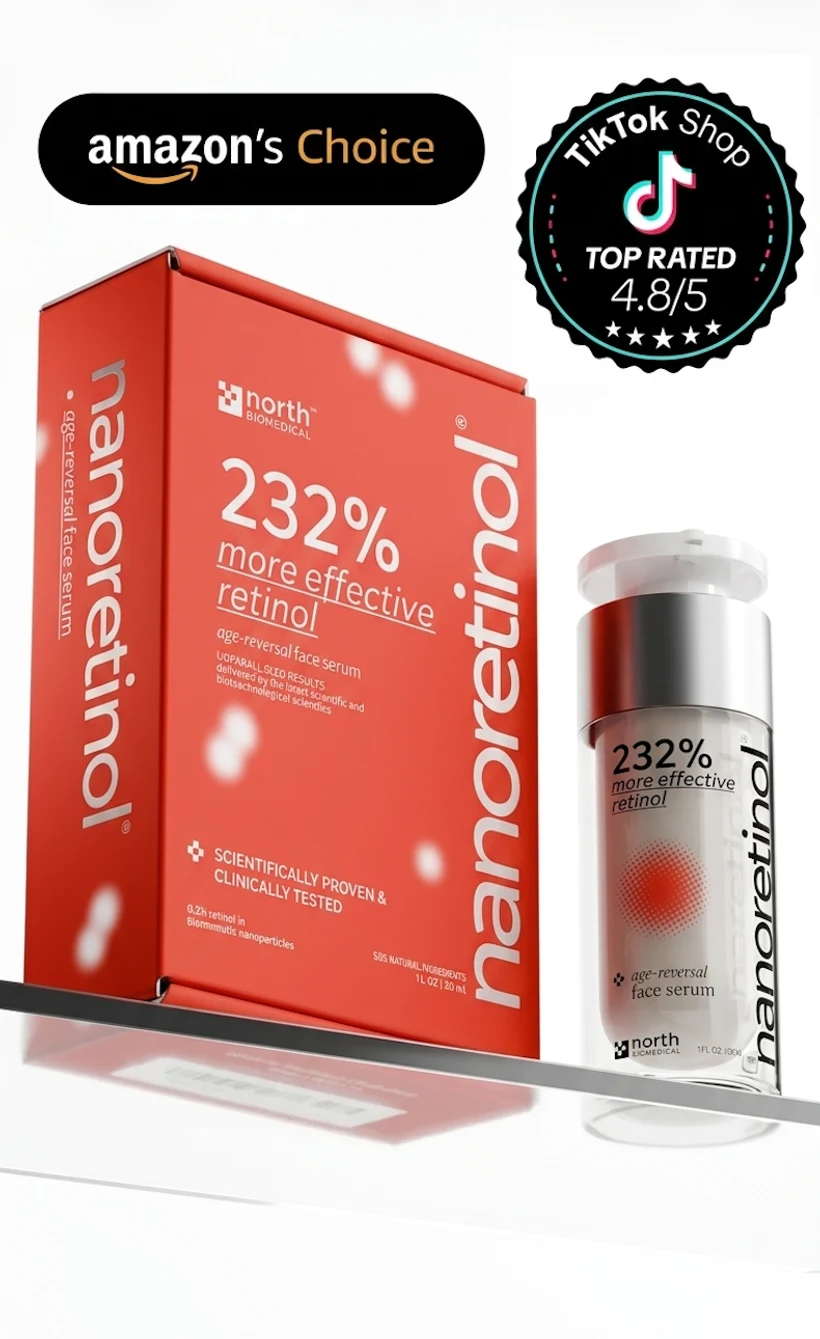
In North Biomedical’s own clinical study, the encapsulated form achieved 232% greater collagen recovery than conventional retinol, and its water-based, 0.2% formulation was engineered to be gentle enough for sensitive areas.
Can you actually get rid of necklace lines?
Honestly? You can soften them meaningfully, and you can prevent them from deepening — but the portion set into the neck’s natural structure will not fully disappear with skincare alone. Anyone promising to erase them completely from a bottle is overselling. The realistic and worthwhile goal is a smoother, firmer, better-hydrated neck where the lines are shallower and far less noticeable.
Two habits do most of the work. The first is relentless sun protection on the neck, every day, to stop further collagen loss. The second is a topical that actually rebuilds collagen — which, in practice, means a retinoid. In a controlled study of naturally aged skin, retinol significantly increased collagen production and improved the look of fine lines [4]. And this is not just a facial-skin finding: a randomized, vehicle-controlled trial of a retinoid applied specifically to the chest and décolletage — skin with the same thin, sun-exposed character as the neck — showed measurable rejuvenation of that exact region [5]. Supporting hydration and treating crepey neck texture alongside those lines rounds out the routine.
The delivery problem — and why it matters most on the neck
There is a catch, and it is a big one on delicate neck skin. Conventional retinol is harsh precisely where the neck is most vulnerable. It struggles to cross the skin barrier intact, tends to sit at the surface oxidizing and irritating, and on thin, oil-poor neck skin that translates quickly into redness and flaking — the reason so many people abandon retinol on the neck within a few weeks.
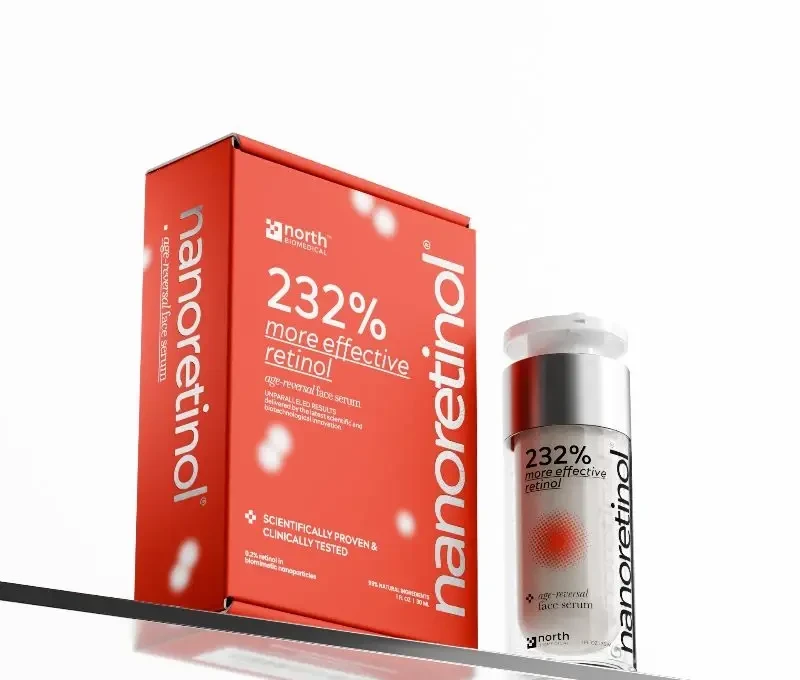
This is the exact problem North Biomedical built Nanoretinol to solve. By encapsulating retinol inside biomimetic lipid nanoparticles that the skin recognizes as “self,” Nanoretinol carries its active payload through the barrier without the chemical disruption that causes irritation — a genuinely meaningful difference on skin as thin as the neck’s. In North Biomedical’s own clinical study, the encapsulated form achieved 232% greater collagen recovery than conventional retinol, and its water-based, 0.2% formulation was engineered to be gentle enough for sensitive areas. For a stubborn, long-term concern like necklace lines, getting the active ingredient deep into thin skin without wrecking the barrier on the way is the whole game.
The takeaway
Necklace lines are a small feature with a complicated backstory: part inherited architecture, part collagen loss, part sun damage, part the daily habit of looking down. You cannot undo the parts written into the neck’s structure, but you can protect what collagen you have left, rebuild more with the right topical, and keep the treatable lines from ever deepening into permanent grooves. Start protecting your neck the way you protect your face, and the rings that worried you in photographs get quieter with time rather than louder.
References
- Shuster S, Black MM, McVitie E. “The influence of age and sex on skin thickness, skin collagen and density.” British Journal of Dermatology. 1975;93(6):639-643. doi:10.1111/j.1365-2133.1975.tb05113.x
- Fisher GJ, Kang S, Varani J, et al. “Mechanisms of photoaging and chronological skin aging.” Archives of Dermatology. 2002;138(11):1462-1470. doi:10.1001/archderm.138.11.1462
- Uitto J. “The role of elastin and collagen in cutaneous aging: intrinsic aging versus photoexposure.” Journal of Drugs in Dermatology. 2008;7(2 Suppl):s12-s16. PMID: 18404866
- Kafi R, Kwak HSR, Schumacher WE, et al. “Improvement of naturally aged skin with vitamin A (retinol).” Archives of Dermatology. 2007;143(5):606-612. doi:10.1001/archderm.143.5.606
- Wood E, Almukhtar R, Gonzalez A, et al. “A Prospective, Randomized, Double-Blind, Vehicle-Controlled Study Evaluating the Efficacy, Safety, and Patient Satisfaction of Tretinoin 0.05% Lotion for Chest Rejuvenation.” Journal of Drugs in Dermatology. 2022;21(6):645-652. doi:10.36849/JDD.6658