Tech Neck Wrinkles: Why Your Phone Is Aging Your Neck Faster Than Your Face
The biomechanics of tech neck lines — and the clinical evidence for treating them
The Anatomy of a Modern Skin Problem
Tech neck isn’t a new condition — horizontal creases in the neck have existed as long as necks have bent forward. But the average American now spends over seven hours daily looking at screens, most of that with the head tilted between 15 and 60 degrees downward. At 60 degrees of forward tilt, the effective weight on cervical structures reaches around 60 pounds. The skin on the front of the neck folds into the same position, repeatedly, for hours.
Repeat that pattern for years, and horizontal neck lines stop being something that appears when you glance down. They become resting creases — present even when you’re standing straight, etched by the sheer mechanical repetition of the same fold.
The term “tech neck wrinkles” captures this dynamic: lines that form specifically as a consequence of modern digital device use. They differ from general aging-related neck laxity in that they can appear at younger ages and tend to run horizontally across the front of the neck rather than in the more diffuse pattern of solar elastosis.
Why Neck Skin Is Especially Vulnerable
There’s a structural reason the neck shows these lines before the face in many people: neck skin is significantly thinner and less gland-rich than facial skin.
Sebaceous glands produce the lipid film that lubricates skin and helps it recover from deformation. The neck has far fewer of these glands than the face. It also has less underlying fat padding, fewer large blood vessels delivering nutrients, and less natural resilience after repeated mechanical stress. When you fold facial skin repeatedly, it has more capacity to recover. Neck skin, folded the same way, creates a crease that deepens a little more each time.
The aging biology compounds the mechanical problem. The neck dermis, like all skin, loses roughly 1% of its collagen content per year after the mid-twenties [2]. This collagen framework is what allows skin to snap back after being stretched or folded. As it degrades, the recovery window lengthens — until the crease simply doesn’t recover at all.
UV exposure adds a third variable. The neck is chronically sun-exposed — often more than people realize, because they apply SPF to the face and forget the neck entirely. Solar elastosis, the accumulation of abnormal elastin caused by UV-induced activation of the elastin promoter, replaces functional elastic fibers with disorganized material that fails to support rebound [2].
The neck dermis, like all skin, loses roughly 1% of its collagen content per year after the mid-twenties.
What Makes Tech Neck Lines Different From General Neck Aging
Turkey neck and general neck laxity involve vertical bands and loose, sagging skin — primarily the result of platysma muscle changes and fat redistribution. Tech neck wrinkles are more specifically the horizontal creases formed by mechanical compression at the natural fold points of the neck, independent of gravity-driven sagging.
This distinction matters for treatment. Platysmal banding typically requires neuromodulator injections or surgical intervention. Tech neck wrinkles — being primarily a skin-quality and collagen-depth issue — respond meaningfully to topical retinoid therapy, and clinical research has confirmed this.
A 2023 prospective study targeting horizontal neck lines in women used a topical rejuvenating treatment and found statistically significant improvements in neck fold depth, skin elasticity, hydration, and radiance after a consistent protocol [1]. The results demonstrate that even well-established horizontal lines can respond to the right topical intervention.
Retinol for Neck Skin: What the Clinical Evidence Shows
Most retinoid research has focused on facial skin, but dedicated neck studies have confirmed that retinol delivers measurable improvements in neck-specific aging signs. A 2023 clinical trial evaluating a retinol-containing topical treatment showed significant improvement in fine lines, wrinkles, crepiness, skin laxity, and texture after 12–16 weeks [3]. Skin biopsy analysis confirmed increased collagen I and collagen III production — the actual structural proteins responsible for keeping neck skin firm.
Retinol works on the neck through the same mechanism as on the face: it converts to retinoic acid and signals fibroblasts to ramp up collagen synthesis while suppressing the MMPs that break collagen down [4]. The key challenge is tolerability. Neck skin is sensitive, and high-concentration retinoids applied without care frequently cause irritation — which then compromises the skin barrier, worsening the texture problem you were trying to solve.
This makes formulation choice particularly important when treating tech neck lines. A retinoid that’s gentle enough to use nightly, at sufficient depth to reach fibroblasts in the lower dermis, and stable enough to not oxidize before it acts, represents the clinical target specification.
A 2023 clinical trial evaluating a retinol-containing topical treatment showed significant improvement in fine lines, wrinkles, crepiness, skin laxity, and texture after 12–16 weeks.
Preventing New Lines While Treating Existing Ones
Topical treatment addresses the collagen side of the equation. But if the mechanical cause continues unchecked, you’re filling a bucket with the tap still running.
Simple ergonomic adjustments compound the topical benefit significantly:
- Raise your phone or tablet toward eye level rather than tilting the head down
- Position laptop screens so the top edge sits at eye height
- Take deliberate neck-extension breaks — gentle chin-up stretches throughout the day partially counteract accumulated forward-flexion stress
Tightening neck skin requires halting the mechanical damage and actively rebuilding the dermal structure simultaneously — neither approach alone is as effective as the combination.
Treating Tech Neck Lines With Nanoretinol
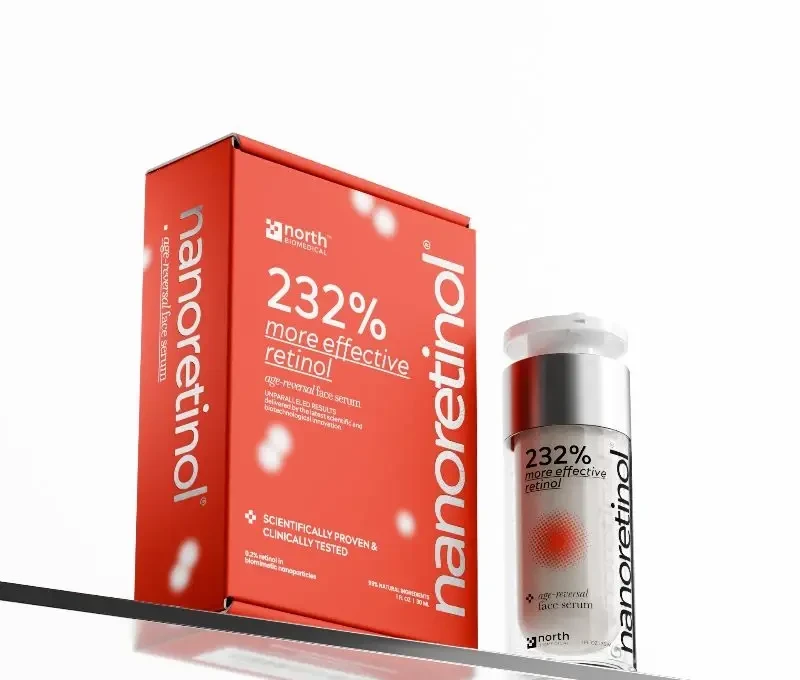
Nanoretinol encapsulates retinol in lipid nanoparticles that are biomimetically recognized by skin cells, allowing passage through the epithelial barrier without disrupting it. This makes it particularly well-suited for neck skin: you get therapeutic-level retinoid delivery with the gentleness that the neck’s thinner skin requires.
In clinical trials, Nanoretinol demonstrated +61% improvement in skin firmness and +56% improvement in elasticity after 56 days — and showed +232% more effective collagen recovery than conventional retinol. For tech neck wrinkles, which are fundamentally a collagen-depletion problem worsened by mechanical stress, this combination of deep delivery and superior collagen stimulation addresses the root mechanism directly.
The existing horizontal neck lines that appeared years before you started treating them won’t vanish overnight. But unlike gravity-driven sagging, tech neck wrinkles are primarily a tissue-quality problem — and tissue quality is exactly what retinoids change.
References
-
Young MB, Lai W, Kononov T, Zahr AS. “A Rejuvenating treatment targeting ‘tech neck’ lines and wrinkles in Chinese women: A prospective, open-label, single-center study.” Journal of Cosmetic Dermatology. 2023;22(1):226–235. doi:10.1111/jocd.15497
-
Uitto J. “The role of elastin and collagen in cutaneous aging: intrinsic aging versus photoexposure.” Journal of Drugs in Dermatology. 2008;7(2 Suppl):s12–16. PMID:18404866
-
Sullivan K, Law RM, Lain E, et al. “Evaluation of a retinol containing topical treatment to improve signs of neck aging.” Journal of Cosmetic Dermatology. 2023;22(10):2755–2764. doi:10.1111/jocd.15904
-
Quan T. “Human Skin Aging and the Anti-Aging Properties of Retinol.” Biomolecules. 2023;13(11):1614. doi:10.3390/biom13111614
-
Varani J, Dame MK, Rittie L, et al. “Decreased collagen production in chronologically aged skin: roles of age-dependent alteration in fibroblast function and defective mechanical stimulation.” American Journal of Pathology. 2006;168(6):1861–1868. doi:10.2353/ajpath.2006.051302