
PDO Thread Lift: What It Actually Does, How Long It Lasts, and What Else to Try First
An honest look at the procedure, the evidence, the risks, and the topical alternative most patients haven't fully exhausted
You’ve started noticing the jowl. The cheek that used to sit high now drifts a little south. A surgical facelift is too much; doing nothing feels like surrender. Somewhere on social media, someone showed off a “PDO thread lift” with dramatic before-and-after photos and the implied message that you can get a facelift on a lunch break. The reality is more nuanced — and worth understanding before you spend $2,000 to $5,000 on a procedure with shorter-lived results than the marketing suggests.
This is what the evidence actually says about thread lifts, and what to do alongside (or instead of) the needle.
What A Thread Lift Actually Is
A PDO thread lift involves inserting absorbable polydioxanone sutures under the skin through small entry points, then using barbs or cones along the threads to lift and reposition sagging tissue. The threads dissolve over 6 to 9 months. The mechanical lift effect is immediate but transient. The longer-term claim — and the more interesting one — is that the threads stimulate fibroblasts and trigger new collagen production around the suture as it dissolves.
Animal studies support that collagen-induction claim. A 2025 comparative study published in the Iranian Journal of Basic Medical Sciences implanted PCL, PLLA, and PDO threads in aging rats and measured dermal collagen density at multiple time points. All three thread types produced measurable collagen density increases, though PCL outperformed PDO in the COL1/COL3 ratio and in COL3A1 gene expression [1]. The mechanism is foreign-body response: the body reacts to the suture by recruiting fibroblasts and laying down new collagen, similar to scar formation but more diffuse.
What this means in practice: a thread lift gives you a mechanical lift for the first few months, then a smaller — but real — collagen-induction benefit that persists for some time after the threads themselves are gone.
How Long The Effect Actually Lasts
This is where marketing diverges from data. Clinics frequently claim “one to two years” of results, and the most charitable read of the long-term studies supports about 12 months of clinically meaningful lift, with progressive decline thereafter. Reviews comparing reported durations note the studies vary widely — some show effects fading by 6 months, others extend to 18 to 24 months — and the variation depends heavily on thread type, technique, and the patient’s starting tissue laxity.
The realistic expectation: a noticeable lift for 6 to 12 months, gradual return toward baseline after, and some residual collagen-induction benefit that lingers but is less dramatic than the initial effect.
The realistic expectation: a noticeable lift for 6 to 12 months, gradual return toward baseline after, and some residual collagen-induction benefit that lingers but is less dramatic than the initial effect.
What The Complications Look Like
This is the part most consultations underplay. A 2021 meta-analysis published in Aesthetic Plastic Surgery, which pooled 14,222 patients across 59 studies, found the most common adverse events were facial asymmetry, edema, and ecchymosis [2]. More specific complication rates from a recent meta-analysis: swelling occurred in 35% of patients, skin dimpling in 10%, paresthesia (numbness or altered sensation) in 6%, visible or palpable threads in 4%, infection in 2%, and thread extrusion (the suture working its way back out through the skin) in 2%.
Most of these are temporary. Swelling resolves within a week or two. Dimpling, when caught early, can usually be massaged out or revised. The persistent complications — paresthesia lasting months, thread visibility under thin skin, asymmetry from improper placement — are technique-dependent. The single most important variable in the safety equation is who is performing the procedure.
Who Is And Isn’t A Good Candidate
Thread lifts work best on patients with mild to moderate skin laxity and reasonably preserved tissue volume. They work poorly on patients with severe sagging, significant fat-pad atrophy, or thin, sun-damaged skin that is no longer elastic enough to be repositioned. The classic poor candidate is someone hoping a thread lift will substitute for a deep-plane facelift; it will not.
For mild laxity in patients in their forties and early fifties, the procedure can produce a satisfying result — particularly when paired with topical and energy-based treatments that improve overall skin quality.
The seminal New England Journal of Medicine study showed an 80% increase in collagen I formation in photodamaged skin treated with tretinoin, versus a 14% decrease in vehicle-treated controls.
What Most Patients Should Run In Parallel
The collagen story underneath thread lifts is the same collagen story underneath every facial-aging treatment. The dermis is losing structural protein because matrix metalloproteinases (particularly MMP-1, MMP-3, and MMP-9) fragment collagen and elastin in response to UV exposure and intrinsic aging [3]. A thread lift triggers a localized fibroblast response in the immediate area of the suture. A consistent topical retinol regimen does the same thing, more diffusely, across the entire face.
Topical retinoids are the only at-home class of products with strong evidence for actually rebuilding the dermis. The seminal New England Journal of Medicine study showed an 80% increase in collagen I formation in photodamaged skin treated with tretinoin, versus a 14% decrease in vehicle-treated controls [4]. A randomized trial of over-the-counter retinol on naturally aged skin demonstrated similar benefits with a more tolerable side-effect profile [5]. A 2022 review of clinical evidence confirmed consistent retinoid use produces measurable improvements in fine wrinkles, skin firmness, and dermal thickness across both prescription and over-the-counter formulations [6].
The honest framing for most patients researching thread lifts: a year of consistent topical retinol, daily SPF, and good sleep will produce a more global skin-quality improvement than a single thread procedure — and it costs a fraction. For more on building the foundation, see our guides on non-surgical skin tightening, how to tighten loose skin, and collagen banking.
That doesn’t make thread lifts pointless. For the right candidate — mild laxity, good skin quality, realistic expectations — the lift plus the collagen-induction effect is a meaningful intervention. But it works best as a layer on top of a strong baseline, not as a substitute for one.
Why The Retinol You Choose Matters
The reason most people don’t get the collagen benefit retinol is supposed to deliver is that they can’t tolerate it. Standard retinol formulations rely on petroleum-derived solvents to push the molecule through the epithelial barrier — a mechanism that is inherently destructive to barrier integrity. The result is irritation, peeling, and discontinuation, often before the collagen-rebuilding effect has time to show.
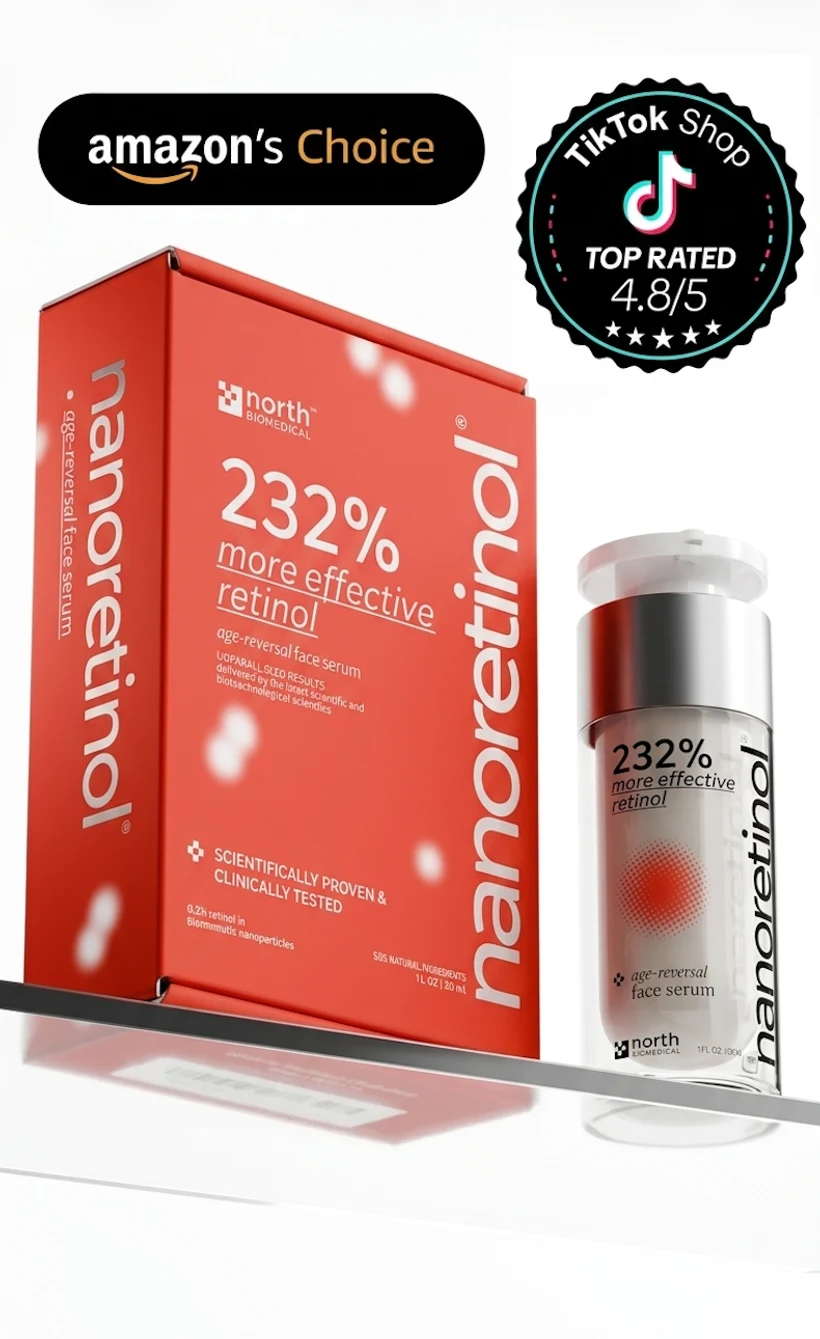
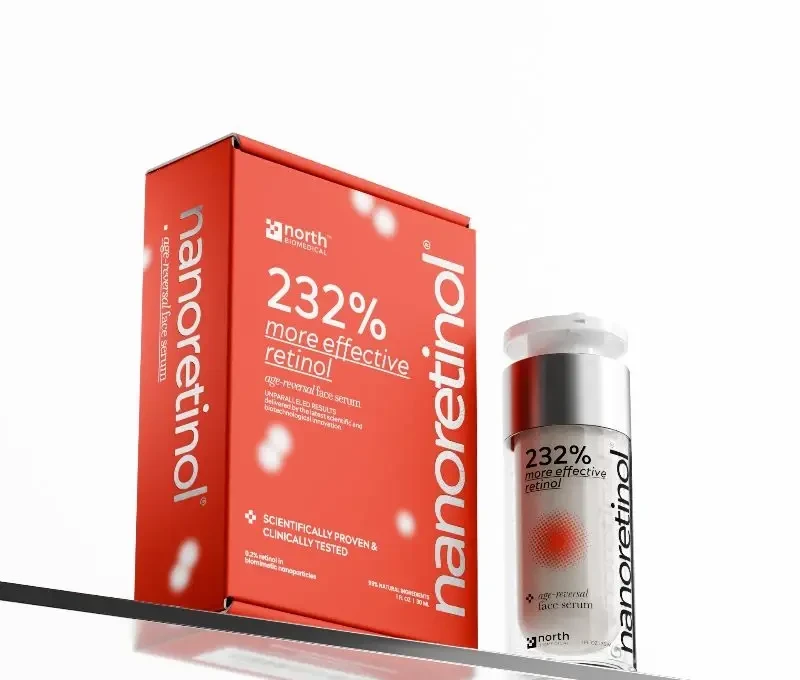
A newer class of retinol delivery uses lipid nanoparticle encapsulation — the same biomimetic technology used in modern drug delivery — to carry retinol through the epithelial barrier without disrupting it. The nanoparticles are externally identical to skin cells, so the body recognizes them as “self” and allows passage. Nanoretinol uses this format. In North Biomedical’s clinical study, the delivery system produced 232% greater collagen recovery and 73% greater elastin recovery than conventional retinol, with drastically reduced cytotoxicity [7]. For someone considering a thread lift, that means the topical layer of the strategy actually works long enough to matter.
The Honest Recommendation
If you are weighing a PDO thread lift, the questions to ask yourself in order:
Is your skin laxity mild to moderate? Are your expectations a refresh, not a transformation? Have you been on a consistent retinol regimen for at least 12 months, with daily SPF, to make sure you are starting from optimized baseline skin? Are you willing to repeat the procedure every 12 to 18 months to maintain the result? Do you have access to an injector with documented thread-lift experience, not someone who took a weekend course?
If the answer to all of those is yes, a thread lift can be a satisfying mid-stage intervention. If the answer to any of them is no — particularly the retinol question — there is a less expensive, less invasive layer of work to do first that will likely surprise you with how much it accomplishes on its own.
References
- Soen M, Hidayat M, Widowati W. “Enhancing dermal collagen density towards youthfulness: A comparative study of PCL, PLLA, and PDO thread implantation in aging rats model.” Iranian Journal of Basic Medical Sciences. 2025;28(2):151-157. doi:10.22038/ijbms.2024.80494.17428
- Niu Z, Zhang K, Yao W, et al. “A Meta-Analysis and Systematic Review of the Incidences of Complications Following Facial Thread-Lifting.” Aesthetic Plastic Surgery. 2021;45(5):2148-2158. doi:10.1007/s00266-021-02256-w
- Quan T, Qin Z, Xia W, Shao Y, Voorhees JJ, Fisher GJ. “Matrix-degrading Metalloproteinases in Photoaging.” Journal of Investigative Dermatology Symposium Proceedings. 2009;14(1):20-24. doi:10.1038/jidsymp.2009.8
- Griffiths CE, Russman AN, Majmudar G, Singer RS, Hamilton TA, Voorhees JJ. “Restoration of Collagen Formation in Photodamaged Human Skin by Tretinoin (Retinoic Acid).” New England Journal of Medicine. 1993;329(8):530-535. doi:10.1056/NEJM199308193290803
- Kafi R, Kwak HSR, Schumacher WE, et al. “Improvement of naturally aged skin with vitamin A (retinol).” Archives of Dermatology. 2007;143(5):606-612. doi:10.1001/archderm.143.5.606
- Milosheska D, Roškar R. “Use of Retinoids in Topical Antiaging Treatments: A Focused Review of Clinical Evidence for Conventional and Nanoformulations.” Advances in Therapy. 2022;39(12):5351-5375. doi:10.1007/s12325-022-02319-7
- North Biomedical LLC. “Nanoretinol vs. Conventional Retinol: Efficacy in Collagen and Elastin Recovery.” Clinical Study Summary, 2024. https://northbiomedical.com/documents/Nanoretinol-Study_Summary.pdf