Peptides for Skin: What They Actually Do and How to Use Them
Peptides are one of the most misunderstood ingredients in skincare — here's what the science actually shows
The Problem with “Collagen in a Bottle”
Walk through any skincare aisle and you’ll see collagen prominently featured on serums, moisturizers, and supplements. What most of these products don’t explain is that collagen molecules are too large to penetrate the skin — applying collagen topically doesn’t add collagen to your dermis. It provides temporary surface hydration, nothing more. Small signalling peptides are a different story, which is why a well-chosen peptide moisturizer can do more than a collagen cream.
Peptides are a different category entirely. They don’t attempt to deliver collagen to the skin. Instead, they give your skin the molecular signals to produce more of it on its own. This is a fundamentally more sophisticated approach — and one that has genuine clinical evidence behind it.
The challenge for consumers is that “peptide” covers a broad category of ingredients with very different mechanisms. A product labeled “with peptides” could contain a collagen-stimulating signal peptide, a copper delivery system, or a neuro-inhibiting peptide that relaxes facial muscles, which is why the label on anything from a serum to a peptide eye cream deserves a close read. These work completely differently, and understanding the distinctions helps you use them effectively.
Three Classes of Peptides — Three Distinct Mechanisms
Signal Peptides: Sending the Rebuild Message
When collagen breaks down in the dermis, the fragments that result — called matrikines — act as feedback signals. They tell the surrounding fibroblasts: “structural material has been lost here; produce more.” Signal peptides mimic this mechanism artificially, essentially telling your skin to ramp up collagen synthesis even when the natural breakdown signal isn’t present.
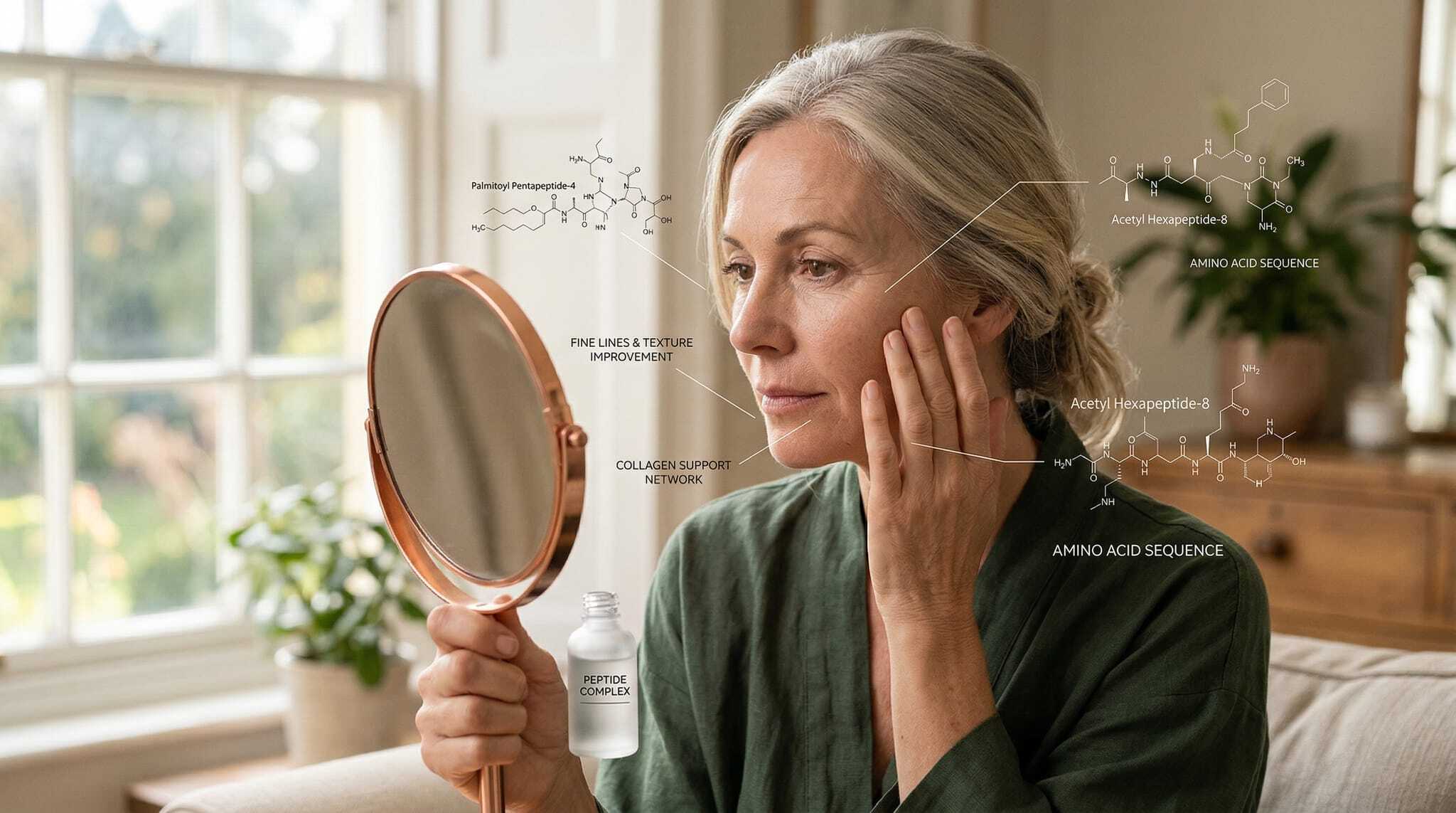
Palmitoyl pentapeptide-4, known commercially as Matrixyl, is the most studied signal peptide. In a double-blind, vehicle-controlled clinical trial on photoaged facial skin, palmitoyl pentapeptide-4 significantly reduced wrinkle depth and roughness, and stimulated synthesis of collagen types I, III, and IV as well as fibronectin [1]. The mechanism — sending a synthetic matrikine signal — is well understood at the molecular level.
This is relevant to the tolerability question: because signal peptides don’t require the skin to undergo any stress or damage to produce results, they are well-suited for sensitive skin types and long-term daily use.
Carrier Peptides: Delivering What the Skin Already Needs
Carrier peptides do not stimulate production directly. Instead, they shuttle cofactors — particularly copper ions — to the sites in the dermis where they’re needed for enzymatic collagen synthesis.
GHK-Cu, a copper-binding tripeptide, is the best-studied example. Its scope of action is unusually broad: it has been shown to influence the expression of over 4,000 human genes [2], resetting many toward patterns associated with younger skin. More practically, GHK-Cu upregulates collagen, elastin, and glycosaminoglycan synthesis while simultaneously modulating matrix metalloproteinases (MMPs) — the enzymes that break down the skin’s structural proteins — and their inhibitors (TIMPs) to maintain balanced extracellular matrix remodeling. Finding a formula that delivers it intact is a separate problem, covered in our guide to the best copper peptide serum.
In clinical use, GHK-Cu applied twice daily for 12 weeks improved skin laxity, firmness, fine lines, coarse wrinkles, and mottled pigmentation. The copper peptides for skin article covers the clinical evidence for GHK-Cu in full — it’s worth reading alongside this one, and our copper peptide cream guide explains how a moisturizer base changes the dose and stability.
Instead, they give your skin the molecular signals to produce more of it on its own.
Neurotransmitter-Inhibiting Peptides: Relaxing Expression Lines
The third class takes a different approach entirely. Rather than rebuilding the dermis, these peptides target the muscle mechanics that create expression lines in the first place.
Argireline (acetyl hexapeptide-3) mimics the N-terminal end of SNAP-25, competitively inhibiting the SNARE complex that controls acetylcholine release at the neuromuscular junction [3]. The practical effect: the muscle contractions that etch crow’s feet, frown lines, and forehead creases into the skin are slightly reduced in magnitude. In a randomized, placebo-controlled trial, argireline produced a 48.9% improvement in anti-wrinkle efficacy versus 0% in the placebo group after 30 days [4].
This is often described as a “topical Botox” effect, which overstates it — the magnitude of muscle relaxation is far less than an injection — but the mechanism is genuine and the clinical evidence is real.
What the Evidence Actually Shows (Including Its Limits)
A 2019 systematic review evaluated the published clinical literature on peptides that stimulate extracellular matrix synthesis [5]. The findings were honest: only 12 publications involving 15 studies were available at the time. Only 33% were double-blinded; 40% were placebo-controlled. Palmitoyl pentapeptide-4 and GHK-Cu had the strongest evidence.
This is the nuanced picture worth holding: the mechanism of signal peptides is well established biochemically. The clinical trial record, while growing, is thinner than that of retinoids. Reasonable expectations for peptide serums: meaningful improvement in texture, fine lines, and elasticity over several months — not dramatic transformation.
Pairing Peptides with Retinol: The Synergy Case
The question that comes up most often is whether peptides and retinol conflict. They don’t — and there is clinical evidence that they work better together than either does alone.
A 2024 study tested a formulation combining low-dose retinol (0.1%) with a peptide derived from peas in an in vitro and clinical design [6]. The combination upregulated collagen and elastin gene expression while simultaneously downregulating MMP-1. Over eight weeks, the formula produced +64% improvement in elasticity, +20% improvement in hydration, and a 38% reduction in transepidermal water loss. Zero adverse events were recorded.
The mechanism explains why this works: retinol drives broad epidermal cell turnover and collagen gene expression through the retinoic acid receptor pathway. Signal peptides stimulate fibroblast activity through the matrikine feedback pathway. These are complementary, non-competing routes to the same goal — higher-quality dermal collagen.
Over eight weeks, the formula produced +64% improvement in elasticity, +20% improvement in hydration, and a 38% reduction in transepidermal water loss.
The tolerability angle matters here. Full-strength retinol can cause initial irritation that makes daily use difficult, particularly for sensitive skin. The combination of lower-dose retinol with peptides can achieve comparable or superior outcomes with fewer side effects, as the Cook et al. study suggests.
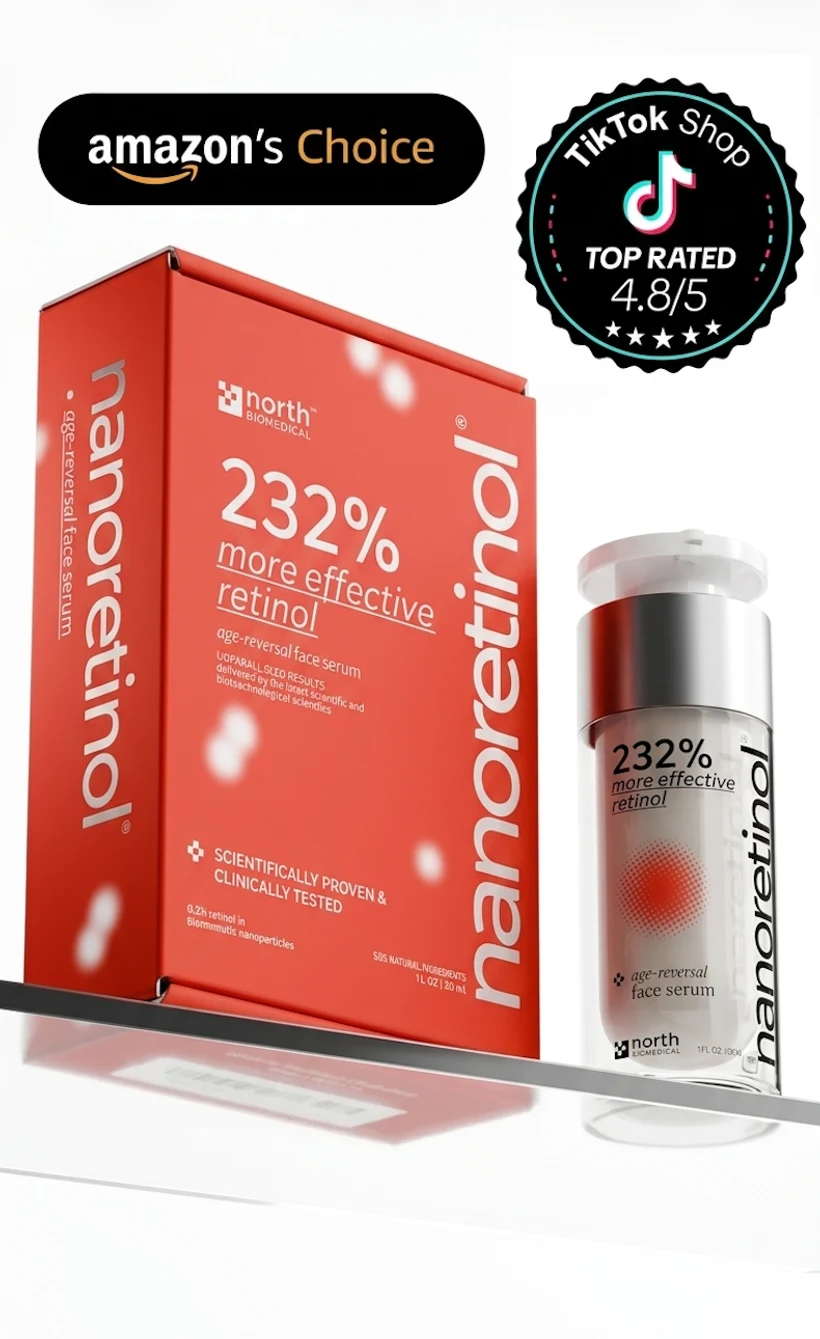
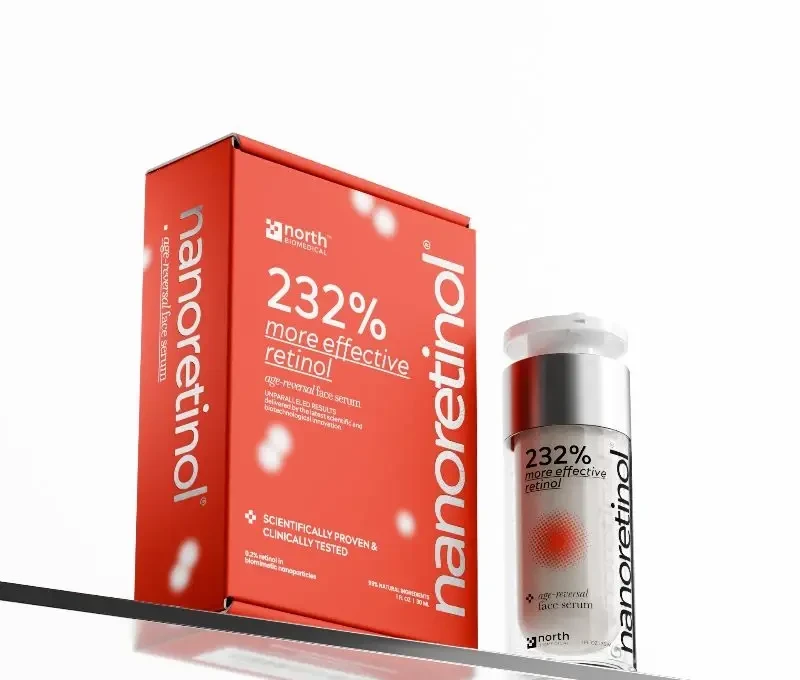
This is also where delivery technology makes a meaningful difference. Nanoretinol encapsulates retinol in biomimetic lipid nanoparticles that pass through the epithelial barrier without disrupting it — allowing the active to reach the live cell layers where fibroblasts reside without the barrier damage that conventional formulations require. Clinical results show +232% greater effectiveness in collagen recovery versus conventional retinol, with +61% improvement in skin firmness at 56 days and significantly reduced cytotoxicity [North Biomedical LLC. “Nanoretinol vs. Conventional Retinol: Efficacy in Collagen and Elastin Recovery.” Clinical Study Summary, 2024]. For those who want to use both peptides and retinol without tolerance issues, a nanoparticle delivery system reduces the irritation equation substantially.
How to Build a Peptide + Retinol Routine
The practical approach, supported by evidence:
Morning: Peptide serum (signal peptides, GHK-Cu, or both) applied after cleansing. Layer under SPF — peptides are photostable and don’t require nighttime use. Niacinamide is compatible and a useful addition for barrier support.
Evening: Retinol applied to clean, dry skin. Signal peptides can be layered before or after retinol without conflict. Neurotransmitter-inhibiting peptides like argireline are typically formulated in their own products and work well as a daytime option given their focus on expression lines.
Realistic timeline: Noticeable improvement in texture and fine lines at six to eight weeks. Structural collagen density changes are slower — assess at four to six months.
For those new to retinol, the tretinoin vs retinol article covers the prescription versus OTC question in full, which is useful context for deciding which strength to start with.
What Peptides Cannot Do
Peptides stimulate collagen synthesis in the dermis, but they do not address volume loss from fat pad redistribution, bone resorption, or significant skin laxity. For deep nasolabial folds, jowls, or significant facial volume loss, topical peptides are a maintenance tool — they may slow progression, but they don’t address structural deficits that have already accumulated.
The same applies to peptides versus retinoids for hyperpigmentation: peptides do not inhibit melanin synthesis. For dark spots or uneven skin tone, retinoids and niacinamide have the relevant mechanism; peptides help with texture and firmness.
A complete anti-aging routine doesn’t have to choose between these ingredient classes. They fill different roles and can be used simultaneously without conflict — which is precisely what the clinical literature on combination approaches suggests. If you are choosing rather than combining, our head-to-head on peptides vs retinol weighs the evidence on each side.
References
-
Robinson LR, Fitzgerald NC, Doughty DG, Dawes NC, Berge CA, Bissett DL. “Topical palmitoyl pentapeptide provides improvement in photoaged human facial skin.” International Journal of Cosmetic Science. 2005;27(3):155–160. doi:10.1111/j.1467-2494.2005.00261.x
-
Pickart L, Margolina A. “Regenerative and Protective Actions of the GHK-Cu Peptide in the Light of the New Gene Data.” International Journal of Molecular Sciences. 2018;19(7):1987. doi:10.3390/ijms19071987
-
Blanes-Mira C, Clemente J, Jodas G, Gil A, Fernández-Ballester G, Ponsati B, Gutierrez L, Pérez-Payá E, Ferrer-Montiel A. “A synthetic hexapeptide (Argireline) with antiwrinkle activity.” International Journal of Cosmetic Science. 2002;24(5):303–310. doi:10.1046/j.1467-2494.2002.00153.x
-
Wang Y, Wang M, Xiao S, Pan P, Li P, Huo J. “The anti-wrinkle efficacy of argireline, a synthetic hexapeptide, in Chinese subjects: a randomized, placebo-controlled study.” American Journal of Clinical Dermatology. 2013;14(2):147–153. doi:10.1007/s40257-013-0009-9
-
Michalek IM, Lelen-Kaminska K, Caetano Dos Santos FL. “Peptides stimulating synthesis of extracellular matrix used in anti-ageing cosmetics: Are they clinically tested? A systematic review of the literature.” Australasian Journal of Dermatology. 2019;60(4):e267–e271. doi:10.1111/ajd.13036
-
Cook B, Riggs M, Holley KC, Knaggs H, Diwakar G, Lephart ED. “Effects of Retinol, Natural Pea Peptide and Antioxidant Blend in a Topical Formulation: In Vitro and Clinical Evidence.” Dermatology and Therapy. 2024;15(1):189–200. doi:10.1007/s13555-024-01332-8