Tretinoin vs Retinol: Which Is Better for Anti-Aging?
Prescription strength vs over-the-counter — the science behind choosing the right retinoid for your skin
The Most Searched Question in Skincare
If you’ve decided to get serious about anti-aging, you’ve likely landed on one question: should I use tretinoin (prescription) or retinol (over-the-counter)?
It seems like it should be simple. Tretinoin is stronger. Stronger means better. Get a prescription and move on.
But dermatology isn’t that straightforward. The “which is better” question ignores crucial variables — tolerability, adherence, cost, accessibility, and a factor most people never consider: how much of the active ingredient actually reaches your skin cells. Understanding the full picture changes the calculation entirely.
The Retinoid Family Tree
First, some essential biochemistry. Both tretinoin and retinol belong to the retinoid family — compounds derived from vitamin A. But they sit at different points in the same metabolic pathway [1]:
Retinol (vitamin A alcohol) → converted by retinol dehydrogenases to retinaldehyde → converted by retinaldehyde dehydrogenases to retinoic acid (tretinoin)
Tretinoin IS retinoic acid — the active form that binds to nuclear retinoic acid receptors (RARs) and directly modulates gene expression. It doesn’t need conversion. It’s ready to work the moment it reaches your cells.
Retinol is two enzymatic steps upstream. It must be converted to retinoic acid inside the skin before it can activate those same receptors. This conversion process is the entire basis of the tretinoin vs retinol debate.
Tretinoin: The Prescription Powerhouse
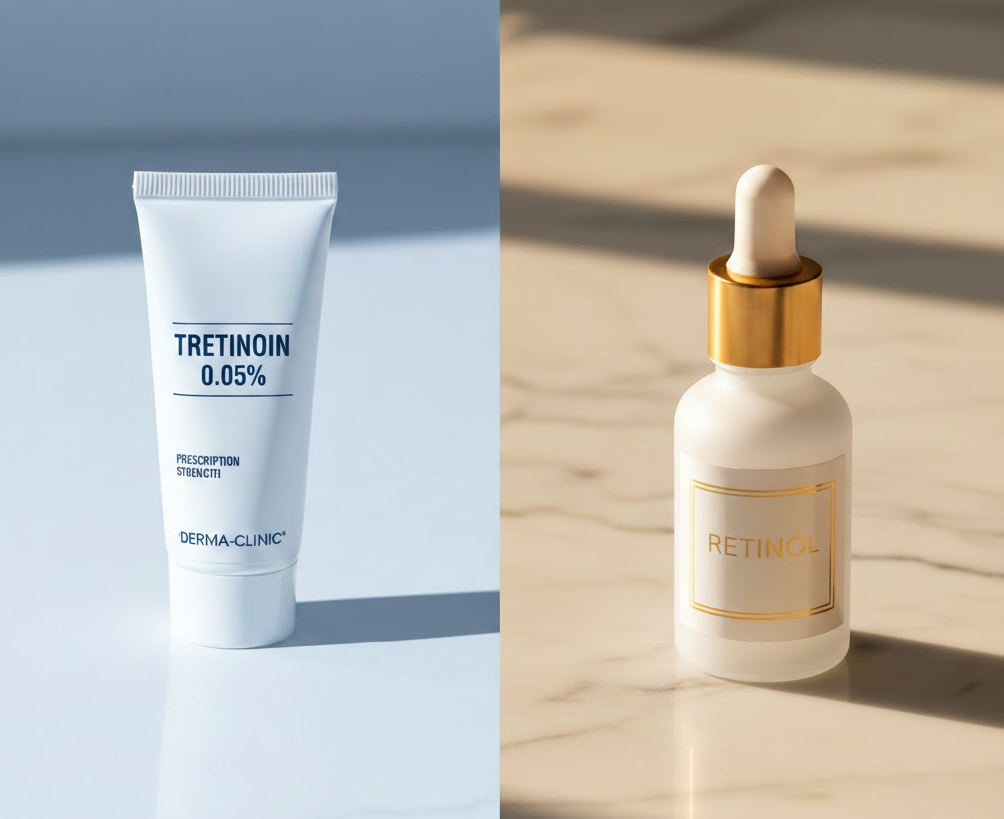
What it is: Retinoic acid itself, available by prescription in concentrations ranging from 0.01% to 0.1%.
How it works: Binds directly to RARs and RXRs in the cell nucleus, upregulating collagen I, III, and VII gene expression, accelerating cell turnover, and normalizing melanin distribution [2].
The evidence: Tretinoin has the deepest clinical evidence base of any topical anti-aging ingredient. Landmark studies dating to the late 1980s demonstrated significant improvement in photodamaged skin — reduced fine wrinkles, improved skin roughness, and faded hyperpigmentation — in randomized controlled trials [2]. It remains the gold standard in dermatological research.
The “which is better” question ignores crucial variables — tolerability, adherence, cost, accessibility, and a factor most people never consider: how much of the active ingredient actually reaches your skin cells.
Speed of results: Because it requires no enzymatic conversion, tretinoin acts faster. Visible improvements typically begin at 4-8 weeks, with significant structural changes (collagen remodeling) evident by 12 weeks [3]. The full clock, including the collagen change that only shows up after 10 months, is mapped in how long tretinoin takes to work.
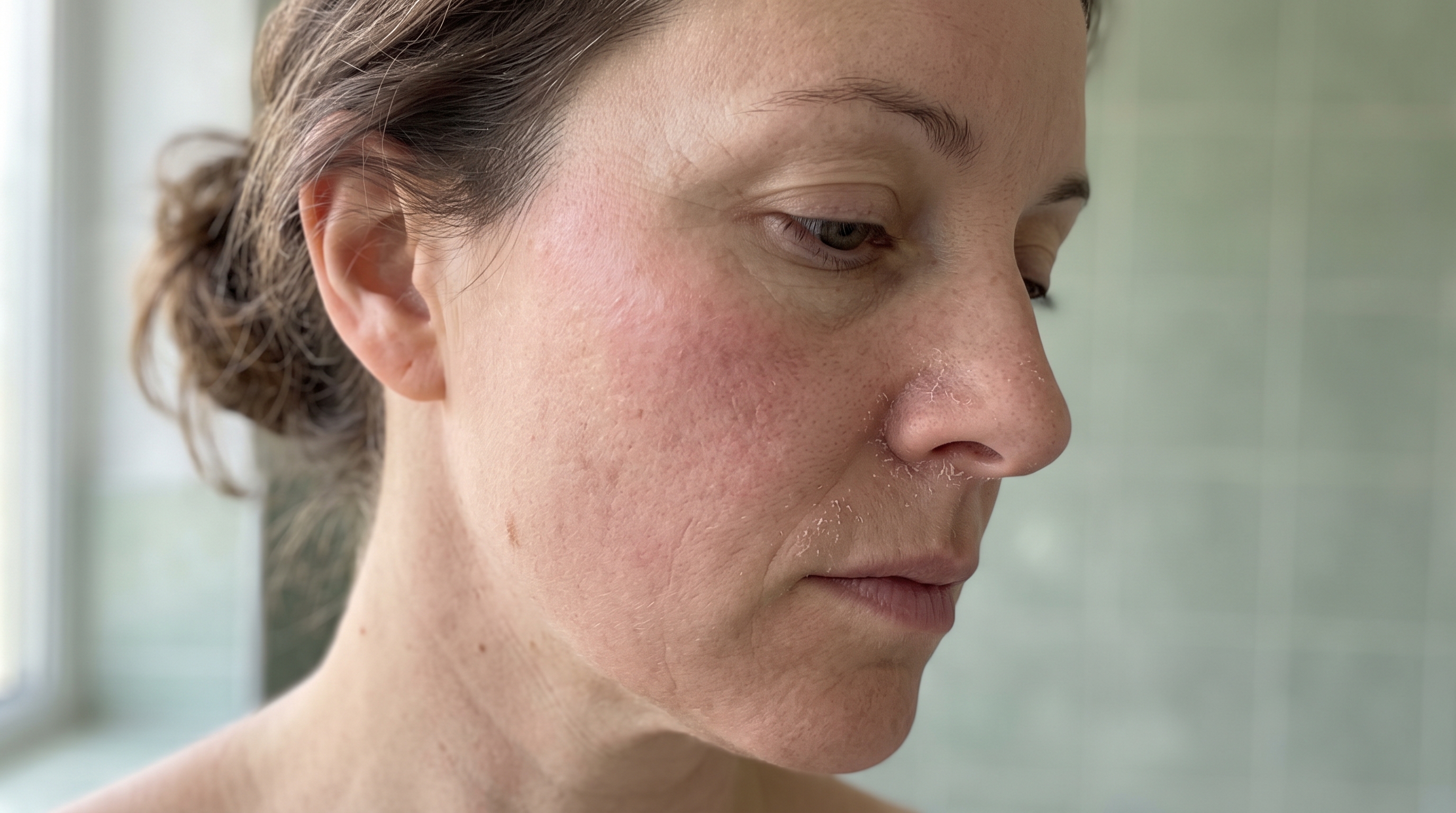
The catch: Tretinoin’s directness is a double-edged sword. Without the buffering effect of the conversion process, it hits receptor targets at full force. The result: significant irritation in most users, especially during the first 2-4 weeks. Redness, peeling, dryness, and stinging — collectively called “retinoid dermatitis” — are so common that many dermatologists consider them expected rather than adverse [3].
Retinol: The Accessible Alternative
What it is: The precursor to retinoic acid, available over-the-counter in concentrations typically ranging from 0.1% to 1%.
How it works: Penetrates the epidermis, then undergoes two-step enzymatic conversion to retinoic acid within skin cells. Activates the same RAR/RXR receptors as tretinoin, triggering identical downstream gene expression [1]. The evidence: A pivotal comparative study published in the Journal of Cosmetic Dermatology directly compared retinol and retinoic acid on human skin over 12 months. The result: retinol produced statistically similar improvements in wrinkle reduction, collagen fiber organization, and epidermal thickness as retinoic acid — it simply took longer to reach the same endpoint [4].
Speed of results: The conversion bottleneck means retinol works more gradually. Expect initial texture improvements at 8-12 weeks, with significant structural changes at 24+ weeks.
The advantage: The very conversion process that slows retinol down also makes it gentler. Enzymatic conversion is rate-limited — your skin can only produce so much retinoic acid at a time, creating a natural ceiling that prevents the receptor flooding that causes tretinoin’s harsh side effects [1]. The result: dramatically better tolerability, fewer dropouts, and higher long-term adherence.
The Head-to-Head Comparison
| Factor | Tretinoin | Retinol |
|---|---|---|
| Active form | Direct (retinoic acid) | Requires conversion |
| Prescription needed | Yes | No |
| Onset of results | 4-8 weeks | 8-12 weeks |
| Peak results | 12-24 weeks | 24-52 weeks |
| Irritation level | High (esp. weeks 1-4) | Mild to moderate |
| Dropout rate | Higher | Lower |
| Cost | $50-200/tube + doctor visit | $15-70 OTC |
| Concentrations | 0.01-0.1% | 0.1-1% |
| Long-term efficacy | Gold standard | Comparable at 12 months |
What Most Comparisons Miss: The Delivery Problem
Here’s what the tretinoin vs retinol debate almost always overlooks: concentration and molecular form are only part of the equation. How much retinoid actually reaches your target cells matters more than what’s printed on the label.
Both conventional tretinoin and conventional retinol face the same fundamental challenge: the skin barrier. The stratum corneum is designed to keep foreign molecules out. To get through it, traditional formulations rely on penetration enhancers — chemical solvents and petroleum derivatives that disrupt the lipid matrix of the barrier through a process called lipid mobility [5].
This works, but it comes with inherent tradeoffs:
- Barrier damage causes irritation. The very mechanism that gets the retinoid through the barrier also damages the barrier itself. This is a primary driver of retinoid dermatitis — not just the retinoid’s activity, but the delivery vehicle’s collateral damage.
How much retinoid actually reaches your target cells matters more than what’s printed on the label.
-
Inconsistent delivery. Penetration enhancer efficacy varies with skin hydration, temperature, and barrier integrity. You can’t precisely control how much active ingredient reaches target cells.
-
Degradation. Both tretinoin and retinol are unstable molecules. Exposure to light and oxygen during application degrades them before they reach the dermis. Studies estimate that a significant percentage of the applied retinoid never reaches its target in conventional formulations.
This is why two people using the same tretinoin prescription can have wildly different experiences — one sees dramatic improvement with manageable irritation, the other gets severe retinoid dermatitis with minimal visible benefit. The delivery system is the uncontrolled variable.
The Third Option: Advanced Delivery
What if you could get prescription-level collagen results without prescription-level irritation — and without a prescription at all?
This is the promise of next-generation delivery technology. Nanoretinol® takes a fundamentally different approach: instead of forcing retinol through the barrier with irritating penetration enhancers, it encapsulates retinol in biomimetic lipid nanoparticles — structures that are externally identical to the skin’s own cell membranes. The body recognizes these nanoparticles as “self” and allows them to pass through the epithelial barrier without disrupting it.
The results reframe the entire tretinoin vs retinol debate: 232% more effective collagen recovery compared to conventional retinol — not because the retinol molecule is different, but because dramatically more of it reaches the target cells intact.
73% more effective elastin recovery — addressing skin firmness and bounce, not just wrinkle depth.
Significantly reduced cytotoxicity — the absence of penetration enhancers means no collateral barrier damage. Clinical trials confirm minimal side effects, and when present, milder than those caused by conventional retinol formulations.
At just 0.2% retinol concentration, Nanoretinol® outperforms conventional retinol at higher concentrations because the delivery efficiency, not the concentration, determines biological activity. It’s the best of both worlds: retinol’s gentleness and accessibility with results that challenge prescription tretinoin.
So Which Should You Choose?
Choose tretinoin if:
- You have a specific dermatological condition (severe acne, significant photodamage) under medical supervision
- You’ve used retinoids before and know you tolerate them well
- You have access to a dermatologist for monitoring and dose adjustments
- You want the fastest possible onset of visible results and accept the irritation tradeoff
Choose retinol if:
- You’re new to retinoids and want to start gently
- You have sensitive skin or a history of reactive skin
- You want anti-aging results without a prescription or dermatologist visits
- Long-term consistency matters more to you than speed
- You prefer a lower-risk, lower-irritation approach
Choose advanced-delivery retinol if:
- You want prescription-level collagen results without prescription-level irritation
- Previous retinol or tretinoin attempts failed due to irritation
- You want the convenience of OTC with the efficacy that exceeds conventional formulations
- Science-backed delivery technology matters more to you than just concentration numbers
The Verdict
The tretinoin vs retinol question frames the choice as a tradeoff: strength vs gentleness, speed vs tolerability. And for decades, that tradeoff was real. But delivery technology has changed the equation. The most important variable isn’t which retinoid you choose — it’s how efficiently it reaches your skin cells. Get that right, and the tretinoin vs retinol debate becomes far less relevant than it used to be.
References
-
Zasada M, Budzisz E. “Retinoids: active molecules influencing skin structure formation in cosmetic and dermatological treatments.” Postepy Dermatologii i Alergologii. 2019;36(4):392-397. doi:10.5114/ada.2019.87443
-
Mukherjee S, Date A, Patravale V, Korting HC, Roeder A, Weindl G. “Retinoids in the treatment of skin aging: an overview of clinical efficacy and safety.” Clinical Interventions in Aging. 2006;1(4):327-348. doi:10.2147/ciia.2006.1.4.327
-
Kang S, Duell EA, Fisher GJ, et al. “Application of retinol to human skin in vivo induces epidermal hyperplasia and cellular retinoid binding proteins characteristic of retinoic acid but without measurable retinoic acid levels or irritation.” Journal of Investigative Dermatology. 1995;105(4):549-556. doi:10.1111/1523-1747.ep12323445
-
Kong R, Cui Y, Fisher GJ, et al. “A comparative study of the effects of retinol and retinoic acid on histological, molecular, and clinical properties of human skin.” Journal of Cosmetic Dermatology. 2016;15(1):49-57. doi:10.1111/jocd.12193
-
Williams AC, Barry BW. “Penetration enhancers.” Advanced Drug Delivery Reviews. 2004;56(5):603-618. doi:10.1016/j.addr.2003.10.025