Retinol vs Retinal: Understanding the One-Step Difference That Changes Everything
Two retinoids, one enzymatic step apart — but the practical differences matter more than you think
The skincare world loves a good head-to-head comparison, and “retinol vs retinal” has become one of the most debated matchups in ingredient science. On paper, the distinction seems simple: retinal (retinaldehyde) is one enzymatic conversion step closer to the active form of vitamin A than retinol. But does that single biochemical step translate into meaningfully better results on your skin?
The answer, like most things in dermatology, depends on what you’re optimizing for.
The Retinoid Family Tree
To understand the retinol-retinal distinction, you need the full conversion pathway. Vitamin A exists in several forms, each progressively closer to the biologically active molecule:
Retinyl esters → Retinol → Retinaldehyde (retinal) → Retinoic acid (tretinoin)
Each arrow represents an enzymatic conversion that happens inside your skin cells. Retinoic acid is the endpoint — the molecule that actually binds to nuclear retinoic acid receptors (RARs) and triggers the gene expression changes responsible for increased collagen synthesis, accelerated cell turnover, and reduced hyperpigmentation [1].
Retinol requires two conversion steps to become active. Retinal requires one. Prescription tretinoin requires zero — it’s already retinoic acid.
This hierarchy has led many to assume that retinal must be superior to retinol: fewer conversions, more direct activity, faster results. The reality is more nuanced.
What Retinaldehyde Actually Does Differently
Retinaldehyde has some genuinely distinctive properties that set it apart from retinol.
Faster Conversion to Retinoic Acid
The single-step conversion from retinal to retinoic acid is catalyzed by retinaldehyde dehydrogenases, and in vitro studies suggest this conversion is relatively efficient. A landmark 1999 study found that retinaldehyde applied topically at 0.05% produced measurable improvements in skin roughness, wrinkling, and overall photodamage, with results approaching those of low-dose tretinoin [2].
Each arrow represents an enzymatic conversion that happens inside your skin cells.
Antibacterial Properties
Unlike retinol, retinaldehyde has demonstrated direct antibacterial activity against Propionibacterium acnes (now Cutibacterium acnes), the bacterium most associated with inflammatory acne. This makes retinal particularly interesting for acne-prone skin, where you want both anti-aging and antimicrobial benefits from a single ingredient [3].
Potentially Better Tolerability
Early clinical work suggested retinaldehyde might be better tolerated than equivalent-strength retinol formulations. A study comparing retinaldehyde to tretinoin found that retinaldehyde produced similar improvements in photoaging with less irritation — though this comparison was against prescription-strength tretinoin, not over-the-counter retinol [2].
The Clinical Evidence: Where It Gets Complicated
Here’s where the “retinal is obviously better” narrative starts to unravel.
Limited Head-to-Head Data
Despite the theoretical advantages, there are remarkably few rigorous clinical trials directly comparing retinol and retinaldehyde at equivalent concentrations on the same endpoints. Most retinaldehyde studies compare it to tretinoin or to vehicle (placebo), not to retinol [4].
This matters because without head-to-head trials, claims about retinal being “up to 11x more effective than retinol” — a figure that circulates widely on social media — lack the controlled clinical evidence to support them. That number appears to derive from in vitro conversion rate estimates, not from measured wrinkle reduction or collagen production in human skin.
Concentration Inconsistencies
Retinol products typically range from 0.025% to 1.0%. Retinaldehyde products usually sit between 0.01% and 0.1%. Comparing a 0.5% retinol to a 0.05% retinal and concluding one is “better” ignores that you’re comparing fundamentally different doses [4].
A comprehensive review of retinoid anti-aging treatments noted that clinical efficacy depends heavily on concentration, vehicle formulation, and delivery system — not solely on which retinoid form is used [4]. A well-formulated retinol at 0.3% might outperform a poorly formulated retinaldehyde at 0.05%, simply because more active compound reaches the target cells.
Stability Challenges
Both retinol and retinaldehyde are unstable molecules that degrade when exposed to light, oxygen, and heat. However, retinaldehyde is generally considered even more reactive and oxidation-prone than retinol, which creates formulation challenges. If the molecule degrades before it penetrates your skin, the theoretical conversion advantage becomes moot [1].
The Real Variable: Delivery, Not Form
The retinol vs retinal debate often misses the bigger picture. Whether your vitamin A derivative needs one conversion step or two matters far less than whether the molecule actually reaches the dermal cells where retinoic acid receptors reside.
If you dramatically improve how much retinol reaches the dermis, the two-step conversion pathway becomes largely irrelevant — your cells receive more than enough substrate to produce retinoic acid efficiently.
Traditional retinoid formulations — whether retinol or retinal — face the same fundamental obstacle: the epithelial barrier. Your skin’s outermost layer is designed to keep foreign molecules out. Conventional formulations use chemical penetration enhancers that disrupt the skin’s lipid matrix to force passage. This works, but it’s inherently destructive — and it’s why retinoid irritation (redness, peeling, burning) is so common regardless of which form you use [5].
This is why research has increasingly focused on encapsulated retinol and nanoparticle delivery systems. A 2022 review explicitly noted that lipid nanoparticle formulations of retinol showed enhanced efficacy compared to conventional formulations at the same concentration, precisely because the delivery technology solved the penetration problem rather than trying to brute-force through the barrier [4].
If you dramatically improve how much retinol reaches the dermis, the two-step conversion pathway becomes largely irrelevant — your cells receive more than enough substrate to produce retinoic acid efficiently.
Where Each Form Makes Sense
Based on the current evidence, here’s a practical framework:
Choose retinaldehyde if:
- You have acne-prone skin and want the antimicrobial benefit
- You’ve tried well-formulated retinol products and experienced persistent irritation
- You prefer a shorter conversion pathway on principle
Choose retinol if:
- You want the deepest evidence base (decades of clinical trials)
- You’re using an advanced delivery formulation that maximizes penetration
- You’re looking for the widest range of product options and concentrations The delivery system matters more than either choice. A retinol product with superior penetration technology will likely outperform a retinaldehyde product with poor bioavailability. The conversion pathway is only relevant for molecules that actually reach their target.
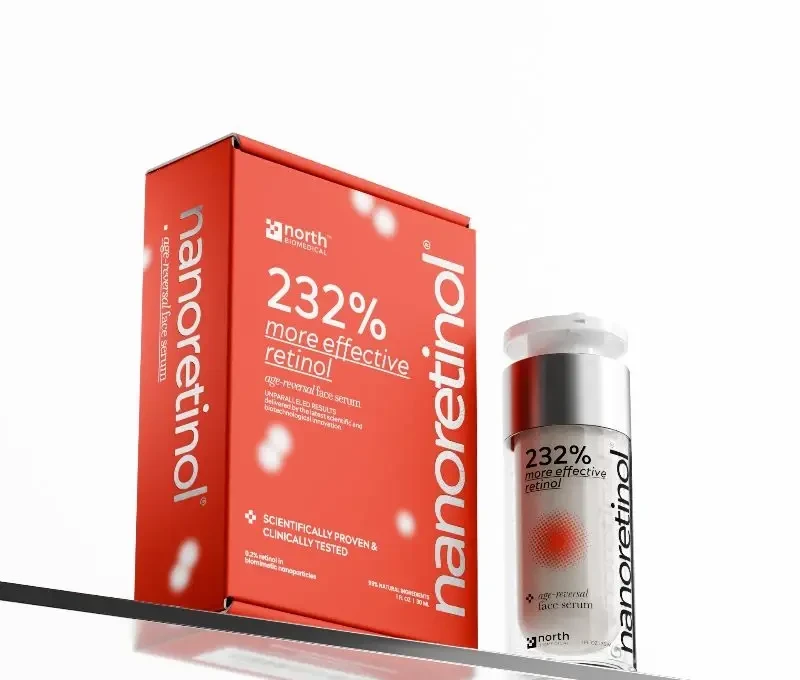
How Nanoretinol® Approaches This Problem
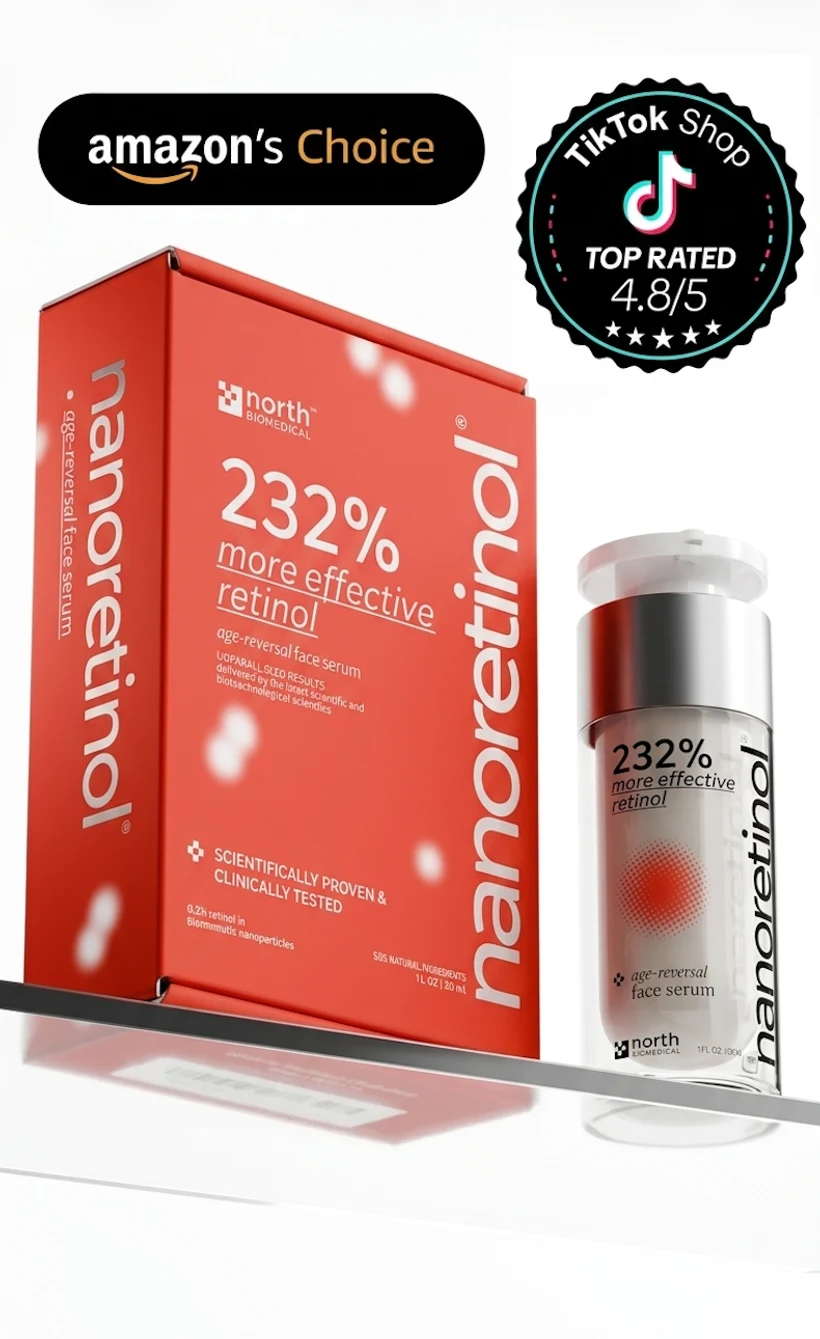
At North Biomedical®, we chose retinol as our active — deliberately. Not because retinaldehyde lacks merit, but because retinol has the most extensive clinical validation in dermatological literature, and our biomimetic lipid nanoparticle technology solves the delivery problem that traditionally held retinol back.
Nanoretinol® encapsulates retinol in nanoparticles that are structurally recognized by skin cells as “self,” bypassing the epithelial barrier without chemical penetration enhancers. The result: +232% more collagen recovery and +73% more elastin recovery compared to conventional retinol, with dramatically reduced irritation. In 56-day clinical trials, users experienced a 61% increase in firmness and 56% increase in elasticity.
When delivery is optimized, the one-step conversion advantage of retinaldehyde becomes marginal. You’re flooding cells with retinol at concentrations that far exceed what traditional formulations deliver — the two-step conversion handles the rest efficiently.
Making Your Decision
The retinol vs retinal debate is scientifically legitimate but practically overemphasized. Both are proven retinoids with meaningful anti-aging activity. The conversion pathway matters less than how much active molecule actually penetrates your skin.
If you’re new to retinoids entirely, our beginner’s guide to retinol covers everything you need to know about starting safely. And if you’re curious about how retinol works at the molecular level, we’ve mapped the full mechanism.
The best retinoid is the one that reaches your cells. Everything else is academic.
References
-
Mukherjee S, Date A, Patravale V, Korting HC, Roeder A, Weindl G. “Retinoids in the treatment of skin aging: an overview of clinical efficacy and safety.” Clinical Interventions in Aging. 2006;1(4):327-348. doi:10.2147/ciia.2006.1.4.327
-
Creidi P, Vienne MP, Ochonisky S, Lauze C, Turlier V, Lagarde JM, Peyrefilte R, Humbert P. “Profilometric evaluation of photodamage after topical retinaldehyde and retinoic acid treatment.” Journal of the American Academy of Dermatology. 1998;39(6):960-965. PMID: 9843009
-
Pechere M, Stecca C, Morganti P, Caserini M, Plewig G, Saurat JH. “Antibacterial activity of retinaldehyde against Propionibacterium acnes.” Dermatology. 1999;199(Suppl 1):29-31. doi:10.1159/000051375
-
Milosheska D, Roškar R. “Use of Retinoids in Topical Antiaging Treatments: A Focused Review of Clinical Evidence for Conventional and Nanoformulations.” Advances in Therapy. 2022;39(12):5351-5375. doi:10.1007/s12325-022-02319-7
-
Draelos Z, Bogdanowicz P, Saurat JH. “Top weapons in skin aging and actives to target the consequences of skin cell senescence.” Journal of the European Academy of Dermatology and Venereology. 2024;38(Suppl 4):15-22. doi:10.1111/jdv.19648