Sagging Jowls: Why Your Jawline Changes After 40 and What You Can Do About It
The anatomy of jowl formation — bone, fat, ligaments, and collagen — and the evidence-based approaches to slowing and improving it
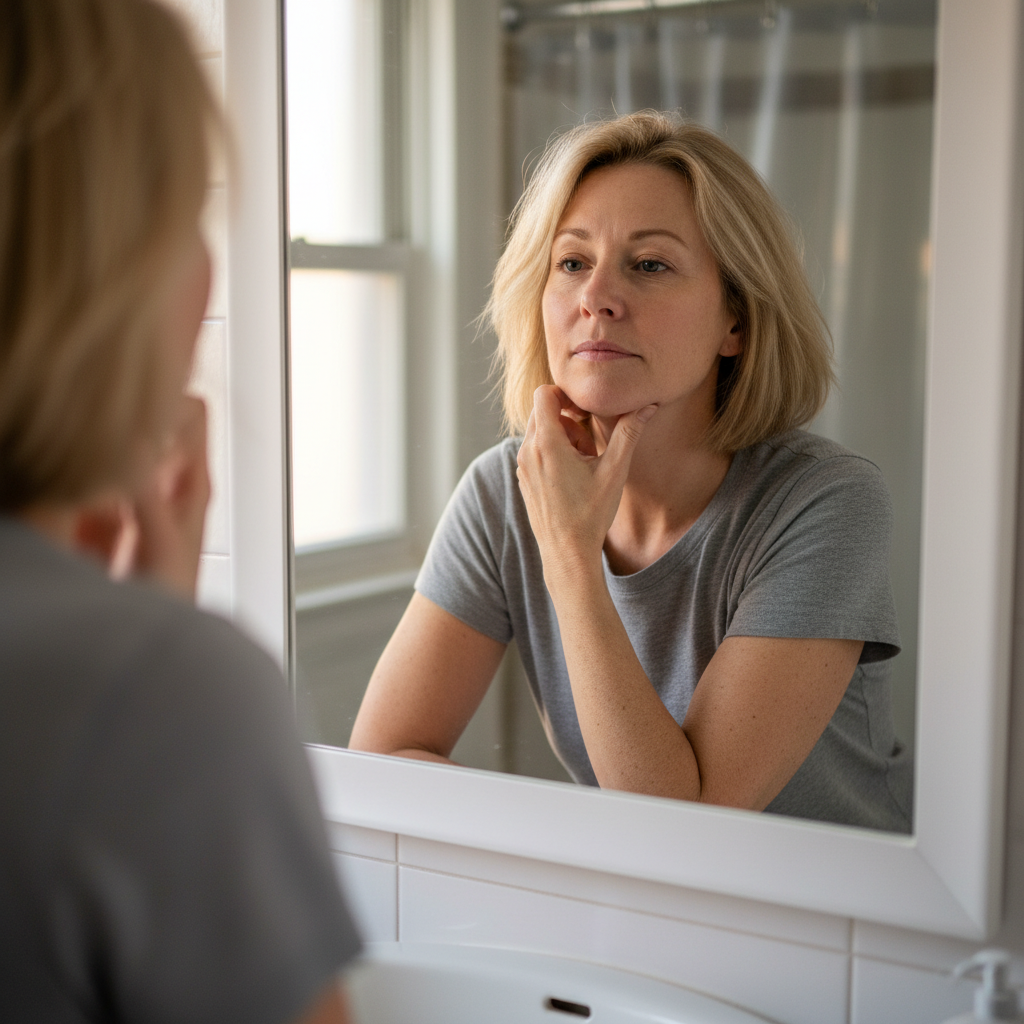
Ask a dermatologist what causes jowls and you’ll get an answer that surprises most people: it’s not just gravity pulling skin downward, and it’s not simply a matter of losing collagen. Jowl formation is the visible surface result of simultaneous changes happening at every layer of your face — skeleton, fat, ligaments, and skin — all degrading at different rates in ways that compound each other.
That complexity matters, because it explains why some interventions work and most don’t.
What’s Actually Happening When Jowls Form
The mandible — the jawbone — resorbs with age. The prejowl area of the jaw, just lateral to the chin, loses bone volume particularly early, creating a relative depression into which overlying soft tissue descends [1]. It’s not that the skin is falling so much as the scaffold beneath it is shrinking.
Simultaneously, the facial fat pads — discrete compartments of subcutaneous fat distributed across the face — lose volume and migrate downward. The malar fat pad (cheek fat) descends along the nasolabial fold as the ligaments holding it in position weaken. The result is a redistribution: fullness leaves the mid-face and accumulates along the jawline, creating the jowl profile [2].
The retaining ligaments — fibrous bands that anchor skin to deeper facial structures at specific points — also elongate and weaken over time. These ligaments are what keep the lower face defined. When they stretch, tissue herniates between them, producing the characteristic bulge at the lower jaw [3].
Skin thinning completes the picture. Collagen density in the dermis declines approximately 1% per year from the mid-20s. Elastin, produced primarily in childhood, degrades without meaningful replacement in adulthood. The skin above the jowl zone becomes thinner, less resilient, and less able to redistribute the gravitational and mechanical forces acting on it [4].
The reason jowls often appear to develop suddenly in your late 40s or early 50s is that multiple slow processes cross a visible threshold simultaneously. Each has been progressing for years; what changes is that their combined effect becomes apparent.
What Non-Invasive Approaches Can and Can’t Do
It’s worth being direct about this: surgical approaches — face lifts, submental liposuction — address the structural causes most directly and produce the most significant results. Non-invasive options are real but more modest. Managing expectations isn’t pessimism; it’s the foundation of making good decisions about where to invest effort.
Collagen density in the dermis declines approximately 1% per year from the mid-20s.
Radiofrequency
Monopolar radiofrequency delivers controlled heat to the dermis and subdermis, stimulating neocollagenesis (new collagen production) and causing immediate tissue tightening through protein denaturation. A controlled trial specifically targeting lower facial laxity — cheeks, jowls, and neck — found measurable improvement in both physician-assessed and patient-assessed outcomes, with results continuing to develop over 3–6 months post-treatment as neocollagenesis completes [6].
Radiofrequency works best for mild to moderate laxity, and benefits typically plateau and partially regress over 1–2 years, requiring maintenance treatment.
Skincare Ingredients for the Dermal Component
No topical ingredient reverses fat pad migration or bone resorption — that’s honest, and worth stating clearly. But the skin component of jowl formation — the thinning dermis that gives way under gravitational stress — is addressable through topical skincare.
Retinoids are the most evidence-backed option. A comprehensive review of retinoid mechanisms confirms upregulation of procollagen type I and III, reduced activity of matrix metalloproteinases (collagen-degrading enzymes), and measurable increase in dermal thickness [4]. A comparative trial confirmed that both OTC retinol and prescription tretinoin upregulate the collagen genes COL1A1 and COL3A1, with retinol producing meaningful results with fewer side effects — an important distinction for maintaining a consistent long-term routine [5].
What this means in practice: retinol won’t lift jowls that have already descended significantly, but it can slow the underlying dermal thinning that makes them worse over time. That’s meaningful when applied consistently over years, not months.
For context on how the same collagen-thinning dynamic affects adjacent anatomy, turkey neck treatment covers the neck area and the treatments that overlap significantly with jowl care.
Copper Peptides
Copper peptides merit mention alongside retinol. They stimulate collagen and elastin synthesis through a different mechanism, and combining a collagen stimulant (retinol) with a compound that also inhibits collagen degradation (copper peptides) has genuine theoretical synergy supported by independent clinical evidence. They’re among the few skincare ingredients with a conversion-backed evidence base.
Facial Exercises
The evidence for facial exercises and jowl improvement is sparse and low quality. One small trial suggested modest improvements in midface fullness with a specific exercise protocol, but the study had significant methodological limitations and the results haven’t been replicated. For lower face laxity specifically, no published trial shows meaningful clinical improvement from exercise alone.
Radiofrequency works best for mild to moderate laxity, and benefits typically plateau and partially regress over 1–2 years, requiring maintenance treatment.
The Nanoretinol Advantage for Consistent Use
Standard retinol reaches the dermis inefficiently. Conventional formulations require barrier disruption to penetrate — the irritation, redness, and peeling many people experience aren’t incidental; they reflect the mechanism by which the formula pushes retinol through. This makes consistent long-term use difficult, particularly for people with sensitive or reactive skin.
Nanoretinol uses biomimetic lipid nanoparticles that pass through the epithelial barrier intact, recognized as “self” by skin cells. Clinical outcomes include a +232% improvement in collagen recovery and a +61% increase in skin firmness at 56 days — results that exceed conventional formulation benchmarks at a lower retinol concentration (0.2%). For the specific goal of maintaining dermal thickness and slowing jowl progression over years of use, consistent application without tolerance-building periods has meaningful practical advantages over conventional formulas that many users discontinue due to irritation.
Building a Realistic Strategy
For women at the early to moderate stage of jowl formation, the most evidence-supported approach combines:
- Retinol or Nanoretinol applied nightly to improve dermal quality and slow the collagen loss component
- Broad-spectrum SPF 30+ daily — UV damage accelerates collagen and elastin loss faster than nearly any other factor; see sunscreen for aging skin
- Professional radiofrequency treatment if you want more meaningful near-term improvement (results develop over 3–6 months, benefit 1–2 years)
- Adequate dietary protein and vitamin C to support baseline collagen synthesis capacity
If jowls are already significant, managing expectations is important. Skincare and energy-based treatments work best as maintenance and early-intervention tools. The more structural the issue — significant fat pad descent, marked bone resorption — the less topical or energy-based intervention can realistically achieve.
What Actually Changes the Trajectory
The most underappreciated leverage point is timing. Starting retinol in your late 30s, maintaining photoprotection through your 40s, and treating professional energy-based treatments as maintenance (annual or biannual) rather than one-time fixes changes the trajectory of jowl formation significantly.
The extracellular matrix changes described in research — fibroblast dysfunction, fragmented collagen accumulation, disorganized scaffolding [7] — respond more readily to intervention early than they do once significant degradation has occurred. The goal isn’t turning back the clock to 25; it’s slowing a process that, left unaddressed, compounds on itself.
References
-
Mendelson B, Wong CH. “Changes in the Facial Skeleton with Aging: Implications and Clinical Applications in Facial Rejuvenation.” Aesthetic Plastic Surgery. 2012;36(4):753–760. doi:10.1007/s00266-012-9904-3
-
Farkas JP, Pessa JE, Hubbard B, Rohrich RJ. “The Science and Theory behind Facial Aging.” Plastic and Reconstructive Surgery Global Open. 2013;1(1):e8–e15. doi:10.1097/GOX.0b013e31828ed1da
-
Swift A, Liew S, Weinkle S, Garcia JK, Silberberg MB. “The Facial Aging Process From the ‘Inside Out’.” Aesthetic Surgery Journal. 2021;41(10):1107–1119. doi:10.1093/asj/sjaa339
-
Mukherjee S, Date A, Patravale V, Korting HC, Roeder A, Weindl G. “Retinoids in the Treatment of Skin Aging: An Overview of Clinical Efficacy and Safety.” Clinical Interventions in Aging. 2006;1(4):327–348. doi:10.2147/ciia.2006.1.4.327
-
Kong R, Cui Y, Fisher GJ, et al. “A Comparative Study of the Effects of Retinol and Retinoic Acid on Histological, Molecular, and Clinical Properties of Human Skin.” Journal of Cosmetic Dermatology. 2016;15(1):49–57. doi:10.1111/jocd.12193
-
Wanitphakdeedecha R, Yogya Y, Yan C, et al. “Efficacy and Safety of Monopolar Radiofrequency for Treatment of Lower Facial Laxity in Asians.” Dermatology and Therapy. 2022;12(11):2563–2573. doi:10.1007/s13555-022-00817-8
-
Quan T, Fisher GJ. “Role of Age-Associated Alterations of the Dermal Extracellular Matrix Microenvironment in Human Skin Aging: A Mini-Review.” Gerontology. 2015;61(5):427–434. doi:10.1159/000371708