Saggy Butt: Why It Happens and How to Firm the Skin Above the Muscle
The biology behind gluteal sagging — and what actually firms the skin layer
Stand sideways. Look in the mirror. The glute that once curved up and held a confident shape now sits a little lower, a little softer, with skin that creases where it never used to. You can do all the squats you want, and the underlying muscle will respond — but the skin on top of that muscle is a separate problem with separate biology, and exercise alone does not fix it.
That is the part most articles get wrong. A “saggy butt” is not just a muscle question. It is also a skin question, a fat-distribution question, and a collagen-architecture question. Each contributes, and each responds to different inputs.
The Three Layers That Make a Butt Look Firm
When you look at the curve of a glute in a mirror, you are looking at three structures stacked together:
- The gluteal muscle — the largest muscle in the body. It can be grown or shrunk through exercise, and it provides the underlying shape.
- The subcutaneous fat layer — a structural cushion above the muscle that gives the butt its rounded surface contour. It is not “just fat” — it is woven into a fibrous lattice that holds shape.
- The skin — dermis and epidermis, anchored by collagen and elastin fibers that resist stretching and snap back from movement.
A truly youthful, firm-looking butt depends on all three. A muscular butt with thinned, crepey skin and depleted fat will still look “saggy” because the surface no longer behaves like a continuous, taut envelope.
What Aging Does to Each Layer
The muscle is the easiest layer to understand: less use, less mass. What is more interesting is what happens to the other two.
Collagen and elastin decline — even in body skin
The dermis is held together by a mesh of collagen fibers (which resist stretch) and elastin fibers (which provide recoil). Both decline with age. A 2023 study in Scientific Reports found that resistance training in midlife adults actually rejuvenated aging skin by reducing circulating inflammatory factors and enhancing dermal extracellular matrix proteins — confirming that skin is metabolically responsive tissue, not just inert covering [1]. The flip side: without that stimulus, the matrix degrades over decades, and skin loses both its bounce and its ability to lie smoothly over the underlying contours.
If you have lost a significant amount of weight, the issue is more dramatic.
The fat layer migrates and thins
Subcutaneous fat over the buttocks redistributes with age. Some of it is simply lost, contributing to flatter contours. But researchers have also documented something stranger: adipose tissue infiltrates upward into the dermis over time, weakening the boundary between skin and underlying support [2]. The result is a softer, more diffuse interface — exactly what looks like “sag” rather than “shape.”
Weight loss accelerates everything
If you have lost a significant amount of weight, the issue is more dramatic. A 2024 study in Obesity Surgery compared histological skin changes after massive weight loss in bariatric and non-bariatric patients and found significant reductions in collagen density and elastic fiber organization regardless of how the weight came off [3]. The skin envelope was sized for the larger body, the supportive matrix degraded under prolonged stretch, and recoil never fully recovers without intervention. This is why post-weight-loss skin laxity is one of the most common drivers of women searching for “saggy butt” solutions.
Glycation — the slow stiffening
There is one more, sneakier mechanism: glycation. Excess sugar in the bloodstream binds to collagen and elastin fibers, forming advanced glycation end products (AGEs) that cross-link the dermal matrix and make it brittle. A widely cited review in Dermato-Endocrinology describes AGEs as “key players in skin aging,” reducing elasticity and contributing to a leathery, sagging appearance [4]. Diet, glucose control, and topical antioxidants all factor in.
What Actually Firms the Skin
Once you understand the three-layer problem, the solution stack falls out logically. You need to address muscle, fat, and skin — and the skin is the layer most articles ignore.
Strength training — for the muscle layer
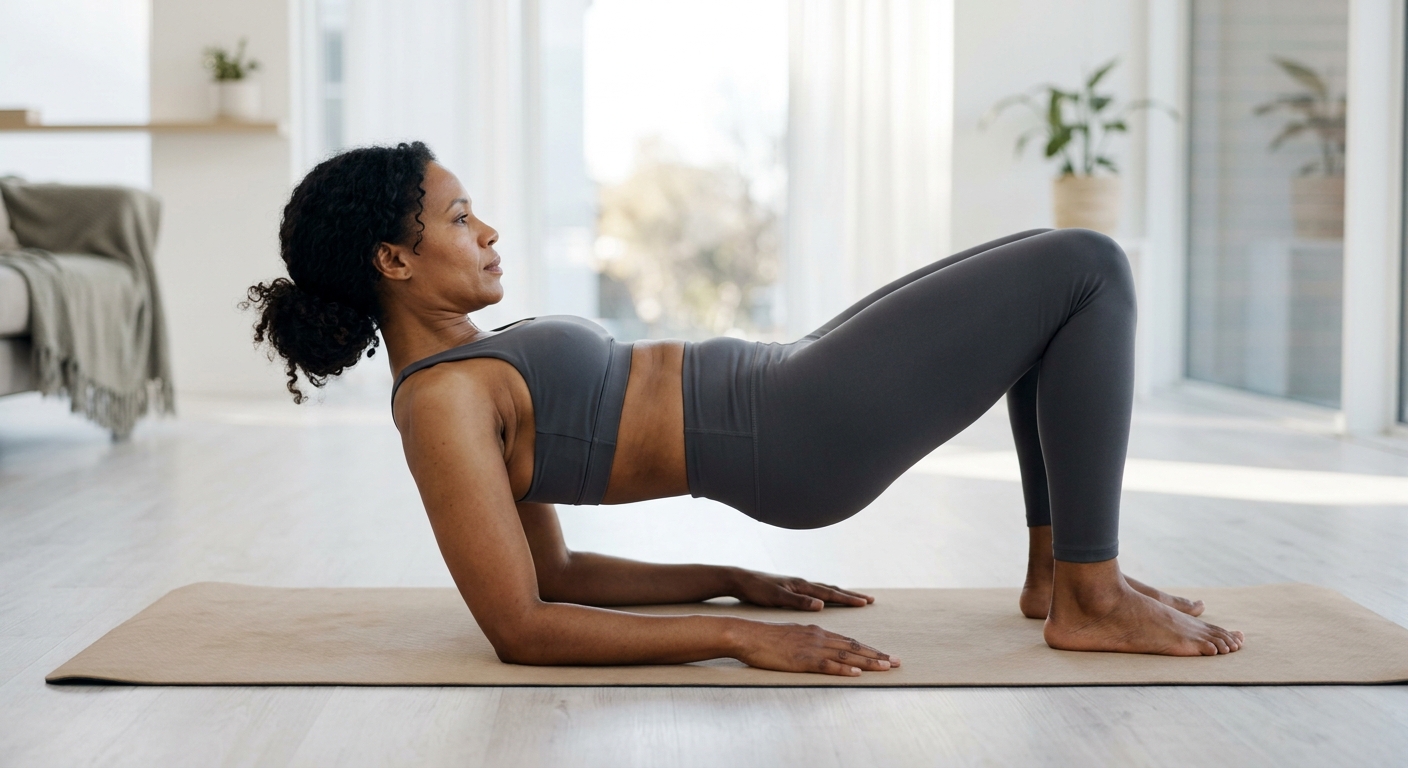
Glute-focused resistance training (hip thrusts, weighted lunges, Bulgarian split squats, heavy squats) rebuilds the underlying muscle and, as the 2023 Scientific Reports trial showed, also benefits the dermis itself [1]. Two to three sessions per week of progressively loaded glute work is the minimum effective dose.
Caloric and protein adequacy — for the fat-and-collagen scaffold
You cannot rebuild dermal collagen on a chronic caloric deficit with low protein intake. Aim for at least 1.2–1.6 g of protein per kilogram of body weight if you are over 40, and avoid aggressive weight loss if firmness is a priority. Rapid loss tightens nothing; it deflates.
Topical retinoids — for the skin layer
This is where most people stop short. Retinoids are the only over-the-counter category with consistent, replicated evidence for improving thinning, photoaged body skin. A 2007 trial in Archives of Dermatology found that 0.4% retinol applied to naturally aged skin in older adults significantly improved fine wrinkling and produced measurable increases in dermal collagen [5]. The benefits apply to body skin too, though the thicker tissue requires consistent application over months.
Most people abandon body retinol within a month for exactly this reason.
Peptides and supportive actives
Peptide serums — particularly palmitoyl pentapeptide and the matrikine class — have shown smaller but real improvements in photoaged skin. A 2005 trial in the International Journal of Cosmetic Science documented improvements in fine lines and skin thickness with twice-daily peptide application over 12 weeks [6]. They are a useful add-on, not a standalone replacement.
Caffeine for short-term skin tone
Caffeine-containing creams produce a temporary tightening effect by constricting microvasculature and reducing fluid retention. A 2015 clinical study in Annals of Dermatology documented modest improvements in skin tone and cellulite appearance with water-soluble caffeine combined with xanthenes [7]. Useful for events; not a long-term firming strategy. The same split runs through our guide to the best cellulite cream, where transient firming and dermal rebuilding are two different purchases.
A Realistic Body-Firming Routine
Combine the layers, and a workable weekly plan looks like this:
- 2–3 strength sessions focused on the glutes, progressively loaded
- Adequate protein at every meal — aim for a serving the size of your palm
- Nightly retinol body lotion on the buttocks, hips, and outer thighs, starting 3 nights per week and ramping up as tolerated
- A weekly body exfoliant (AHA-based) to accelerate cell turnover and improve retinol penetration
- Daily SPF on exposed body skin — UV degrades collagen everywhere, even on parts you do not see in the mirror
Expect 12–24 weeks for visible firming. The skin layer is the slowest to respond, but it is also the layer that determines whether all the other work shows.
The Retinol Penetration Problem on Body Skin
Body skin is thicker than facial skin. The barrier is more robust, retinol penetration is slower, and the standard solution — using a higher concentration — almost always backfires. High-strength retinol on the buttocks triggers the same redness, peeling, and barrier damage as on the face, except on a much larger surface area. Most people abandon body retinol within a month for exactly this reason.
The bottleneck is not how much retinol is in the bottle. It is how much actually crosses the epithelial barrier and reaches the cells that build collagen. Nanoretinol uses biomimetic lipid nanoparticles — particles whose surface mimics the membrane of your own skin cells — to deliver retinol through the barrier without disrupting it. The body’s epithelial cells treat the nanoparticles as “self” and let them pass. In comparative testing, this approach achieved 232% more collagen recovery and 73% more elastin recovery than conventional retinol [8] — and in 56-day clinical trials, users showed a 61% increase in skin firmness and 56% increase in elasticity.
For body application, the practical effect is that you can use it consistently — every night if you want — on large areas like the glutes and outer thighs, without the cycle of irritation that derails most body-retinol plans.
What Will Not Fix It
A short list of things that get sold for “butt firming” but do not produce meaningful results:
- Slimming creams alone. Caffeine-only creams give an hour-long tightening; they do not change the underlying matrix.
- Cryotherapy at home. No reliable evidence for dermal collagen induction from at-home cold devices.
- Foam rollers and gua sha. Useful for muscle recovery; no published evidence for changing skin firmness.
- Detox wraps. Temporary fluid shifts. No structural change.
The skin envelope is built on the same biology everywhere on the body. The actives that work on the face — retinoids, peptides, AHAs, SPF — are the same actives that work on the body, with consistency and time as the variables that determine whether you see results.
The Honest Timeline
Glute muscle responds in 6–8 weeks. Subcutaneous fat redistribution from training is a 3–6 month story. Skin remodeling is the slowest layer of all: 12–24 weeks before visible improvement, with continued gains over a year or more. Most people stop too early. The ones who do not — who train consistently, eat enough protein, and treat the skin as its own organ requiring its own input — get the result that the gym alone cannot deliver.
References
- Nishikori S, Yasuda J, Murata K, Takegaki J, Harada Y, Shirai Y, Fujita S. “Resistance training rejuvenates aging skin by reducing circulating inflammatory factors and enhancing dermal extracellular matrices.” Scientific Reports. 2023;13(1):10214. doi:10.1038/s41598-023-37207-9
- Ezure T, Amano S, Matsuzaki K. “Infiltration of subcutaneous adipose layer into the dermal layer with aging.” Skin Research and Technology. 2022;28(2):311-316. doi:10.1111/srt.13133
- Hany M, Zidan A, Ghozlan NA, Ghozlan MN, Abouelnasr AA, Sheta E, Hamed Y, Kholosy H, Soffar M, El Midany WM, Torensma B. “Comparison of Histological Skin Changes After Massive Weight Loss in Post-bariatric and Non-bariatric Patients.” Obesity Surgery. 2024;34(3):855-865. doi:10.1007/s11695-024-07066-y
- Gkogkolou P, Böhm M. “Advanced glycation end products: Key players in skin aging?” Dermato-Endocrinology. 2012;4(3):259-270. doi:10.4161/derm.22028
- Kafi R, Kwak HSR, Schumacher WE, Cho S, Hanft VN, Hamilton TA, King AL, Neal JD, Varani J, Fisher GJ, Voorhees JJ, Kang S. “Improvement of Naturally Aged Skin With Vitamin A (Retinol).” Archives of Dermatology. 2007;143(5):606-612. doi:10.1001/archderm.143.5.606
- Robinson LR, Fitzgerald NC, Doughty DG, Dawes NC, Berge CA, Bissett DL. “Topical palmitoyl pentapeptide provides improvement in photoaged human facial skin.” International Journal of Cosmetic Science. 2005;27(3):155-160. doi:10.1111/j.1467-2494.2005.00261.x
- Byun SY, Kwon SH, Heo SH, Shim JS, Du MH, Na JI. “Efficacy of Slimming Cream Containing 3.5% Water-Soluble Caffeine and Xanthenes for the Treatment of Cellulite: Clinical Study and Literature Review.” Annals of Dermatology. 2015;27(3):243-249. doi:10.5021/ad.2015.27.3.243
- North Biomedical LLC. “Nanoretinol vs. Conventional Retinol: Efficacy in Collagen and Elastin Recovery.” Clinical Study Summary, 2024.