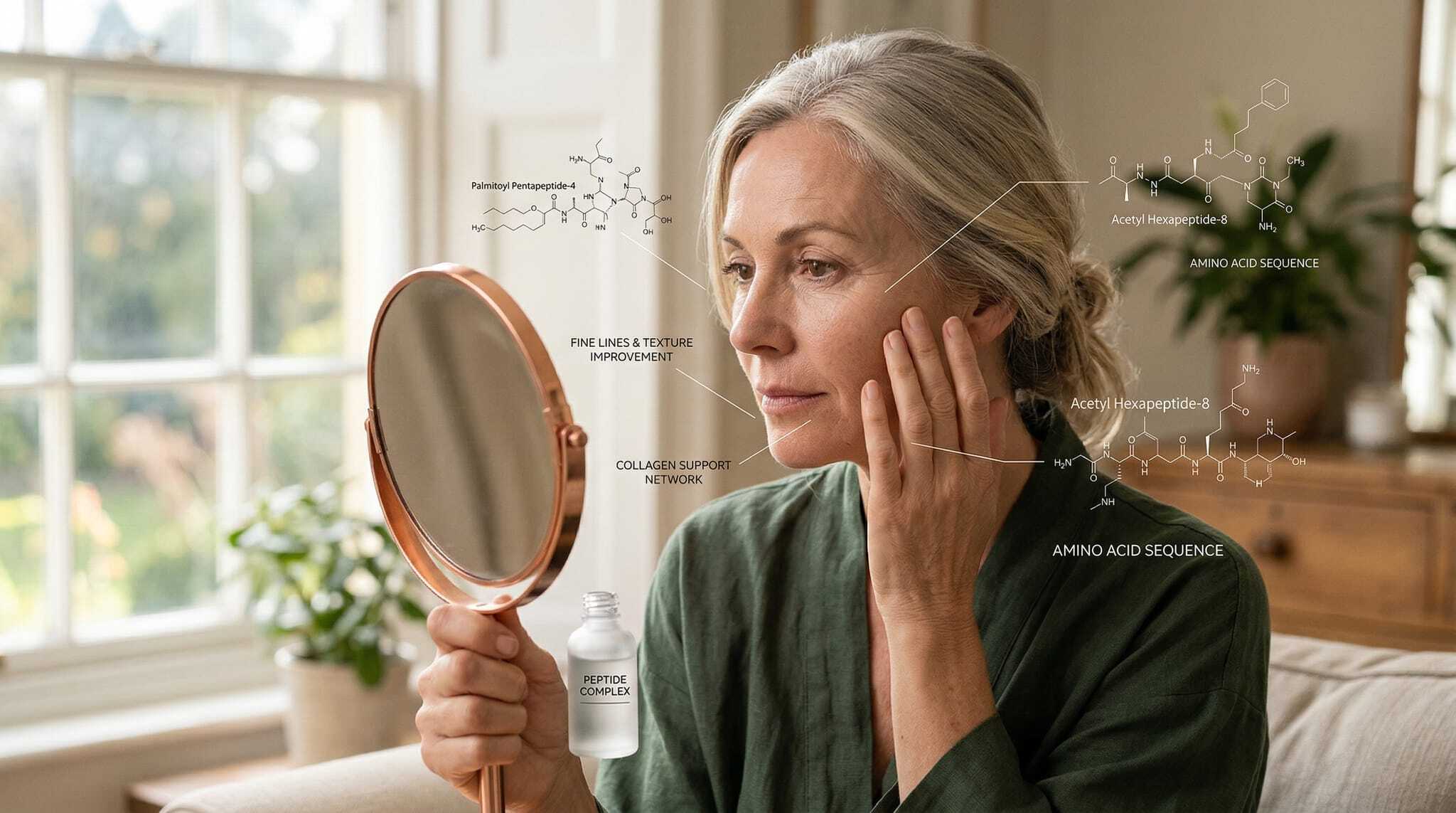
Best Peptide Serum Ingredients: What to Look For
Signal peptides, neurotransmitter inhibitors, and copper complexes — what the evidence supports and what labels leave out
The best peptide serum is not necessarily the bottle with the longest ingredient list or the highest price. Look for a named, clinically studied peptide, a formula designed for stability and delivery, and claims that match what that specific peptide has actually been tested to do [1][6].
Best Peptide Serum Ingredients: The Short Answer
| If your priority is… | Look for… | Evidence caveat |
|---|---|---|
| Fine lines and surface texture | Palmitoyl pentapeptide-4 or related signal peptides | Small human trials are encouraging, but formulas and doses vary [1][2]. |
| Expression lines | Acetyl hexapeptide-8 or related neurotransmitter peptides | Effects are modest and cannot reproduce injectable neuromodulators [3]. |
| Repair signaling | GHK-Cu or another clearly identified copper peptide | Strong mechanistic evidence; topical product-level evidence is less consistent [4][5]. |
| A broader routine | A transparent multi-peptide formula | More peptides are not automatically better if doses, stability, and delivery are unknown. |
This is an ingredient-selection guide, not a ranking of branded serums. Companies frequently reformulate products, while the principles for judging the label remain useful.
Why Peptides Are Everywhere in Anti-Aging Skincare
Walk through the skincare aisle of any department store and you will find the word “peptides” on roughly half the anti-aging serums. The marketing is loud, but the science behind it is real — peptides are short chains of amino acids that act as molecular messengers, telling skin cells what to build, when to repair, and how quickly to turn over [1].
The catch: not all peptides do the same thing, and not every peptide serum delivers enough of the right ones to matter. Some formulations contain trace amounts of a single peptide floating in a sea of glycerin. Others combine multiple classes at concentrations that clinical trials have actually tested.
If you are over 40 and trying to figure out which peptide serum is worth the investment, the answer starts with understanding what these molecules actually do once they reach your skin.
The Three Classes of Peptides That Matter
Signal Peptides — The Collagen Builders
Signal peptides work by mimicking the fragments of broken-down collagen. When collagen degrades naturally, the body detects these fragments and responds by producing more. Signal peptides exploit this feedback loop — they arrive at fibroblast receptors and essentially say “we need more collagen here.”
The most studied signal peptide is palmitoyl pentapeptide-4, commercially known as Matrixyl. In a double-blind trial published in the International Journal of Cosmetic Science, subjects who applied a cream containing palmitoyl pentapeptide-4 for 12 weeks showed statistically significant improvement in wrinkle depth and skin roughness compared to the vehicle control [2]. A more recent randomized trial confirmed these findings specifically for crow’s feet, reporting measurable wrinkle reduction with consistent use [3]. If you would rather get your peptides from a cream than a serum, our guide to choosing a peptide moisturizer explains which formulas are worth buying.
A newer generation, palmitoyl tripeptide-38 (Matrixyl synthe’6), goes further — it stimulates synthesis of not just collagen but also fibronectin and laminin, the structural proteins that form the scaffolding between skin cells.
Neurotransmitter Peptides — The Expression Line Smoothers
Think of these as topical muscle relaxants. Acetyl hexapeptide-8, better known as Argireline, works by inhibiting the SNARE complex — the same neurotransmitter release mechanism that Botox targets [3]. The result is a subtle relaxation of the muscles responsible for expression lines around the forehead and eyes.
If you are over 40 and trying to figure out which peptide serum is worth the investment, the answer starts with understanding what these molecules actually do once they reach your skin.
No topical peptide will replicate the dramatic results of an injection. But the clinical evidence shows that Argireline can meaningfully soften expression lines with daily application, particularly when combined with other peptide classes [3]. It is one of the few topical ingredients with a plausible Botox-adjacent mechanism, and the research, while still evolving, supports moderate efficacy for fine lines.
Carrier Peptides — The Repair Specialists
Carrier peptides transport trace minerals into the skin, most notably copper. GHK-Cu (glycyl-L-histidyl-L-lysine copper complex) is the standout in this category. It occurs naturally in human plasma, and its concentration declines significantly with age — by 60, you have roughly a third of the GHK-Cu levels you had at 20. Judging a GHK-Cu formula on its label is covered in our guide to the best copper peptide serum.
The research on GHK-Cu is unusually broad. A comprehensive review in BioMed Research International documented its role in stimulating collagen synthesis, promoting wound healing, reducing inflammation, and even modulating gene expression related to tissue remodeling [4]. A separate review confirmed its potential as an anti-aging peptide with effects on skin thickness, elasticity, and firmness [5].
The practical limitation: copper peptides are notoriously unstable. They oxidize easily and do not play well with certain other actives, particularly vitamin C. If your routine already includes an L-ascorbic acid serum, you will want to use copper peptides at a different time of day.
What to Look for in a Peptide Serum
Not all peptide serums are created equal. The gap between a well-formulated product and a marketing exercise can be enormous. Here is what separates the two:
Multiple peptide classes. The best formulations combine signal, neurotransmitter, and carrier peptides. Each class targets a different aspect of skin aging — collagen loss, muscle-driven lines, and mineral delivery — so combining them produces broader results than any single peptide alone.
Adequate concentration. Most clinical studies on palmitoyl pentapeptide-4 used concentrations around 4 ppm (parts per million). That sounds small, but many serums contain even less. Look for products that list peptides in the top third of their ingredient list, or better yet, disclose concentration.
Complementary actives. Peptides pair well with hyaluronic acid (for hydration), niacinamide (for barrier support), and retinol (for cell turnover). The combination of a peptide serum with a well-formulated retinol is one of the most evidence-backed anti-aging strategies available [6].
Stable packaging. Peptides degrade with exposure to light and air. Airless pump bottles or opaque dropper containers preserve efficacy far better than open jars.
How Peptides Compare to Retinol
Peptides and retinol are not competitors — they are complementary. Retinol works primarily by accelerating cell turnover and stimulating collagen synthesis through retinoic acid receptors. Peptides work through entirely different pathways: receptor signaling, neurotransmitter modulation, and mineral delivery [6].
If your routine already includes an L-ascorbic acid serum, you will want to use copper peptides at a different time of day.
Where retinol can cause irritation — especially in the first weeks of use — peptides are remarkably well-tolerated. They do not thin the stratum corneum, do not increase photosensitivity, and rarely cause redness or peeling. This makes them an excellent addition to any retinol-based routine, not a replacement for one.
The strongest anti-aging protocols use both: retinol for deep structural remodeling, and peptides for the signaling and repair work that retinol cannot do alone. Applied at different times of day — retinol as your night serum, peptides in the morning — the two actives cover more ground than either could independently.
The Delivery Problem Most Peptide Serums Ignore
Here is the uncomfortable truth about most peptide products: peptides are large molecules. Many of them struggle to penetrate the stratum corneum — the outermost layer of dead skin cells that acts as the body’s first barrier against the outside world.
This is why palmitoylation matters. Attaching a fatty acid chain (like palmitic acid) to a peptide makes it more lipophilic — more likely to slip through the lipid-rich spaces between skin cells. It is also why the best copper peptide formulations use specific delivery vehicles to improve bioavailability [4].
The delivery challenge is not unique to peptides. Retinol faces the same barrier problem, which is why advanced delivery technologies — like lipid nanoparticle encapsulation — have emerged as a way to dramatically improve how much active ingredient actually reaches the target cells. Nanoretinol® by North Biomedical® uses biomimetic lipid nanoparticles to deliver retinol past the epithelial barrier, achieving +232% greater collagen recovery compared to conventional retinol in controlled testing. The nanoparticles are recognized by skin cells as “self,” bypassing the barrier damage that traditional formulations cause.
When you combine a well-formulated peptide serum with a delivery-optimized retinol, you are not just layering two actives — you are covering both the signaling pathways (peptides) and the structural remodeling pathways (retinol) with ingredients that can actually reach the cells that need them.
Building a Peptide-Retinol Routine After 40
A practical routine that incorporates both:
Morning: Cleanser → peptide serum (look for Matrixyl + Argireline combination) → hyaluronic acid → moisturizer → sunscreen
Evening: Cleanser → retinol (start 2–3 nights per week, build to nightly) → moisturizer
This separation keeps copper peptides away from any vitamin C in your morning routine and gives retinol uninterrupted time to work overnight. As tolerance builds, you can increase retinol frequency without worrying about peptide interference — the two actives operate through independent mechanisms and do not compete for the same receptors.
The Takeaway
Peptides are not a replacement for retinol, and retinol is not a replacement for peptides. The science supports using both — peptides for targeted signaling and repair, retinol for deep structural renewal. The key is choosing formulations that contain clinically studied peptides at meaningful concentrations, and pairing them with a retinol that actually reaches the cells where collagen is made.
Peptide Serums: Quick Questions
Which peptide is best for wrinkles?
There is no universal winner. Palmitoyl pentapeptide-4 has human data for photoaged skin, while acetyl hexapeptide formulations target expression-related lines through a different mechanism [2][3]. The exact formula and dose matter as much as the peptide name.
How long does a peptide serum take to work?
The cited human studies measured change over weeks to months, not days. Judge a tolerated product after consistent use over a comparable period, and be skeptical of immediate collagen-rebuilding claims [2][3].
Can peptides replace retinol?
Not on the current evidence. Peptides can complement a retinoid routine or provide a gentler option when retinoids are not tolerated, but retinoids have the deeper clinical evidence base for photoaging [1][6]. The full comparison, including why irritation rather than efficacy usually drives the switch, is in peptides vs retinol.
References
-
Schagen SK. “Topical Peptide Treatments with Effective Anti-Aging Results.” Cosmetics. 2017;4(2):16. doi:10.3390/cosmetics4020016
-
Robinson LR, Fitzgerald NC, Doughty DG, et al. “Topical palmitoyl pentapeptide provides improvement in photoaged human facial skin.” Int J Cosmet Sci. 2005;27(3):155-160. doi:10.1111/j.1467-2494.2005.00261.x
-
Aruan RR, Hutabarat H, Widodo AA. “Double-blind, Randomized Trial on the Effectiveness of Acetylhexapeptide-3 Cream and Palmitoyl Pentapeptide-4 Cream for Crow’s Feet.” J Clin Aesthet Dermatol. 2023;16(2):38-42. PMID: 36909866
-
Pickart L, Vasquez-Soltero JM, Margolina A. “GHK Peptide as a Natural Modulator of Multiple Cellular Pathways in Skin Regeneration.” Biomed Res Int. 2015;2015:648108. doi:10.1155/2015/648108
-
Dou Y, Lee A, Zhu L, Morton J, Bhargava V. “The potential of GHK as an anti-aging peptide.” Aging Pathobiol Ther. 2020;2(1):58-61. doi:10.31491/apt.2020.03.014
-
Errante F, Ledwoń P, Bhatt TK, et al. “Cosmeceutical Peptides in the Framework of Sustainable Wellness Economy.” Molecules. 2024;29(19):4717. doi:10.3390/molecules29194717