Sebaceous Filaments: What They Are and How to Minimize Them
They're not blackheads—and squeezing them makes things worse. Here's what sebaceous filaments are and what actually works
What Sebaceous Filaments Actually Are
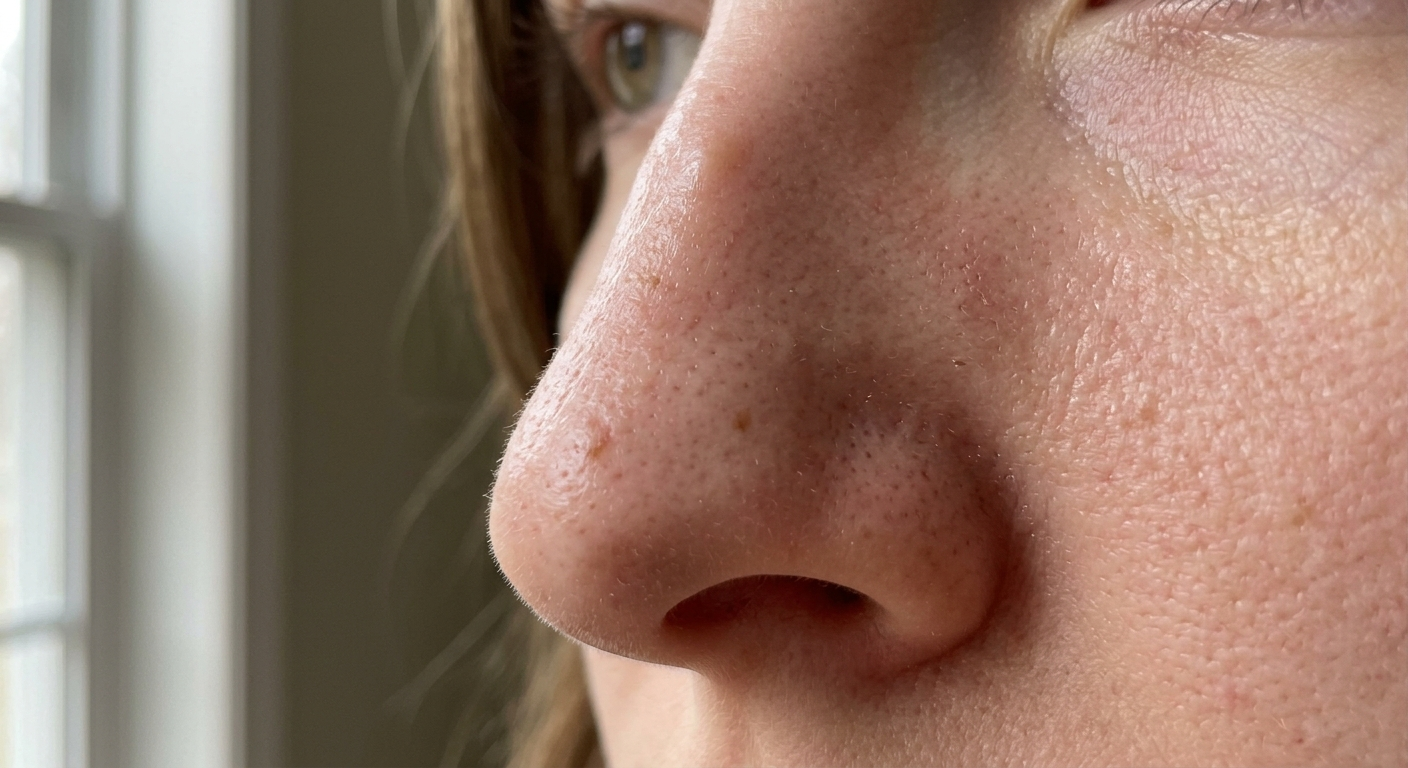
If you’ve examined your nose under a bright light or in a magnifying mirror and noticed tiny gray or yellowish specks in your pores, you’ve been looking at sebaceous filaments. They’re easy to mistake for blackheads—and the mistake is understandable—but they’re fundamentally different, and treating them like blackheads consistently makes them worse.
Sebaceous filaments are 1-2mm white-to-yellow spicules that form inside pilosebaceous units (the follicle-sebaceous gland complex) as a result of normal sebum accumulation combined with cornified keratinocytes [1]. Unlike blackheads, which are follicular plugs filled with oxidized debris, sebaceous filaments are composed primarily of sebum, skin cells, and follicular components that are continuously produced by functional glands. They’re not a blockage. They’re how sebaceous glands work.
Every follicle that contains a sebaceous gland has sebaceous filaments. In people with larger pores and higher sebum production, they become visible to the naked eye—especially on the nose, chin, and central forehead, where sebaceous gland density is highest.
Why Some People See Them More Than Others
Visibility depends primarily on three factors:
Sebum production rate. The more sebum your glands produce, the faster filaments refill after any removal. Sebum production is regulated by androgens—hormones that fluctuate during puberty, perimenopause, and periods of elevated stress. This is why sebaceous filament visibility often changes over time even without changes in skincare.
Pore diameter. Larger pores hold more material and create a wider, more visible channel. Pore size is largely determined by genetics and by the integrity of the collagen scaffold surrounding each follicle. As skin ages and collagen support loosens, pores appear to enlarge—which is why sebaceous filaments often become more noticeable in the forties and beyond, even in people who had relatively smooth skin in their twenties. For more on the science of pore size, see our article on how to minimize the appearance of pores.
Surface skin texture. A rough or thickened stratum corneum creates uneven contrast that makes pore content more visible. Smooth, well-exfoliated skin creates a more uniform background where individual pore filaments are less distinguishable.
Why Squeezing Doesn’t Work
The instinct when seeing a pore-blocking substance is to compress the skin and force the contents out. With sebaceous filaments, this provides a few minutes of visible clearance before the filament refills completely—typically within 30 days, and sometimes faster [1].
Repeated squeezing has a worse outcome than the filaments themselves: it inflames the follicle wall, triggers post-inflammatory redness, and over time stretches pore diameter—making the problem measurably worse, not better. Every squeeze that “works” is also widening the pore that made it visible in the first place.
With sebaceous filaments, this provides a few minutes of visible clearance before the filament refills completely—typically within 30 days, and sometimes faster.
The same logic applies to pore strips. They remove the top portion of a sebaceous filament, creating a temporary cleared appearance, but don’t change the underlying sebum production rate and can cause localized barrier damage with regular use.
The Two Ingredients That Actually Work
Effective management of sebaceous filaments requires addressing two separate steps in the cycle: dissolving the current filament content, and slowing the rate at which new filaments accumulate. Two ingredients have the best clinical evidence for each step.
Salicylic acid (beta-hydroxy acid)
Salicylic acid is lipophilic—it dissolves in oils rather than water, which allows it to penetrate sebum-filled follicles where water-based acids cannot reach [2]. Inside the pilosebaceous unit, salicylic acid dissolves intercellular lipids, loosens the keratinocyte-sebum matrix, and gradually reduces the density of visible filament material at the pore opening.
Clinical evidence supports its effectiveness in reducing sebum secretion and improving skin texture. In one prospective study, a salicylic acid formulation applied daily for 21 days significantly reduced sebum production, improved skin hydration, and reduced surface roughness in participants with oily and combination skin [3]. For sebaceous filaments specifically, a 1-2% BHA product such as a salicylic acid serum applied daily produces the most consistent results. Our overview of salicylic acid for skin covers concentration guidance and formulation types in more detail.
Retinol for long-term regulation
Retinol works at a different level than BHA—it regulates keratinocyte turnover rate and influences sebaceous gland activity [4]. By accelerating the renewal of epidermal cells, retinol prevents the buildup of cornified keratinocytes that contributes to filament density. Over months of consistent use, retinol also stimulates collagen production around follicular walls, which can modestly tighten pore diameter and reduce visible filament size.
A case report published in Cureus documented complete resolution of sebaceous filaments in a patient treated with topical tretinoin 0.025% applied once daily—with the face fully cleared within six weeks [1]. While OTC retinol produces results more gradually, the mechanism is the same. For more on retinol’s relationship with pore appearance, see our dedicated article on retinol and pores.
The combination that works: BHA to clear existing filament content → retinol to slow the refill rate. Used together, they address both sides of the cycle.
Supporting Strategies
Niacinamide reduces sebum excretion rate through mechanisms independent of BHA and retinol. In a placebo-controlled trial, topical 2% niacinamide significantly reduced casual sebum levels over a four-week period in Caucasian participants [5]. It’s a useful addition to any sebum-targeting routine, particularly for people who find salicylic acid or retinol drying at higher frequencies.
In one prospective study, a salicylic acid formulation applied daily for 21 days significantly reduced sebum production, improved skin hydration, and reduced surface roughness in participants with oily and combination skin.
Oil cleansing seems counterintuitive but has a logical basis: applying a lightweight cleansing oil to dry skin before water-based cleansing attracts and partially dissolves the lipid-based sebum content of filaments, loosening material before it is removed. This double-cleansing method consistently improves pore appearance in people with high sebum output, particularly in the evening routine.
Maintaining barrier hydration. Dehydrated skin triggers a compensatory increase in sebum production. A non-comedogenic, lightweight moisturizer helps maintain the right moisture balance without adding lipid congestion to follicles. The goal is hydrated skin, not suppressed sebum to the point of barrier dysfunction.
Why Retinol Tolerability Matters Here
The pore-dense central face zone—nose, forehead, chin—is also the area where skin is thinnest and most reactive. Conventional retinol formulations use barrier-disrupting chemicals to push retinol through the skin’s outer layers. In the sebaceous-rich zones where filaments appear, this often produces peeling, redness, and sensitivity significant enough to interrupt treatment.
Nanoretinol uses a different mechanism. Its biomimetic lipid nanoparticles are recognized by skin as structurally similar to cell membranes, allowing passage through the epithelial barrier without requiring disruption of it [6]. Retinol is delivered intact to target cells—including cells adjacent to sebaceous gland tissue—with significantly less surface irritation.
For someone with visibly enlarged pores and high-activity sebaceous glands who is beginning retinol for the first time, this tolerability profile makes nightly use sustainable rather than intermittent. The collagen-stimulating and pore-tightening effects of retinol accumulate only with consistent use—sporadic application after irritation forces a restart of the process each time.
Managing Expectations Realistically
Sebaceous filaments will always refill. That is not a treatment failure—it is normal physiology. The realistic goal is reducing how visible they appear at any given time and how quickly they become dense enough to see.
With consistent BHA plus retinol use over 8-12 weeks, most people notice: reduced filament density (less material visible at each pore), modest reduction in pore diameter over time from improved collagen support, and a more uniform skin surface texture that makes remaining filaments less prominent by contrast.
When active BHA use is paused, filaments gradually become more visible again—typically over four to six weeks. This is not a regression; it simply reflects that sebum production is ongoing. Long-term management means maintaining the routine rather than treating sebaceous filaments as something to be fixed once and forgotten.
The Bottom of the Biology
Sebaceous filaments are worth understanding rather than just fighting. They’re not a sign of unhealthy skin or inadequate cleansing—they’re the visible output of functional glands doing their job. Sebum itself plays important roles in barrier function, moisture retention, and antimicrobial protection. The objective of treatment is to reduce visibility while maintaining a healthy, functional skin barrier, not to eliminate sebum production entirely—which would trade one concern for a considerably more serious one.
References
-
Mineroff JP, Hyde JT, Hsu S. “A Case Report of Sebaceous Filaments.” Cureus. 2023;15(11):e48656. doi:10.7759/cureus.48656
-
Arif T. “Salicylic acid as a peeling agent: a comprehensive review.” Clin Cosmet Investig Dermatol. 2015;8:455-461. doi:10.2147/CCID.S84765
-
Draelos ZD, Kantor I, Rigel DS, Whitfield MD, Kawa M. “Clinical Efficacy of a Salicylic Acid–Containing Gel on Acne Management and Skin Barrier Function: A 21‐Day Prospective Study.” J Drugs Dermatol. 2025. PMID:40682377
-
Geiger JM. “Retinoids and sebaceous gland activity.” Dermatology. 1995;191(4):305-10. doi:10.1159/000246581
-
Draelos ZD, Matsubara A, Smiles K. “The effect of 2% niacinamide on facial sebum production.” J Cosmet Laser Ther. 2006;8(2):96-101. doi:10.1080/14764170600717704
-
North Biomedical LLC. “Nanoretinol vs. Conventional Retinol: Efficacy in Collagen and Elastin Recovery.” Clinical Study Summary, 2024. northbiomedical.com/documents/Nanoretinol-Study_Summary.pdf