Will Retinol Shrink Pores? What It Can—and Can't—Change
What retinol actually does to your pores — and what no topical product can change
Will retinol shrink pores? Not in the literal, permanent sense. Retinol cannot change the genetically determined diameter of a pore opening, and it cannot “close” pores. It can make pores look smaller by clearing material that stretches the follicle, modestly reducing oiliness, smoothing the surface, and supporting the collagen around each opening.
That distinction—physical pore size versus visible pore appearance—is the key to setting realistic expectations.
Will Retinol Shrink Pores? The Short Answer
Retinol can improve the appearance of enlarged pores through three time-dependent effects:
- Weeks 2–6: more orderly cell turnover can reduce keratin and debris inside the follicle.
- Weeks 4–8: modest sebum regulation can reduce oil-related distension and shine.
- Months 3–6+: collagen support can make the tissue around a pore look firmer and less slack.
It cannot erase pores, override genetics, or create permanently “poreless” skin. Those are marketing promises, not biological outcomes [1][4].
What Determines Pore Size
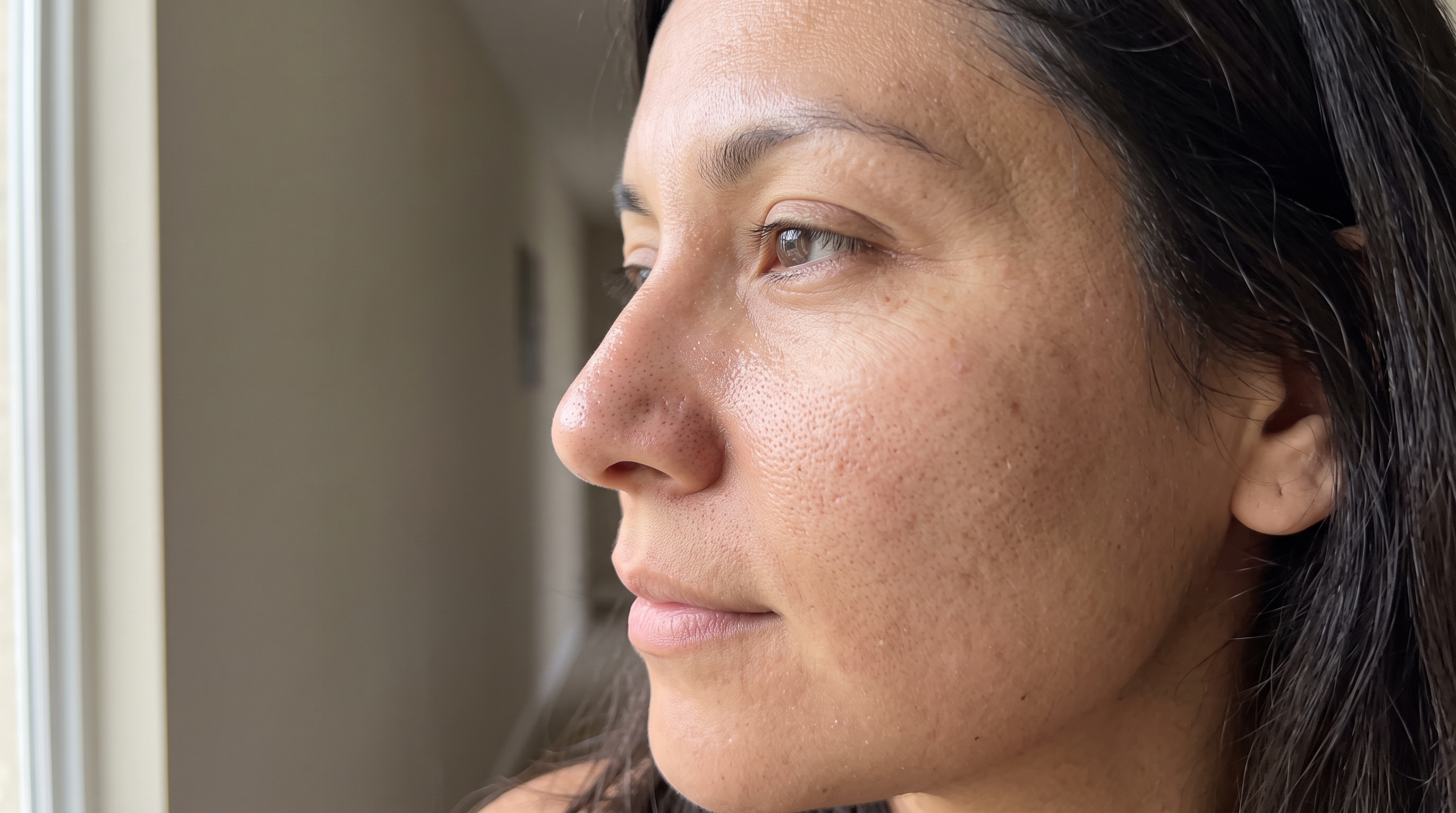
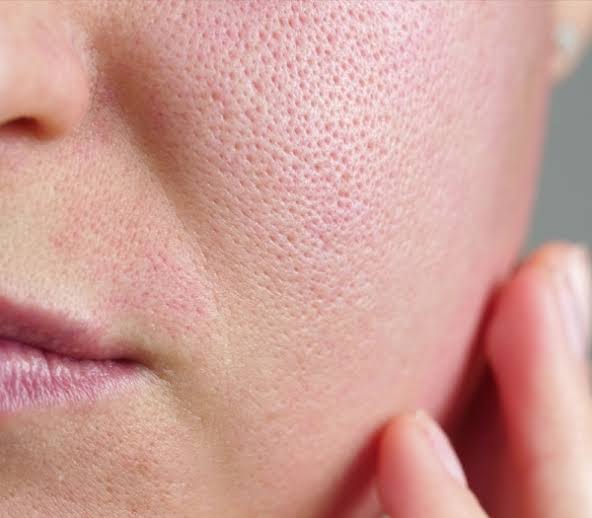
A “pore” on your face is the opening of a pilosebaceous unit — a hair follicle combined with a sebaceous (oil) gland. The physical diameter of this opening is primarily determined by genetics and doesn’t change meaningfully in response to topical products [1].
However, what we perceive as “pore size” is influenced by several modifiable factors:
Sebum production. Higher sebum output stretches the follicular opening and creates a visible sheen that emphasizes pore appearance. Oily skin types consistently report larger-looking pores [1].
Keratin and debris accumulation. Dead skin cells (corneocytes) and sebum can accumulate inside the follicular canal, physically distending the pore opening. This is essentially a microcomedone — the precursor to a blackhead — and it makes pores appear dramatically larger [2].
Perifolicular collagen integrity. Each pore is surrounded by a collagen scaffold in the dermis. When collagen degrades with age and UV exposure, the supporting structure around the pore weakens. The pore doesn’t grow, but it loses the structural “scaffolding” that kept it taut. Think of it like a tent collapsing when you remove the tent poles [3].
Skin surface texture. Rough, uneven skin texture creates shadows and light patterns that emphasize pore visibility. Smoother skin reflects light more uniformly, making pores less noticeable.
This is important because retinol addresses three of these four factors directly.
How Retinol Minimizes Pore Appearance
Mechanism 1: Accelerated Cell Turnover (Weeks 2–6)
Retinol’s most immediate effect on pores comes from its ability to normalize desquamation — the process by which dead skin cells shed from the stratum corneum.
When retinol converts to retinoic acid and binds to nuclear receptors in keratinocytes, it accelerates the cell division rate in the basal layer of the epidermis. New cells push upward faster, and the shedding process at the surface becomes more efficient [4]. The practical result: fewer dead cells accumulate inside follicular canals.
Think of it like a tent collapsing when you remove the tent poles.
This is the same mechanism that makes retinol effective against acne — by keeping the follicular canal clear, it prevents the cellular debris buildup that distends pores visually. Clinical studies on retinoids consistently report improvements in skin texture and comedone clearance within the first 4–8 weeks of use [2].
For pore appearance specifically, this is often the first visible improvement users notice. Pores look “cleaner” and less prominent because the dark shadow of accumulated debris inside them is reduced.
Mechanism 2: Sebum Regulation (Weeks 4–8)
Retinoids influence sebaceous gland function, though the mechanism in over-the-counter retinol is subtler than in prescription retinoids like isotretinoin (which dramatically suppresses sebum production).
Topical retinol modulates sebocyte differentiation and can reduce sebum output modestly over time [4]. Less sebum means less distension of the pore opening and less surface shine that emphasizes pore visibility. The effect is gradual — measured in weeks, not days — and is more pronounced in naturally oily skin types.
A clinical trial testing retinol serums at 0.3% and 0.5% observed improvements in skin “unevenness” parameters that correlate with reduced sebum-related pore prominence by week 8 [5].
Mechanism 3: Collagen Rebuilding (Months 3–6+)
This is the most significant mechanism for long-term pore minimization, and it’s where retinol separates itself from ingredients that only address surface-level factors. As we age, collagen in the dermis degrades — partly from UV-induced matrix metalloproteinase (MMP) activity, partly from chronological aging [3]. The collagen fibers surrounding each pore lose density and organization. Without this structural support, pores appear larger and more prominent, particularly under the eyes, across the cheeks, and on the nose.
Retinol directly addresses this by stimulating fibroblasts to produce new procollagen I and III while simultaneously inhibiting MMPs that degrade existing collagen [6]. The landmark Kafi et al. study demonstrated significant increases in both procollagen I immunostaining and glycosaminoglycan expression — the structural matrix components that support the skin architecture around pores [6].
This collagen rebuilding effect takes months to become visible because you’re literally rebuilding dermal structure. But it’s the most durable improvement: firmer perifolicular tissue creates a tighter appearance around each pore opening.
For a detailed timeline of when to expect each phase, see our article on how long retinol takes to work.
What Retinol Can’t Do for Pores
It can’t change your genetics. If you have naturally large pores (common in oily skin types and certain ethnicities), retinol won’t make them the same size as someone genetically predisposed to smaller pores.
It can’t produce instant results. No topical product can visibly “shrink” pores in a single application. Products claiming instant pore minimization are using optical diffusers (silicone-based primers) that scatter light to blur pore visibility temporarily. Retinol works through biological mechanisms that take weeks to months.
It can’t reverse severe structural loss. Profound collagen depletion from decades of sun exposure may not be fully restorable with topical retinol alone. In these cases, procedures like radiofrequency treatments or fractional laser can provide additional structural tightening [1].
Complementary Ingredients for Pore Minimization
Retinol works best for pores when combined strategically with other ingredients:
Niacinamide (Vitamin B3). Regulates sebum production through a different pathway than retinol. Studies show 2% niacinamide significantly reduces sebum excretion rate within 2–4 weeks. Safe to layer with retinol in the same routine [2].
If you have naturally large pores (common in oily skin types and certain ethnicities), retinol won’t make them the same size as someone genetically predisposed to smaller pores.
Salicylic acid (BHA). Oil-soluble, so it penetrates inside the pore to dissolve sebum and debris. Works synergistically with retinol’s cell turnover acceleration. Best used on alternate days or in the morning while retinol is used at night.
Sunscreen. Prevents the UV-induced collagen degradation that causes perifolicular structural loss. Non-negotiable if you’re using retinol for pore improvement — you’re rebuilding collagen by night and protecting it by day.
Peptides. Signal peptides like Matrixyl can boost collagen synthesis through pathways complementary to retinol, potentially accelerating the structural improvements around pores.
For a category-by-category comparison of what to actually buy, see our guide to the best products for large pores.
Why Delivery Technology Matters for Pores
Here’s a detail most pore-focused skincare advice misses: the collagen-building mechanism — the most important one for long-term pore improvement — requires retinol to reach the dermis. That’s where fibroblasts live. That’s where collagen is produced. That’s where the perifolicular structural support actually exists.
Surface-level retinol application that barely penetrates the stratum corneum can address cell turnover and surface texture (mechanisms 1 and 2). But if the molecule doesn’t reach the dermis in meaningful concentrations, you’re missing the most impactful mechanism entirely [7].
This is why encapsulated retinol and nanoparticle delivery systems represent a genuine advancement for pore concerns. Better dermal penetration means more collagen stimulation around pore structures.
How Nanoretinol® Targets Pore-Related Concerns
Nanoretinol® by North Biomedical® was engineered to solve the dermal delivery problem. The biomimetic lipid nanoparticles pass through the epithelial barrier via biological recognition — your skin cells identify them as “self” — rather than relying on chemical penetration enhancers that damage the barrier.
For pore concerns specifically, this means:
Deeper collagen stimulation. The +232% more effective collagen recovery compared to conventional retinol translates to better structural support around pore openings — the mechanism that matters most for visible pore minimization. Reduced irritation. Because the nanoparticles don’t disrupt the skin barrier, the dryness and flaking that often accompanies retinol use (and can temporarily make pores more visible) is drastically reduced.
Consistent delivery. The nanoparticle mesh distributes retinol homogeneously across the skin surface, ensuring uniform treatment rather than patchy penetration that leaves some areas under-treated.
In clinical trials, users experienced +61% increase in firmness and +56% increase in elasticity within 56 days — metrics that directly correlate with improved perifolicular structural integrity and visible pore refinement.
Realistic Expectations: A Pore Timeline
Based on the mechanisms above:
Weeks 2–4: Improved surface texture. Pores look “cleaner” as cell turnover clears follicular debris. Mild skin smoothing reduces shadows that emphasize pore visibility.
Weeks 6–8: Sebum regulation begins. Pores appear less prominent in oily areas. Skin surface feels more matte and even.
Months 3–6: Collagen rebuilding produces visible structural improvement. Perifolicular tissue is firmer. Pores appear tighter and less slack — especially in cheek and nose areas where age-related collagen loss is most pronounced.
Month 6+: Maintenance. Continued use preserves the collagen improvements. Stopping retinol means structural gains will gradually revert as normal collagen turnover continues without the enhanced synthesis rate.
If you’re starting retinol for the first time, our beginner’s guide covers the safe onboarding process. For sensitive skin, see our guide on retinol for sensitive skin — because an irritated, flaking face will make pores look worse before they look better.
The goal isn’t poreless skin — that only exists in filtered photos. The goal is healthy, well-maintained skin where pores are supported by strong collagen, clear of debris, and refined by consistent cell turnover. Retinol delivers all three.
Retinol and Pores: Quick Questions
Can retinol close pores permanently?
No. Pores do not open and close like doors, and topical products cannot permanently change their genetically determined openings. Retinol may make them look tighter by reducing congestion and improving the surrounding skin [1].
How long does retinol take to improve pore appearance?
Surface texture and congestion may improve within roughly 4–8 weeks. Changes linked to collagen remodeling generally require several months of consistent use [4][5][6].
Can retinol make pores look worse at first?
Temporary dryness, flaking, or irritation can make texture and pores look more obvious during the adjustment period. Reducing frequency and supporting the skin barrier is more useful than pushing through significant irritation.
References
-
Lee SJ, Seok J, Jeong SY, Park KY, Li K, Seo SJ. “Facial Pores: Definition, Causes, and Treatment Options.” Dermatologic Surgery. 2016;42(3):277-285. doi:10.1097/DSS.0000000000000657
-
Draelos ZD. “The science behind skin care: Cleansers.” Journal of Cosmetic Dermatology. 2018;17(1):8-14. doi:10.1111/jocd.12469
-
Fisher GJ, Kang S, Varani J, Bata-Csorgo Z, Wan Y, Datta S, Voorhees JJ. “Mechanisms of photoaging and chronological skin aging.” Archives of Dermatology. 2002;138(11):1462-1470. doi:10.1001/archderm.138.11.1462
-
Mukherjee S, Date A, Patravale V, Korting HC, Roeder A, Weindl G. “Retinoids in the treatment of skin aging: an overview of clinical efficacy and safety.” Clinical Interventions in Aging. 2006;1(4):327-348. doi:10.2147/ciia.2006.1.4.327
-
Zasada M, Budzisz E. “A Clinical Anti-Ageing Comparative Study of 0.3 and 0.5% Retinol Serums: A Clinically Controlled Trial.” Skin Pharmacology and Physiology. 2020;33(2):102-116. doi:10.1159/000508168
-
Kafi R, Kwak HS, Schumacher WE, Cho S, Hanft VN, Hamilton TA, King AL, Neal JD, Varani J, Fisher GJ, Voorhees JJ, Kang S. “Improvement of naturally aged skin with vitamin A (retinol).” Archives of Dermatology. 2007;143(5):606-612. doi:10.1001/archderm.143.5.606
-
Milosheska D, Roškar R. “Use of Retinoids in Topical Antiaging Treatments: A Focused Review of Clinical Evidence for Conventional and Nanoformulations.” Advances in Therapy. 2022;39(12):5351-5375. doi:10.1007/s12325-022-02319-7