
Smile Line Filler Alternatives: What Actually Works Before You Book a Syringe
Before you spend $700 on hyaluronic acid filler, here's what the dermatology literature says about what tightens smile lines without a needle.
There is a moment, somewhere around forty, when you catch your reflection at a particular angle and notice that the smile lines that used to disappear when your face relaxed do not disappear anymore. They have set. For many women, that moment is the start of a quiet internal debate that ends in a Google search for “smile line filler” — twenty-two thousand of which happen in the United States every month.
Hyaluronic acid filler works. The peer-reviewed evidence is solid: a 2024 randomized trial of cross-linked HA filler for moderate-to-severe nasolabial folds found statistically significant reduction at 90 and 180 days, with an excellent safety profile [1]. But filler is also a four-figure annual investment, an in-office procedure, and a fix that masks rather than treats the underlying cause. Before you book it — or while you are deciding whether to top up — it is worth understanding what topical alternatives can do, because the data on that is also surprisingly strong.
Why Smile Lines Form in the First Place
Smile lines, technically called nasolabial folds, are not just wrinkles. They are the visible result of three different aging processes stacking on top of each other:
- Collagen loss. From age 25 onward, the dermis loses roughly 1% of its collagen per year, dropping skin firmness and resilience along the lines of repeated muscle pull [2].
- Elastin fragmentation. UV-driven matrix metalloproteinases (MMP-1, MMP-3, and MMP-9) literally chew through the elastin scaffolding that lets skin snap back after movement [3].
- Midface volume descent. The buccal and malar fat pads that sit high in a younger face deflate and slide downward, deepening the crease where the cheek meets the lip.
Filler addresses the third problem — volume — with mechanical replacement. But it cannot rebuild collagen or repair elastin. That is where topical interventions earn their place.
In one study, tretinoin treatment of photodamaged skin produced an 80% increase in collagen I formation versus a 14% decrease in the vehicle control.
What the Clinical Evidence Actually Shows for Topical Alternatives
Retinoids — The Most Studied Topical for Smile Lines
A 2015 double-blind randomized trial directly tested topical retinol (0.2%) paired with a botanical booster against prescription tretinoin 0.025% in photoaged skin. After 84 days, both treatments produced statistically significant improvements in nasolabial fold appearance — with retinol approaching the efficacy of the prescription option [4]. A separate systematic review covering 25 studies concluded that tretinoin “was consistently effective in improving both clinical and histological signs of photoaging” [5].
The mechanism is well established: topical retinoids bind to retinoic acid receptors in keratinocytes and fibroblasts, upregulating procollagen I synthesis and downregulating MMP activity. The result is denser collagen networks in the dermis — confirmed by skin biopsy. In one study, tretinoin treatment of photodamaged skin produced an 80% increase in collagen I formation versus a 14% decrease in the vehicle control [5].
Peptides — Slower, but with Compounding Effects
Signal peptides like Matrixyl 3000 and copper peptides do not work as fast as retinoids, but they communicate with fibroblasts to stimulate collagen production with very little irritation. They are most useful as a complement to retinoid therapy rather than a replacement. The copper peptides article covers the mechanism in detail.
Sunscreen — The One You Cannot Skip
A 2013 randomized controlled trial published in Annals of Internal Medicine showed daily sunscreen use reduced photoaging by 24% over four years compared to discretionary use [6]. Smile lines deepen faster in unprotected skin because UV damage compounds the MMP problem. If you are pursuing topical alternatives to filler, sunscreen is not optional — it is the foundation that lets the other actives work.
What Topicals Cannot Do
Honest answer: topical treatment cannot fully restore a deeply established, structurally hollow nasolabial fold to a 25-year-old contour. If the volume loss is severe — visible in your three-quarter profile, casting a shadow at neutral expression — filler may be the more efficient intervention.
The 2015 trial used a 0.2% retinol formulation specifically because higher concentrations cause too much irritation for most users to maintain.
What topicals can do, with consistent use over 6–12 months:
- Soften the surface texture of the fold
- Shorten its visible length by tightening the cheek skin above it
- Slow the rate at which the fold deepens further
- Improve overall skin firmness and elasticity in the midface
This is meaningful — and for many women, enough to delay filler by years.
The Retinol Tolerance Problem
Here is the catch with conventional retinol. The 2015 trial used a 0.2% retinol formulation specifically because higher concentrations cause too much irritation for most users to maintain. Yet most over-the-counter retinol products on the market push 1% or higher, relying on petroleum-derived emulsifiers to force the active across the skin barrier. The result is the classic retinol purge — redness, peeling, burning — and a 60–80% dropout rate within the first three months.
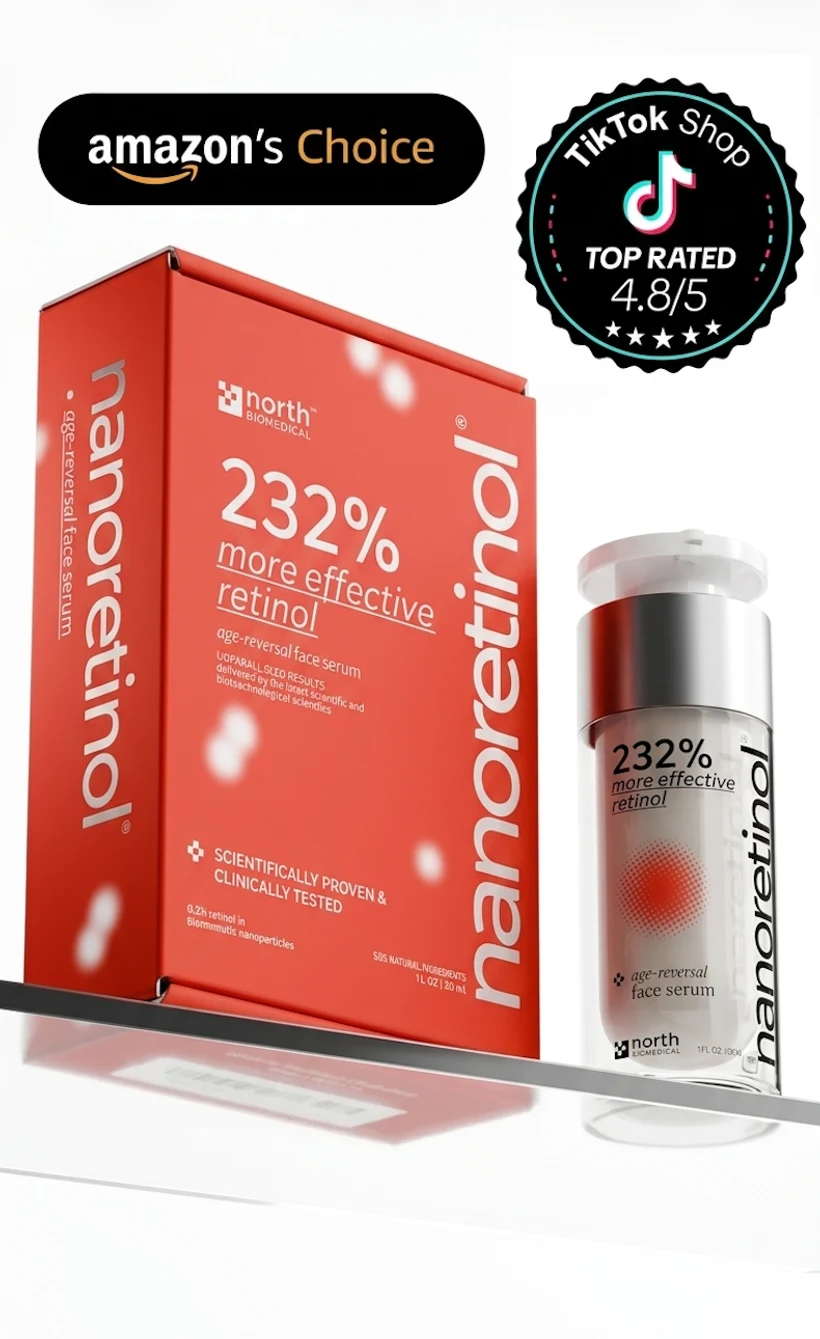
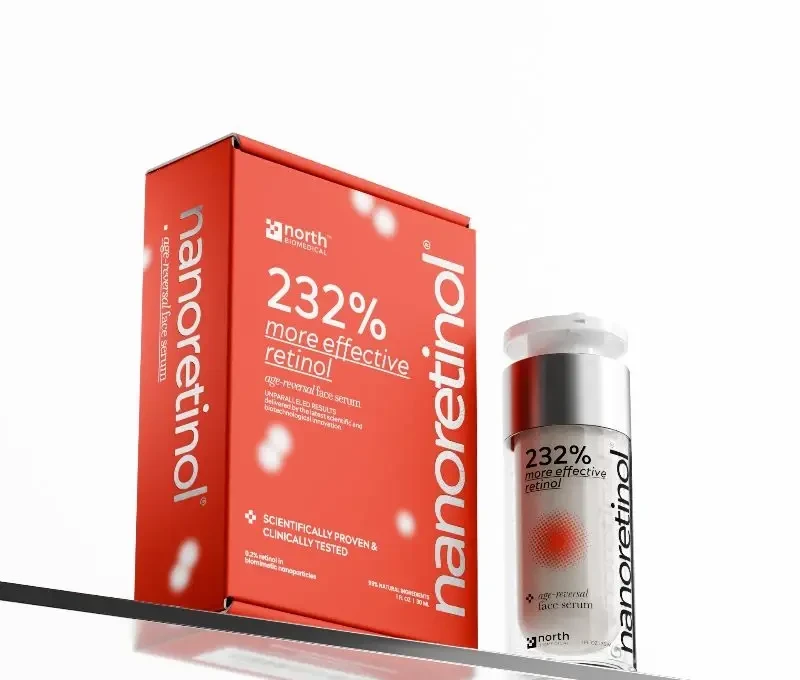
This is where the delivery system matters more than the dose. Nanoretinol uses 0.2% retinol encapsulated in biomimetic lipid nanoparticles. The nanoparticles are externally identical to skin cells, so the epithelial barrier recognizes them as “self” and allows passage — no chemical disruption, no barrier damage [7]. In clinical comparison against conventional retinol, Nanoretinol delivered +232% more collagen recovery and +73% more elastin recovery, with measurable improvements in firmness (+61%) and elasticity (+56%) over 56 days [8]. For someone trying to soften nasolabial folds without a needle, that combination — proven mechanism, gentler delivery, fewer dropouts — is the strongest topical case currently available.
A Sensible Plan If You Are Considering Filler
If you are weighing filler versus topical, here is a stepwise approach that does not foreclose either path:
- Start with sunscreen daily — non-negotiable. SPF 30+, applied every morning.
- Add a clinically validated retinol (0.2% encapsulated, ideally) nightly for at least 12 weeks before judging results.
- Add a peptide serum in the morning routine to complement collagen-building from the retinoid.
- Reassess at 6 months. Take a photo from the same angle, same lighting, before you start. Most people underestimate how much their skin changes because they see it every day.
- If the fold is still structurally hollow, then consider filler with a qualified injector — and continue the topical routine, which will extend the life of the filler and slow the underlying aging process.
The women who get the best results from filler are the ones whose skin is already in its best possible condition before the syringe arrives. That preparation does not happen in the injector’s chair. It happens at the bathroom sink, every night, for years.
References
- Yazdanparast T, Hassanzadeh H, Nasrollahi SA, Firooz A. “Safety and Efficacy Assessment of a Cross-Linked Hyaluronic Acid Dermal Filler for Correction of Moderate-to-Severe Nasolabial Folds in Skin Types III and IV.” Dermatologic Therapy. 2024;2024:8487221. doi:10.1155/2024/8487221
- Shuster S, Black MM, McVitie E. “The Influence of Age and Sex on Skin Thickness, Skin Collagen and Density.” British Journal of Dermatology. 1975;93(6):639-643. doi:10.1111/j.1365-2133.1975.tb05113.x
- Fisher GJ, Kang S, Varani J, et al. “Mechanisms of Photoaging and Chronological Skin Aging.” Archives of Dermatology. 2002;138(11):1462-1470. doi:10.1001/archderm.138.11.1462
- Bouloc A, Vergnanini AL, Issa MC. “A Double-Blind Randomized Study Comparing the Association of Retinol and LR2412 with Tretinoin 0.025% in Photoaged Skin.” Journal of Cosmetic Dermatology. 2015;14(1):40-46. doi:10.1111/jocd.12131
- Mukherjee S, Date A, Patravale V, Korting HC, Roeder A, Weindl G. “Retinoids in the Treatment of Skin Aging: An Overview of Clinical Efficacy and Safety.” Clinical Interventions in Aging. 2006;1(4):327-348. doi:10.2147/ciia.2006.1.4.327
- Hughes MCB, Williams GM, Baker P, Green AC. “Sunscreen and Prevention of Skin Aging: A Randomized Trial.” Annals of Internal Medicine. 2013;158(11):781-790. doi:10.7326/0003-4819-158-11-201306040-00002
- Jun MS, Kim CK, Park BJ, et al. “Synthesis of Retinol-Loaded Lipid Nanocarrier via Vacuum Emulsification to Improve Topical Skin Delivery.” Polymers. 2021;13(5):826. doi:10.3390/polym13050826
- North Biomedical LLC. “Nanoretinol vs. Conventional Retinol: Efficacy in Collagen and Elastin Recovery.” Clinical Study Summary, 2024.