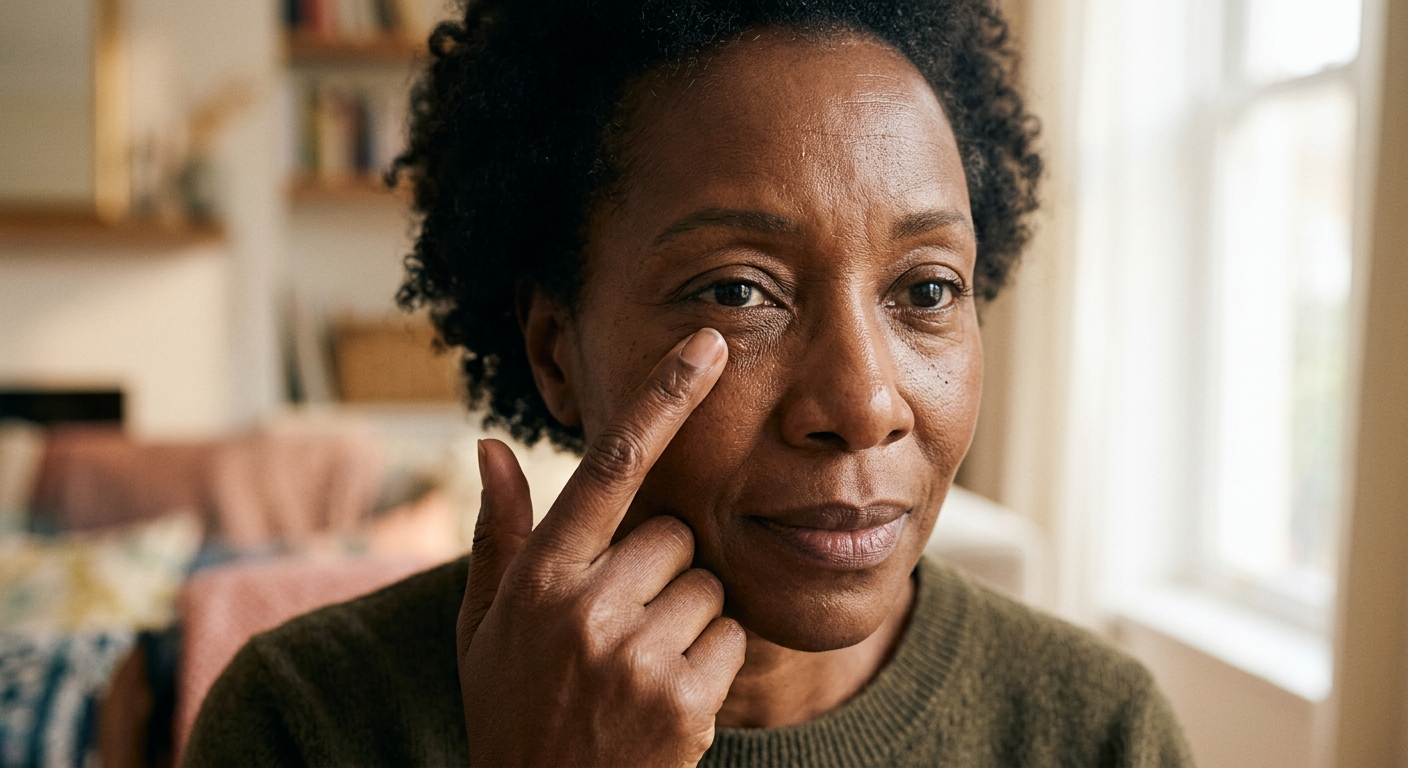
Under Eye Wrinkles: Why They Form First and What Actually Smooths Them
The periorbital skin ages faster than anywhere else on your face — here's the science behind it and the evidence-backed treatments that work
Why Under Eye Wrinkles Show Up Before Everything Else
If wrinkles had a favorite starting point, it would be the skin just below your eyes. The periorbital region is where most people first notice the clock ticking — fine lines that seem to appear overnight, deepening into creases that no amount of concealer can hide.
There is a straightforward anatomical reason for this. The skin around your eyes is roughly 0.5mm thick, compared to about 2mm on the rest of your face [1]. That means the periorbital area has roughly one-quarter the structural buffer of your cheeks or forehead. Less thickness means less collagen, fewer elastic fibers, and a barrier that is disproportionately vulnerable to both UV damage and the mechanical stress of roughly 10,000 blinks per day.
Add the constant movement of facial expressions — squinting, laughing, concentrating — and you have skin that is simultaneously the thinnest on your body and the most mechanically stressed. The result is predictable: fine lines around the eyes often appear a full decade before wrinkles elsewhere on the face.
The Collagen Problem Under Your Eyes
Collagen is the scaffolding protein that keeps skin firm and smooth. Starting around age 25, collagen production declines by approximately 1% per year [2]. In most parts of your face, that decline is gradual enough to go unnoticed for years. But in the periorbital area, where the collagen reserve was already minimal, even small losses translate into visible changes.
The issue is compounded by matrix metalloproteinases (MMPs) — enzymes that break down collagen and elastin. UV exposure dramatically increases MMP activity. A landmark study found that UV radiation induces collagen-degrading enzymes within hours, and repeated exposure creates a cumulative deficit that the skin cannot repair fast enough [3]. Given that the under-eye area receives significant sun exposure and lacks the protection of thicker skin, MMP-driven collagen degradation hits this region especially hard.
There is also the loss of subcutaneous fat beneath the eyes. The fat pads that cushion the periorbital area thin with age, creating hollowing that makes wrinkles appear deeper than they are. This is why under-eye wrinkles often seem to worsen dramatically in your 40s and 50s — it is not just the surface creasing, but the structural support beneath it disappearing.
What the Research Says About Retinoids and Under Eye Skin
Retinoids — vitamin A derivatives including retinol, retinaldehyde, and tretinoin — are the most clinically studied topical ingredient for wrinkle reduction. Their mechanism of action is well understood: retinoids bind to retinoic acid receptors (RARs) in skin cells, triggering increased collagen synthesis, inhibition of MMPs, and accelerated cellular turnover [4].
Starting around age 25, collagen production declines by approximately 1% per year.
A comprehensive review of periorbital cosmeceuticals found that retinoid-based eye creams produced a 30% improvement in fine line reduction during clinical assessments, with 75% of participants experiencing visible wrinkle improvement within 12 weeks [1]. The improvement occurs through two simultaneous pathways: new collagen formation in the dermis, and epidermal thickening that smooths the skin surface.
The turnover acceleration is particularly relevant for under-eye skin. Faster cell renewal means fresher, less damaged cells reach the surface sooner, which directly improves the texture and light-reflecting qualities of the skin. One study demonstrated that topical retinol increased epidermal thickness and upregulated collagen types I and III — the two primary structural collagens that maintain skin firmness [5].
The Delivery Problem Most Products Cannot Solve
Here is where the science gets uncomfortable for most eye cream manufacturers. The under-eye skin’s extreme thinness should theoretically make it easier for active ingredients to penetrate. In practice, the opposite is often true. That same thinness is why puffiness and laxity are so often sold as a single problem, which we separate in our guide to the best eye cream for puffy eyes.
Conventional retinol formulations rely on chemical penetration enhancers — petroleum derivatives and solvents that temporarily disrupt the skin’s lipid barrier to push active ingredients through. On thicker facial skin, this approach works adequately, with manageable irritation. On the delicate periorbital skin, these enhancers can cause redness, peeling, and inflammation that actually accelerates the aging they are supposed to prevent [4]. That irritation is why many people reach for gentler surface fixes instead; our guide to eye patches for wrinkles explains what those actually deliver.
This creates a frustrating paradox: the area that needs retinol most is the area least able to tolerate conventional retinol formulations. Many dermatologists recommend using lower concentrations around the eyes — 0.025% to 0.05% tretinoin, or 0.1% to 0.3% retinol — which reduces irritation but also reduces efficacy.
The vehicle — the delivery system carrying the retinol — matters enormously. A clinical study found that a 1% retinol in a poor vehicle can deliver less active ingredient to target cells than a 0.2% retinol in a superior delivery system [6]. The concentration on the label tells you very little about how much retinol actually reaches the fibroblasts that produce collagen.
Evidence-Based Treatments That Target Under Eye Wrinkles
Beyond retinoids, several ingredients have clinical evidence supporting their use for periorbital wrinkles:
Clinical testing shows 232% more effective collagen recovery and 73% greater elastin recovery compared to conventional retinol delivery — improvements that matter significantly in the collagen-depleted under-eye area.
Vitamin C (L-ascorbic acid): A potent antioxidant that neutralizes UV-generated free radicals and is a required co-factor for collagen synthesis. Studies show that topical vitamin C increases collagen production and provides photoprotection when used consistently [7]. For under-eye skin, it works synergistically with retinol — vitamin C handles the oxidative damage while retinol drives the repair.
Peptides: Signal peptides like palmitoyl pentapeptide-4 (Matrixyl) have shown the ability to stimulate collagen production. Clinical data indicates a 37% increase in collagen and 30% increase in epidermal thickness after 60 days of twice-daily application to the periorbital area [1].
Ceramides: These lipids are essential for barrier function. As the skin barrier weakens with age, moisture loss accelerates — and chronically dehydrated under-eye skin wrinkles more visibly. Ceramide-containing products help restore the barrier without the irritation of chemical penetration enhancers, and pairing them with a hyaluronic acid eye cream adds the water that ceramides then hold in place. Whether those lipids are better delivered in a light serum or a richer cream depends on how dry your lids currently are, a choice we unpack in eye serum vs eye cream.
Sun protection: This is not glamorous advice, but it remains the most impactful. The same research that linked UV exposure to MMP activation found that consistent broad-spectrum SPF use slowed collagen degradation significantly [3]. If you do nothing else for under-eye wrinkles, wearing sunscreen daily will produce more long-term benefit than any eye cream applied at night.
A Smarter Approach to Retinol Around the Eyes
The ideal retinol treatment for under-eye wrinkles would deliver enough active ingredient to stimulate collagen synthesis without triggering the inflammatory response that damages already-thin periorbital skin. This is where delivery technology becomes critical.
Nanoretinol® uses biomimetic lipid nanoparticles to deliver retinol through the epithelial barrier. The nanoparticles are engineered to be structurally similar to the skin’s own cell membranes, so the body recognizes them as “self” and allows passage without the need for harsh chemical penetration enhancers. Clinical testing shows 232% more effective collagen recovery and 73% greater elastin recovery compared to conventional retinol delivery — improvements that matter significantly in the collagen-depleted under-eye area.
At 0.2% retinol concentration, the formulation is well within the range that clinical studies have shown effective for periorbital use, while the nanoparticle delivery system means the actual amount of retinol reaching target cells is substantially higher than what that concentration typically achieves.
What Actually Works — In Order of Priority
If under-eye wrinkles are your primary concern, here is what the clinical evidence supports, ranked by impact:
- Daily broad-spectrum sunscreen — prevents further collagen degradation
- Topical retinoid — the only ingredient class proven to rebuild collagen and increase skin thickness
- Antioxidant serum (vitamin C) — complements retinol by addressing oxidative damage
- Adequate hydration — ceramides and hyaluronic acid maintain barrier function
- Consistent application — results require 8 to 16 weeks of daily use
Reducing daily mechanical stress belongs alongside that list, which is why the best eye makeup remover is the one that lifts makeup off in the fewest passes. So does placing product where it stays on skin instead of migrating into the eye, which how to apply eye cream sets out precisely.
The periorbital region aged first because it started with less. The good news is that the same thinness that made it vulnerable also means it responds more quickly to effective treatment. When the right ingredients actually reach the dermal fibroblasts, the under-eye area can show visible improvement faster than thicker-skinned regions — the structure is simply closer to the surface.
References
- Varma SR, Sivaprakasam TO, Arumugam I, et al. “A review of the efficacy of popular eye cream ingredients.” Skin Research and Technology. 2024;30(6):e13780. doi:10.1111/srt.13780
- Varani J, Dame MK, Rittie L, et al. “Decreased collagen production in chronologically aged skin.” American Journal of Pathology. 2006;168(6):1861-1868. doi:10.2353/ajpath.2006.051302
- Fisher GJ, Wang ZQ, Datta SC, et al. “Pathophysiology of premature skin aging induced by ultraviolet light.” New England Journal of Medicine. 1997;337(20):1419-1428. doi:10.1056/NEJM199711133372003
- Mukherjee S, Date A, Patravale V, et al. “Retinoids in the treatment of skin aging: an overview of clinical efficacy and safety.” Clinical Interventions in Aging. 2006;1(4):327-348. doi:10.2147/ciia.2006.1.4.327
- Kong R, Cui Y, Fisher GJ, et al. “A comparative study of the effects of retinol and retinoic acid on histological, molecular, and clinical properties of human skin.” Journal of Cosmetic Dermatology. 2016;15(1):49-57. doi:10.1111/jocd.12193
- Zasada M, Budzisz E. “Retinoids: active molecules influencing skin structure formation in cosmetic and dermatological treatments.” Postepy Dermatologii i Alergologii. 2019;36(4):392-397. doi:10.5114/ada.2019.87443
- Pullar JM, Carr AC, Vissers MCM. “The Roles of Vitamin C in Skin Health.” Nutrients. 2017;9(8):866. doi:10.3390/nu9080866