Vampire Facial: What PRP Actually Does for Your Skin (and What It Doesn't)
The science behind the Kim Kardashian selfie — sorted from the marketing.
The Kim Kardashian selfie did more for vampire facials than any peer-reviewed paper ever has. A photograph of her face streaked with blood after a treatment in 2013 made the procedure famous enough that almost every medspa in the country now offers some version of it. The marketing talks about “harnessing your own healing factors” and “natural rejuvenation.” The clinical literature tells a more careful story.
Here’s what we actually know.
What a Vampire Facial Is
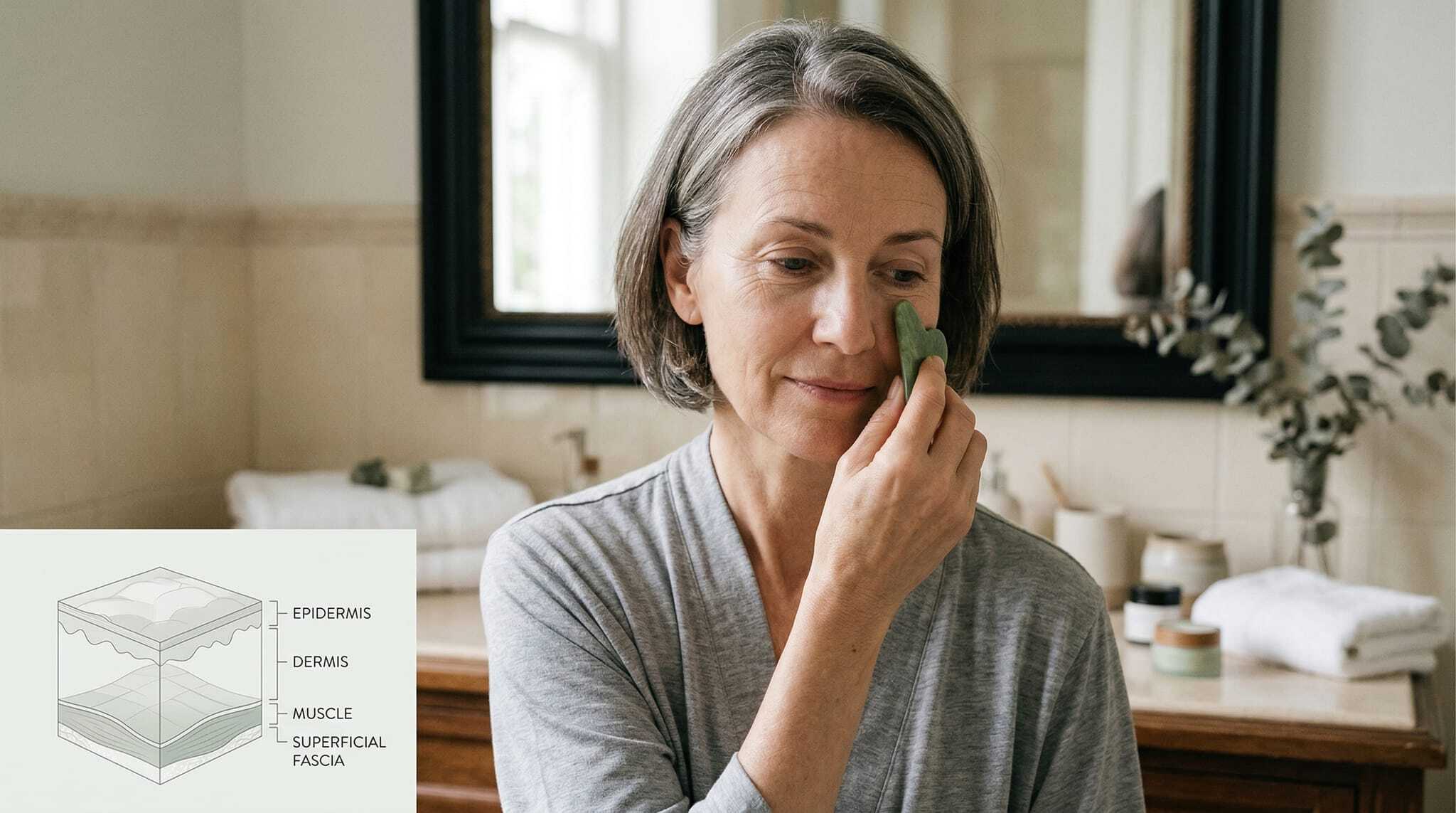
A vampire facial — known clinically as platelet-rich plasma (PRP) facial rejuvenation — uses a simple two-step process. A practitioner draws a small vial of your blood and spins it in a centrifuge, which separates the heavy red cells from the lighter, yellow plasma containing concentrated platelets and growth factors. That plasma layer is then either injected into the dermis or applied to the face after microneedling — tiny channels that let the plasma reach deeper layers.
The premise is biologically reasonable. Platelets are part of your wound-healing response: when tissue is injured, they release growth factors like PDGF, TGF-β, and VEGF that signal nearby fibroblasts to multiply, produce collagen, and build new blood vessels. The hypothesis is that flooding the dermis with these signals — without an actual wound — triggers the same regenerative response on demand.
The Mechanism, Spelled Out
In a healthy young dermis, fibroblasts respond to growth factor signals by producing type I and type III collagen and rebuilding the extracellular matrix. PRP delivers a concentrated dose of those signals plus the small mechanical injury of the needling itself, which is its own collagen stimulus. The combination, in theory, gives you the benefits of microneedling amplified by a localized growth-factor cocktail.
The mechanism is the easy part. The harder question is whether the visible results match the biological story.
What the Studies Actually Show
The most-cited histology paper comes from a 2016 prospective controlled trial in Annals of Dermatology. Researchers took 20 women between 40 and 49 and measured collagen density in skin samples before and after PRP injection. They found roughly an 89% increase in dermal collagen optical density in PRP-treated areas compared with pre-treatment baseline [1]. The microscope evidence is real.
They found roughly an 89% increase in dermal collagen optical density in PRP-treated areas compared with pre-treatment baseline.
A separate study by Elnehrawy and colleagues in the Journal of Cosmetic Dermatology gave 20 women a single PRP injection and measured wrinkle severity afterward. They reported significant improvement in nasolabial fold depth and skin texture from a single session [2]. Other small trials have shown similar wrinkle and tone improvements.
So far, so good. But when researchers tried to step back and assess the entire body of evidence, the picture got murkier.
A 2024 umbrella review in Blood Transfusion analyzed 13 systematic reviews of PRP for facial rejuvenation published between 2015 and 2023. The authors concluded that “the available evidence is insufficient to suggest firm conclusions” — and rated 12 of the 13 reviews as having low or critically low confidence in their findings [3]. The problem isn’t that PRP doesn’t work; it’s that most studies are small, uncontrolled, and use different protocols (different centrifuge speeds, different platelet concentrations, different needling depths), so it’s hard to predict what any individual person will get.
A 2021 systematic appraisal in Clinical, Cosmetic and Investigational Dermatology reached a similar verdict: PRP appears to have measurable effects on skin texture and fine wrinkles, but most of the evidence comes from open-label studies without proper controls, and effect sizes vary widely between protocols [4].
Realistic Expectations
If you’re considering a vampire facial, the honest version of the pitch goes something like this:
- It is a treatment for skin quality — texture, fine lines, glow — not skin volume. It will not replace fillers or address deep folds.
- Most reported improvements show up gradually over 8–12 weeks as new collagen forms, not immediately. The dewy, plump look right after treatment is from inflammation, not new tissue.
- Results are generally subtle. Most studies report patient satisfaction increases, but objective measurements of wrinkle depth often improve modestly.
- Quality varies enormously by practitioner. Centrifuge protocol, platelet concentration, needling depth, and number of sessions all affect outcome.
- Cost is real. A single session typically runs $700–$1,500 in the US, and protocols often call for 3–4 sessions over a few months.
Most reported improvements show up gradually over 8–12 weeks as new collagen forms, not immediately.
The Quieter Question Nobody Asks
Strip the procedure down to its mechanism and what you’re really paying for is fibroblast activation — getting the cells in your dermis to make more collagen. PRP does that by delivering growth factor signals through micro-channels in your skin barrier. It works because it bypasses a delivery problem that normally blocks topical interventions from reaching the dermis, which is a genuinely different proposition from an oxygen facial, where nothing crosses the barrier at all.
But there’s a second route to fibroblast activation that doesn’t require needles or a centrifuge: a well-delivered topical retinoid.
A 2017 study in the International Journal of Cosmetic Science found that topical retinol significantly increased epidermal thickness, dermal vascularity, and type I collagen production in naturally aged human skin in vivo, working through the same TGF-β signaling pathway that PRP exploits [5]. The catch, as with PRP, is delivery. Retinol that doesn’t reach the dermis can’t activate the fibroblasts that live there.
Most over-the-counter retinols rely on petroleum-derived solvents that loosen the skin barrier to push the active through. That works, sort of, but at the cost of irritation, dryness, and sometimes the visible peeling that makes people quit. Our explainer on microneedling benefits covers the broader principle: when you breach the barrier, you get penetration but you pay a cost.
Where Nanoretinol Fits In
Nanoretinol uses the same principle that makes PRP-with-microneedling work — concentrated active ingredients reaching the dermis — but solves the delivery problem differently. The retinol is encapsulated in lipid nanoparticles whose outer membrane is biomimetic: the skin barrier recognizes them as “self” and lets them pass without being disrupted. No needles. No barrier damage. No solvent burn.
In comparative testing, this delivery system produced a 232% improvement in collagen recovery and a 73% improvement in elastin recovery versus conventional retinol formulations, with significantly lower cytotoxicity at the cellular level. For more on how growth-factor-style topicals compare with this approach, our piece on growth factor serums is worth reading alongside this one.
This isn’t an argument against in-clinic procedures. PRP, microneedling, and other professional treatments have their place — particularly for people who want results faster than a topical can deliver. But the underlying biology is the same in both cases: fibroblasts will rebuild the dermis when they get the right signals through the right channels. The decision is mostly about how you’d rather get them there.
What Actually Works
If you’re choosing between vampire facials and a serious topical routine, the practical filter is honest expectations and a budget you can sustain. PRP can help with texture and fine lines if you can afford a series of sessions and find a skilled practitioner. A well-delivered retinoid can help with the same things on a much smaller budget, applied at home, every night, for as long as you keep using it.
Both approaches work because both reach the same cells. The route is just different. Most of what is sold as a facial for wrinkles never reaches those cells at all.
References
- Abuaf OK, Yildiz H, Baloglu H, Bilgili ME, Simsek HA, Dogan B. “Histologic Evidence of New Collagen Formulation Using Platelet Rich Plasma in Skin Rejuvenation: A Prospective Controlled Clinical Study.” Annals of Dermatology. 2016;28(6):718-724. doi:10.5021/ad.2016.28.6.718
- Elnehrawy NY, Ibrahim ZA, Eltoukhy AM, Nagy HM. “Assessment of the efficacy and safety of single platelet-rich plasma injection on different types and grades of facial wrinkles.” Journal of Cosmetic Dermatology. 2017;16(1):103-111. doi:10.1111/jocd.12258
- Cruciani M, Masiello F, Pati I, Pupella S, De Angelis V. “Platelet rich plasma for facial rejuvenation: an overview of systematic reviews.” Blood Transfusion. 2024;22(5):429-439. doi:10.2450/BloodTransfus.730
- Xiao H, Xu D, Mao R, Xiao M, Fang Y, Liu Y. “Platelet-Rich Plasma in Facial Rejuvenation: A Systematic Appraisal of the Available Clinical Evidence.” Clinical, Cosmetic and Investigational Dermatology. 2021;14:1697-1724. doi:10.2147/CCID.S340434
- Shao Y, He T, Fisher GJ, Voorhees JJ, Quan T. “Molecular basis of retinol anti-ageing properties in naturally aged human skin in vivo.” International Journal of Cosmetic Science. 2017;39(1):56-65. doi:10.1111/ics.12348