Vaseline on Face: Is It Good for Your Skin? What Dermatology Research Says
The internet's favorite $4 anti-aging hack, separated cleanly into what it does and what it only pretends to do.
Every few months, a video resurfaces claiming that a woman in her sixties has flawless skin because she has slathered Vaseline on her face every night since her twenties. The comments fill with people ready to throw out their serums. It is a seductive story — great skin for the price of a coffee — and like most seductive skincare stories, it is about a third true.
Petroleum jelly is one of the most misunderstood products in the bathroom. It is neither the miracle nor the pore-clogging villain it gets cast as. It does one thing exceptionally well, and understanding exactly what that one thing is will tell you precisely how to use it after 40 — and where it will quietly let you down.
What Vaseline Actually Does to Skin
Vaseline is petrolatum, a purified semi-solid blend of hydrocarbons. It is an occlusive: a sealing agent. When you spread it on your face, it forms a breathable water-repellent film that dramatically slows the evaporation of moisture from your skin. In measurements of transepidermal water loss — the rate at which water escapes through the skin — petrolatum can reduce loss by up to around 98%, more than almost any other single ingredient [1].
That is not nothing. Contrary to the myth that it “just sits on top,” classic research shows petrolatum actually penetrates into the upper layers of the stratum corneum and helps the skin’s own barrier recover faster after it has been disrupted [2]. And a landmark 2016 study found something even more surprising: occluding skin with petrolatum didn’t merely trap water — it triggered the skin to ramp up its own antimicrobial peptides and boost barrier-building proteins like filaggrin and loricrin [3]. The “inert” grease turns out to gently nudge the skin toward repairing itself.
It is also, despite decades of rumor, non-comedogenic. A comprehensive dermatology review confirms that highly refined petrolatum does not clog pores on its own and carries an excellent safety record [1]. This is why “slugging” — sealing your face with a thin layer at night — became a genuine dermatologist-endorsed technique for dry, compromised skin.
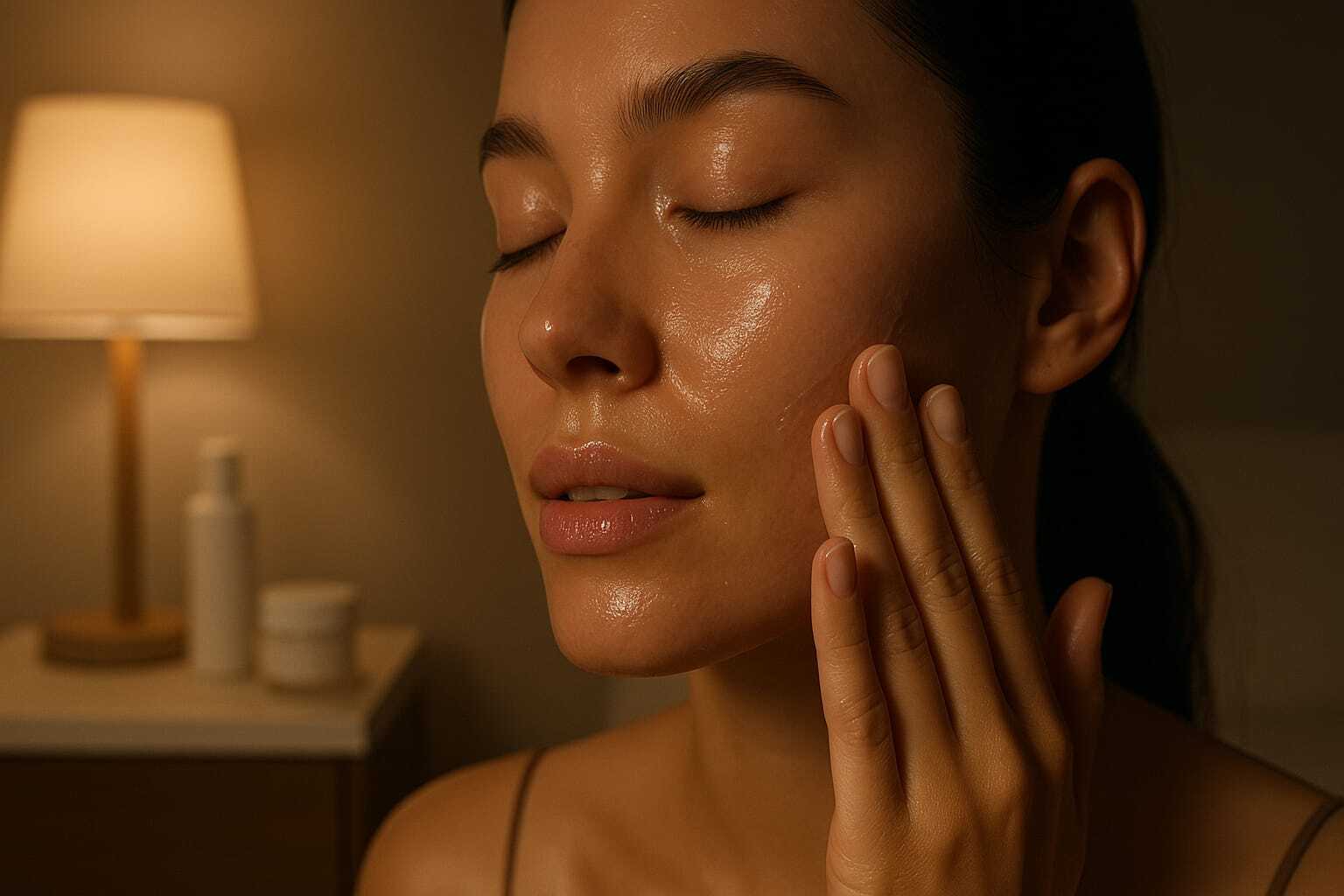
When you spread it on your face, it forms a breathable water-repellent film that dramatically slows the evaporation of moisture from your skin.
The Catch: Sealing Is Not Treating
Here is where the sixty-year-old-with-flawless-skin story falls apart. Vaseline is a lid, not a meal. It has zero active ingredients. It contains no antioxidants, no vitamins, no peptides, nothing that instructs your skin to do anything. It cannot add moisture — it can only prevent moisture that is already there from leaving. Spread it over dry, dehydrated skin and you simply seal in the dryness.
And it does absolutely nothing for the actual architecture of aging. It will not fade a dark spot, smooth a wrinkle that already exists, or rebuild a milligram of lost collagen. Applied too heavily, or over skin that wasn’t cleaned properly, it can also trap dead cells and oil and contribute to little bumps like milia in susceptible people.
So when someone credits lifelong Vaseline use for their youthful skin, the more likely explanation is a robust, well-hydrated skin barrier — plus good genes and sun avoidance. A strong barrier absolutely makes skin look better. It just isn’t the same as reversing the aging happening underneath.
What Your Skin Needs That Vaseline Can’t Give
After our mid-twenties, we shed roughly 1% of our collagen each year, and the loss speeds up around menopause. That is the real engine behind thinning, creasing, and sagging — and it lives in the dermis, far below where an occlusive operates.
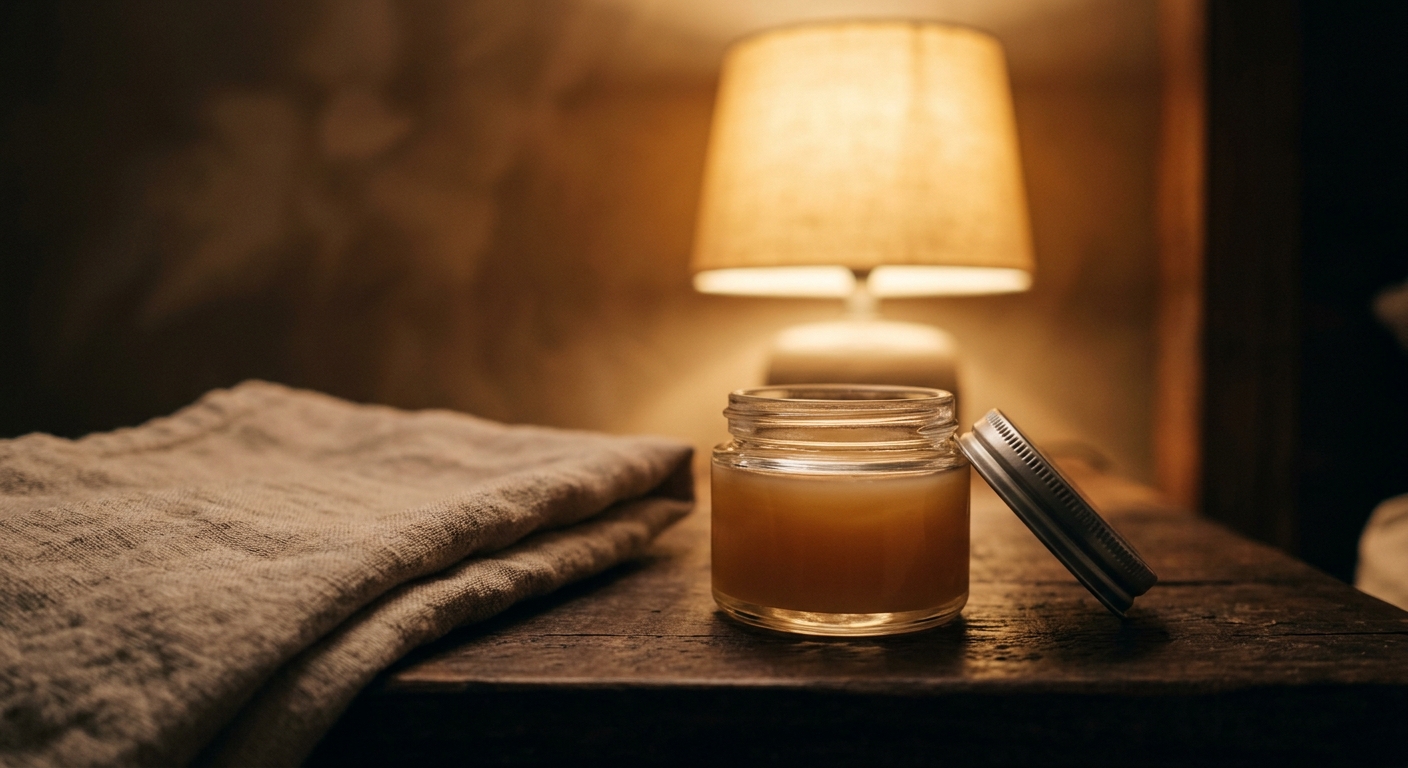
The most effective way to use Vaseline is as a partner to real actives, not a replacement for them.
Reversing it takes an active ingredient that penetrates deep and signals the skin to rebuild. Vitamin A is the most studied option in existence: in controlled trials, topical retinol visibly improved naturally aged skin and increased collagen production at the tissue level [4]. Retinoids are dermatology’s benchmark for firming skin and restoring elasticity, the exact structural work no amount of petroleum jelly can perform [5].
The Best of Both: Seal What You Treat
The most effective way to use Vaseline is as a partner to real actives, not a replacement for them. Apply your treatment first; seal with a thin occlusive layer second. That order matters — occlusion can even enhance how well an active penetrates, and a light seal over a well-formulated retinoid can improve comfort for dry skin.
But the retinoid itself has to be one your skin will actually tolerate. The reason most people quit vitamin A is the burning, flaking, and redness of conventional retinol clawing its way through the barrier — the very barrier you were trying to protect with Vaseline in the first place.
Nanoretinol resolves that contradiction. It encapsulates retinol in biomimetic lipid nanoparticles that pass through the skin barrier because the body recognizes them as its own, rather than damaging their way in. In North Biomedical’s clinical study, this delivery system was 232% more effective at collagen recovery and 73% more effective at elastin recovery than conventional retinol — with clinical results of a 61% jump in firmness and a 56% rise in elasticity over 56 days — all in a gentle, water-based, 99% natural 0.2% formula. It supplies the active renewal your skin is missing; an occlusive like Vaseline simply guards the result.
Used this way, Vaseline finally earns its reputation — not as the treatment, but as the seal on top of one that actually works.
The Bottom Line, Reconsidered
Is Vaseline good for your face? Yes — as one of the best moisture-sealers money can buy, and a legitimately smart finishing step for dry, mature, or barrier-compromised skin. What it is not is an anti-aging treatment. Pair a thin overnight layer with a well-delivered retinoid and you get both halves of the equation: protection on the surface, and real rebuilding underneath.
References
- Kamrani P, Hedrick J, Marks JG, Zaenglein AL. “Petroleum jelly: A comprehensive review of its history, uses, and safety.” Journal of the American Academy of Dermatology. 2024;90(4):807-813. doi:10.1016/j.jaad.2023.06.010
- Ghadially R, Halkier-Sorensen L, Elias PM. “Effects of petrolatum on stratum corneum structure and function.” Journal of the American Academy of Dermatology. 1992;26(3):387-396. PMID: 1564142
- Czarnowicki T, Malajian D, Khattri S, et al. “Petrolatum: Barrier repair and antimicrobial responses underlying this ‘inert’ moisturizer.” Journal of Allergy and Clinical Immunology. 2016;137(4):1091-1102. doi:10.1016/j.jaci.2015.08.013
- Kafi R, Kwak HS, Schumacher WE, et al. “Improvement of Naturally Aged Skin With Vitamin A (Retinol).” Archives of Dermatology. 2007;143(5):606-612. doi:10.1001/archderm.143.5.606
- Mukherjee S, Date A, Patravale V, Korting HC, Roeder A, Weindl G. “Retinoids in the treatment of skin aging: an overview of clinical efficacy and safety.” Clinical Interventions in Aging. 2006;1(4):327-348. doi:10.2147/ciia.2006.1.4.327