Witch Hazel for Skin: What It Really Does for Mature Skin (and What It Can't)
The astringent your grandmother swore by, examined through the lens of modern skin science.
There is a bottle of witch hazel in more American medicine cabinets than almost any other skincare product, and most of them have been there for decades. It is cheap, it is old, and it feels like it works — that clean, tight sensation after you swipe it across your face reads instantly as “this is doing something.” For women navigating the shifts of aging skin, witch hazel often gets promoted from a first-aid staple to a daily anti-aging step. The question worth asking is whether that promotion is earned.
The honest answer is: partly. Witch hazel is a genuinely useful botanical with real, measurable effects on skin. It is also frequently asked to do a job it was never built for.
What Witch Hazel Actually Is
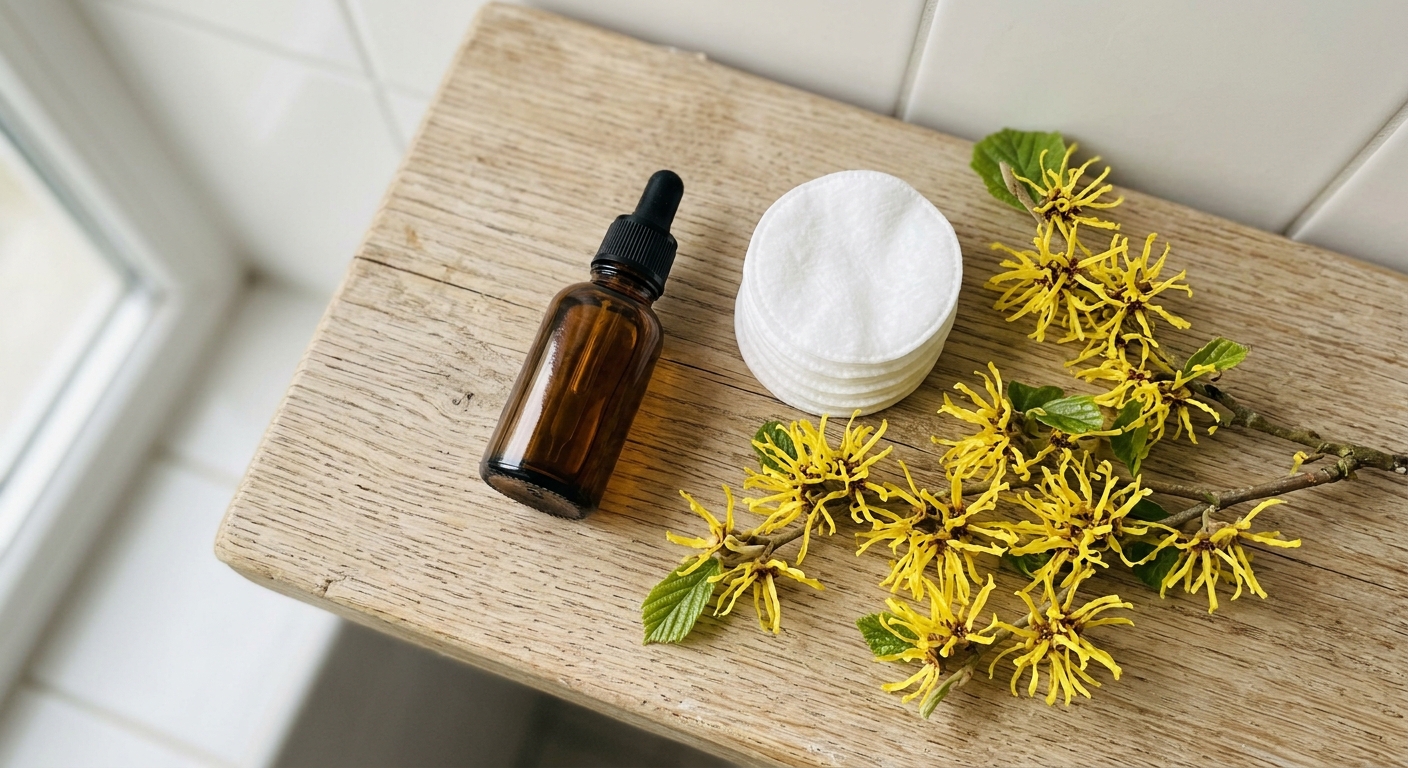
Witch hazel comes from Hamamelis virginiana, a shrub native to North America. The extract used in skincare is pulled from its bark and leaves, and it is rich in a class of compounds called tannins — particularly one named hamamelitannin — along with proanthocyanidins, flavonoids, and gallic acid [1]. These polyphenols are the reason witch hazel does anything at all.
Tannins are astringents. When they contact skin, they bind loosely to surface proteins and cause tissue to contract, which is the source of that familiar tightening feeling. That same action temporarily reduces the look of large pores and helps blot excess oil, which is why witch hazel earned its reputation as a toner for oily and combination skin.
The Benefits That Hold Up to Science
Strip away the folklore and there is a legitimate core. Modern laboratory work shows witch hazel bark extract meaningfully lowers markers of inflammation in human skin cells, reducing pro-inflammatory signals like IL-6 and IL-8 and calming the NF-κB pathway that drives redness and irritation [2]. For skin that flushes easily or feels reactive — common in perimenopause and beyond — that soothing capacity is real.
In practice, it is a preventive, test-tube finding at specific concentrations, not evidence that dabbing witch hazel on your face rebuilds the structural proteins you have already lost.
Witch hazel is also a capable antioxidant. Polyphenol-rich extracts from the plant’s leaves and bark scavenge reactive oxygen species, the unstable molecules generated by UV light and pollution that accelerate visible aging [3]. Antioxidant defense is a foundational part of any anti-aging strategy, and witch hazel contributes to it.
Most intriguingly, one 2025 analysis found that witch hazel bark extract inhibited collagenase and elastase in the lab — the enzymes that break down collagen and elastin [3]. On paper, that sounds like an anti-aging headline. In practice, it is a preventive, test-tube finding at specific concentrations, not evidence that dabbing witch hazel on your face rebuilds the structural proteins you have already lost. Preventing further breakdown and generating new collagen are separate problems, and mature skin needs both.
Where Witch Hazel Falls Short
Here is the part the marketing tends to skip. The “tightening” you feel is a surface astringent effect, not structural firming. It fades within hours and does nothing for the collagen loss that actually causes sagging and fine lines. A recent review of witch hazel’s dermatological uses is candid on this point: its strengths lie in soothing, astringing, and antioxidant protection, not in remodeling aged skin [1].
There is also a formulation trap. Traditional drugstore “distilled witch hazel” is frequently preserved in alcohol — sometimes 14% or more — and for dry, thinning, mature skin, that can compromise the skin barrier and leave you worse off than before. If you use witch hazel, an alcohol-free formula is non-negotiable.
At a fully stabilized 0.2% in a water-based, 99% natural formula, it delivers what an astringent never could: genuine structural renewal.
What Mature Skin Is Actually Missing
From roughly age 25, we lose about 1% of our dermal collagen every year, and the decline steepens sharply around menopause. That lost scaffolding is why skin creases, thins, and slackens. No astringent addresses it, because astringing is a surface event and collagen lives in the dermis below.
The single most rigorously studied ingredient for reversing this is vitamin A — retinol and its relatives. In a landmark controlled trial, topical retinol significantly improved fine wrinkles in naturally aged skin and increased collagen production in the dermis, with benefits confirmed at the tissue level [4]. Decades of clinical work have established retinoids as the reference standard for stimulating new collagen, smoothing texture, and improving skin elasticity, which is exactly the deficit witch hazel leaves untouched [5].
The Smarter Way to Combine Them
This is not an argument against witch hazel. It is an argument for using it in its lane. Witch hazel makes a reasonable, calming toner for aging skin — especially the alcohol-free kind — and pairs well with soothing actives like niacinamide. Think of it as skin maintenance: comfort, oil control, antioxidant backup.
For the actual anti-aging work, you need an ingredient that reaches the dermis and tells your cells to rebuild. This is where delivery becomes everything, because conventional retinol struggles to penetrate the skin barrier without irritating it — the redness and peeling that made so many women quit retinol in the first place.
Nanoretinol was engineered to solve exactly that problem. It encapsulates retinol inside biomimetic lipid nanoparticles that the skin recognizes as “self” and allows to pass through the barrier intact, rather than forcing their way in and damaging it. In North Biomedical’s clinical study, this delivery approach proved 232% more effective at collagen recovery and 73% more effective at elastin recovery than conventional retinol, while being markedly gentler — a meaningful advantage for the sensitive, reactive skin that reaches for witch hazel in the first place. At a fully stabilized 0.2% in a water-based, 99% natural formula, it delivers what an astringent never could: genuine structural renewal.
Witch hazel earns its spot in your routine as a gentle, protective supporting player. Just don’t ask the astringent to do the architect’s job.
The Takeaway
Witch hazel is real medicine in miniature — soothing, antioxidant, mildly astringent — and for calming reactive or oily mature skin, it belongs in the rotation. What it cannot do is rebuild the collagen and elastin that define how young your skin looks and feels. Pair it with a proven collagen-building retinoid, and you get the best of both: skin that is calm today and firmer over time.
References
- Wójciak M, Pacuła W, Sowa I, Feldo M, Graczyk F, Załuski D. “Hamamelis virginiana L. in Skin Care: A Review of Its Pharmacological Properties and Cosmetological Applications.” Molecules. 2025;30(13):2744. doi:10.3390/molecules30132744
- Piazza S, Martinelli G, Vrhovsek U, et al. “Anti-Inflammatory and Anti-Acne Effects of Hamamelis virginiana Bark in Human Keratinocytes.” Antioxidants (Basel). 2022;11(6):1119. doi:10.3390/antiox11061119
- Wójciak M, Pacuła W, Tyszczuk-Rotko K, et al. “Comparative Analysis of Polyphenol-Rich Extracts from Hamamelis virginiana Leaves and Bark: ROS Scavenging and Anti-Inflammatory Effects on Skin Cells.” Molecules. 2025;30(17):3572. doi:10.3390/molecules30173572
- Kafi R, Kwak HS, Schumacher WE, et al. “Improvement of Naturally Aged Skin With Vitamin A (Retinol).” Archives of Dermatology. 2007;143(5):606-612. doi:10.1001/archderm.143.5.606
- Mukherjee S, Date A, Patravale V, Korting HC, Roeder A, Weindl G. “Retinoids in the treatment of skin aging: an overview of clinical efficacy and safety.” Clinical Interventions in Aging. 2006;1(4):327-348. doi:10.2147/ciia.2006.1.4.327