
Best Eye Cream for Wrinkles: What Actually Smooths Fine Lines Around the Eyes
A science-first guide to the ingredients that work on periorbital wrinkles — and how to choose an eye cream that earns its price.
If you have ever wondered why the first fine lines of aging show up around your eyes — long before your forehead or cheeks look any different — the answer is measured in fractions of a millimeter. The skin of the eyelid and the surrounding periorbital area is the thinnest on your entire face. High-frequency ultrasound mapping of facial skin puts the dermis around the eye at roughly 0.58 mm in women, a fraction of the thickness found on the forehead or cheeks [1]. Thin skin has less collagen to spare, so it shows loss sooner and creases faster with every blink, squint, and smile.
That is why the market is flooded with eye creams, and why choosing one is so confusing. The truth is that the best eye cream for wrinkles has almost nothing to do with the elegance of the jar or the price on the label, and almost everything to do with a short list of ingredients that have real clinical evidence behind them. Here is what that evidence actually says.
Why the Eye Area Needs Its Own Strategy
The skin around your eyes is not just thin — it is also low in oil glands, constantly in motion, and prone to puffiness and shadowing. That combination means it dries out quickly, wrinkles dynamically, and shows fatigue before anywhere else. A good eye product has to do two different jobs at once: deliver hydration that visually softens fine lines today, and deliver active ingredients that rebuild the underlying structure over the coming months. Men bring the same anatomy and a different set of habits to that problem, addressed in our guide to the best eye cream for men.
Most eye creams only do the first job. They plump the surface with humectants, the wrinkles look softer for a few hours, and nothing changes underneath. To actually reduce wrinkles — not just mask them — you need ingredients that reach the living skin below.
The Ingredients That Actually Work
Retinoids: the gold standard
No topical ingredient class has more human data behind it than retinoids. In a landmark study published in the New England Journal of Medicine, topical tretinoin increased new type I collagen formation in photodamaged skin by roughly 80%, while untreated skin continued to lose collagen [2]. That is the difference between smoothing skin and structurally rebuilding it.
If you look for a single hero ingredient in an eye cream for wrinkles, a well-formulated retinol is it.
Crucially, this works in the eye area specifically. A 24-week randomized controlled trial measured periorbital wrinkles — crow’s feet and infraorbital lines — and found that a topical retinoid-family regimen delivered wrinkle-reduction comparable to prescription tretinoin, with better tolerability [3]. If you look for a single hero ingredient in an eye cream for wrinkles, a well-formulated retinol is it.
Peptides: promising support
Signal peptides such as palmitoyl pentapeptide (Matrixyl) and acetyl hexapeptide (Argireline) are marketed heavily for the eye area. A randomized split-application trial applied both directly to crow’s feet and saw modest improvements in wrinkle grading over eight weeks [4]. The honest read: peptides are a reasonable supporting act — gentle and well tolerated — but the effect sizes are small and did not reach statistical significance in a small sample. Treat them as a complement to a retinoid, not a replacement.
Caffeine: for the look of tiredness
Caffeine penetrates skin readily and works as an antioxidant and free-radical scavenger while boosting local microcirculation [5]. It will not erase a wrinkle, but it can temporarily reduce the puffiness and shadowing that make the whole eye area read as older and more tired. Think of it as a same-morning cosmetic benefit rather than a structural one.
Hyaluronic acid: instant softening, with a lesson about delivery
Hyaluronic acid is the workhorse humectant, and it genuinely helps. In a study centered on the periorbital region, a topical nano-sized hyaluronic acid reduced wrinkle depth by up to 40% and raised skin hydration by up to 96% over eight weeks [6]. Note the detail that makes that result unusual: the hyaluronic acid was nano-sized. Standard hyaluronic acid molecules are too large to penetrate; shrinking them is what let the ingredient reach the depth where it could act. Hold on to that idea — it matters for retinol too.
When you read an eye cream label, prioritize a stabilized retinol as the active, supported by hyaluronic acid and niacinamide for hydration and barrier support, and antioxidants for daily defense.
What to Look For — and What to Ignore
When you read an eye cream label, prioritize a stabilized retinol as the active, supported by hyaluronic acid and niacinamide for hydration and barrier support, and antioxidants for daily defense. Peptides and caffeine are nice additions. Fragrance, gold flakes, and elaborate claims are not. The noun on the front of the box is the least informative part of it — our comparison of eye serum vs eye cream explains why the vehicle, not the category name, decides how much active reaches living skin.
Equally important is what an eye cream should not promise. No cream fills a deep static crease the way a filler does, and results take weeks, not days — the collagen studies above measured change over months, not overnight. Any product claiming to erase wrinkles by morning is selling hydration and calling it repair.
The Real Bottleneck Is Delivery
Here is the problem hiding inside every “best eye cream” list: an active ingredient only works if it actually reaches the living skin. Conventional retinol is notoriously unstable and penetrates inconsistently, and the traditional way to force it deeper — chemicals and petroleum derivatives that disrupt the skin barrier — is exactly the wrong approach for the delicate eye contour, where irritation shows instantly. If your eye area reacts to almost everything you put near it, our guide to the best eye cream for sensitive skin works through the formulation rules that matter most there.
This is where delivery technology changes the equation, and it is the reason retinol around the eyes has historically been a balancing act between results and irritation. The nano-hyaluronic acid result above hinted at the principle: smaller, better-delivered particles reach depths that standard formulations cannot.
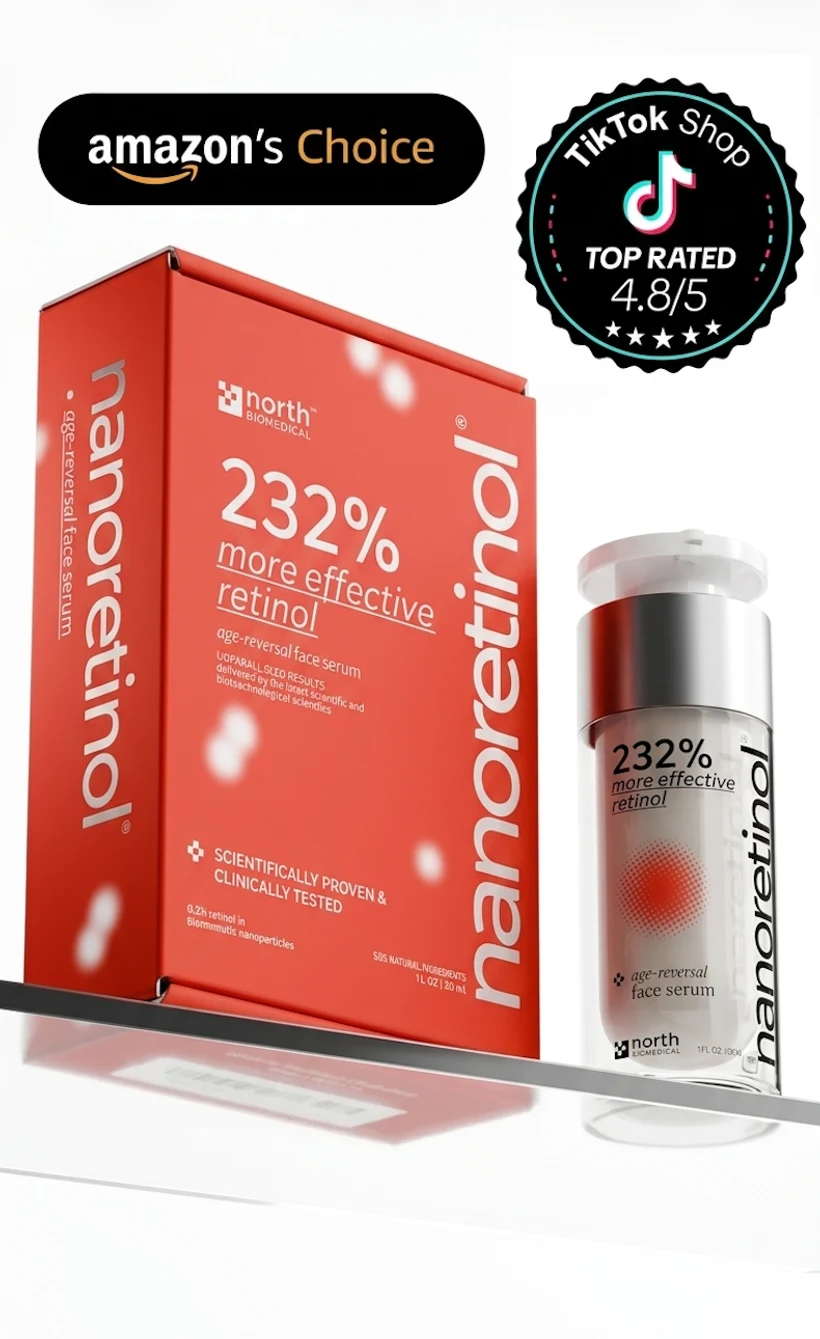
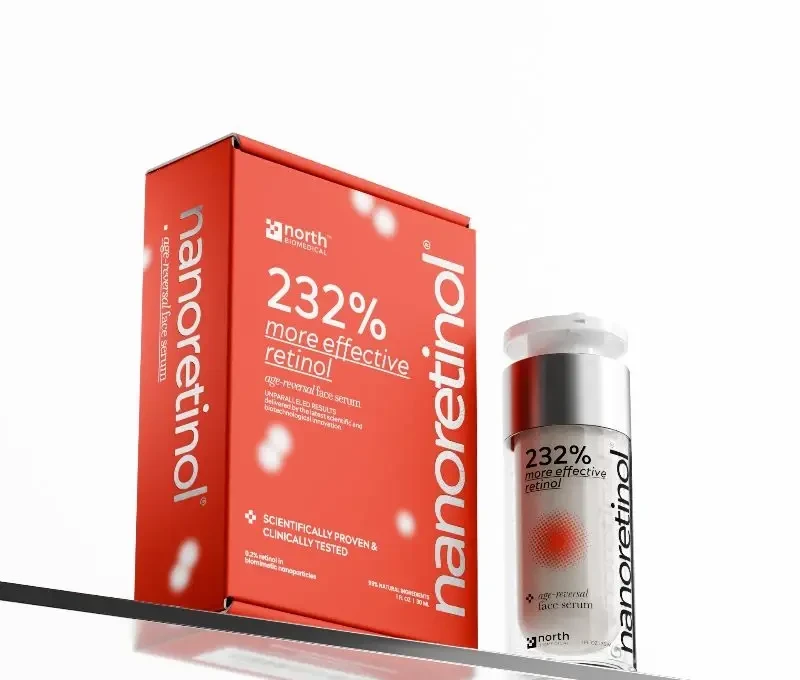
Nanoretinol was built around that principle. It encapsulates retinol inside biomimetic lipid nanoparticles that the skin recognizes as “self” and admits through the barrier — no barrier-stripping chemistry required. In North Biomedical’s testing, this delivery made the same active dramatically more effective: 232% more collagen recovery and 73% more elastin recovery versus conventional retinol, with clinical results of a 61% increase in firmness and a 56% increase in elasticity over 56 days. Because it is a water-based, 99% natural, gentler formulation, it is suitable for the sensitive eye contour — the exact area where thin skin, fast wrinkling, and low tolerance for irritation collide.
If you want to go deeper on the science of the eye area, our guides to under-eye wrinkles and crow’s feet break down why they form and how to treat each one.
Choosing Well
The best eye cream for wrinkles is not a marketing story — it is a delivery system for a proven active. Look for a stabilized retinol first, backed by hydration from hyaluronic acid and niacinamide, with peptides, caffeine, and antioxidants as useful extras. Then be patient: real change is measured over months of nightly use, not in a single morning. Technique carries part of that load, and how to apply eye cream covers the placement and dose that keep a good formula on your skin rather than in your eye. Pair the right ingredient with the right delivery, and the thinnest, most expressive skin on your face finally gets what it has been missing.
References
- Meng Y, Feng L, Shan J, Yuan Z, Jin L. “Application of high-frequency ultrasound to assess facial skin thickness in association with gender, age, and BMI in healthy adults.” BMC Medical Imaging. 2022;22:113. doi:10.1186/s12880-022-00839-w
- Griffiths CE, Russman AN, Majmudar G, Singer RS, Hamilton TA, Voorhees JJ. “Restoration of Collagen Formation in Photodamaged Human Skin by Tretinoin (Retinoic Acid).” New England Journal of Medicine. 1993;329(8):530–535. doi:10.1056/NEJM199308193290803
- Fu JJJ, Hillebrand GG, Raleigh P, et al. “A randomized, controlled comparative study of the wrinkle reduction benefits of a cosmetic niacinamide/peptide/retinyl propionate product regimen vs. a prescription 0.02% tretinoin product regimen.” British Journal of Dermatology. 2010;162(3):647–654. doi:10.1111/j.1365-2133.2009.09436.x
- Aruan RR, Hutabarat H, Widodo AA, Firdiyono MTCC, Wirawanty C, Fransiska L. “Double-blind, Randomized Trial on the Effectiveness of Acetylhexapeptide-3 Cream and Palmitoyl Pentapeptide-4 Cream for Crow’s Feet.” The Journal of Clinical and Aesthetic Dermatology. 2023;16(2):37–43. PubMed: 36909866
- Herman A, Herman AP. “Caffeine’s Mechanisms of Action and Its Cosmetic Use.” Skin Pharmacology and Physiology. 2013;26(1):8–14. doi:10.1159/000343174
- Jegasothy SM, Zabolotniaia V, Bielfeldt S. “Efficacy of a New Topical Nano-hyaluronic Acid in Humans.” The Journal of Clinical and Aesthetic Dermatology. 2014;7(3):27–29. PubMed: 24688623