Best Serum for Mature Skin: A Science-First Buyer's Guide for Women 40+
What actually makes a serum work on aging skin — and how to choose by concern, not by marketing
Why Mature Skin Needs a Different Serum
If your old serum suddenly seems to do nothing, the problem isn’t you — it’s that the skin underneath it has changed. Somewhere in your mid-twenties, the fibroblasts in your dermis — the cells that spin out collagen and elastin like a textile mill — began to slow their looms. Collagen production falls by roughly 1% per year from that point on, and the existing scaffolding starts to fragment under the action of matrix-degrading enzymes [1]. The result is structural: less of the springy mesh that holds skin taut, organized into a looser weave that no longer snaps back.
That decline doesn’t happen alone. Cell turnover slows, so the surface looks duller and rougher. The skin’s barrier — the mortar between your surface cells — becomes leakier, which is why mature skin so often reads as “dry” no matter how much cream you apply. And hyaluronic acid, the water-binding molecule that gives young skin its plumpness, dwindles, taking volume with it.
A serum matters here because it’s the most concentrated, most deeply penetrating step in any routine — a lightweight delivery vehicle designed to drop active ingredients where creams can’t reach. Choosing the best anti-aging serum for skin over 40 isn’t about chasing a trendy name. It’s about matching evidence-backed actives to the specific biology that’s changed.
The Actives That Actually Earn Their Place
Thousands of ingredients get marketed. Only a handful have decades of peer-reviewed evidence behind them. These are the load-bearing walls of any serious anti-aging serum.
Retinoids: The Gold Standard for Collagen
If skincare had a single most-studied molecule, it would be the retinoid — the vitamin A family that includes retinol. Retinoids work upstream of nearly every visible sign of aging: they bind receptors inside skin cells that switch on new collagen synthesis and simultaneously dial down the enzymes that chew existing collagen apart. A systematic review of randomized controlled trials found topical tretinoin (prescription-strength retinoid) significantly improved the clinical signs of photoaged skin versus placebo [2]. For most people, an over-the-counter retinol serum for wrinkles delivers much of that benefit with a gentler ramp-up.
If your old serum suddenly seems to do nothing, the problem isn’t you — it’s that the skin underneath it has changed.
The catch is tolerance. Conventional retinol works partly by irritating — it disrupts the barrier on its way in, which is why so many women quit during the redness-and-peeling phase. That trade-off, as we’ll see, is exactly what newer delivery science is designed to eliminate. This makes finding the best retinol serum for mature skin less about the percentage on the label and more about how the molecule is delivered.
Vitamin C: Antioxidant and Collagen Cofactor
Vitamin C does two jobs at once, and both matter more as skin ages. First, it’s a potent antioxidant — it neutralizes the free radicals generated by UV and pollution that accelerate collagen breakdown. Second, it’s a non-negotiable cofactor for the enzymes that build collagen; without ascorbic acid, those enzymes simply can’t crosslink collagen into stable fibers [3]. That’s why a well-formulated vitamin C serum for mature skin pairs so well with retinoids: one supplies the raw machinery for collagen, the other tells the cell to run it. The limiting factor is stability — ascorbic acid oxidizes quickly in air and light, so formulation and packaging determine whether you’re applying active vitamin C or a useless brown liquid.
Peptides: The Signal to Rebuild
Peptides are short chains of amino acids that act like text messages to your skin cells. Copper peptides (GHK-Cu) are among the most studied: this naturally occurring complex stimulates collagen and elastin synthesis, supports fibroblast function, and modulates the repair enzymes involved in remodeling skin [4]. Where retinoids push the gas pedal and vitamin C supplies the fuel, copper peptides and signal peptides hand the cell the blueprint. They’re also exceptionally gentle, which makes them a smart partner for anyone whose skin can’t tolerate aggressive actives.
Niacinamide and Hyaluronic Acid: Barrier and Bounce
Niacinamide (vitamin B3) is the quiet workhorse. It boosts the skin’s production of ceramides and other barrier lipids, evens out tone and blotchiness, and in clinical study improved the appearance of aging facial skin — fine lines, sallowness, and elasticity all measured better after twelve weeks [5]. For mature skin with a compromised barrier, it’s foundational.
Hyaluronic acid addresses the volume problem directly. It’s a humectant that can hold many times its weight in water, and topical formulations — especially low-molecular-weight versions small enough to penetrate — have been shown to reduce wrinkle depth and improve hydration and elasticity in as little as eight weeks [6]. It won’t rebuild collagen, but it plumps the surface and softens fine lines immediately, which is why it belongs in nearly every mature-skin routine.
A serum with 10% of an active that can’t cross the skin barrier is weaker than one with 2% that’s engineered to get in cleanly.
Why Delivery Beats Concentration
Here’s the insight most labels work hard to hide: the number on the front of the bottle tells you almost nothing. A serum with 10% of an active that can’t cross the skin barrier is weaker than one with 2% that’s engineered to get in cleanly. Skin is built to keep things out — that’s its whole job — so the real engineering challenge of any collagen-supporting serum is penetration without provocation.
This is the trap conventional retinol falls into. To get the molecule deep enough to work, traditional formulas essentially force it through a barrier they damage in the process. The irritation isn’t a sign of potency — it’s a sign of a crude delivery method. A higher percentage just means more collateral damage, which is why “stronger” retinol so often means redder, flakier skin rather than better results.
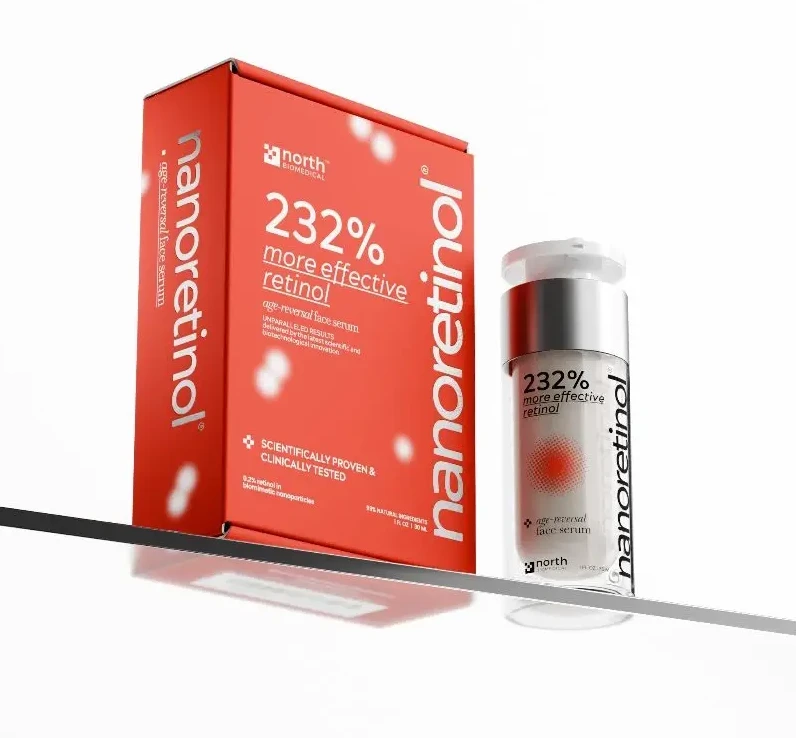
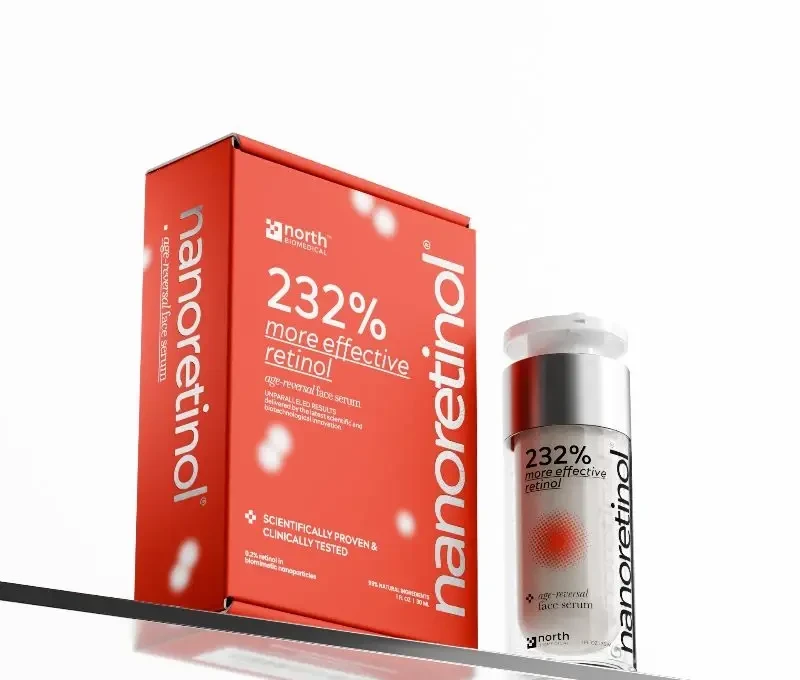
The smarter path is to make the active invisible to the skin’s defenses. That’s the principle behind Nanoretinol, North Biomedical’s approach to retinol delivery. The retinol is encapsulated inside biomimetic lipid nanoparticles — a kind of biological Trojan horse the skin recognizes as “self” and waves through, without the barrier disruption that causes redness and peeling. The molecule arrives intact and deep; the barrier stays whole.
The data follow from the mechanism. In North Biomedical’s head-to-head testing, the encapsulated form was 232% more effective in collagen recovery and 73% more effective in elastin recovery than conventional retinol, with drastically reduced cytotoxicity [7]. In a 56-day clinical evaluation, users saw a 61% improvement in skin firmness and a 56% improvement in elasticity. It achieves this at just 0.2% retinol — fully stabilized in a water-based gel that’s 99% natural, vegan, and gentle enough for sensitive skin and the eye contour. That’s the whole argument for delivery over concentration, made concrete: a small, smart dose outperforms a large, blunt one.
Building Your Routine by Concern
So which serum is the best serum for older skin? Honestly — the one that matches your top concern and that you’ll actually use consistently.
If your priority is wrinkles and loss of firmness, a well-delivered retinoid is the highest-leverage choice, ideally one engineered to skip the irritation tax. If it’s dullness, dark spots, and protection, lead with vitamin C, layered under sunscreen each morning. If it’s a fragile, reactive barrier, build around niacinamide and peptides before introducing anything stronger. And for everyday plumpness and hydration, hyaluronic acid is the reliable baseline that pairs with all of them.
The best facial serum for aging skin isn’t a single product — it’s the right active, delivered intelligently, applied with patience. Mature skin rewards consistency over intensity. Pick by your biology, give it the eight to twelve weeks the research consistently uses to measure real change, and let the formulation — not a big number on the label — do the work.
References
- Fisher GJ, Varani J, Voorhees JJ. “Looking Older: Fibroblast Collapse and Therapeutic Implications.” Archives of Dermatology. 2008;144(5):666-672. doi:10.1001/archderm.144.5.666
- Sitohang IBS, Makes WI, Sandora N, Suryanegara J. “Topical Tretinoin for Treating Photoaging: A Systematic Review of Randomized Controlled Trials.” International Journal of Women’s Dermatology. 2022;8(1):e003. doi:10.1097/JW9.0000000000000003
- Pullar JM, Carr AC, Vissers MCM. “The Roles of Vitamin C in Skin Health.” Nutrients. 2017;9(8):866. doi:10.3390/nu9080866
- Pickart L, Margolina A. “Regenerative and Protective Actions of the GHK-Cu Peptide in the Light of the New Gene Data.” International Journal of Molecular Sciences. 2018;19(7):1987. doi:10.3390/ijms19071987
- Bissett DL, Oblong JE, Berge CA. “Niacinamide: A B Vitamin That Improves Aging Facial Skin Appearance.” Dermatologic Surgery. 2005;31(7 Pt 2):860-865. PMID:16029679
- Jegasothy SM, Zabolotniaia V, Bielfeldt S. “Efficacy of a New Topical Nano-hyaluronic Acid in Humans.” Journal of Clinical and Aesthetic Dermatology. 2014;7(3):27-29. PMID:24688623
- North Biomedical LLC. “Nanoretinol vs. Conventional Retinol: Efficacy in Collagen and Elastin Recovery.” Clinical Study Summary, 2024.