Best Vitamin C Serum: What Actually Works for Brightening and Anti-Aging
Why most C serums fail before they reach your skin — and the formulation rules that separate the few that actually work
Walk into any beauty aisle and you will see fifty bottles labeled “vitamin C serum.” They range from $12 drugstore picks to $180 dermatologist-counter formulas. Most of them will not do much. A handful will quietly transform your skin tone, collagen scaffolding, and resilience to UV damage over a few months of consistent use.
The difference is not the price. The difference is the chemistry — which form of vitamin C, at what pH, with which stabilizers. Get those three variables right and you have a real anti-aging tool. Get them wrong and you are paying for an expensive bottle of brown water.
This guide will walk through what the published research actually says, then translate that into a buying framework you can use the next time you are squinting at a label.
Why your skin needs topical vitamin C in the first place
Healthy human skin contains millimolar concentrations of vitamin C — levels comparable to those in your liver and adrenal glands [6]. The epidermis is especially rich. That ascorbate pool is doing two jobs simultaneously. It acts as a chain-breaking antioxidant, neutralizing free radicals generated by UV exposure, pollution, and ordinary cellular metabolism. And it serves as a non-negotiable enzymatic cofactor for prolyl and lysyl hydroxylase — the enzymes that hydroxylate collagen precursors so the triple helix can fold and stabilize [1, 6].
Without enough vitamin C, your fibroblasts cannot assemble structurally sound collagen. This was first demonstrated cleanly by Sheldon Pinnell’s lab in 1981, when prolonged ascorbate exposure increased collagen synthesis in cultured fibroblasts roughly eightfold [1]. The implication is mechanical: when skin ascorbate runs low, the dermal scaffolding weakens. Sun exposure and chronological aging both deplete that reserve, and oral supplementation hits a plasma ceiling long before epidermal stores are saturated. Topical replenishment is the only practical route to actually raise vitamin C in the skin itself [6].
So the goal of a vitamin C serum is not exotic. You are trying to restore something your skin already had a lot more of when you were twenty-five. Vitamin C pairs comfortably with vitamin B3, and our best niacinamide serum guide covers how to layer the two. For how vitamin C compares with the other brightening mechanisms, see our guide to choosing a brightening serum.
The L-ascorbic acid problem
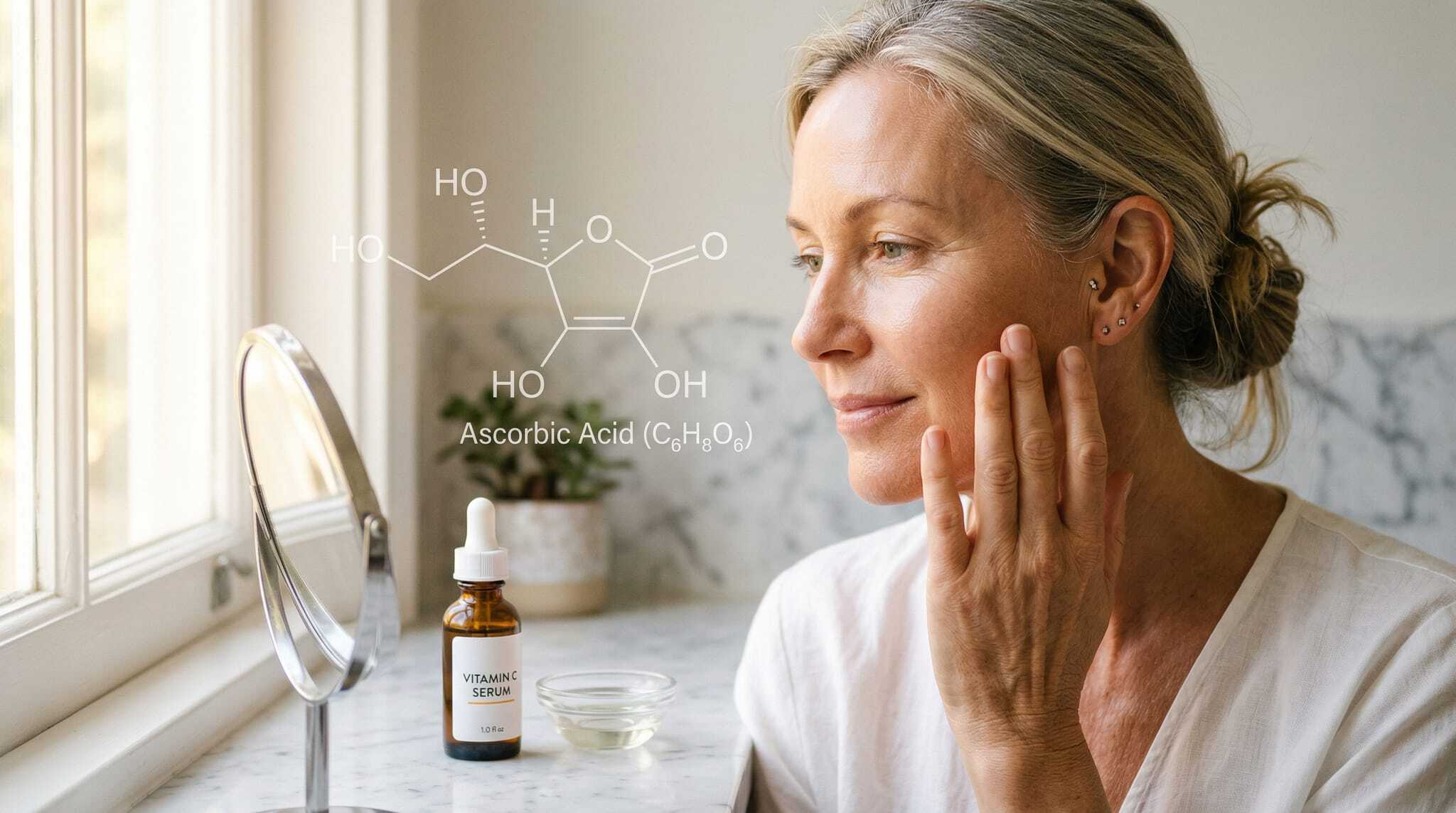
L-ascorbic acid is the form your skin’s enzymes actually recognize and use. It is also one of the most temperamental molecules in cosmetic chemistry.
You are trying to restore something your skin already had a lot more of when you were twenty-five.
In aqueous solution L-ascorbic acid oxidizes rapidly to dehydroascorbic acid, then to inactive degradation products [4]. The brown or yellow tint that appears in old vitamin C serums is exactly this oxidation, and an oxidized serum does not just lose efficacy — the degradation products can actually generate free radicals on the skin, doing the opposite of what you wanted. Light, heat, oxygen exposure, and elevated pH all accelerate the breakdown.
Beyond stability, L-ascorbic acid faces a delivery problem. The molecule is hydrophilic and ionizes at neutral pH, which means it cannot cross the lipid-rich stratum corneum. Pinnell’s 2001 percutaneous absorption study established the rule that the entire industry now follows: L-ascorbic acid must be formulated below pH 3.5 for its carboxylic acid groups to stay protonated and traverse the skin barrier [2]. Above pH 3.5, almost nothing gets in.
That same study found maximal skin levels at 20% L-ascorbic acid, with no additional benefit from higher concentrations, and a tissue half-life of about four days after saturation. Three of the popular stable derivatives tested — magnesium ascorbyl phosphate, ascorbyl-6-palmitate, and dehydroascorbic acid — did not measurably raise intracellular L-ascorbic acid in skin [2]. That finding remains uncomfortable for the marketing claims of many “stable C” products.
The Pinnell formula and why ferulic acid matters
In 2005, Pinnell’s group published the paper that defined the modern gold-standard serum: 15% L-ascorbic acid + 1% alpha-tocopherol (vitamin E) + 0.5% ferulic acid [3]. Adding the ferulic acid did two things at once. It stabilized the C + E pair against oxidation during storage, and it doubled the photoprotective capacity of the combination in human and porcine skin — from roughly a fourfold to an eightfold reduction in erythema and sunburn-cell formation after solar-simulated radiation. Thymine dimer formation, a direct marker of UV-induced DNA damage, also dropped.
This is the recipe behind SkinCeuticals C E Ferulic and the countless dupes that have followed it. When you see a product labeled “Pinnell formula” or “C E Ferulic-style,” that 15/1/0.5 ratio is what they are referencing. A well-executed version of this formula remains the most evidence-supported topical vitamin C product on the market. If you are weighing it against a gentler barrier-focused active, our comparison of niacinamide vs vitamin C lays out when to reach for each.
A clean 12-week split-face trial backs up the clinical effect. Patients treated with a 10% L-ascorbic acid serum showed statistically significant improvement in fine wrinkles, plus punch biopsies that confirmed increased Grenz-zone collagen and elevated type I collagen mRNA on the treated side [8]. That is histologically demonstrable remodeling, not just temporary plumping.
For sensitive skin or anyone who finds L-ascorbic acid stinging, a 5-10% tetrahexyldecyl ascorbate formula is the next-best alternative.
What about THD ascorbate, sodium ascorbyl phosphate, and the rest?
For people whose skin cannot tolerate the low pH of L-ascorbic acid, or who want a product that does not require a freezer, the derivatives are tempting. The honest answer is that the evidence is uneven.
Tetrahexyldecyl ascorbate (THD ascorbate, ascorbyl tetraisopalmitate) is lipid-soluble, which lets it cross the stratum corneum more easily than pure L-ascorbic acid. Intracellular esterases then cleave it back to active vitamin C. That mechanism is real, but a 2021 mechanistic study showed THDC itself is a weak antioxidant that degrades quickly under oxidative stress and can even reduce keratinocyte viability when used alone [7]. Combined with a co-stabilizer like acetyl zingerone, the same formulation suppressed MMP1/MMP7 enzymes and increased fibroblast collagen production. Translation: THD ascorbate can work, but the rest of the formula matters enormously.
Sodium ascorbyl phosphate (SAP) and magnesium ascorbyl phosphate (MAP) are more pH-tolerant and shelf-stable, and they require intracellular phosphatase enzymes to convert back to L-ascorbic acid. They are gentler on sensitive skin, but as Pinnell’s penetration data showed, they do not raise skin ascorbate levels nearly as effectively as the parent molecule [2, 4]. They have a place in routines for very reactive skin, but they are not equivalent to a well-formulated 10-20% L-ascorbic acid serum.
Ascorbyl glucoside and 3-O-ethyl ascorbic acid sit in a similar middle ground — more stable, less proven, modestly effective in the studies that exist [4].
How to actually pick one
A 2017 clinical review collapses the decision into four pillars that any well-formulated topical vitamin C should deliver: antioxidant defense against UV and pollution, photoprotection that reduces UVB-induced erythema by roughly half, collagen support through enzyme cofactor and gene-expression effects, and pigment lightening via tyrosinase inhibition [5]. If you can verify a product meets the formulation rules below, it will hit those four pillars.
Use this checklist:
- For L-ascorbic acid serums, look for 10-20% concentration, a stated pH at or below 3.5, and inclusion of ferulic acid and vitamin E for the documented synergy and stability advantage.
- The bottle should be opaque or amber, with an airless pump or dropper that limits air exposure. Clear glass droppers are a red flag.
- The serum should be water-clear to pale yellow. Brown or orange means oxidation. Replace it.
- Refrigeration extends shelf life but is not strictly required for a well-stabilized formula.
- For sensitive skin or anyone who finds L-ascorbic acid stinging, a 5-10% tetrahexyldecyl ascorbate formula is the next-best alternative.
- Use sunscreen during the day. Vitamin C is not a sunscreen, but a 2023 systematic review confirmed it amplifies sunscreen protection and produces meaningful pigment fading when used consistently for months, not weeks [5].
For the broader anti-aging picture, vitamin C pairs naturally with retinol-based serums because the two address aging through complementary pathways — collagen synthesis cofactor on one side, cell turnover and signaling on the other. The combination is one of the most consistently studied in dermatology.
Where Nanoretinol fits
A serious anti-aging routine for skin over 40 generally includes both a vitamin C and a retinoid. The challenge with conventional retinol is that the delivery problem looks identical to the one vitamin C has — only worse. Most of the molecule sits on the surface, oxidizes, or irritates the barrier on its way in. Higher concentrations cause more peeling, not more results.
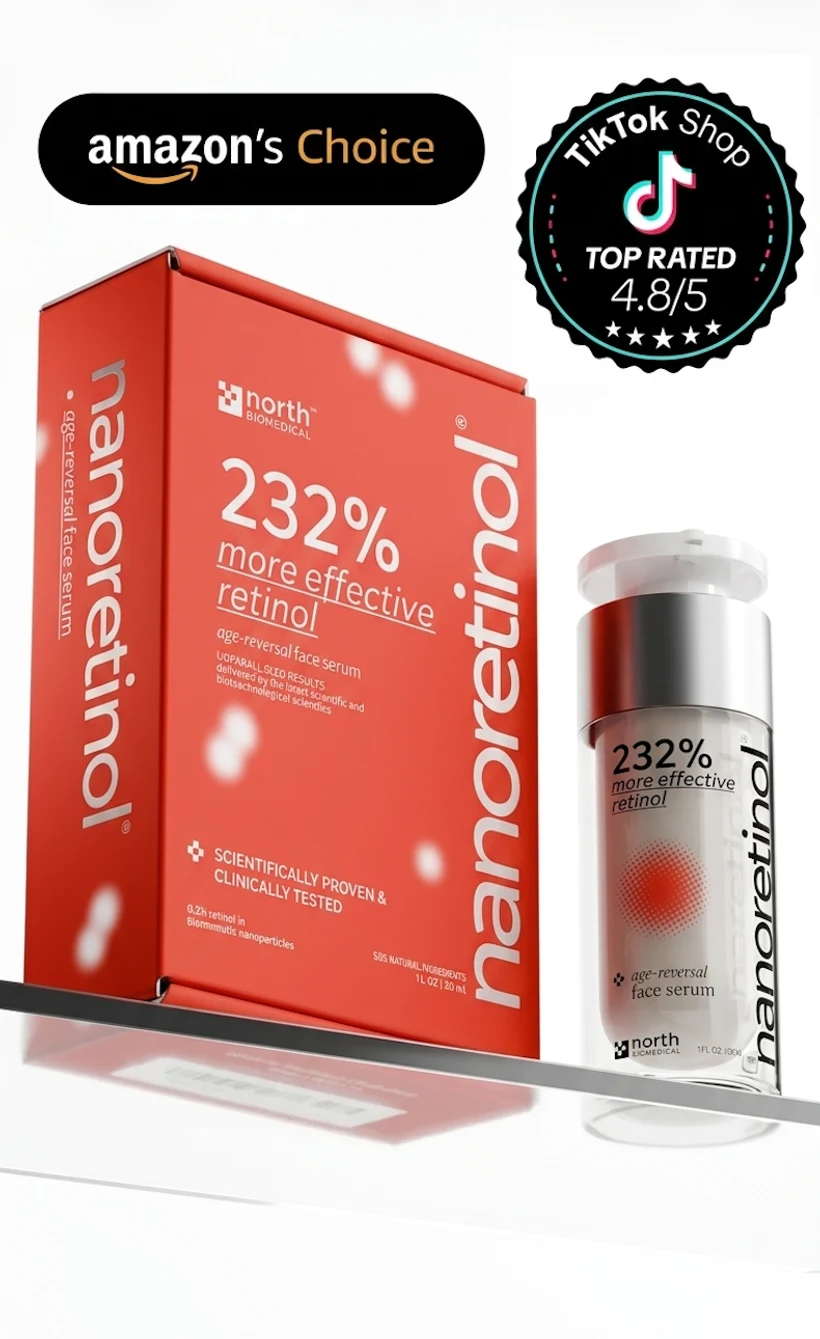
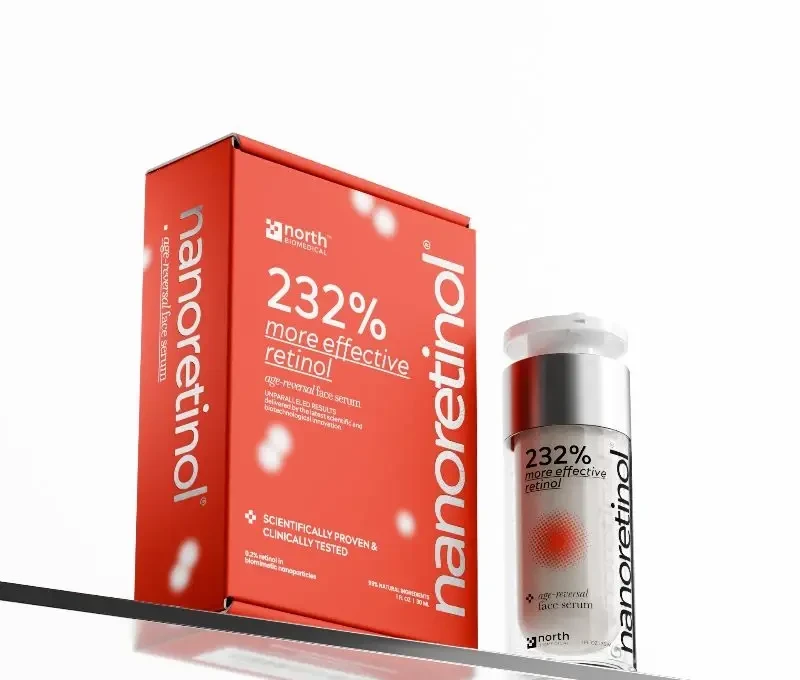
Nanoretinol takes the opposite approach. The retinol is encapsulated in biomimetic lipid nanoparticles that the skin recognizes as self and allows through the epithelial barrier intact. A reported 232% improvement in collagen recovery and 73% improvement in elastin recovery versus conventional retinol comes not from a higher concentration, but from solving the delivery problem the same way modern drug development does [North Biomedical LLC, 2024]. Layered over a well-formulated vitamin C serum, the two address the structural side of aging together: collagen scaffolding, antioxidant defense, and dermal remodeling.
The takeaway
A good vitamin C serum is not the one with the highest number on the label or the prettiest bottle. It is the one whose chemistry survives the trip from factory to bottle to your skin: pH below 3.5 for L-ascorbic acid, stabilizing partners like ferulic acid and vitamin E, airless packaging, a clear-to-pale-yellow color when you use it, and consistent daily use over months rather than weeks. Get those right and the published evidence says you will see measurable changes in tone, texture, and resilience.
References
- Murad S, Grove D, Lindberg KA, Reynolds G, Sivarajah A, Pinnell SR. “Regulation of collagen synthesis by ascorbic acid.” Proceedings of the National Academy of Sciences USA. 1981;78(5):2879-2882. doi:10.1073/pnas.78.5.2879
- Pinnell SR, Yang H, Omar M, Monteiro-Riviere N, DeBuys HV, Walker LC, Wang Y, Levine M. “Topical L-ascorbic acid: percutaneous absorption studies.” Dermatologic Surgery. 2001;27(2):137-142. doi:10.1046/j.1524-4725.2001.00264.x
- Lin FH, Lin JY, Gupta RD, Tournas JA, Burch JA, Selim MA, Monteiro-Riviere NA, Grichnik JM, Zielinski J, Pinnell SR. “Ferulic acid stabilizes a solution of vitamins C and E and doubles its photoprotection of skin.” Journal of Investigative Dermatology. 2005;125(4):826-832. doi:10.1111/j.0022-202X.2005.23768.x
- Stamford NPJ. “Stability, transdermal penetration, and cutaneous effects of ascorbic acid and its derivatives.” Journal of Cosmetic Dermatology. 2012;11(4):310-317. doi:10.1111/jocd.12006
- Al-Niaimi F, Chiang NYZ. “Topical Vitamin C and the Skin: Mechanisms of Action and Clinical Applications.” Journal of Clinical and Aesthetic Dermatology. 2017;10(7):14-17. PubMed: 29104718
- Pullar JM, Carr AC, Vissers MCM. “The Roles of Vitamin C in Skin Health.” Nutrients. 2017;9(8):866. doi:10.3390/nu9080866
- Swindell WR, Randhawa M, Quijas G, Bojanowski K, Chaudhuri RK. “Tetrahexyldecyl Ascorbate (THDC) Degrades Rapidly under Oxidative Stress but Can Be Stabilized by Acetyl Zingerone to Enhance Collagen Production and Antioxidant Effects.” International Journal of Molecular Sciences. 2021;22(16):8756. doi:10.3390/ijms22168756
- Fitzpatrick RE, Rostan EF. “Double-blind, half-face study comparing topical vitamin C and vehicle for rejuvenation of photodamage.” Dermatologic Surgery. 2002;28(3):231-236. doi:10.1046/j.1524-4725.2002.01129.x