Dry Flaky Skin on Face: What's Really Causing It and How to Fix It for Good
Why your face keeps peeling — and the ingredient science that finally stops it
When “Just Moisturize More” Stops Working
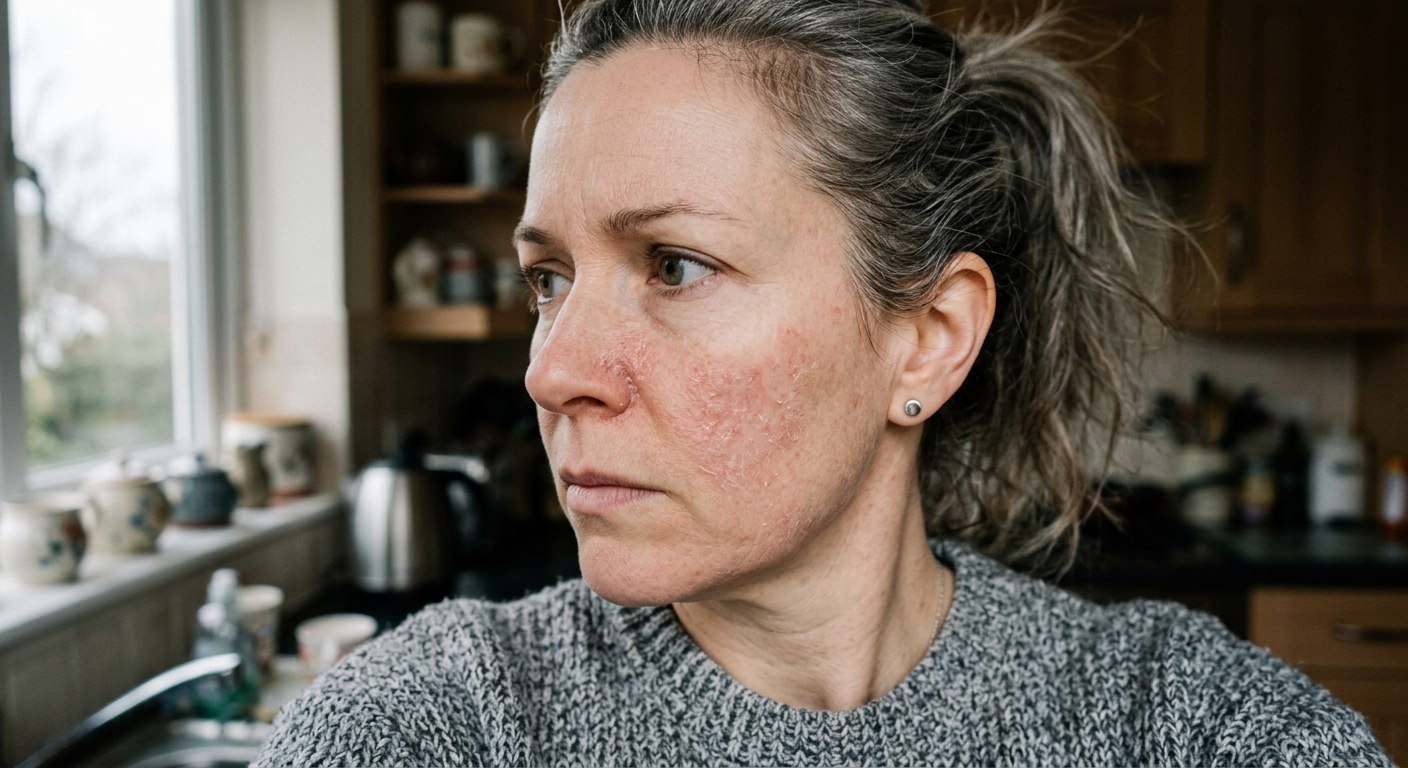
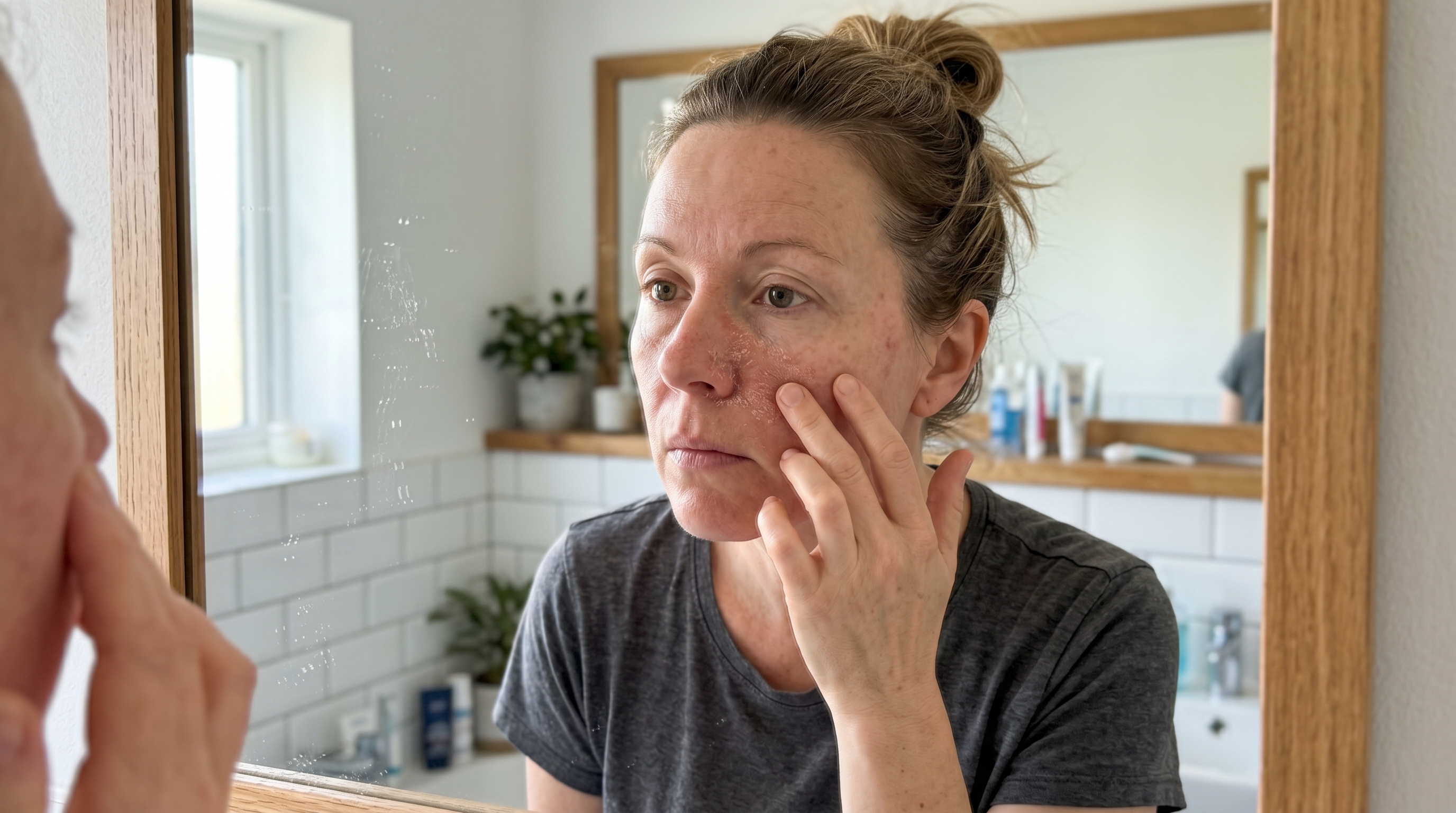
You’ve tried three different moisturizers. You’re drinking plenty of water. You’ve given up hot showers. And still — every morning, you see small scales of skin lifting away from your cheeks, forehead, or around your nose. The texture is rough to the touch and looks worse under makeup.
If that sounds familiar, you’ve moved past garden-variety dryness and into something with a more specific biological cause. Dry, flaky skin on the face isn’t a failure of willpower or routine. It’s a structural breakdown in the stratum corneum — the outermost layer of your skin — and fixing it requires understanding what that layer is actually made of and what it needs.
What “Flaking” Is, Biologically Speaking
Your skin is constantly renewing itself. Every 28 to 40 days (a timeline that lengthens significantly with age), new keratinocytes born in the deepest epidermal layer travel upward, flatten, and eventually shed invisibly from the surface. This process — desquamation — is normally so gradual you never see it.
When it goes wrong, those dead corneocytes don’t release properly. They clump together and lift in visible flakes instead of shedding individually. The immediate causes vary, but they almost always involve dysfunction in the skin barrier.
The barrier is a lipid-rich matrix made primarily of ceramides, cholesterol, and free fatty acids, arranged in lamellar sheets between flattened skin cells. When those lipids are depleted — by age, harsh cleansers, over-exfoliation, cold weather, or certain topical actives — the barrier can no longer hold water effectively or regulate desquamation properly. Transepidermal water loss (TEWL) rises, cells dry out and stick to each other, and the result is visible flaking [1].
Why It Gets Worse After 40
A specific set of changes makes mature skin significantly more prone to flaking than younger skin.
First, ceramide production declines. These waxy lipid molecules are the “mortar” between skin cells, and they fall by roughly 30–40% in the decades after 40 [1]. Less ceramide means a more porous barrier — one that loses water faster and is less able to regulate the shedding cycle.
Second, filaggrin — a protein essential for binding water in the outer skin layers — is produced less efficiently as skin ages. Filaggrin breaks down into natural moisturizing factors (NMFs) like amino acids and urocanic acid that attract and hold water inside corneocytes [2]. When filaggrin drops, the cells in the stratum corneum become desiccated and brittle. Instead of shedding cleanly, they fracture and flake.
These waxy lipid molecules are the “mortar” between skin cells, and they fall by roughly 30–40% in the decades after 40.
Third, sebaceous gland activity slows, particularly after menopause. The natural oils that once kept the skin surface supple are simply produced in smaller quantities [3]. Combined with the barrier changes above, mature skin is left structurally underpowered to resist flaking — even with good habits.
The Triggers That Make It Acute
Chronic low-level flaking tends to become much worse when specific triggers are added:
Over-cleansing or using detergent-heavy products. Surfactants that strip the skin (sodium lauryl sulfate being the most commonly cited) degrade lamellar lipids. Studies have documented measurable increases in TEWL following repeated use of strong surfactants — exactly the mechanism that produces a flaky, compromised barrier [2].
Weather transitions. Cold, dry air drops relative humidity, and indoor heating drops it further. Corneocytes lose water rapidly in these conditions, and desquamation becomes visibly irregular.
Retinol — temporarily. This one surprises people. Retinoids accelerate keratinocyte turnover, which is precisely what makes them effective for anti-aging. But in the early weeks of use, that acceleration can cause faster shedding than the barrier can manage — producing noticeable flaking, redness, and tightness [4]. This is an effect of the retinoid’s mechanism, not damage to the skin. It typically resolves as the skin adapts.
Exfoliating without repairing. Using AHAs, BHAs, or physical exfoliants without compensating with barrier-supporting products amplifies the problem. Exfoliation is often appropriate — but it should always be paired with ceramide and humectant application afterward.
What Actually Fixes Flaky Skin
Several ingredient categories are well-supported by clinical evidence for repairing the compromised barrier behind dry, flaky skin.
Despite initially causing flaking, retinol is one of the most effective long-term treatments for dry, mature skin.
Ceramides
The most direct intervention is replenishing the lipid molecule that has declined. Topical ceramide formulations penetrate the stratum corneum and integrate into the lamellar matrix, measurably restoring barrier function. Clinical studies show that ceramide-containing skincare regimens significantly reduce TEWL and improve skin hydration in older adults with xerosis within weeks of regular use [5].
Look for products listing ceramide NP, ceramide AP, or ceramide EOP — these are the specific subtypes most structurally relevant to the barrier.
Humectants
Humectants like hyaluronic acid, glycerin, and sodium PCA attract water from the environment and bind it in the stratum corneum. They don’t repair the barrier on their own, but they compensate for the water-holding dysfunction while barrier repair is underway. In clinical testing, formulations combining humectants with NMF components significantly reduced transepidermal water loss and visible scaling in patients with xerosis [2].
Retinol — with the right delivery
Here is where the picture gets more nuanced. Despite initially causing flaking, retinol is one of the most effective long-term treatments for dry, mature skin. It stimulates collagen production, normalizes desquamation, and thickens the dermis — all of which produce a healthier, better-regulated surface over time [4].
The problem is the early adjustment period. Conventional retinol formulations require barrier disruption to penetrate — a mechanism that temporarily worsens the very flaking you’re trying to address.
Lipid nanoparticle-encapsulated retinol — like Nanoretinol — bypasses this mechanism. The nanoparticles mimic the skin’s own cell membranes, allowing passage through the epithelial barrier without requiring disruption of the lipid matrix. Clinical data shows that Nanoretinol is significantly gentler on skin cells than conventional retinol, with drastically reduced cytotoxicity — making it a more viable option for people whose skin is already compromised and flaking [4].
The Routine Rebuild
If you’re dealing with persistent facial flaking, the practical sequence is:
- Switch to a pH-appropriate, low-surfactant cleanser. This alone can reduce TEWL-related scaling significantly [2].
- Apply a ceramide-containing moisturizer immediately after cleansing — not when skin is fully dry. Damp skin absorbs ceramides and humectants more effectively. If you are still choosing a product, compare them in our guide to the best face moisturizer for dry skin.
- If using retinol: buffer with ceramide cream before application, use no more than two to three nights per week initially, and consider a gentler delivery format.
- Layer a humectant underneath your moisturizer. Glycerin serums or hyaluronic acid add a water-attracting layer that complements the barrier-sealing effect of ceramides.
If you’ve already damaged your skin barrier through over-exfoliation or harsh products, a temporary pause on all actives — two to four weeks of purely supportive skincare — will typically restore enough baseline function to re-introduce them. See our full guide to skin barrier repair for the recovery protocol.
For those interested in upgrading to a retinol that’s designed to work with compromised skin rather than against it, encapsulated retinol technology represents a meaningful shift from conventional formulations — especially relevant when starting from a flaky, barrier-deficient baseline.
What’s Worth Knowing
Dry, flaky skin on the face is not a cosmetic inconvenience. It signals a barrier that is actively losing function — and if left unaddressed, the consequences compound: increased sensitivity, accelerated photoaging, and a surface that cannot respond well to even well-intentioned actives.
The solution isn’t aggressive exfoliation or richer moisturizers alone. It’s a systematic repair of the lipid architecture that holds the barrier together — starting with ceramides, supported by humectants, and eventually enhanced by a retinol delivery system that doesn’t require tearing that architecture apart to function.
References
- Tončić RJ, Kezić S, Hadžavdić SL, Marinović B. “Skin barrier and dry skin in the mature patient.” Clin Dermatol. 2018;36(2):109-115. doi:10.1016/j.clindermatol.2017.10.002
- Weber TM, Kausch M, Rippke F, Schoelermann AM, Filbry AW. “Treatment of xerosis with a topical formulation containing glyceryl glucoside, natural moisturizing factors, and ceramide.” J Clin Aesthet Dermatol. 2012;5(8):29-39. https://pubmed.ncbi.nlm.nih.gov/22916312/
- Schachner LA, Alexis AF, Andriessen A, et al. “Insights into acne and the skin barrier: Optimizing treatment regimens with ceramide-containing skincare.” J Cosmet Dermatol. 2023;22(11):2902-2909. doi:10.1111/jocd.15946
- Li J, Li Q, Geng S. “All-trans retinoic acid alters the expression of the tight junction proteins Claudin-1 and -4 and epidermal barrier function-associated genes in the epidermis.” Int J Mol Med. 2019;43(4):1789-1805. doi:10.3892/ijmm.2019.4098
- Chang ALS, Chen SC, Osterberg L, Brandt S, von Grote EC, Meckfessel MH. “A daily skincare regimen with a unique ceramide and filaggrin formulation rapidly improves chronic xerosis, pruritus, and quality of life in older adults.” Geriatr Nurs. 2018;39(1):24-28. doi:10.1016/j.gerinurse.2017.05.002