Dry Skin Around the Eyes: Causes and How to Fix It
Why the eye area dries out, flakes, and creases first — and the gentlest way to restore it.
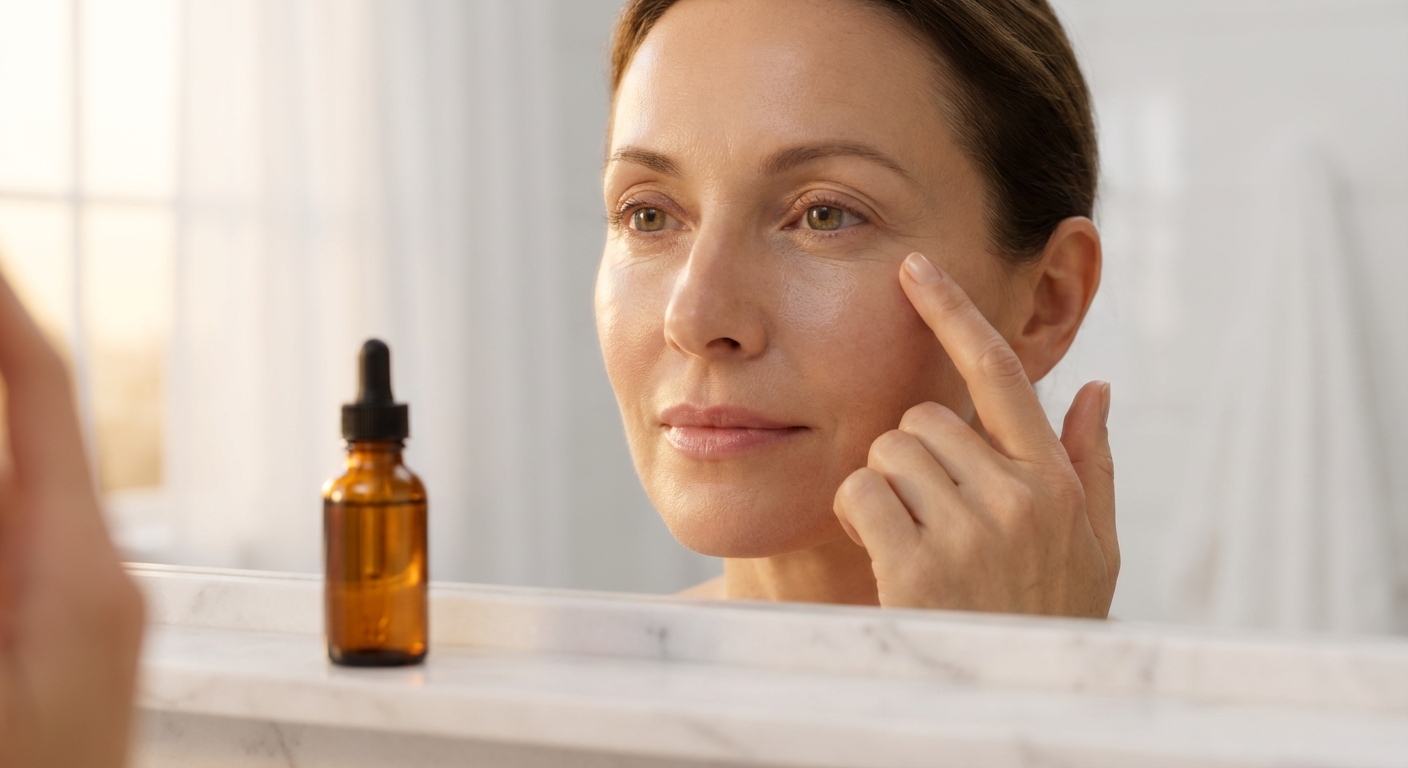
You notice it first thing in the morning, or the moment concealer goes on: the skin around your eyes feels tight, looks faintly flaky, and settles into fine creases that were not there a few years ago. Dry skin around the eyes is one of the most common complaints among women over 40 — and one of the most misunderstood. It is rarely a sign you are doing something wrong. It is mostly a sign of where that skin sits and how it is built.
Why the Eye Area Dries Out First
The skin around your eyes is not a smaller version of the skin on your cheek. It is structurally different in ways that matter.
It is the thinnest skin on the face. Eyelid and under-eye skin has a markedly thinner epidermis and stratum corneum — the outer protective layer — than the cheek or forehead. It also carries very few oil glands. Research analyzing eyelid skin found it has remarkably low surface lipids compared with neighboring facial regions, relying instead on unusually large surface cells to hold onto water [1].
That is an elegant system when it works. But it leaves the eye area with almost no oily buffer against the things that strip moisture: cold air, central heating, wind, hot showers, and cleansers.
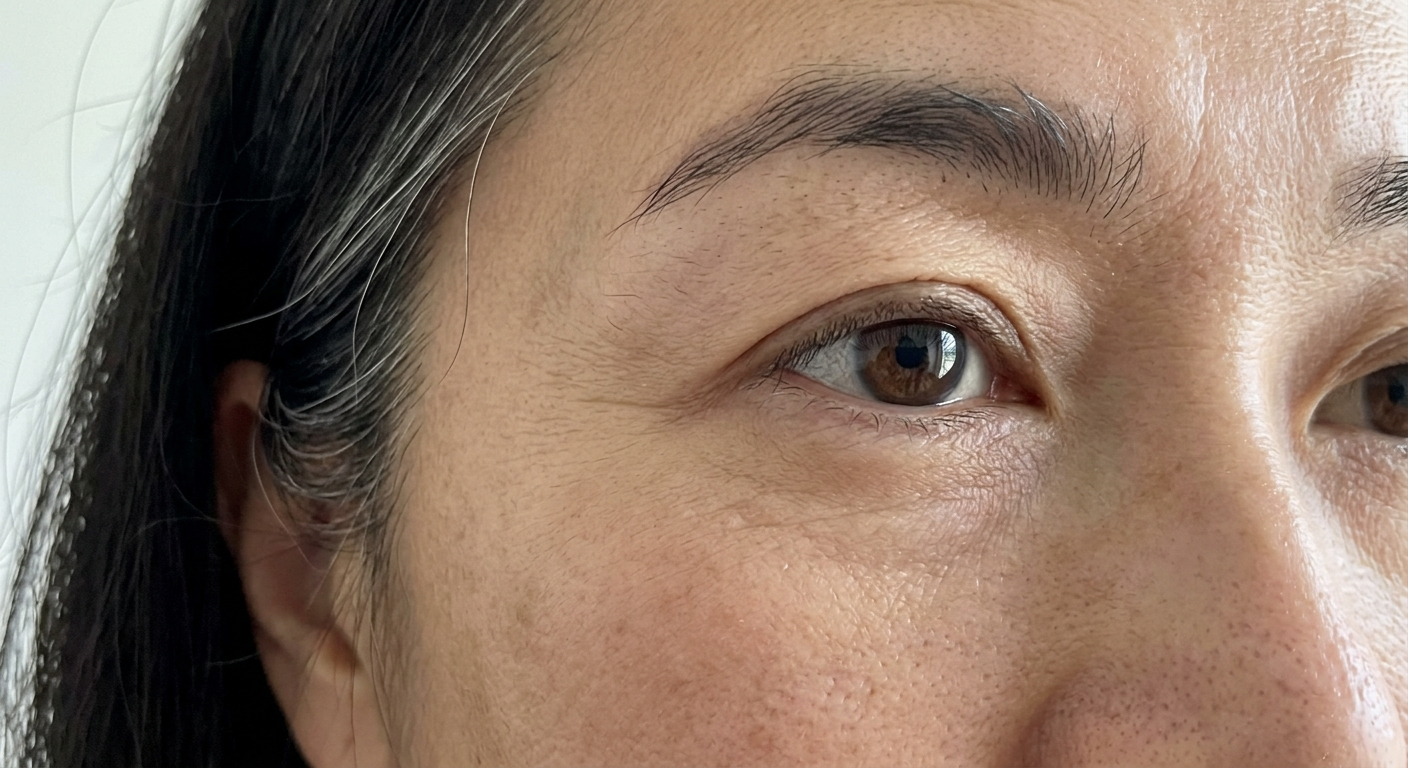
When that thin, low-oil skin loses water faster than it can replace it, you get the tightness, the flaking, and the papery look that makes the whole eye area read as older and more tired than the rest of your face.
Why It Gets Worse With Age
If the eye area is fragile to begin with, aging compounds the problem.
The skin around your eyes is not a smaller version of the skin on your cheek.
The skin’s barrier — the brick-and-mortar layer that keeps water in — changes measurably over the decades. A study using Raman spectroscopy found that the stratum corneum’s lipid organization declines with age, weakening its ability to hold moisture [2]. A broader review of aging skin describes the same pattern: aged skin shows defective barrier repair, lower lipid production, reduced natural moisturizing factor, and a higher surface pH — a combination that drives the dryness, or xerosis, so common in mature skin [3].
In other words, the eye area starts thin and low on oil, and then the one defense it has — its barrier — slowly loses efficiency. Dryness there is not bad luck. It is the predictable result of structure meeting time.
The Everyday Triggers That Tip It Over
Beyond aging, a few habits reliably push eye-area skin from “fine” to “flaky”:
- Harsh cleansers and makeup removers that dissolve the little oil the area has.
- Rubbing — wiping makeup off, scrubbing at itchy eyes — which physically damages a delicate barrier.
- Over-exfoliating the eye area, or letting strong actives migrate into it.
- Climate — low humidity, heating, air conditioning, and wind.
One important note: if the skin around your eyes is intensely itchy, red, scaly, or weeping, that may be a form of dermatitis rather than simple dryness, and it is worth seeing a dermatologist. For ordinary tightness and flaking, though, the fix is a smarter skincare approach.
How to Restore Dry Skin Around the Eyes
The goal is simple: lose less water, and rebuild the barrier that holds it.
Nanoretinol is a lightweight, water-based gel with a stabilized 0.2% retinol concentration, formulated to be gentle enough for the eye contour.
Cleanse gently. Swap foaming or stripping cleansers for a mild, non-foaming formula, and never scrub the eye area — press, do not rub. Our guide to the best eye makeup remover covers which chemistries dissolve makeup so the rubbing stops being necessary. If powder keeps exposing the flakes, the best eyeshadow for older women is often a thin cream formula rather than another layer of primer.
Support the barrier. Look for ingredients that mimic or replenish the skin’s own moisture system: ceramides and fatty acids to rebuild the mortar, glycerin and hyaluronic acid to draw in water (the job of a well-made hyaluronic acid eye cream), and squalane to seal it. Our guide to skin barrier repair covers this in depth.
Apply to slightly damp skin and protect with sunscreen daily — UV exposure further degrades the barrier you are trying to rebuild. Choosing a filter that will not migrate into the eye is covered in sunscreen around the eyes.
Treat the dehydration, not just the surface. Persistent dryness around the eyes often travels with early crepiness. If that sounds familiar, our article on crepey eyelids explains the overlap.
Where Retinol Fits — and Why People Avoid It Here
Here is the part most people get wrong about the eye area. Dry, crepey eye skin is not only a hydration problem; it is also an early sign of thinning collagen. And the most proven way to rebuild collagen is retinol — topical retinol applied to aged skin significantly raises procollagen and improves fine wrinkling [4], and it upregulates the genes that produce new collagen [5].
The trouble is that conventional retinol is exactly the wrong texture for the most fragile skin on the face. It is famously drying and irritating, so most people are told to keep it well away from the eyes — and so the one area that shows aging first never gets the ingredient that helps most. That advice is not wrong about ordinary retinol. It is a delivery problem disguised as an ingredient problem.
A Retinol Built for Delicate Skin
This is the gap Nanoretinol addresses. Rather than forcing its way through the skin barrier — the mechanism that makes conventional retinol sting and flake — Nanoretinol encapsulates retinol inside biomimetic lipid nanoparticles. The skin recognizes these particles as “self” and allows them through without barrier damage.
That difference is what makes it appropriate where ordinary retinol is not. Nanoretinol is a lightweight, water-based gel with a stabilized 0.2% retinol concentration, formulated to be gentle enough for the eye contour. It is suitable for sensitive skin, and in North Biomedical’s clinical study summary, Nanoretinol vs. Conventional Retinol: Efficacy in Collagen and Elastin Recovery (2024), the encapsulated form was significantly gentler on skin cells than conventional retinol while delivering markedly better collagen recovery. For the thin, dryness-prone skin around the eyes, gentle and effective is not a luxury — it is the whole requirement. For readers whose eye area stings as well as flakes, our guide to the best eye cream for sensitive skin separates true allergy from barrier-driven reactivity.
What Patience Around the Eyes Looks Like
Dry skin around the eyes is built into the anatomy: thin skin, few oil glands, a barrier that weakens with age. You cannot change the structure, but you can absolutely change how well it holds moisture. Cleanse gently, rebuild the barrier with the right ingredients, protect against UV, and — when you are ready to address the crepiness underneath — choose a retinol that respects how delicate the area is. Calm, consistent care beats aggressive care every time here.
References
- Pratchyapruit W, Kikuchi K, Gritiyarangsan P, Aiba S, Tagami H. “Functional analyses of the eyelid skin constituting the most soft and smooth area on the face: contribution of its remarkably large superficial corneocytes to effective water-holding capacity of the stratum corneum.” Skin Research and Technology. 2007;13(2):169-175. PMID: 17374058
- Boireau-Adamezyk E, Baillet-Guffroy A, Stamatas GN. “Age-dependent changes in stratum corneum barrier function.” Skin Research and Technology. 2014;20(4):409-415. doi:10.1111/srt.12132
- Wang Z, Man MQ, Li T, Elias PM, Mauro TM. “Aging-associated alterations in epidermal function and their clinical significance.” Aging (Albany NY). 2020;12(6):5551-5565. doi:10.18632/aging.102946
- Kafi R, Kwak HSR, Schumacher WE, et al. “Improvement of naturally aged skin with vitamin A (retinol).” Archives of Dermatology. 2007;143(5):606-612. doi:10.1001/archderm.143.5.606
- Kong R, Cui Y, Fisher GJ, Wang X, Chen Y, Schneider LM, Majmudar G. “A comparative study of the effects of retinol and retinoic acid on histological, molecular, and clinical properties of human skin.” Journal of Cosmetic Dermatology. 2016;15(1):49-57. doi:10.1111/jocd.12193