Ectoin for Skin: The Extremophile Molecule Quietly Reshaping Hydration Science
An osmolyte borrowed from salt-loving bacteria has become one of the most clinically interesting hydrators in skincare
There is a strain of bacteria, Halomonas elongata, that lives in salt lakes where the brine concentration would shrivel almost any other living thing on contact. To survive, it manufactures a small ring-shaped molecule that sits inside the cell and binds water in a way that protects every protein and membrane the bacterium owns. The molecule is called ectoin. In the early 2000s, formulators realized that what kept Halomonas alive in salt could keep human skin functioning in conditions that drain it — dry indoor air, urban pollution, UV stress, a compromised barrier. Ectoin has since moved from microbiology labs into one of the more clinically interesting hydrators on the market, and its mechanism is unlike anything else in skincare.
What Ectoin Actually Is
Ectoin is a cyclic amino acid derivative — formally 1,4,5,6-tetrahydro-2-methyl-4-pyrimidinecarboxylic acid — first isolated and characterized in 1985 from halophilic phototrophic bacteria [1]. In its native context it is a “compatible solute”: a small molecule that organisms accumulate at extraordinary internal concentrations to balance osmotic pressure without disturbing the function of their proteins. It is, in the most literal sense, a survival molecule.
What makes it useful on skin is the way it interacts with water. Most humectants — glycerin, hyaluronic acid, urea — work by direct hydrogen bonding with water molecules and by being themselves hydrophilic. Ectoin works differently. It is a kosmotrope: a molecule that organizes the water around it into a more structured shell, and that shell is preferentially excluded from the surface of nearby proteins and membranes [2]. The practical consequence is that ectoin protects the structural water layer that keeps cellular proteins folded and skin barrier lipids intact, even under stress conditions that would normally strip them.
What the Clinical Evidence Shows
Ectoin’s first major dermatology study, published in 2004, tested whether topical ectoin could prevent the molecular signatures of UVA-induced photoaging [3]. The results were striking. Pretreatment with ectoin reduced UVA-induced ceramide release, lipid peroxidation, and the upregulation of matrix metalloproteinase-1 — the collagen-degrading enzyme central to photoaging. The study positioned ectoin not as a sunscreen substitute, but as something different: a cellular shield that limits the cascade of damage that UV light triggers once it enters the skin.
A 2014 randomized, comparator-controlled trial tested an ectoin-containing cream on adults with mild to moderate atopic dermatitis [4]. Across the treated areas, ectoin reduced eczema severity, itch, and transepidermal water loss in a manner comparable to a standard glucocorticoid-free dermatological emollient — but with a different mechanistic profile better suited to the chronically inflamed barrier. A 2022 systematic review pooling clinical data on topical ectoin in barrier-impaired skin reached a consistent conclusion: ectoin meaningfully improves hydration, lowers TEWL, and reduces the irritation markers associated with a damaged stratum corneum, with a strong safety profile across age groups [5].
The study positioned ectoin not as a sunscreen substitute, but as something different: a cellular shield that limits the cascade of damage that UV light triggers once it enters the skin.
There is also a smaller but growing body of work on environmental stressors. Ectoin reduced inflammatory and oxidative responses to particulate matter (the kind found in urban pollution) in airway and skin cell models [6]. For the type of skin that gets dry, dull, and slightly inflamed by city living, this matters: ectoin appears to dampen the inflammatory reaction to PM2.5 in a way conventional moisturizers do not.
How It Differs From Hyaluronic Acid and Glycerin
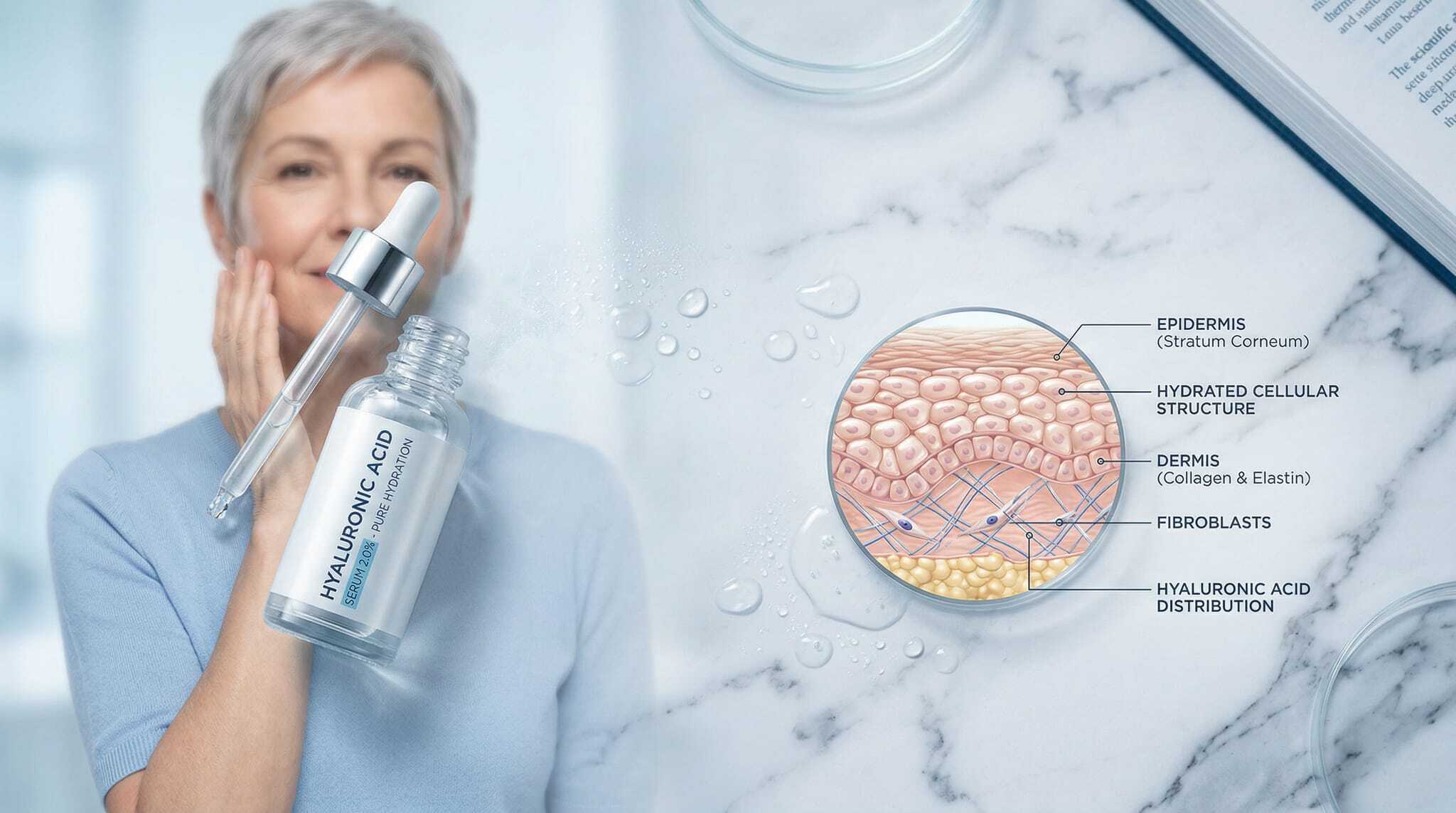
The two humectants ectoin gets compared to most often are hyaluronic acid and glycerin. Hyaluronic acid is a large polysaccharide that holds water on the skin’s surface and, in low-molecular-weight form, plumps the upper dermis. Glycerin is a small humectant that draws water into the stratum corneum and supports barrier enzyme activity. Both are excellent. Neither does what ectoin does.
Ectoin does not bulk-hydrate the way hyaluronic acid does — it is too small a molecule to hold a visible water reservoir on the surface. What it does is protect the function of the water that is already there. Cellular proteins, membrane phospholipids, and the enzymes that build ceramides all depend on a structured shell of bound water. Ectoin keeps that shell intact when temperature, UV, dryness, or pollution would otherwise disrupt it. The clinical signature is not “skin feels plumper in 10 minutes” — it is “skin maintains barrier function and resists irritation across stressful conditions over weeks.”
In a multifunctional review of ectoin’s mechanisms, researchers noted that the molecule’s effect is best understood as cell protection rather than pure moisturization [7]. That framing maps to what users of ectoin serums tend to report: not a dramatic plumping effect, but skin that handles winter air, retinol nights, and travel less reactively.
The brand’s clinical study showed 232% greater collagen recovery and 73% greater elastin recovery than conventional retinol, at only 0.2% concentration in a 99% natural water-based formula.
What Ectoin Does Not Do
It is worth being clear about the limits. Ectoin does not stimulate fibroblasts to produce more collagen. It does not bind to retinoid receptors and remodel the dermal matrix. It does not fade existing pigmentation, smooth deep wrinkles, or fix structural collagen loss after years of UV exposure. These are not failures — they are simply outside its mechanism. Ectoin is a barrier and stress-protection molecule, not a structural one.
This is why the most useful framing of ectoin in an anti-aging routine is as a partner ingredient, not a centerpiece. It does the protective and hydration work that allows other actives — particularly retinol — to be used more consistently and at higher tolerance.
Where Ectoin and Retinol Meet
The most thoroughly evidenced active for actually reversing the visible signs of skin aging is topical retinol. A 2007 randomized trial showed that 0.4% retinol applied three times weekly produced significant improvements in fine wrinkles, skin roughness, and dermal hyaluronic acid expression in older adults, with biopsy-confirmed dermal remodeling [8]. The challenge is tolerance: most retinol formulations cross the barrier by partially disrupting it, and the resulting peeling and redness drive abandonment within months.
Ectoin sits exactly where this gap exists. Pairing an ectoin-containing serum or moisturizer with a nightly retinoid measurably reduces the irritation phase that drives most users to give up. The barrier stays better hydrated, ceramide production stays higher, and the inflammatory response to retinoid initiation is muted.
There is, however, a more elegant route to the same outcome. Nanoretinol was designed to bypass the barrier-disruption problem entirely. Retinol is encapsulated inside biomimetic lipid nanoparticles — recognized by skin cells as similar to their own membranes — so the active is carried through the epithelial barrier without breaking it open. The brand’s clinical study showed 232% greater collagen recovery and 73% greater elastin recovery than conventional retinol, at only 0.2% concentration in a 99% natural water-based formula. Pair Nanoretinol with an ectoin serum in the morning and you have what the science actually points to: structural remodeling at night, barrier and stress protection through the day. That combination — backed by mechanism and clinical data on both sides — is where ectoin earns a place in a serious anti-aging routine.
How to Use It
Look for ectoin (sometimes labeled “ectoine”) high in the ingredient list of a hydrating serum, ideally at concentrations of 1–2% where most clinical studies have shown effect [7]. Apply it after cleansing and before heavier emollients. It pairs well with niacinamide, hyaluronic acid, and ceramides, and it is one of the more useful tools available for the early weeks of a retinoid routine. The molecule has been quietly available for two decades. Its time as an under-rated hydrator is ending.
References
- Galinski EA, Pfeiffer HP, Trüper HG. “1,4,5,6-Tetrahydro-2-methyl-4-pyrimidinecarboxylic acid. A novel cyclic amino acid from halophilic phototrophic bacteria of the genus Ectothiorhodospira.” European Journal of Biochemistry. 1985;149(1):135-139. doi:10.1111/j.1432-1033.1985.tb08903.x
- Yu I, Jindo Y, Nagaoka M. “Microscopic Understanding of Preferential Exclusion of Compatible Solute Ectoine: Direct Interaction and Hydration Alteration.” The Journal of Physical Chemistry B. 2007;111(34):10231-10238. doi:10.1021/jp068367z
- Buenger J, Driller H. “Ectoin: An Effective Natural Substance to Prevent UVA-Induced Premature Photoaging.” Skin Pharmacology and Physiology. 2004;17(5):232-237. doi:10.1159/000080216
- Marini A, Reinelt K, Krutmann J, Bilstein A. “Ectoine-Containing Cream in the Treatment of Mild to Moderate Atopic Dermatitis: A Randomised, Comparator-Controlled, Intra-Individual Double-Blind, Multi-Center Trial.” Skin Pharmacology and Physiology. 2014;27(2):57-65. doi:10.1159/000351381
- Kauth M, Trusova OV. “Topical Ectoine Application in Children and Adults to Treat Inflammatory Diseases Associated with an Impaired Skin Barrier: A Systematic Review.” Dermatology and Therapy. 2022;12(2):295-313. doi:10.1007/s13555-021-00676-9
- Unfried K, Kroker M, Autengruber A, Gotić M, Sydlik U. “The Compatible Solute Ectoine Reduces the Exacerbating Effect of Environmental Model Particles on the Immune Response of the Airways.” Journal of Allergy. 2014;2014:708458. doi:10.1155/2014/708458
- Graf R, Anzali S, Buenger J, Pfluecker F, Driller H. “The Multifunctional Role of Ectoine as a Natural Cell Protectant.” Clinics in Dermatology. 2008;26(4):326-333. doi:10.1016/j.clindermatol.2008.01.002
- Kafi R, Kwak HSR, Schumacher WE, Cho S, Hanft VN, Hamilton TA, King AL, Neal JD, Varani J, Fisher GJ, Voorhees JJ, Kang S. “Improvement of Naturally Aged Skin With Vitamin A (Retinol).” Archives of Dermatology. 2007;143(5):606-612. doi:10.1001/archderm.143.5.606