Glycation and Your Skin: How Sugar Silently Accelerates Aging From the Inside Out
Advanced glycation end products stiffen collagen, dull your complexion, and undermine every other anti-aging product you use — here's the science
The Aging Process Nobody Sees Coming
Most people can name the obvious enemies of youthful skin: UV exposure, stress, poor sleep, skipping sunscreen. But there’s a biochemical process happening inside your body right now that’s quietly stiffening your collagen, dulling your complexion, and making your skin less responsive to every anti-aging product you own.
It’s called glycation — and if you eat sugar, it’s already at work.
Glycation is a non-enzymatic reaction where excess glucose molecules bind to proteins like collagen and elastin, forming compounds called Advanced Glycation End products, or AGEs [1]. Once formed, AGEs permanently crosslink the collagen fibers in your dermis, turning flexible, resilient tissue into something rigid and brittle. The result is visible: deeper wrinkles, loss of elasticity, a dull or yellowish tone, and skin that feels stiffer than it should for your age [2].
What makes glycation particularly insidious is that it’s cumulative, irreversible at the fiber level, and accelerated by the same UV exposure that causes photoaging. It’s not one bad meal — it’s decades of glucose exposure slowly rewriting your skin’s structural blueprint.
How Glycation Damages Collagen and Elastin
To understand glycation, picture the collagen fibers in your dermis as a network of flexible cables. They slide past each other, absorb mechanical stress, and give skin its bounce. Healthy collagen is regularly turned over — old fibers are broken down and replaced with new ones in a continuous maintenance cycle.
Glycation disrupts this system at every level.
When glucose reacts with the amino acids in collagen, it initiates a cascade called the Maillard reaction — the same chemistry that browns bread in a toaster. In your skin, this reaction produces AGEs that form permanent crosslinks between adjacent collagen fibers [3]. These crosslinks lock the fibers in place, eliminating their flexibility and preventing normal enzymatic turnover. The collagen can no longer be efficiently recycled and replaced.
The damage extends to elastin as well. Glycated elastin loses its ability to stretch and recoil, contributing to the sagging and laxity that characterize aged skin [4]. And because both collagen and elastin are long-lived proteins with slow turnover rates, they’re particularly vulnerable to accumulating glycation damage over time — the longer a protein exists in tissue, the more opportunities glucose has to modify it [5].
Research has shown that AGE accumulation in skin collagen correlates directly with chronological age and is significantly amplified by UV exposure [1]. UVA radiation doesn’t just cause its own category of damage — it accelerates the glycation process itself, stimulating the formation of pentosidine and carboxymethyllysine (CML), two of the most studied AGEs in human skin [6].
In your skin, this reaction produces AGEs that form permanent crosslinks between adjacent collagen fibers.
The Visible Signs of Glycated Skin
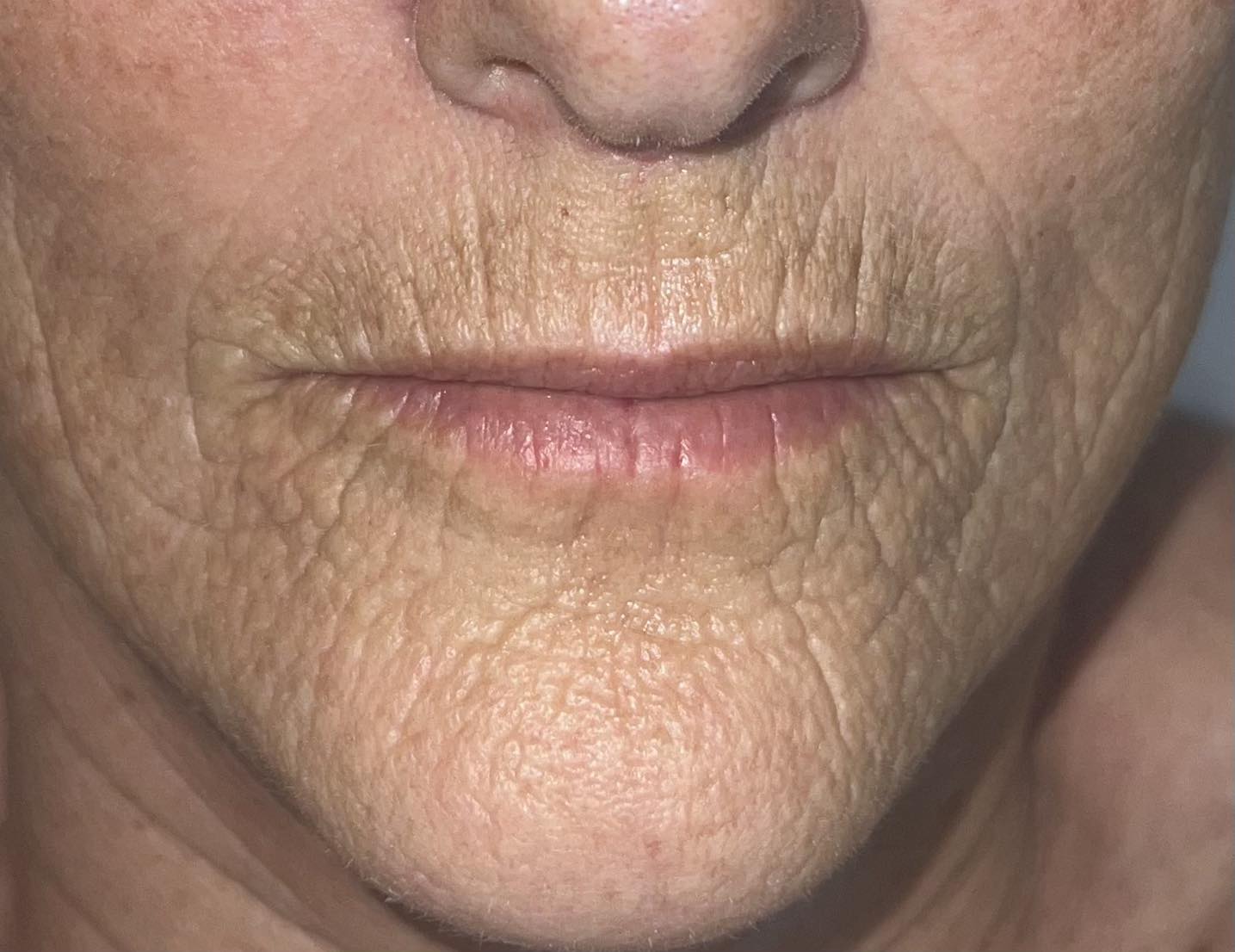
Glycation doesn’t produce a single dramatic symptom. Instead, it creates a constellation of changes that collectively make skin look and feel older than it is:
Stiffness and loss of bounce. Crosslinked collagen can’t flex. Skin loses the elastic recoil that makes it snap back when pinched — a change you can literally feel.
Yellowing and sallowness. AGEs are brown-pigmented compounds. As they accumulate in the dermis, they contribute to a dull, yellowish undertone that no brightening serum can fully correct, because the discoloration is structural, not superficial [2].
Deeper wrinkles. Rigid collagen creases more easily and recovers less readily. Lines that would normally soften with hydration become permanent because the underlying fibers are locked in their deformed position.
Reduced responsiveness to topical treatments. This is perhaps the most frustrating effect. Glycated collagen resists the enzymatic processes that active ingredients rely on to stimulate remodeling. Your retinol, your peptides, your growth factors — they’re all trying to trigger collagen turnover in tissue that’s been crosslinked into rigidity [7].
What Drives Glycation — Beyond Just Sugar
While dietary sugar is the most commonly cited driver, glycation is more nuanced than “eat less cake.” Several factors influence how much glycation damage your skin accumulates:
Blood glucose levels. Chronically elevated blood sugar — whether from diabetes, insulin resistance, or consistently high-glycemic diets — significantly accelerates AGE formation. The DCCT study demonstrated that intensive glycemic control in diabetic patients measurably reduced skin collagen glycation compared to conventional therapy [8].
Broad-spectrum SPF doesn’t just prevent sun damage — it slows AGE formation in the dermis.
UV exposure. Sunlight acts as a glycation accelerator. UVA irradiation combined with existing dermal glycation enhances the expression of matrix metalloproteinases (MMPs) that degrade what functional collagen remains, while simultaneously promoting further AGE accumulation [6].
Cooking methods. Foods prepared at high temperatures — grilling, frying, roasting — contain preformed AGEs that are absorbed into the bloodstream. Dietary AGE intake has been shown to correlate with circulating AGE levels and markers of oxidative stress [1].
Age itself. Even with a perfect diet, glycation accumulates over time simply because glucose is always present in the bloodstream. The question isn’t whether glycation is happening — it’s how fast.
Fighting Back: Collagen Renewal as the Counterattack
Since glycation crosslinks are essentially permanent at the individual fiber level, the primary defense strategy is to outpace the damage — stimulating enough new collagen synthesis to replace glycated fibers before they dominate the dermal matrix.
This is where retinol becomes strategically important. Retinol is the most clinically validated topical ingredient for upregulating collagen production in the dermis [9]. It activates fibroblasts, promotes procollagen synthesis, and supports the enzymatic turnover that clears damaged matrix components. For glycated skin, this renewal function isn’t just anti-aging — it’s structural maintenance.
The challenge is delivery. Glycated skin often has a compromised barrier, and conventional retinol formulations that rely on chemical penetration enhancers can cause irritation that further disrupts an already stressed system. What’s needed is retinol that reaches the dermis efficiently without barrier damage.
Nanoretinol® addresses this directly. By encapsulating retinol in biomimetic lipid nanoparticles — particles engineered to mimic the skin’s own cell membranes — it delivers the active ingredient deeper and more gradually, without the barrier disruption associated with conventional formulations. In clinical testing, this delivery method produced 232% greater collagen recovery than conventional retinol [10], with significantly reduced cytotoxicity.
For skin fighting glycation damage, this approach is especially relevant: maximizing collagen renewal while minimizing additional stress on tissue that’s already structurally compromised.
Practical Steps to Reduce Glycation Damage
Moderate your glycemic load. You don’t need to eliminate sugar entirely. Focus on reducing spikes: choose whole grains over refined, pair carbohydrates with protein and fat, and limit processed foods with added sugars.
Wear sunscreen daily. UV exposure amplifies glycation. Broad-spectrum SPF doesn’t just prevent sun damage — it slows AGE formation in the dermis.
Prioritize active collagen stimulation. Glycated collagen can’t be unglyacted, but it can be replaced. Consistent use of retinol — the most proven topical for collagen synthesis — keeps the renewal pipeline active.
Consider antioxidant support. Oxidative stress and glycation are interlinked. Topical antioxidants like vitamin C and oral supplements like alpha-lipoic acid may help reduce the oxidative conditions that accelerate AGE formation [7].
Be patient. Collagen turnover in adult skin takes months. Reversing the visible effects of years of glycation requires consistent, sustained effort — but the dermis does respond when given the right signals.
References
- Gkogkolou P, Böhm M. “Advanced Glycation End Products: Key Players in Skin Aging?” Dermato-Endocrinology. 2012;4(3):259-270. doi:10.4161/derm.22028
- Danby FW. “Nutrition and Aging Skin: Sugar and Glycation.” Clinics in Dermatology. 2010;28(4):409-411. doi:10.1016/j.clindermatol.2010.03.018
- Sivan SS, Tsitron E, Wachtel E, et al. “Advanced Glycation End Products Induce Crosslinking of Collagen In Vitro.” Biochimica et Biophysica Acta. 1998;1407(3):215-224. PMID: 9748585
- Chen CY, Zhang JQ, Li L, et al. “Advanced Glycation End Products in the Skin: Molecular Mechanisms, Methods of Measurement, and Inhibitory Pathways.” Frontiers in Medicine. 2022;9:837222. doi:10.3389/fmed.2022.837222
- Verzijl N, DeGroot J, Thorpe SR, et al. “Effect of Collagen Turnover on the Accumulation of Advanced Glycation End Products.” Journal of Biological Chemistry. 2000;275(50):39027-39031. doi:10.1074/jbc.M006700200
- Mizutari K, Ono T, Ikeda K, Kayashima K, Horiuchi S. “Photo-Enhanced Modification of Human Skin Elastin in Actinic Elastosis by N(epsilon)-(Carboxymethyl)lysine, One of the Glycoxidation Products of the Maillard Reaction.” Journal of Investigative Dermatology. 1997;108(5):797-802. doi:10.1111/1523-1747.ep12292244
- Di Cerbo A, Giannetti G, et al. “Mitigating Glycation and Oxidative Stress in Aesthetic Medicine: Hyaluronic Acid and Trehalose Synergy for Anti-AGEs Action in Skin Aging Treatment.” Cosmetics. 2024;11(6):195. PMC11610400
- Monnier VM, Bautista O, Kenny D, et al. “Skin Collagen Glycation, Glycoxidation, and Crosslinking Are Lower in Subjects With Long-Term Intensive Versus Conventional Therapy of Type 1 Diabetes.” Diabetes. 1999;48(4):870-880. doi:10.2337/diabetes.48.4.870
- Mukherjee S, Date A, Patravale V, et al. “Retinoids in the Treatment of Skin Aging: An Overview of Clinical Efficacy and Safety.” Clinical Interventions in Aging. 2006;1(4):327-348. PMID: 18046911
- North Biomedical LLC. “Nanoretinol® vs. Conventional Retinol: Efficacy in Collagen and Elastin Recovery.” Clinical Study Summary, 2024. Study PDF