Can Retinol Reverse Sun Damage? What Science Says About Photoaging
The clinical evidence on retinol's ability to repair UV-induced skin changes — and its limits
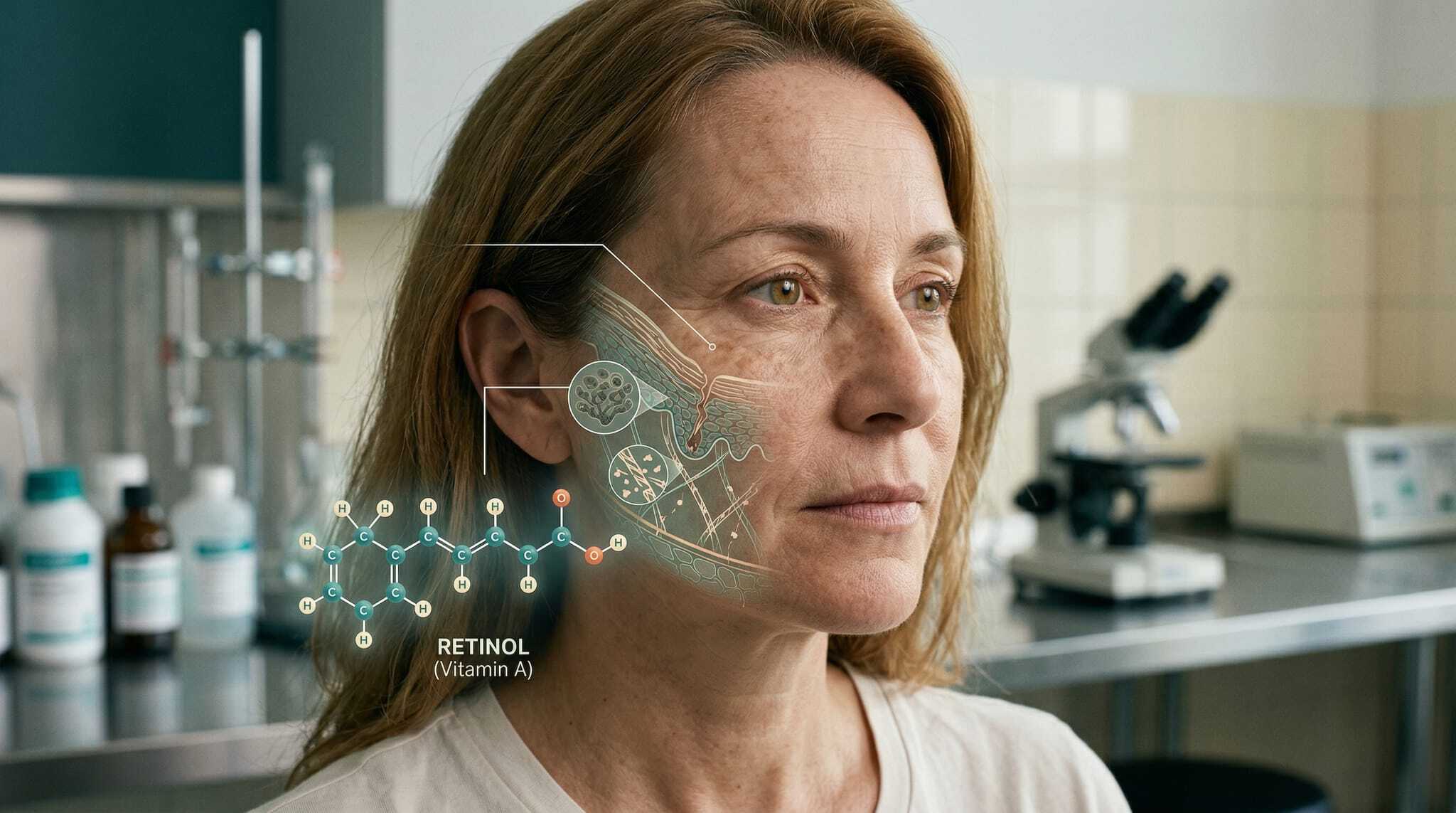
Sun damage is the single largest contributor to premature skin aging. By some estimates, up to 80% of visible facial aging — wrinkles, dark spots, textural roughness, loss of elasticity — is attributable to cumulative UV exposure rather than chronological age [1]. Dermatologists call this photoaging, and it’s fundamentally different from the gentle, gradual aging that happens to sun-protected skin.
So the natural question: if sun exposure caused the damage, can anything undo it? Retinol has become the most recommended over-the-counter ingredient for photoaging. But does “treating” sun damage mean actually reversing it, or just masking it?
The clinical evidence paints a nuanced picture — and a surprisingly optimistic one.
What Sun Damage Actually Does to Skin
Before understanding whether retinol can reverse photoaging, you need to understand what UV radiation changes at the molecular level.
Collagen Degradation
UV exposure activates matrix metalloproteinases (MMPs) — enzymes that literally digest collagen fibers in the dermis. A single significant sun exposure can elevate MMP levels for days. Over years, this creates a net collagen deficit: your skin breaks down collagen faster than it can rebuild, leading to thinning, sagging, and wrinkle formation [2].
Solar Elastosis
UV radiation damages elastic fibers and triggers the abnormal accumulation of degraded elastin material — a condition called solar elastosis. This thickened, disorganized elastin is what gives severely photoaged skin its leathery texture. Unlike collagen degradation, solar elastosis involves actual structural corruption of the fiber architecture [1].
Melanocyte Dysfunction
UV exposure disrupts the orderly distribution of melanin by damaging melanocytes and their signaling pathways. The result: uneven pigmentation, age spots (solar lentigines), and the mottled skin tone characteristic of sun-damaged skin. These aren’t cosmetic surface stains — they reflect permanent changes to the pigment-producing cells themselves [3].
Epidermal Thickening and Roughness
Chronic UV exposure thickens the stratum corneum (outermost skin layer) while simultaneously thinning the viable epidermis beneath it. This creates a paradox: the skin feels rougher and coarser on the surface while becoming more fragile structurally [1].
What Retinol Can Reverse (The Evidence)
Here’s where the clinical data becomes encouraging. Retinol doesn’t just prevent further damage — it actively repairs several categories of photoaging.
Collagen Rebuilding: Strong Evidence
The most robust evidence for retinol’s photoaging reversal comes from collagen studies. The Kafi et al. study (2007) at the University of Michigan demonstrated that topical retinol significantly increased procollagen I production and glycosaminoglycan expression — direct evidence that retinol stimulates the dermal machinery to build new collagen [4].
This isn’t just slowing degradation. Retinol simultaneously increases collagen synthesis and inhibits MMP activity, creating a dual mechanism that shifts the balance from net collagen loss to net collagen gain [2]. Over months, this measurably reduces wrinkle depth and improves skin firmness.
By some estimates, up to 80% of visible facial aging — wrinkles, dark spots, textural roughness, loss of elasticity — is attributable to cumulative UV exposure rather than chronological age.
A comprehensive 2022 review confirmed that retinol’s collagen-stimulating effects are well-documented across multiple controlled trials, with nanoformulations showing particularly strong results due to enhanced dermal penetration [5].
Pigmentation Correction: Good Evidence
Retinol accelerates epidermal turnover, which helps shed melanin-laden keratinocytes faster. Clinical trials have documented significant improvements in skin evenness and reduction of hyperpigmentation with consistent retinol use [6]. The Zasada study (2020) specifically measured skin brightening and found progressive improvements in both the 0.3% and 0.5% retinol groups over 12 weeks [6].
For a deeper look at retinol’s effect on pigmentation specifically, our article on retinol for dark spots covers the mechanism in detail.
Texture and Roughness: Strong Evidence
Improved epidermal turnover replaces sun-damaged surface cells with healthier ones. Multiple studies report significant reduction in roughness parameters measured by profilometry (surface imaging technology) within 8–12 weeks of consistent retinol use [4][6]. This is one of the earliest visible improvements users notice — smoother, more refined skin texture.
Fine Line Reduction: Strong Evidence
The Kafi study reported statistically significant reductions in fine wrinkling scores (-1.64 vs -0.08 for vehicle on a 0–9 scale). Importantly, these were measured on naturally aged skin in elderly subjects, confirming that retinol improves wrinkling independent of other anti-aging interventions [4].
What Retinol Cannot Reverse (The Limits)
Scientific honesty requires acknowledging what retinol doesn’t fix.
Deep Wrinkles and Folds
Retinol excels at fine lines and moderate wrinkles. Deep creases — nasolabial folds, deep forehead furrows, pronounced crow’s feet — involve dermal volume loss and structural changes that topical retinol alone cannot fully reverse. These typically require combination approaches or procedures [5].
Severe Solar Elastosis
While retinol can prevent further elastic fiber damage and stimulate some new fiber production, severely degraded elastic tissue with established solar elastosis is difficult to fully restore topically. The abnormal elastin accumulation represents structural corruption, not just depletion [1].
Precancerous and Cancerous Changes
Actinic keratoses, basal cell carcinomas, and melanomas caused by UV exposure are medical conditions requiring dermatological treatment. Retinol is not a treatment for skin cancer or precancerous lesions. If you notice unusual growths, asymmetric moles, or non-healing lesions, see a dermatologist immediately.
Broken Capillaries (Telangiectasia)
The visible broken blood vessels common in photoaged skin don’t respond to retinol. These require laser or IPL treatment.
The Delivery Problem Matters More for Photoaged Skin
Photoaged skin presents a specific challenge for retinol delivery. Years of UV exposure alter the skin barrier — the stratum corneum is often thickened and irregular, creating an inconsistent substrate for topical absorption. Traditional retinol formulations that rely on chemical penetration enhancers face an even harder time achieving uniform dermal delivery in sun-damaged skin [5].
If you notice unusual growths, asymmetric moles, or non-healing lesions, see a dermatologist immediately.
This is where encapsulated retinol technology becomes particularly relevant. Lipid nanoparticle delivery systems don’t depend on disrupting the barrier to achieve penetration. Instead, they use biomimetic particles that pass through the epithelial barrier via biological recognition — the same mechanism regardless of barrier condition.
How Nanoretinol® Addresses Photoaging
North Biomedical® designed Nanoretinol® with a delivery system borrowed from pharmaceutical drug delivery, not cosmetics. The biomimetic lipid nanoparticles are structurally identical to skin cell membranes, allowing passage through the epithelial barrier without chemical penetration enhancers.
For photoaged skin specifically, this matters because:
Consistent penetration. Unlike conventional formulations that absorb unevenly through damaged barriers, nanoparticles achieve uniform dermal delivery regardless of stratum corneum irregularities.
Higher effective dose. With +232% more effective collagen recovery and +73% more effective elastin recovery compared to conventional retinol, more reparative activity reaches the damaged dermis.
Reduced irritation. Photoaged skin is often simultaneously sensitized. Nanoretinol®‘s delivery mechanism avoids the barrier disruption that causes retinoid irritation — critical for skin that’s already compromised by UV damage.
Clinical trials showed +61% increase in firmness and +56% increase in elasticity within 56 days — meaningful reversal metrics for photoaged skin.
The Sunscreen Equation
No discussion of retinol and sun damage is complete without emphasizing a critical point: retinol repairs past damage while sunscreen prevents new damage. Using retinol without daily sunscreen is like bailing water from a boat while the hole is still open. Retinol increases photosensitivity slightly (by accelerating turnover, newer cells are exposed sooner), but the primary reason to pair it with SPF is strategic: you want all of retinol’s collagen-building and pigment-correcting activity directed at repairing accumulated damage, not fighting fresh UV insults.
Use retinol at night. Use broad-spectrum SPF 30+ every morning. This is non-negotiable for photoaging management.
What You Can Realistically Expect
Based on the clinical evidence, here’s an honest assessment of retinol’s photoaging reversal potential:
Highly responsive to retinol: Fine lines, texture roughness, mild-to-moderate hyperpigmentation, skin dullness, epidermal thinning.
Partially responsive: Moderate wrinkles, skin laxity, mottled pigmentation, overall skin tone unevenness.
Minimally responsive: Deep wrinkles and folds, severe solar elastosis, broken capillaries, precancerous lesions.
For most people with mild-to-moderate photoaging, consistent retinol use produces meaningful, visible improvements within 3–6 months. For a detailed week-by-week timeline, see our article on how long retinol takes to work.
The science is clear: you can’t erase decades of sun exposure entirely, but you can meaningfully reverse a significant portion of its visible effects. The key variables are consistency, duration, and — more than most people realize — whether your retinol actually reaches the cells that need it.
References
-
Mukherjee S, Date A, Patravale V, Korting HC, Roeder A, Weindl G. “Retinoids in the treatment of skin aging: an overview of clinical efficacy and safety.” Clinical Interventions in Aging. 2006;1(4):327-348. doi:10.2147/ciia.2006.1.4.327
-
Fisher GJ, Kang S, Varani J, Bata-Csorgo Z, Wan Y, Datta S, Voorhees JJ. “Mechanisms of photoaging and chronological skin aging.” Archives of Dermatology. 2002;138(11):1462-1470. doi:10.1001/archderm.138.11.1462
-
Kligman AM, Grove GL, Hirose R, Leyden JJ. “Topical tretinoin for photoaged skin.” Journal of the American Academy of Dermatology. 1986;15(4 Pt 2):836-859. doi:10.1016/s0190-9622(86)70242-9
-
Kafi R, Kwak HS, Schumacher WE, Cho S, Hanft VN, Hamilton TA, King AL, Neal JD, Varani J, Fisher GJ, Voorhees JJ, Kang S. “Improvement of naturally aged skin with vitamin A (retinol).” Archives of Dermatology. 2007;143(5):606-612. doi:10.1001/archderm.143.5.606
-
Milosheska D, Roškar R. “Use of Retinoids in Topical Antiaging Treatments: A Focused Review of Clinical Evidence for Conventional and Nanoformulations.” Advances in Therapy. 2022;39(12):5351-5375. doi:10.1007/s12325-022-02319-7
-
Zasada M, Budzisz E. “A Clinical Anti-Ageing Comparative Study of 0.3 and 0.5% Retinol Serums: A Clinically Controlled Trial.” Skin Pharmacology and Physiology. 2020;33(2):102-116. doi:10.1159/000508168