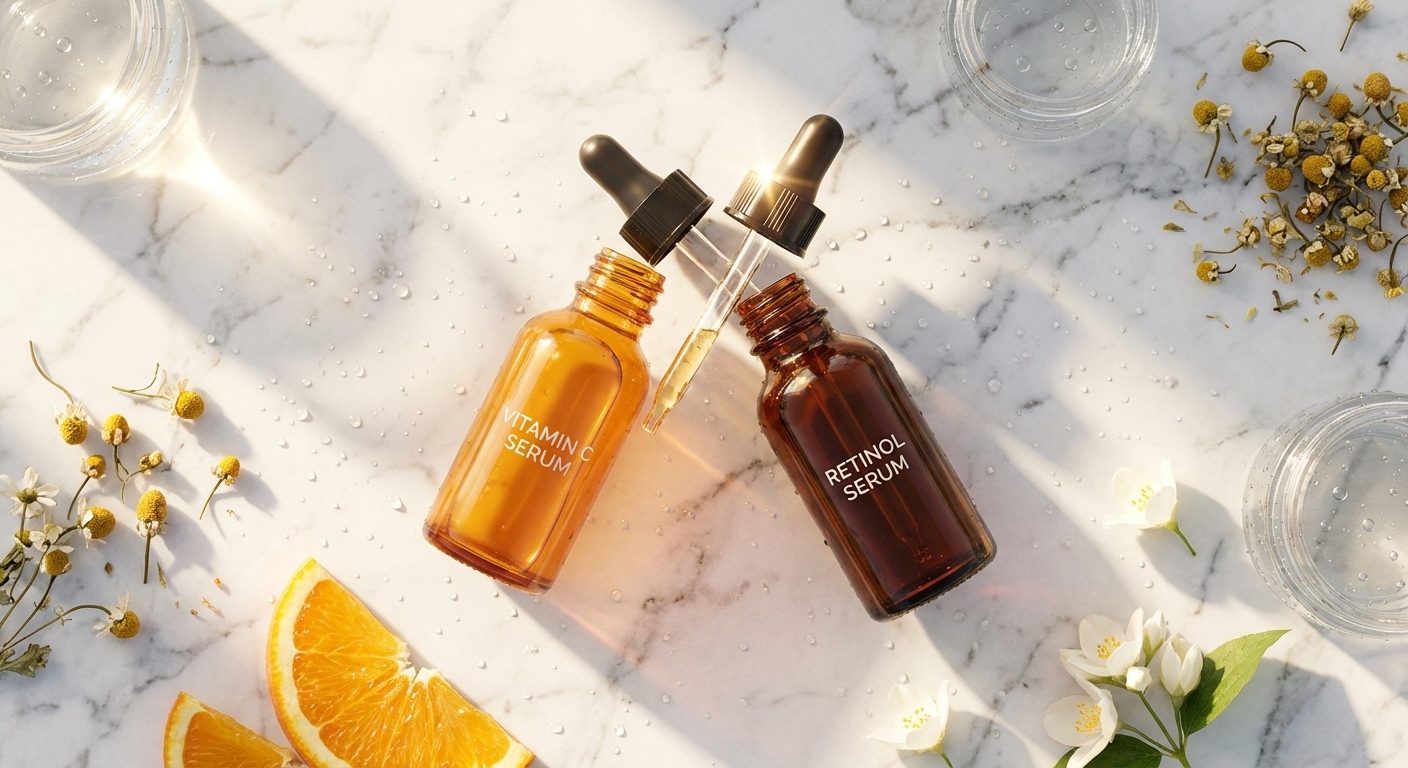
Retinol and Vitamin C Together: Can You Use Both in Your Routine?
The two most powerful anti-aging ingredients — do they clash or complement?
The Myth That Won’t Die
For years, the skincare world operated under a simple rule: never mix retinol and vitamin C. The reasoning sounded scientific enough — retinol works best at a slightly acidic pH (around 5.5–6), while L-ascorbic acid (the most studied form of vitamin C) requires a much lower pH (below 3.5) to penetrate skin effectively [1]. Put them together, the argument went, and you’d either destabilize the retinol or render the vitamin C useless.
This advice was everywhere — dermatologist blogs, beauty magazines, product packaging. There was just one problem: it was an oversimplification that modern formulation science has largely made irrelevant.
What the Science Actually Shows
The pH incompatibility argument had some merit in the 1990s, when most retinol products were poorly stabilized and L-ascorbic acid formulations were notoriously finicky. But two decades of cosmetic chemistry have changed the landscape dramatically.
First, modern retinol formulations don’t rely on a precise pH window to work. Retinol is converted to retinoic acid inside the skin cell, through a two-step enzymatic process that’s pH-independent [2]. The retinol molecule itself is relatively stable across a wide pH range when properly encapsulated or formulated with stabilizing agents.
Second, vitamin C now comes in multiple forms beyond raw L-ascorbic acid. Derivatives like sodium ascorbyl phosphate (SAP), ascorbyl glucoside, and magnesium ascorbyl phosphate work at neutral pH ranges, are far more stable, and can be layered with virtually any active without chemical conflict [3].
Third — and this is the key insight — even when using L-ascorbic acid, applying it at a different time than retinol (morning vs evening) completely eliminates any pH interaction. They never meet on your skin.
Why You Want Both: Complementary Mechanisms
The real question isn’t whether you can use retinol and vitamin C together. It’s why you should. These two ingredients attack skin aging through completely different biological pathways, and the combination is genuinely more effective than either alone.
Retinol works from the inside out. It penetrates the epidermis, converts to retinoic acid, binds to nuclear receptors (RARs and RXRs), and directly upregulates collagen and elastin gene expression [2]. It accelerates cell turnover, normalizes pigmentation, and thickens the dermis over time. Think of it as the renovation crew — tearing down damaged structures and rebuilding them stronger.
Vitamin C works from the outside in. As the skin’s most potent aqueous-phase antioxidant, it neutralizes free radicals generated by UV exposure and pollution before they can damage collagen fibers [1]. It also serves as an essential cofactor for prolyl hydroxylase and lysyl hydroxylase — the enzymes that stabilize newly formed collagen triple helices. Without adequate vitamin C, your body literally cannot produce stable collagen, no matter how much retinol stimulates its synthesis.
Without adequate vitamin C, your body literally cannot produce stable collagen, no matter how much retinol stimulates its synthesis.
In other words: retinol tells your skin to make more collagen. Vitamin C ensures that collagen is structurally sound and protects it from being degraded by oxidative stress. They’re not competing — they’re completing each other’s work.
The Best Strategy: AM/PM Split
The simplest, most effective approach is to separate them by time of day:
Morning: Vitamin C. Apply your vitamin C serum after cleansing, before sunscreen. Vitamin C is a photoprotective antioxidant — it doesn’t replace sunscreen, but it significantly boosts your UV defense by neutralizing free radicals that sunscreen misses [4]. Using it in the morning puts it to work when oxidative stress is highest. Evening: Retinol. Apply retinol after cleansing at night. Retinol is photosensitive (light degrades it) and increases sun sensitivity, making nighttime the logical window. Your skin also enters repair mode during sleep, with increased blood flow and growth hormone release that synergize with retinol’s cell-renewal effects.
This split is elegant because it gives each ingredient its optimal environment without any chemical interaction concerns, regardless of which forms you’re using.
Can You Layer Them in the Same Routine?
Yes — if you choose compatible forms. Here’s your compatibility matrix:
Retinol + L-ascorbic acid (same routine): Possible but not ideal. If you must, apply vitamin C first (it needs to be closer to skin’s surface for antioxidant protection), wait 15–20 minutes for it to fully absorb and the skin’s pH to normalize, then apply retinol. The wait time is key.
Retinol + vitamin C derivatives (same routine): No issues. SAP, ascorbyl glucoside, and other derivatives work at neutral pH and can be layered immediately before or after retinol without interaction concerns.
Encapsulated retinol + any vitamin C: The safest combination. When retinol is encapsulated in a delivery system (lipid nanoparticles, liposomes, or cyclodextrins), it’s physically separated from the vitamin C on the skin’s surface. The retinol only releases once inside the cell, making surface-level pH interactions irrelevant.
Choosing the Right Vitamin C Form
Not all vitamin C is created equal for this pairing:
Your skin also enters repair mode during sleep, with increased blood flow and growth hormone release that synergize with retinol’s cell-renewal effects.
L-ascorbic acid (10–20%): The most studied, most potent, but most unstable. Best used in the AM/PM split approach. Look for formulations with vitamin E and ferulic acid, which stabilize L-ascorbic acid and amplify its antioxidant effect synergistically [4].
Sodium ascorbyl phosphate (SAP, 2–5%): Stable, gentle, effective at neutral pH. Excellent for same-routine layering with retinol. Particularly good for sensitive skin types who find L-ascorbic acid too irritating.
Ascorbyl glucoside (2–5%): Very stable, slowly converts to ascorbic acid in the skin. Suitable for layering and for those who want a low-maintenance routine.
The important thing is consistency. A vitamin C derivative used daily will outperform a potent L-ascorbic acid serum that sits in your cabinet because it’s too complicated to layer.
What About Oxidation and Stability?
Here’s a practical concern that matters more than pH: both retinol and L-ascorbic acid are susceptible to oxidation. Retinol degrades when exposed to light and air. L-ascorbic acid turns brown and becomes ineffective (and potentially irritating) when oxidized. This is one reason the AM/PM split works so well practically — you’re only opening one product at a time, and each is stored optimally. But it’s also why formulation technology matters enormously.
Traditional retinol formulations leave the molecule exposed to oxygen and light with every application, progressively degrading the active ingredient. Encapsulated retinol solves this by shielding the molecule until it’s inside the skin cell.
Nanoretinol® takes this further with biomimetic lipid nanoparticle encapsulation — the retinol is protected within a structure the body recognizes as “self,” delivering 232% more effective collagen recovery compared to conventional retinol while being significantly gentler on skin cells. This encapsulation also means Nanoretinol® pairs seamlessly with vitamin C in any form, since the retinol never interacts with other actives on the skin’s surface. It’s the ideal foundation for a multi-active anti-aging routine.
Building Your Combined Routine
Here’s a straightforward protocol that works:
Morning: Gentle cleanser → Vitamin C serum → Moisturizer → Broad-spectrum SPF 30+
Evening: Gentle cleanser → Retinol (start 2–3x/week, build to nightly) → Moisturizer
Give your skin 4–6 weeks to adjust to each ingredient individually before combining them. If you’re new to both, start retinol first (it requires more tolerance-building), then add vitamin C after your skin has adapted.
Stronger Together
The retinol-vitamin C combination isn’t just safe — it’s one of the most evidence-backed pairings in all of skincare. One builds collagen. The other protects it. Together, they address aging from both sides of the equation. Stop overthinking the chemistry and start using both consistently. Your skin already knows what to do with them.
References
-
Pullar JM, Carr AC, Vissers MCM. “The Roles of Vitamin C in Skin Health.” Nutrients. 2017;9(8):866. doi:10.3390/nu9080866
-
Zasada M, Budzisz E. “Retinoids: active molecules influencing skin structure formation in cosmetic and dermatological treatments.” Postepy Dermatologii i Alergologii. 2019;36(4):392-397. doi:10.5114/ada.2019.87443
-
Telang PS. “Vitamin C in dermatology.” Indian Dermatology Online Journal. 2013;4(2):143-146. doi:10.4103/2229-5178.110593
-
Lin FH, Lin JY, Gupta RD, et al. “Ferulic acid stabilizes a solution of vitamins C and E and doubles its photoprotection of skin.” Journal of Investigative Dermatology. 2005;125(4):826-832. doi:10.1111/j.0022-202X.2005.23768.x
-
Mukherjee S, Date A, Patravale V, Korting HC, Roeder A, Weindl G. “Retinoids in the treatment of skin aging: an overview of clinical efficacy and safety.” Clinical Interventions in Aging. 2006;1(4):327-348. doi:10.2147/ciia.2006.1.4.327