Does Retinol Build Collagen? The Science of Collagen Restoration
How retinol stimulates fibroblasts, inhibits collagen breakdown, and what delivery has to do with it
The Short Answer: Yes. Here’s How.
Retinol builds collagen. This isn’t marketing — it’s one of the most thoroughly documented effects in dermatology, supported by decades of clinical trials, histological studies, and molecular biology research.
But the mechanism is more sophisticated than most skincare content suggests. Retinol doesn’t just “boost collagen.” It orchestrates a coordinated molecular response that simultaneously increases new collagen production and decreases the enzymatic breakdown of existing collagen [1]. Understanding how this works explains both why retinol is so effective and why most retinol products underdeliver on their promises.
The Molecular Pathway: From Retinol to New Collagen
Retinol itself doesn’t directly build collagen. It’s a precursor — a molecule that must be converted before it becomes biologically active.
When retinol reaches skin cells, it undergoes a two-step enzymatic conversion. First, retinol dehydrogenase converts it to retinaldehyde. Then, retinaldehyde dehydrogenase converts retinaldehyde to all-trans retinoic acid (tretinoin) — the biologically active form [1].
This is where the real action begins. Retinoic acid enters the cell nucleus and binds to retinoic acid receptors (RARs) — specifically RAR-α and RAR-γ, which are expressed in skin. These receptors function as transcription factors: proteins that directly regulate gene expression [2].
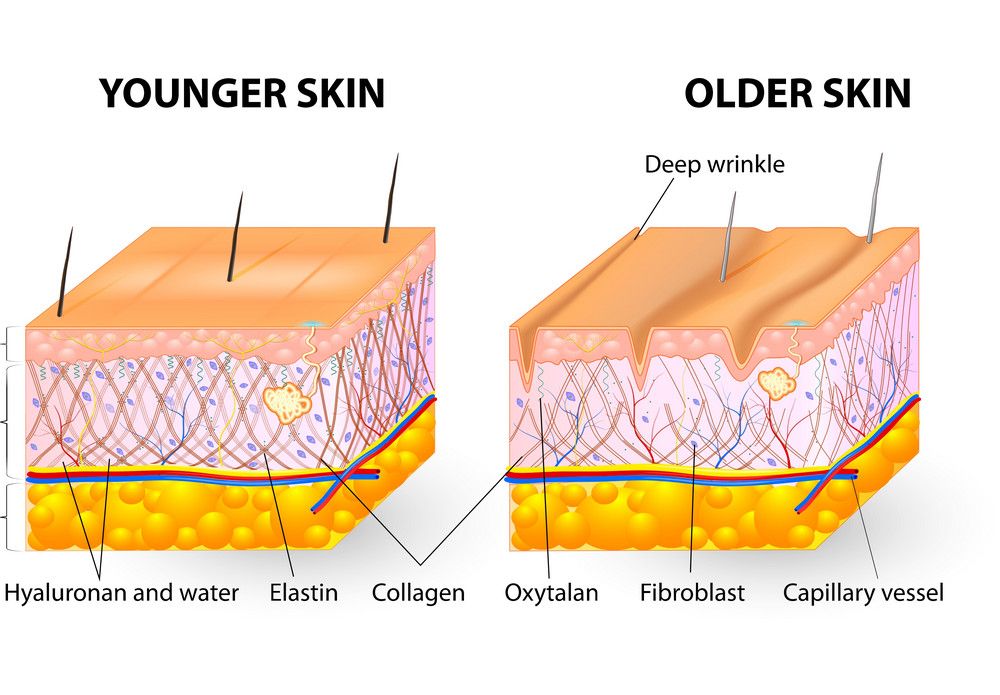
When retinoic acid activates RARs, it upregulates the expression of procollagen genes — particularly types I and III, which together comprise over 90% of skin’s collagen. Fibroblasts, the primary collagen-producing cells in the dermis, respond by increasing procollagen synthesis. More procollagen molecules are assembled, processed, and deposited into the extracellular matrix as mature collagen fibers [3].
Think of it this way: retinoic acid doesn’t build collagen itself. It tells fibroblasts to build more collagen — by literally switching on the genes that encode it.
The Other Half: Stopping Collagen Destruction
Building new collagen is only half the equation. If collagen is being degraded faster than it’s produced, the net effect is still loss. This is exactly what happens in aging skin.
The enzymes responsible for collagen breakdown are called matrix metalloproteinases (MMPs) — particularly MMP-1 (collagenase), MMP-3 (stromelysin), and MMP-9 (gelatinase). These enzymes cleave collagen fibers into fragments that are then further degraded and cleared [2].
In young skin, MMP activity is tightly regulated. In aged and photoaged skin, MMP levels are chronically elevated — fibroblasts produce more of them, and the natural tissue inhibitors of metalloproteinases (TIMPs) that normally keep them in check become less effective [2].
UV exposure dramatically amplifies this imbalance. A single episode of UV irradiation can increase MMP-1 expression by several-fold within hours [4]. Over years of cumulative sun exposure, this results in substantial collagen degradation — the molecular basis of wrinkles, sagging, and lost firmness.
Retinol doesn’t just “boost collagen.” It orchestrates a coordinated molecular response that simultaneously increases new collagen production and decreases the enzymatic breakdown of existing collagen.
Retinoic acid directly inhibits MMP expression. It blocks the AP-1 signaling pathway that drives MMP production, effectively reducing collagen destruction at the transcriptional level [2]. Simultaneously, retinoid signaling increases TIMP expression, further tipping the balance toward collagen preservation.
This dual action — stimulating synthesis while inhibiting degradation — is why retinol is uniquely effective for collagen restoration. It’s not just adding to the supply; it’s fixing the imbalance.
What the Clinical Trials Actually Show
The molecular biology is compelling, but what happens when you apply retinol to real human skin? The Varani Study (2000): Researchers applied topical vitamin A (retinol) to naturally aged human skin obtained from hip surgery patients aged 80+. After 7 days of treatment, retinol-treated skin showed significantly increased fibroblast growth, reduced MMP expression, and increased collagen synthesis compared to untreated controls. The study confirmed that retinol’s collagen-building effects work in chronologically aged skin — not just photoaged skin [3].
The Kafi Clinical Trial (2007): A randomized, double-blind, vehicle-controlled trial applied 0.4% retinol to the arms of 36 elderly subjects (average age 87) for 24 weeks. Histological analysis revealed significantly increased glycosaminoglycan expression and procollagen type I production. Clinically, treated skin showed improved fine wrinkle appearance [5]. This was retinol — not prescription tretinoin — producing measurable collagen changes in naturally aged skin over six months.
The Fisher Review (2002): A comprehensive analysis of the mechanisms underlying both photoaging and chronological skin aging confirmed that retinoid treatment counteracts both processes through the same molecular pathways: upregulation of procollagen synthesis and downregulation of MMP-mediated collagen degradation [2].
Why Concentration Isn’t Everything
A common assumption is that higher retinol concentrations produce better collagen results. The science tells a more nuanced story.
Retinol’s conversion to retinoic acid is enzyme-dependent, and the enzymes involved have saturation limits. Beyond a certain concentration, additional retinol simply can’t be converted — it either sits on the skin surface, causes irritation, or is metabolized through alternative pathways that don’t produce collagen benefits [1].
This is why a 0.2% retinol formulation with superior delivery can outperform a 1% formulation with poor delivery. The bottleneck isn’t how much retinol you apply — it’s how much reaches the dermal fibroblasts where collagen is produced.
Most topical retinol never reaches the dermis. The stratum corneum — the outermost layer of dead skin cells — is an effective barrier. Traditional formulations attempt to overcome this barrier using chemical penetration enhancers: solvents and surfactants that disrupt the skin’s lipid matrix to force retinol through. This works, partially, but it damages the skin barrier in the process — producing the redness, peeling, and irritation that retinol is infamous for.
The collagen-building activity happens in the dermis. If retinol is degraded or trapped in the epidermis, it generates irritation without generating collagen. Delivery efficiency — not concentration — determines whether retinol actually fulfills its collagen-building potential.
Consistency matters enormously for collagen restoration, since the timeline for visible results spans 8-12 weeks of regular use.
The Delivery Problem That Changes the Equation
This is where lipid nanoparticle technology transforms the retinol equation.
Nanoretinol® encapsulates retinol in biomimetic lipid nanoparticles — structures that mimic the composition of skin cell membranes. Because they’re recognized as “self” by the body, they pass through the epithelial barrier without disrupting it. No chemical penetration enhancers. No barrier damage. No inflammatory cascade.
The result: 232% more effective collagen recovery and 73% more effective elastin recovery compared to conventional retinol. These aren’t theoretical projections — they’re measured outcomes from controlled assays comparing nanoparticle-encapsulated retinol against free retinol at the cellular level.
By delivering retinol intact to dermal fibroblasts — the actual site of collagen production — nanoparticle encapsulation ensures the full molecular cascade unfolds where it matters. More retinol reaches the target cells. More is converted to retinoic acid. More procollagen genes are activated. More collagen is deposited.
And because there’s no barrier disruption, the irritation that causes most people to abandon retinol — or use it inconsistently — is dramatically reduced. Consistency matters enormously for collagen restoration, since the timeline for visible results spans 8-12 weeks of regular use.
The Timeline for Collagen Restoration
Collagen doesn’t rebuild overnight. Understanding the timeline helps set realistic expectations: Weeks 1-4: Retinol begins upregulating procollagen gene expression. Cellular turnover increases. No visible collagen changes yet, though skin texture may start improving as cell renewal accelerates.
Weeks 4-8: Procollagen synthesis ramps up. New collagen fibers are being deposited in the dermal matrix. MMP activity is decreasing. Histological changes would be detectable under a microscope, but visible changes are subtle.
Weeks 8-12: The first clinically visible improvements emerge — reduced fine lines, improved skin firmness, better texture. This is the threshold where most clinical trials begin reporting statistically significant changes [5].
Months 3-6+: Continued use produces progressive improvement. Collagen density increases, existing collagen fibers become better organized, and the cumulative reduction in MMP activity preserves more of what’s being built. The Kafi trial showed continued improvement through 24 weeks [5].
What This Means for Your Routine
Retinol’s ability to build collagen is real, robust, and well-documented. But realizing that potential requires three things:
Consistent use. Collagen restoration is a slow, cumulative process. Sporadic application won’t sustain the gene expression changes needed for meaningful results. Build tolerance gradually and then maintain a steady routine.
Effective delivery. The retinol must reach dermal fibroblasts to stimulate collagen. Formulation technology matters more than concentration — a point the industry is slowly recognizing.
Sun protection. UV exposure upregulates the same MMPs that retinol downregulates. Using retinol without sunscreen is counterproductive — you’re building collagen at night and destroying it during the day.
The science is clear: retinol is the most effective topical ingredient for stimulating collagen production in human skin. The remaining question isn’t whether retinol works — it’s whether your retinol is reaching the cells that do the work.
References
-
Mukherjee S, Date A, Patravale V, et al. “Retinoids in the treatment of skin aging: an overview of clinical efficacy and safety.” Clinical Interventions in Aging. 2006;1(4):327-348. doi:10.2147/ciia.2006.1.4.327
-
Fisher GJ, Kang S, Varani J, et al. “Mechanisms of photoaging and chronological skin aging.” Archives of Dermatology. 2002;138(11):1462-1470. doi:10.1001/archderm.138.11.1462
-
Varani J, Warner RL, Gharaee-Kermani M, et al. “Vitamin A antagonizes decreased cell growth and elevated collagen-degrading matrix metalloproteinases and stimulates collagen accumulation in naturally aged human skin.” Journal of Investigative Dermatology. 2000;114(3):480-486. doi:10.1046/j.1523-1747.2000.00902.x
-
Fisher GJ, Wang ZQ, Datta SC, et al. “Pathophysiology of premature skin aging induced by ultraviolet light.” New England Journal of Medicine. 1997;337(20):1419-1428. doi:10.1056/NEJM199711133372003
-
Kafi R, Kwak HS, Schumacher WE, et al. “Improvement of naturally aged skin with vitamin A (retinol).” Archives of Dermatology. 2007;143(5):606-612. doi:10.1001/archderm.143.5.606