How to Get Rid of Blackheads: What Actually Clears Them (and What Just Wrecks Your Pores)
Blackheads aren't trapped dirt, and squeezing them makes pores worse. Here's the evidence-based way to clear them and keep them from coming back.
A Blackhead Is Not Trapped Dirt
The single most useful thing to understand about blackheads is that the dark color has nothing to do with dirt. You cannot wash a blackhead away, because there is no grime to remove.
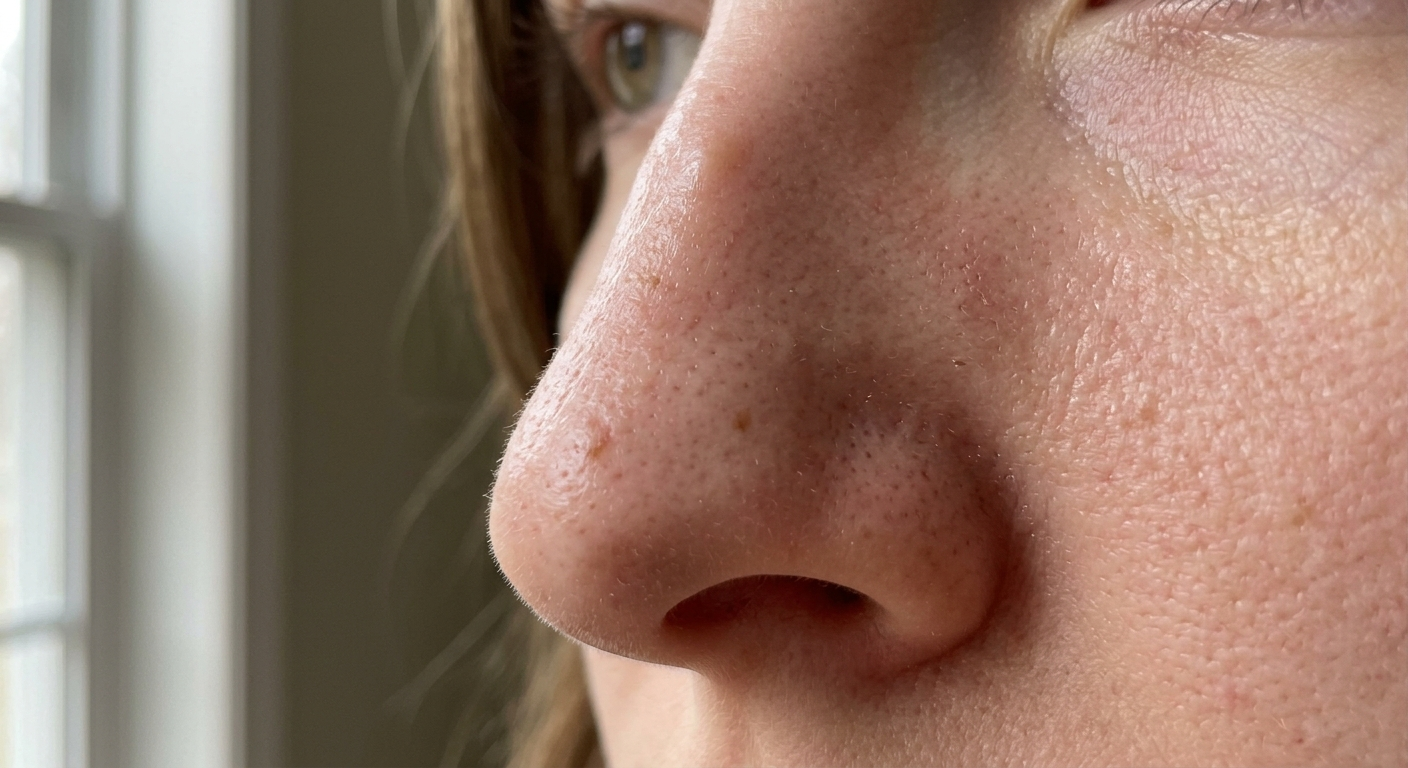
A blackhead is an open comedo: a hair follicle whose opening has become plugged with a mixture of sebum (skin oil) and dead skin cells. Because the top of the plug is exposed to air, the lipids and pigment within it oxidize. Squalene, one of the most abundant fats in human sebum, is especially prone to this. When it peroxidizes at the surface of the follicle, it darkens, and that oxidized squalene, together with melanin, is what gives a blackhead its characteristic black-brown color [1]. The same plug sitting under intact skin would be a whitehead. Expose its tip to oxygen and it turns dark.
This is why scrubbing harder accomplishes nothing. The discoloration is a chemical reaction happening below the skin surface, not a layer of dirt sitting on top of it.
Why Blackheads Form in the First Place
Two things have to go wrong together. First, the cells lining the follicle have to start shedding abnormally, sticking together instead of sloughing off cleanly. This is called follicular hyperkeratinization, and it creates the scaffolding of the plug. Second, the sebaceous gland attached to that follicle has to produce enough oil to feed it. Sebum production is driven largely by androgens, which is why blackheads cluster on the nose, chin, and central forehead, where sebaceous glands are densest and largest.
Hormonal shifts during perimenopause and menopause change this balance, which is one reason women who had clear skin for decades sometimes notice blackheads returning in their forties. Many people mistake them for sebaceous filaments, which are a normal, near-universal feature of oily areas rather than true clogs, so it is worth learning to tell the two apart before you start treating them.
First, the cells lining the follicle have to start shedding abnormally, sticking together instead of sloughing off cleanly.
Why Squeezing, Strips, and Scrubs Backfire
The instinct to physically extract a blackhead is understandable, and it even appears to work for a few minutes. The problem is what happens afterward.
Manual squeezing and pore strips remove only the visible top of the plug. They do nothing to change the rate at which sebum is produced or the abnormal shedding that built the plug, so the follicle refills, often within weeks. Worse, the mechanical force inflames and stretches the follicle wall. Over time, repeated extraction widens the pore opening, which makes the next blackhead more visible than the last. Harsh physical scrubs add micro-injury to an already irritated barrier without addressing either underlying cause.
In other words, the methods that feel the most satisfying are the ones most likely to leave you with larger, more noticeable pores a year from now.
What Actually Works: Three Ingredients With Evidence
Clearing blackheads durably means working on the two root causes at once: dissolving the plug that already exists, and slowing the abnormal shedding and oil that rebuild it.
A leave-on product at 0.5–2% used a few times a week is usually more effective than an occasional scrub.
Salicylic acid (a beta-hydroxy acid). Salicylic acid is oil-soluble, so it penetrates into the sebum-filled follicle and dissolves the keratin-and-oil plug from the inside. In clinical use, salicylic-acid-based regimens measurably reduce comedonal acne, the category blackheads belong to, and are generally well tolerated [2]. A leave-on product at 0.5–2% used a few times a week is usually more effective than an occasional scrub. You can read more about how it works in our guide to salicylic acid for skin, and our guide to choosing a salicylic acid toner covers the leave-on format many people reach for first when blackheads cluster around the nose and chin.
A topical retinoid. If salicylic acid clears today’s blackheads, retinoids are what stop tomorrow’s from forming. Retinoids normalize the way follicular cells shed, resolving the microcomedone, the microscopic precursor that every blackhead grows from. Dermatology guidelines consider topical retinoids the foundation of comedonal acne therapy precisely because they are comedolytic at the source rather than cosmetic at the surface [3].
Niacinamide. Because oil volume feeds the plug, moderating sebum helps. In a controlled study, topical 2% niacinamide significantly lowered the sebum excretion rate over several weeks [4]. It also supports the skin barrier, which makes it a useful partner to the more active exfoliating ingredients. Our overview of niacinamide’s benefits covers this in more detail.
The Retinoid Problem Most People Hit
Here is the catch with the most effective ingredient on the list. Conventional retinols and prescription retinoids work, but they frequently cause dryness, redness, and peeling in the first weeks. For blackhead-prone skin that is already irritated from years of squeezing and scrubbing, that sting is often the reason people abandon the one ingredient that would have fixed the problem.
Most conventional retinol formulations rely on penetration enhancers and petroleum-derived solvents that push the active through the skin by disrupting the protective barrier. The barrier disruption is the source of the irritation, not the retinol itself.
This is the gap Nanoretinol was built to close. It encapsulates retinol in biomimetic lipid nanoparticles that the skin recognizes as “self” and admits through the barrier without breaking it down, so the active reaches the follicle without the cycle of burning and peeling. The formula is water-based and 99% natural, absorbs to a smooth matte finish rather than a greasy film, and is gentle enough for sensitive and oily skin. North Biomedical’s clinical testing found it significantly gentler than conventional retinol while delivering markedly more of the active to target cells, which is what makes consistent, irritation-free use realistic for the people who need a retinoid most.
Putting It All Together
Stop trying to remove blackheads by force. Build a routine that dissolves the existing plug and prevents the next one: a salicylic acid serum a few times a week or a daily salicylic acid cleanser, a well-tolerated retinoid at night, niacinamide to keep oil and the barrier in check, and daily sunscreen, since retinoids increase sun sensitivity. Give it eight to twelve weeks. Blackheads form on a follicular cycle measured in weeks, so durable improvement follows the same timeline, and it arrives without the enlarged pores that aggressive extraction leaves behind.
References
- Condrò G, Sciortino R, Perugini P. “Squalene Peroxidation and Biophysical Parameters in Acne-Prone Skin: A Pilot ‘In Vivo’ Study.” Pharmaceuticals. 2023;16(12):1704. doi:10.3390/ph16121704
- Bettoli V, Micali G, Monfrecola G, Veraldi S. “Effectiveness of a combination of salicylic acid-based products for the treatment of mild comedonal-papular acne: a multicenter prospective observational study.” Giornale Italiano di Dermatologia e Venereologia. 2020;155(6):744-748. doi:10.23736/S0392-0488.20.06751-6
- Leyden J, Stein-Gold L, Weiss J. “Why Topical Retinoids Are Mainstay of Therapy for Acne.” Dermatology and Therapy. 2017;7(3):293-304. doi:10.1007/s13555-017-0185-2
- Draelos ZD, Matsubara A, Smiles K. “The effect of 2% niacinamide on facial sebum production.” Journal of Cosmetic and Laser Therapy. 2006;8(2):96-101. doi:10.1080/14764170600717704